



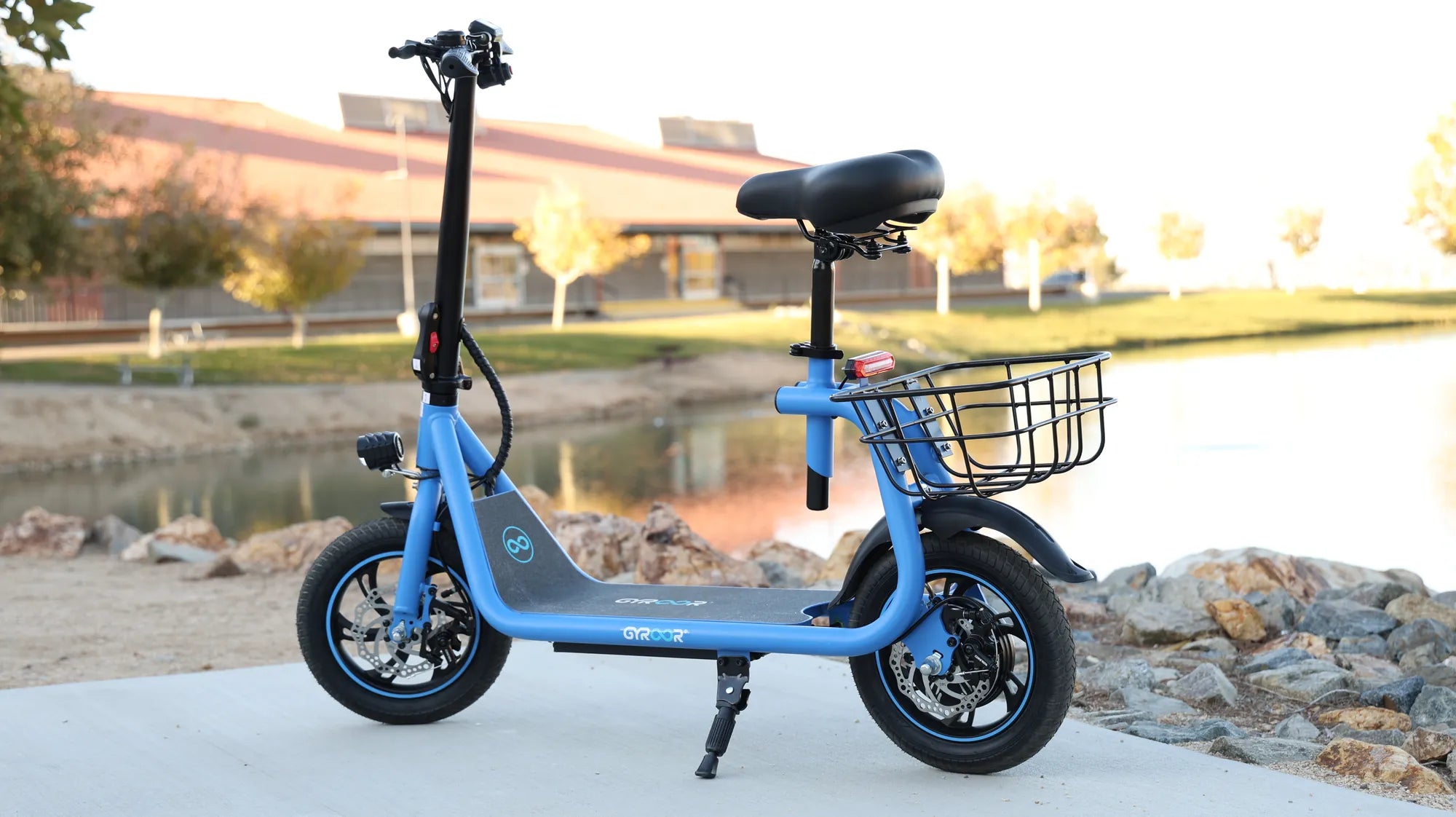
Introduction to 84V E-Bikes: Power Redefined
An 84v ebike is not merely an incremental upgrade; it's a fundamental shift in electric bicycle capability. Voltage, in simple terms, is the electrical pressure that pushes power from the battery to the motor. While most consumer e-bikes operate on 36V, 48V, or 52V systems, an 84V platform represents the high-performance tier, engineered for riders who demand motorcycle-like acceleration, higher sustained speeds, and the ability to conquer severe gradients without breaking a sweat.
This guide will dissect the reality behind the 84v ebike hype. You will learn how the higher voltage translates to tangible riding benefits, the critical technical and safety considerations, and how leading brands like Gyroor implement this technology responsibly. We'll provide a clear comparison against lower-voltage systems and help you determine if an 84v ebike aligns with your riding style and local regulations.
The move to 84V is about transcending the limitations of standard e-bikes. It caters to performance enthusiasts, off-road adventurers, and long-distance commuters who face challenging terrain. However, with great power comes a need for greater understanding of the required components, investment, and legal landscape.
The Engineering Edge: How an 84V System Transforms Your Ride
The core advantage of an 84v ebike lies in fundamental electrical principles. Power (watts) is the product of Voltage (V) and Current (Amps). By significantly increasing the voltage, the system can deliver the same or greater power while drawing less current. This has profound implications for performance, efficiency, and component longevity.
Lower current means reduced heat generation in the motor, controller, and wiring. Heat is the enemy of efficiency and a primary cause of component failure. An 84V system running at 30 amps delivers 2,520 watts, while a 52V system would need to pull over 48 amps to achieve the same power, generating significantly more heat and stress. This efficient power transfer is the engineering secret behind the robust performance.
Furthermore, higher voltage allows for the use of thinner gauge wiring without risk of overheating, contributing to weight savings and cleaner builds. The controller, the brain of the e-bike, can also operate more efficiently, translating throttle input into instantaneous, smooth, and powerful acceleration. This technical foundation enables the dramatic riding experience detailed in the next section.
Power, Speed, and Torque: The Performance Triad
The rider feels the 84V advantage immediately in three key areas: acceleration, top speed, and hill-climbing torque. The instant you twist the throttle, the surge of power is visceral. This is because torque is directly related to current; an 84V system's controller can deliver massive current spikes for very short durations, resulting in neck-snapping acceleration that leaves lower-voltage e-bikes behind.
Regarding top speed, while local laws often limit street-legal e-bikes to 20-28 mph, the 84v ebike platform has the headroom to reach 35 mph, 40 mph, or more, depending on motor windings and controller limits. This reserve power means the bike isn't straining at its legal limit, providing a relaxed, efficient, and cool-running ride at common commuting speeds. For private land or off-road use, the speed potential is a major draw.
The most transformative benefit for many is hill-climbing ability. Torque is what gets you up a hill. The high-voltage, high-current capability means an 84V system can maintain power and speed on gradients that would cause a standard e-bike to slow to a crawl or overheat. We're talking about conquering 30%, 40%, or even steeper inclines with ease, opening up new terrain for exploration.
Efficiency and Range: The Surprising Benefit
A common misconception is that more power equates to drastically reduced range. With a well-designed 84V system, this isn't necessarily true. Efficiency is the key. Because the system operates at lower current for a given power output, it experiences fewer electrical losses as heat.
Imagine climbing a long, steep hill. A 52V 1000W system might be drawing near its maximum current, operating at low efficiency and generating substantial heat, which drains the battery quickly. An 84v ebike with a 1500W motor might tackle the same hill at a higher speed but at a lower percentage of its maximum current, operating in a more efficient part of its performance curve. This can lead to similar or even better energy consumption for the same task.
Ultimately, range is determined by battery capacity (Watt-hours). An 84V system paired with a high-capacity battery (e.g., 84V 20Ah = 1,680 Wh) offers a massive energy reservoir. When ridden conservatively at speeds comparable to a 52V bike, the range can be exceptional. The power is there when you need it, without always sacrificing miles for performance.
Key Considerations Before Upgrading to 84V
Transitioning to an 84v ebike is a significant step that requires careful thought beyond the allure of speed. It involves a higher financial investment, a commitment to safety, and a clear understanding of the machine's capabilities and legal status. It is not a modification to be undertaken lightly on an existing low-voltage bike.
The total cost of ownership is higher. The battery pack itself, requiring more cells in series, is the most expensive component. This is followed by the need for a high-voltage controller, a robust motor, and a reinforced frame and braking system capable of handling the increased performance. Maintenance, while not necessarily more frequent, may involve more specialized knowledge or parts.
Rider skill and responsibility become paramount. The accelerative force and higher potential speeds demand greater anticipation, braking distance, and protective gear. It shifts the riding experience closer to that of a lightweight electric motorcycle, requiring a corresponding mindset focused on safety and control.
The Component Ecosystem: More Than Just a Battery
An 84V system is not a standalone battery. It is an integrated ecosystem where every component must be rated for the higher voltage and the increased power throughput. Swapping only the battery on a 48V bike will result, at best, in component failure and, at worst, in a serious fire hazard.
Essential compatible components include:
- Motor: Must be a high-wattage hub motor (typically 1500W minimum, often 3000W+) or a powerful mid-drive. The motor's windings and thermal management must handle the sustained power.
- Controller: The brain must be specifically designed for 84V input. It regulates the high current to the motor. A quality controller with programmable features is crucial for tuning performance and safety limits.
- Wiring & Connectors: All main power wires, including battery discharge leads and motor phase wires, must be of sufficient gauge. Connectors like XT90 or Anderson PP must be used to prevent melting under load.
- Brakes: Hydraulic disc brakes with large rotors (180mm or more) are an absolute necessity. Mechanical disc or rim brakes are utterly inadequate for safely stopping a high-performance 84v ebike.
- Frame & Wheels: The frame must withstand higher torque and speeds. Wheels should be double-walled and properly tensioned to handle the stress.
Safety, Regulation, and Legality
This is the most critical section for any prospective buyer. The legality of an 84v ebike on public roads is complex and varies widely. In the United States, a federally defined "low-speed electric bicycle" must have a motor under 750W (1hp) and a maximum speed of 20 mph under motor power alone. Most 84V systems far exceed these limits.
Therefore, a powerful 84v ebike is often classified as a moped (Class 1 or 2) or even a motorcycle (L1e or L3e in Europe), requiring registration, insurance, a driver's license, and a helmet. Riding it on bike paths or trails where traditional e-bikes are permitted is almost always illegal and dangerous. They are primarily intended for private property or off-road use unless specifically registered as a motor vehicle.
Battery safety is non-negotiable. High-voltage, high-capacity packs carry significant risk if poorly constructed. Insist on a battery with UL 2271 or UL 2849 certification, like those used by Gyroor. This ensures the battery pack has passed rigorous safety tests for electrical, mechanical, and environmental hazards. Never charge a battery unattended or with a non-OEM charger.
Gyroor’s Approach to High-Voltage Performance
As a brand trusted by over 100,000 riders, Gyroor approaches high-voltage e-bike technology with a philosophy centered on safety, reliability, and integrated design. Understanding that an 84v ebike is a system, Gyroor engineers its performance models from the ground up, ensuring all components are harmonized for optimal and safe operation.
Safety is the cornerstone. Every Gyroor battery pack, including those for high-voltage models, utilizes UL-certified cells and incorporates advanced Battery Management Systems (BMS) with protections against overcharge, over-discharge, short circuit, and individual cell balancing. This commitment mitigates the primary risks associated with high-performance lithium-ion packs.
Durability is engineered in. With IPX5 water-resistant ratings on key components, Gyroor e-bikes are built to handle real-world conditions, from wet roads to dusty trails. This is crucial for a performance machine that may be pushed to its limits. Furthermore, the security of a comprehensive 1-year warranty on the bike, including the battery and motor, provides peace of mind that is rare in the high-performance segment. This warranty is backed by accessible customer support in North America and Europe.
84V vs. 52V/48V: A Data-Driven Comparison for the Right Choice
Choosing the right voltage platform depends entirely on your use case. The following table provides a clear, data-driven comparison to guide your decision.
| Feature / Metric | 48V / 52V E-Bike | 84V E-Bike |
|---|---|---|
| Typical System Voltage | 48V (Nominal 54.6V) / 52V (Nominal 58.8V) | 84V (Nominal 92.4V) |
| Common Motor Power | 500W - 1000W | 1500W - 3000W+ |
| Top Speed (Potential) | 20 - 28 mph (Legal), ~35 mph (Max) | 35 - 45+ mph |
| Hill Climb Ability | Good for moderate hills (up to 15-20% grade) | Excellent for very steep hills (30-40%+ grade) |
| Acceleration | Moderate, similar to a brisk bicycle | Very Strong, motorcycle-like |
| Primary Use Case | City Commuting, Leisure, Light Trail | Off-Road, Performance Commuting, Private Land |
| Typical Regulatory Class | Class 1, 2, or 3 E-Bike (in the US/EU) | Often Classified as Moped/Motorcycle (L1e-B, etc.) |
| Component Stress | Moderate | High (Requires Heavy-Duty Parts) |
| Relative Cost | $$ | $$$ - $$$$ |
If your needs are met by paved paths, bike lanes, and moderate terrain within legal e-bike limits, a 48V or 52V system is the practical, cost-effective, and legal choice. If you require extreme off-road performance, need to traverse mountainous terrain regularly, or seek a high-speed vehicle for private land and are willing to navigate vehicle registration, the 84v ebike is the definitive tool for the job.
Frequently Asked Questions (FAQ)
Q: Is an 84v ebike street legal?
A: In most jurisdictions, as a standard e-bike, it is not. It typically exceeds the power (750W) and/or speed (20-28 mph) limits for bicycle classification. It may be registered as a moped or motorcycle if it meets specific equipment requirements (lights, mirrors, etc.), but this process varies by location. Always check your local and state/provincial laws.
Q: Can I convert my 52V e-bike to 84V?
A: Not safely or effectively. It requires replacing almost every major electrical component (battery, controller, display, throttle, often the motor) and ensuring the frame, brakes, and wheels can handle the power. The cost and complexity usually exceed buying a purpose-built 84v ebike. It is not recommended for most users.
Q: Do 84v ebikes require more maintenance?
A> Not necessarily more frequent, but the maintenance is more critical. Brake pads will wear faster due to higher speeds. Torque on the wheel axles and frame should be checked regularly. The electrical system, while robust, should be inspected for loose connections. The emphasis is on preventative checks due to the higher forces involved.
Q: Are they safe to ride in the rain?
A> This depends entirely on the bike's build quality. A properly engineered 84v ebike with a high IP rating for water resistance (like Gyroor's IPX5 rating for key components) is designed to handle wet conditions. However, you should avoid submerging any part of the bike, especially the battery compartment, and dry it off after riding in heavy rain. Never charge a wet battery.
Q: What is the real-world range I can expect?
A> Range is highly variable. With a large battery (e.g., 84V 20Ah = 1680Wh) and conservative riding at 20 mph, you could see 40-50 miles. Under aggressive, full-throttle riding on hilly terrain, range could drop to 20-25 miles. Always consider the Watt-hour (Wh) rating of the battery for the most accurate range comparison between bikes.
Conclusion: Is an 84V E-Bike Your Next Upgrade?
The 84v ebike stands as the apex predator of the electric bicycle world, offering a level of performance that blurs the line between bicycle and light electric motorcycle. Its advantages in acceleration, hill-climbing, and high-speed cruising are undeniable, backed by sound electrical engineering that can also offer efficiency benefits. For the right rider—the off-road enthusiast, the performance seeker with access to private land, or the commuter facing extreme terrain who can navigate legal registration—it is a transformative machine.
However, this power demands respect. The prerequisites are significant: a substantial budget for a complete, well-engineered system; a commitment to safety through UL-certified batteries and premium brakes; and a thorough understanding of the legal landscape that often places it outside the realm of a simple bicycle. It is not a casual upgrade but a conscious decision to enter the high-performance e-mobility sphere.
If your riding aspirations are bound by city limits and bike paths, a high-quality 48V or 52V e-bike remains the smarter, legal, and more practical choice. But if you seek to unlock the full potential of electric two-wheeled power and are prepared for the responsibilities that come with it, the world of 84V awaits. Explore engineering that prioritizes safety and reliability without compromising on thrill.
Ready to explore high-performance electric mobility? Browse the full Gyroor collection, featuring advanced, responsibly engineered models, at gyroorboard.com.
How Fast Can a Class 2 Ebike Go: The Complete Speed Guide
How Much Does a Dirt Bike Cost? A Complete Price & Ownership Guide