



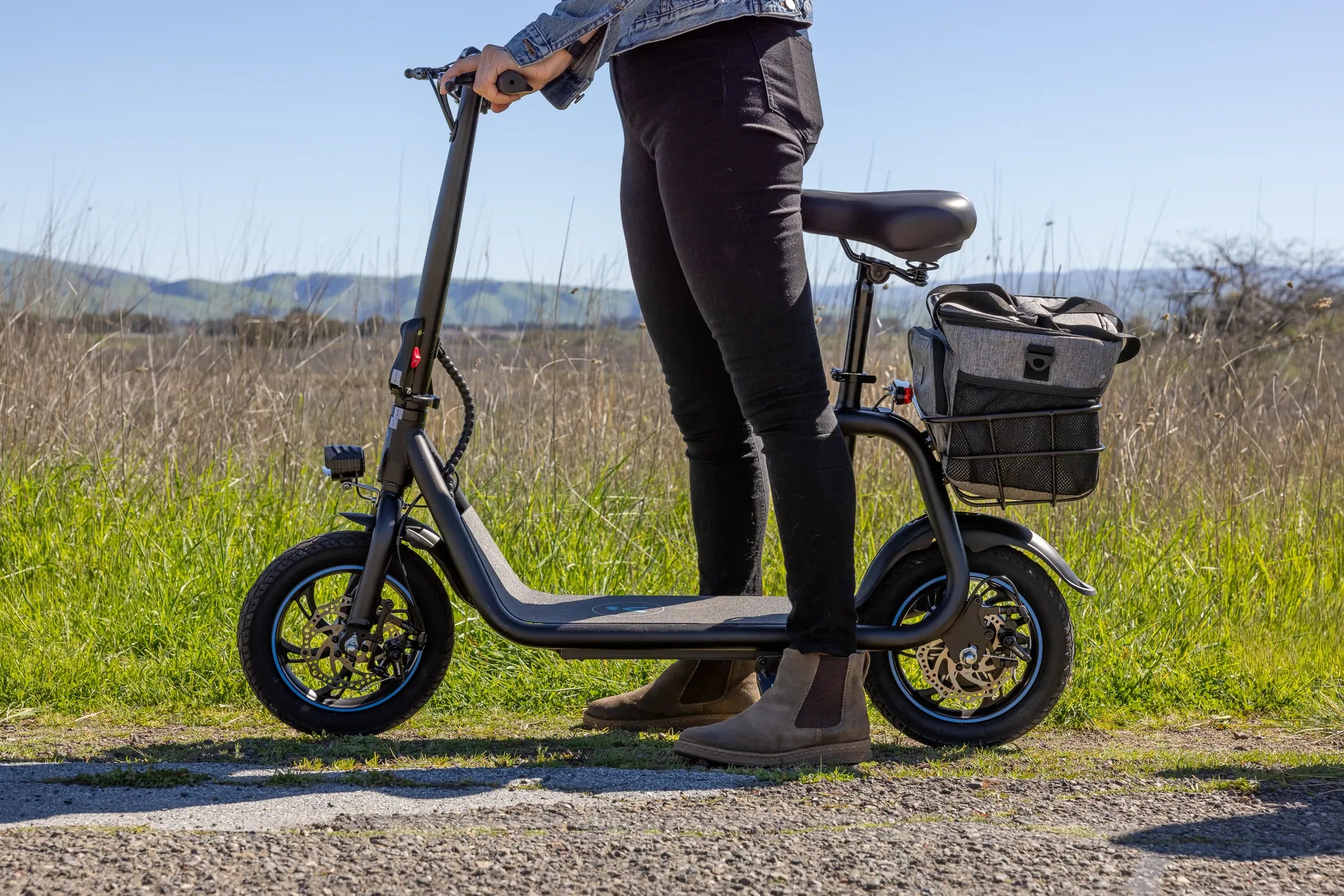
Introduction to Seated Electric Scooter Legality
The convenience and comfort of seated electric scooters have propelled their popularity, but they bring a complex legal question to the forefront: Are seated electric scooters legal? The answer is rarely a simple yes or no. It's a mosaic of state statutes, local ordinances, and vehicle classifications that vary dramatically from one jurisdiction to another.
This article serves as your practical roadmap. We will dissect the legal frameworks, define key terms, and provide actionable steps to determine the rules for your specific location. Navigating this landscape is essential for safe, lawful, and enjoyable riding.
As a leader in personal electric mobility, Gyroor is committed to rider safety and regulatory awareness. Trusted by over 100,000 riders, our focus on certified components and clear specifications helps riders make informed, compliant choices.
Defining the Vehicle: What Makes a Seated E-Scooter Different?
Legally, a seated electric scooter is often a different beast than its standing counterpart. The presence of a seat, combined with typical design features, can shift its classification entirely. Understanding this distinction is the first step in understanding the law.
Standing electric scooters are frequently categorized as "Electric Stand-Up Scooters" or "Personal Mobility Devices." They are often subject to shared micromobility program rules or specific low-speed statutes. Their design implies short-term, standing use on sidewalks or bike lanes in many areas.
In contrast, a seated electric scooter more closely resembles a motorized bicycle or moped. The seated riding posture, longer wheelbase, and often more powerful motor suggest a vehicle designed for road use. This physical form triggers regulators to evaluate them under laws governing bicycles, mopeds, or even motorcycles.
Key differentiators include higher typical top speeds (often 20-30+ mph), larger battery capacities for extended range, and a construction meant for sustained riding. These factors directly influence where you can legally operate them.
The Regulatory Gray Area: Classifications and Key Terms
The legal status hinges on how authorities classify your vehicle. Seated scooters often fall into a gray area between several established categories. The specific classification depends on a handful of technical specifications.
Common legal categories include Low-Speed Electric Bicycles (Class 1, 2, and 3), which require functional pedals and have motor cut-off speeds. Without pedals, a vehicle may be classified as a "Motorized Scooter" or "Moped," which carries stricter requirements. For very low-speed models, some areas may still consider them a "Personal Mobility Device."
Regulators focus on concrete metrics. Maximum speed (usually 20 mph or 28 mph thresholds) is the most critical. Motor wattage (e.g., 500W vs. 750W) defines power output. The presence of pedals is a major differentiator for e-bike laws. Vehicle weight and wheel diameter can also be factors in local codes.
Misclassification can lead to fines, impoundment, or being denied insurance coverage in the event of an accident. Knowing your vehicle's exact specs is non-negotiable.
Navigating U.S. Regulations: State-by-State and Local Ordinances
In the United States, there is no single federal law governing seated electric scooters. The primary authority rests with individual states. However, even within a state, cities and counties can enact stricter ordinances, creating a three-tiered system: federal safety standards (like UL for batteries), state vehicle code, and local municipal law.
This patchwork system means a scooter legal in one city might be prohibited just across the county line. Laws are also in constant flux as legislatures try to catch up with technology. A law that was accurate six months ago may have been amended.
The general trend is toward regulation rather than prohibition. States are increasingly adopting the three-class e-bike system, but seated scooters without pedals frequently fall outside this clean framework, defaulting to moped or motorized scooter rules.
State Law Spotlight: Examples of Common Regulatory Frameworks
Examining a few states illustrates the national diversity. California's clear three-class e-bike law offers a path for seated scooters with pedals. A seated scooter without pedals and capable of over 20 mph likely falls under moped regulations, requiring registration, insurance, and a helmet.
Florida law defines a "motorized scooter" and prohibits them on sidewalks. If the scooter exceeds 30 mph, it's classified as a motorcycle. Texas has a specific definition for "motor-assisted scooters" (under 40 lbs, 15 mph max) and bans them on roads with speed limits over 35 mph; more powerful seated models exist in a legal gray zone.
Some states, like Pennsylvania, have historically had very restrictive definitions that effectively prohibited many seated electric scooters from public roads, though recent legislative efforts are underway to change this. Always consult your state's official vehicle code.
The Importance of Local City Ordinances
State law may permit operation, but your city council controls the details. Local ordinances dictate the where and how of riding. These rules are paramount for daily use.
Common local restrictions include outright bans on sidewalks for any motorized device, designation of specific bike lanes or trails where they are allowed or prohibited, and parking regulations that prevent locking to certain fixtures. Helmet mandates for all ages are also often a city-level decision.
To find these rules, search your city's website for "municipal code" and look under titles like "Vehicles and Traffic," "Streets and Sidewalks," or "Parks and Recreation." Contacting your local police department's non-emergency line can also provide clarity.
Key Legal Requirements for Riding a Seated E-Scooter
Once you've determined your scooter's classification and local permission, you must comply with operational requirements. These form a checklist for legal and safe riding.
Age Restrictions, Licensing, and Registration
These requirements scale with the vehicle's classification. If classified as a low-speed e-bike (with pedals), no license or registration is typically needed, and the minimum age may be 14-16. If classified as a moped or motorized scooter, a driver's license (or moped permit), vehicle registration, license plate, and even insurance may be mandatory.
For example, a 500W seated scooter with a top speed of 25 mph will likely require a driver's license in most states, as it exceeds the common 20 mph e-bike limit. Proof of ownership and a Manufacturer's Certificate of Origin (provided by brands like Gyroor) may be needed for registration.
Safety Equipment and Operational Rules
Beyond the rider, the vehicle itself must be equipped properly. Standard requirements include a front white headlight and rear red taillight for night riding, side and rear reflectors, and an audible bell or horn. These are not just good ideas; they are often legal mandates.
Operational rules mirror those for bicycles or cars, depending on classification. You must ride in the direction of traffic, obey all traffic signals, and use hand signals for turns. DUI laws apply universally. Most jurisdictions prohibit passengers unless the scooter is specifically designed for two people. Always yield to pedestrians.
Gyroor’s Commitment to Compliant and Safe Riding
Choosing a reputable brand is a critical part of legal and safe riding. Gyroor designs its seated scooters and e-bikes with an awareness of the regulatory landscape, building features that aid in compliance and protect the rider.
Our commitment extends beyond the sale. With over 100,000 riders across North America and Europe and a 4.5/5 average rating, we provide the documentation and support riders need to navigate local rules confidently.
How Gyroor Specifications Align with Common Regulations
Gyroor models are engineered with key regulatory thresholds in mind. Multiple speed mode settings allow a rider to cap their scooter's top speed to 15-20 mph to comply with local e-bike or sidewalk rules, even if the hardware is capable of more.
Every Gyroor scooter uses UL-certified battery packs, a critical safety standard that many cities and insurance providers require. Our IPX5 water-resistant design ensures reliability in various weather conditions, contributing to safe operation. These features aren't just specs; they are built-in tools for legal compliance.
Utilizing the 1-Year Warranty and US-Based Support
Gyroor's comprehensive 1-year warranty covers the frame, motor, and battery, providing peace of mind. Our US-based customer support team can assist with technical specifications and documentation, such as motor wattage certificates or safety standard verifications, which you may need for local authority inquiries or registration processes.
This support system underscores a responsible approach to micromobility, where the manufacturer partners with the rider for safe, lawful enjoyment of the product.
Practical Steps to Determine Your Local Legality
Don't guess. Follow this systematic research plan before you ride.
Research Checklist and Official Resources
First, identify your scooter's exact specifications: maximum speed on level ground, motor wattage (continuous output), weight, and whether it has operational pedals. Have your model's manual handy.
Next, conduct your legal research: 1) Search online for "[Your State] electric bicycle law" or "[Your State] motorized scooter statute." 2) Visit your city's official website and search its municipal code for keywords like "electric scooter," "motorized bicycle," or "moped." 3) Contact your local Department of Motor Vehicles (DMV) for registration questions and your city police department's non-emergency line for operational rule clarifications.
Recommended resources include your state's Department of Transportation (DOT) website, the PeopleForBikes e-bike law tracker, and your local city council's published ordinances.
Comparison of Common Electric Vehicle Classifications
| Vehicle Type | Key Features | Typical Max Speed | Common Legal Classification | License/Reg. Often Required? |
|---|---|---|---|---|
| Standing E-Scooter | Standing ride, small deck, lean-to-steer | 15-20 mph | Personal Mobility Device / Motorized Scooter | No |
| Seated E-Scooter (no pedals) | Seat, higher power, motorcycle-style controls | 20-30+ mph | Motorized Scooter / Moped | Yes, if over 20-28 mph |
| Class 2 E-Bike (with pedals) | Throttle-assisted, functional pedals | 20 mph | Low-Speed Electric Bicycle | No |
| Gyroor Seated Models | Speed modes, UL-certified battery, IPX5 rating | Configurable (e.g., 15/20/28 mph) | Depends on use mode & local law | Check local rules |
Frequently Asked Questions (FAQ) on Seated E-Scooter Legality
1. Are seated electric scooters legal on sidewalks?
Almost universally, no—especially in urban areas. They are typically considered too fast and heavy for pedestrian spaces. Local laws almost always restrict them to roads, bike lanes, or multi-use paths. Always check your city ordinance.
2. Do I need a license for a seated scooter with a 500W motor?
It depends primarily on its classified top speed, not just wattage. If the scooter can exceed 20 mph (or 28 mph in some states), it will likely be classified as a moped, requiring a driver's license. If speed-limited to 20 mph, it may qualify as an e-bike where no license is needed.
3. Can I modify my scooter to go faster?
We strongly advise against it. Modifying a scooter to increase its speed will almost certainly make it illegal under its original classification, void the manufacturer's warranty (including Gyroor's 1-year warranty), and compromise safety systems designed for the original motor and battery configuration.
4. Are Gyroor seated models street-legal?
Gyroor models are designed to meet common federal safety standards (like UL certification) and are built with configurable speed modes to help riders comply with local speed laws. However, final "street-legal" status is determined by your local and state laws based on where and how you use the scooter. We provide the specs and support to help you prove compliance.
5. What happens if I'm caught riding an illegal scooter?
Penalties vary but can include substantial fines, points on your driver's license (if you have one), and impoundment of the scooter. Riding an unregistered, uninsured vehicle could also leave you personally liable for damages in an accident.
Conclusion: Riding Responsibly Within the Law
The legality of seated electric scooters is defined by a detailed interplay of specifications, state code, and local ordinance. Ignorance of the law is not a valid defense. The responsible rider's journey begins with thorough research into their specific vehicle's capabilities and their jurisdiction's rules.
Prioritize safety and compliance by choosing a brand that builds for these realities. Gyroor’s focus on certified components, configurable performance, and strong customer support provides a foundation for lawful enjoyment. Equip yourself with knowledge, gear, and a compliant vehicle.
Enjoy the freedom and efficiency of seated electric mobility, but do so with respect for the law and the safety of everyone sharing the path and road. Ready to explore a range designed with compliance in mind? Browse the full Gyroor collection at gyroorboard.com.
Best Electric Scooters Under $350 2025: Affordable and Reliable Rides
Best Electric Scooters in India with Price: Top Picks for 2024