



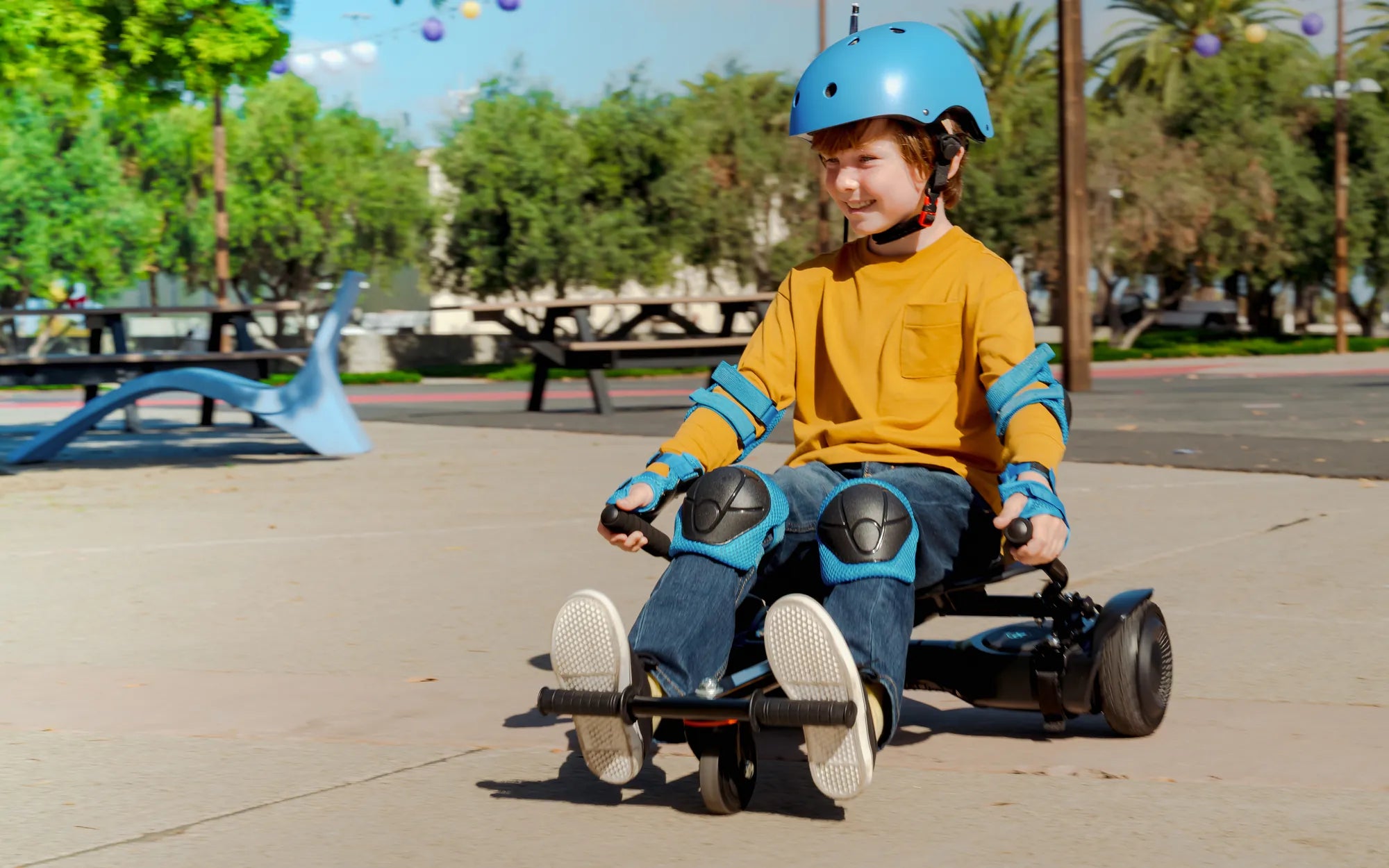
Imagine stepping onto a personal transporter and riding away instantly, with no wobbly learning phase. The automatic hoverboard makes this a reality, representing a fundamental leap in micro-mobility by integrating advanced self-balancing technology. This article will dissect the engineering principles behind automatic stabilization, analyze its transformative impact on urban commuting, and provide a detailed framework for evaluating quality and safety in this emerging product category. You will learn why this innovation is poised to become a staple for last-mile travel and how to choose a model engineered for long-term, reliable performance.
What is an Automatic Hoverboard?
An automatic hoverboard is the next evolutionary step in self-balancing scooters. Its defining characteristic is a sophisticated auto-balance system that actively stabilizes the platform for the rider from the moment they step on. Unlike first-generation hoverboards that required users to learn delicate foot control for balance, an automatic model uses sensor arrays and microprocessors to maintain equilibrium autonomously. This core feature transforms it from a recreational gadget into a practical, accessible mode of personal transportation.
The technology fundamentally shifts the user experience. Traditional hoverboards operate on a principle of rider-induced balance; you lean to go forward or back, and subtle foot movements keep you upright. The automatic variant removes this cognitive and physical load. The board manages its own pitch and roll stability, allowing the rider to focus solely on direction and speed. This drastically reduces the barrier to entry, making it viable for a much wider demographic, including younger teens and older adults who may have been hesitant before.
In the context of the broader micro-mobility landscape, the automatic hoverboard carves out a unique niche. It offers the compact, portable form factor of a classic hoverboard but with the intuitive usability of a stand-on electric scooter. Brands like Gyroor are pioneering this space by integrating this intelligent technology with proven electric drivetrain components, creating a product category that truly embodies futuristic, hassle-free transport. The goal is seamless integration into daily life—a device you can grab and go without a second thought.
The Core Technology: How Auto-Balance Works
The magic of the automatic hoverboard lies in a fusion of hardware and software. At its heart are inertial measurement units (IMUs) containing high-precision gyroscopes and accelerometers. These sensors constantly measure the board's orientation, tilt, and angular velocity hundreds of times per second. This real-time data stream is the primary input for the stabilization algorithm. The system knows the exact angle of the deck relative to the ground at every millisecond.
This sensor data is fed into a dedicated microprocessor, often an ARM-based chipset. Here, a proprietary control algorithm processes the information. It calculates the precise counter-movement required to keep the board level. If the front tilts down, the algorithm commands the motors to correct that tilt instantly. This closed-loop feedback system operates continuously, creating a dynamic equilibrium. The result is a platform that feels solid and stable underfoot, actively resisting falls instead of relying on the rider to do so.
The system's commands are executed by high-torque, brushless DC hub motors embedded in each wheel. These motors receive split-second instructions to spin forward or backward at varying speeds to achieve the desired stabilization and propulsion. The power delivery is smooth and responsive, translating complex algorithmic calculations into a simple, intuitive riding feel. This integration of sensing, processing, and actuation is what separates an automatic hoverboard from its predecessors, offering a fundamentally different—and safer—base experience.
Gyroor's Implementation: Safety and Stability First
Gyroor's approach to automatic hoverboard technology emphasizes redundancy and resilience. Their systems often employ dual IMU sensors for fail-safe operation. If one sensor were to encounter an error, the secondary unit takes over, preventing a sudden loss of balance. This hardware redundancy is a critical safety feature often overlooked in lower-tier products. It ensures the core auto-balance function remains active under virtually all conditions.
Furthermore, Gyroor integrates this intelligent balancing system with its rigorously tested power train. The motors are tuned not just for speed, but for smooth, consistent torque delivery that complements the stabilization algorithm. The battery management system (BMS) communicates with the main processor, ensuring power delivery is stable and does not interfere with the sensitive balance controls. This holistic engineering creates a cohesive product where the auto-balance isn't just an added feature; it's the central pillar around which the entire vehicle is designed, ensuring reliable performance that builds genuine rider confidence.
Why Automatic Hoverboards Are the Practical Future
The practical case for the automatic hoverboard is built on accessibility, efficiency, and integration. For urban and suburban environments, the "last-mile" problem—the distance between a transportation hub and one's final destination—remains a key logistical hurdle. Public transit, bicycles, and cars often leave a gap of 1-3 miles that is too short to drive conveniently but just long enough to walk uncomfortably, especially with bags or in poor weather. The automatic hoverboard is an ideal solution for this specific range.
Its primary advantage over other micro-mobility options is the near-zero learning curve. Compared to a traditional electric scooter (which requires kicking off and balancing) or a standard hoverboard (which requires practice), an automatic model is usable within minutes. This immediacy dramatically increases its utility as a true tool, not a toy. You can keep it by the door for quick trips to the corner store, commute from a parking lot to the office, or navigate a large college campus without breaking a sweat or needing prior skill.
From a space and logistics perspective, automatic hoverboards are supremely efficient. They are more compact and lighter than most e-scooters and e-bikes, making them easy to carry onto a bus, store under a desk, or tuck into a car trunk. This portability, combined with instant usability, means they are more likely to be used for multiple short trips throughout the day. They fill the micro-mobility gap between walking and cycling with a solution that is both time-saving and effortless, promoting a shift away from short car trips and reducing urban congestion and emissions.
Data-Driven Benefits: Time and Accessibility
A logical comparison highlights the automatic hoverboard's unique value proposition. Consider a common 1.5-mile urban trip. Walking this distance typically takes 25-30 minutes. A traditional e-scooter might cut that to 10 minutes, but requires finding parking or carrying a 30+ lb device. A standard hoverboard could match the time but demands a skilled rider. The automatic hoverboard achieves the 10-minute travel time while being instantly accessible to any able-bodied person and easier to carry at ~25 lbs.
The accessibility benefit is quantifiable in terms of potential user base. By removing the balance skill requirement, automatic hoverboards open up personal electric transportation to millions who previously found it intimidating or impractical. This includes older children (with proper safety gear), adults who are not naturally coordinated, and individuals looking for the simplest possible point-A-to-point-B device. This expansion of the addressable market is a key driver for the category's growth, moving it from a niche hobbyist segment into the mainstream consumer transportation arena.
Key Features of a Quality Automatic Hoverboard
When evaluating an automatic hoverboard, the auto-balance feature is just the starting point. A quality product is defined by the synergy of several key components. Motor power is crucial; look for dual motors with a combined wattage of at least 500W for adequate torque and hill-climbing ability (approximately 15-degree inclines). The wheel size and type matter significantly for ride comfort—8.5-inch or larger air-filled (pneumatic) or solid rubber tires absorb road vibrations better than small, hard plastic wheels, providing a smoother ride on varied surfaces.
Range and speed are practical specifications. A real-world range of 10-12 miles on a single charge covers most daily last-mile needs, while a top speed of 8-10 mph offers a brisk, safe pace for sidewalk and bike lane use. The charging time should be reasonable, ideally under 3-4 hours for a full charge. User interface elements like clear battery level indicators, speed modes (beginner/advanced), and intuitive power buttons contribute to a polished experience. Bluetooth connectivity for app-based controls, ride statistics, and firmware updates is a marker of a modern, connected device.
Build quality is immediately apparent. The deck should be made of a robust, slip-resistant material. The frame should feel solid, with no flex or creaking. All panels should fit together seamlessly, with no sharp edges or gaps. High-quality models feature bright LED headlights and tail lights for visibility, and some include ambient deck lighting. These features collectively determine not just how the hoverboard performs on day one, but how it holds up over months of daily use.
Non-Negotiable Safety & Durability Specs
Three specifications are non-negotiable for a serious automatic hoverboard: battery certification, water resistance, and warranty. First, the battery must be UL 2272 certified. This stringent standard tests the battery pack for electrical, mechanical, and environmental safety, drastically reducing the risk of fire—a critical concern with lithium-ion batteries. Never compromise on this.
Second, an IPX5 water-resistance rating is essential for real-world reliability. IPX5 means the device can withstand water jets from any direction, protecting it from wet roads, puddles, and light rain. This ensures the hoverboard won't fail due to incidental moisture, making it a truly all-weather capable transporter. Third, a strong warranty, such as a 1-year comprehensive warranty on parts and labor, is the manufacturer's vote of confidence in its product. It protects your investment and signals that the company stands behind its engineering and quality control.
The Gyroor Advantage: Engineered for Real-World Use
Gyroor positions its automatic hoverboards at the intersection of innovative technology and proven, reliable engineering. The brand's philosophy centers on delivering a futuristic riding experience without compromising on the fundamentals of safety and durability. By building its auto-balance systems around UL 2272 certified battery packs, Gyroor addresses the most significant safety concern head-on, providing peace of mind that is foundational for a device used for daily transportation.
The commitment to resilience is evident in the IPX5 water-resistant construction found across its lineup. This isn't a marketing afterthought; it's a design imperative that allows riders to confidently navigate damp streets or morning dew without anxiety. Coupled with robust frames and high-torque motors, this creates a product built for the unpredictability of daily commutes, not just smooth pavements on sunny days. Gyroor's 1-year warranty further underscores this commitment, offering tangible support to a growing community of over 100,000 riders.
This holistic approach synthesizes the discussed technology and features into a cohesive product. The auto-balance technology provides the intuitive entry point. The certified safety and rugged build ensure long-term reliability. The strong customer support network resolves any issues. Together, they offer what many competitors do not: a future-proof automatic hoverboard that users can depend on as a legitimate tool for urban mobility, backed by a brand with a track record in the personal electric vehicle space.
Comparative Analysis: Automatic Hoverboard vs. Other Micro-Mobility
Understanding where the automatic hoverboard fits requires a clear comparison with adjacent transportation categories. The following table breaks down key parameters.
| Feature | Automatic Hoverboard | Traditional Hoverboard | Electric Kick Scooter | Electric Bike |
|---|---|---|---|---|
| Learning Curve | Very Low (Minutes) | High (Hours/Days) | Low (Minutes) | Very Low (None) |
| Portability (Weight) | High (~22-28 lbs) | High (~22-28 lbs) | Medium (~30-40 lbs) | Low (50+ lbs) |
| Storage Footprint | Very Small | Very Small | Small (Folds) | Large |
| Typical Range | 10-12 Miles | 10-12 Miles | 15-20 Miles | 20-40+ Miles |
| Ideal Use Case | Last-Mile, Casual Urban | Recreation, Skilled Riders | Medium Commutes | Long Commutes, Errands |
| Key Advantage | Instant Stability & Portability | Low Cost, Agile | Speed & Range | Range, Comfort, Utility |
As the table illustrates, the automatic hoverboard's unique selling proposition is its combination of instant stability and excellent portability. It sacrifices some range and speed compared to e-scooters and e-bikes to achieve a supremely compact and user-friendly form factor. For the specific niche of ultra-convenient, short-distance travel where carrying and storing the vehicle is as important as riding it, the automatic hoverboard is arguably unmatched.
Frequently Asked Questions (FAQ)
Q1: Is an automatic hoverboard truly safe for a complete beginner?
Yes, that is its primary design goal. The auto-balance technology actively stabilizes the board, so a beginner does not need to learn how to balance it manually. However, "safe" also depends on rider behavior. Beginners should always start in a safe, open area, wear a helmet and protective gear, and familiarize themselves with the controls (accelerating, braking, turning) at low speeds before venturing into traffic or crowded areas.
Q2: How does the IPX5 rating protect my hoverboard in daily use?
An IPX5 rating means the hoverboard's enclosure is protected against low-pressure water jets from any direction. In practice, this protects the internal electronics (motors, battery, control board) from water sprayed by puddles, wet roads, or light rain. It allows you to ride on damp surfaces without fear of immediate damage. It is not, however, a permit to submerge the board or ride through deep standing water.
Q3: What is the real-world range I can expect on a single charge?
Manufacturer ranges are often based on ideal conditions (light rider, flat surface, slow speed). Real-world range is typically 70-80% of the advertised maximum. For a model advertised at 12 miles, expect 8-10 miles for an average adult rider on mixed terrain with some inclines. Factors like rider weight, terrain, temperature, and riding speed (faster speeds drain the battery quicker) all significantly impact the actual distance you can travel.
Q4: Why is a UL 2272 certified battery so important?
The UL 2272 standard is a comprehensive safety certification for lithium-ion battery systems in light electric vehicles. It involves rigorous testing for overcharge, short circuit, imbalance, drop, crush, shock, vibration, and water exposure. A certified battery pack has passed these tests, meaning its cells, wiring, BMS, and enclosure are designed to prevent thermal runaway (fires) under fault conditions. It is the single most important indicator of a hoverboard's fundamental safety.
Q5: How does a 1-year warranty support me as a rider?
A robust 1-year warranty provides significant financial and practical protection. It typically covers defects in materials and workmanship for components like the battery, motors, control board, and frame. If a covered part fails under normal use within the warranty period, the manufacturer will repair or replace it, often covering parts and labor. This reduces the long-term cost of ownership and demonstrates the brand's confidence in its product's reliability, allowing you to invest in the technology with greater assurance.
Stepping Into Smarter, More Accessible Mobility
The automatic hoverboard represents a tangible step toward the future of personal transportation—one defined by intuition, accessibility, and seamless integration into daily life. By solving the core challenge of balance, it transforms a novel concept into a genuinely practical tool for millions. The potential extends beyond mere convenience; it promotes a shift towards efficient, electric micro-mobility that can alleviate urban congestion and reduce our environmental footprint for short trips.
However, this future is only realized through responsible engineering and informed consumer choice. The promise of auto-balance must be underpinned by unwavering commitments to safety certifications like UL 2272, durability standards like IPX5, and strong customer guarantees. This is where the distinction between a fleeting gadget and a reliable transport device is made. Embracing this new mode of travel means choosing products built on this foundation of trust and performance.
Ready to experience intuitive, personal transportation? Explore how Gyroor combines advanced auto-balance technology with certified safety and rugged design in its latest models. Browse the full Gyroor collection at gyroorboard.com and discover the hoverboard engineered for your real world.
Christmas Gift Ideas for Preteen Girls: The Ultimate Guide to Gifts for 9-12 Year Olds
Pink and Purple Scooter for Kids: The Ultimate Guide to Fun and Safety