



Introduction: The Advertised Range vs. Your Real-World Journey
You've seen the spec: 'Up to 40 miles per charge.' But when you hit the road, the battery indicator drops faster than expected. Understanding electric scooters range: how far can you go on a single charge is the most critical question for any rider, yet the answer is rarely a single number. The advertised maximum range is a benchmark achieved under ideal laboratory conditions—lightweight rider, perfect temperature, flat ground, and slow, steady speed.
Your daily reality involves hills, stop-and-go traffic, your body weight, and changing weather. This gap between the ideal and the practical is what leaves many riders with 'range anxiety.' This guide cuts through the marketing to provide a factual, data-driven framework. We'll decode the technical specifications, quantify the impact of real-world variables, and show you how to accurately estimate the true distance your scooter can cover, ensuring you never get stranded.
By the end, you'll be equipped to interpret any scooter's capabilities, from a compact commuter model to a high-performance machine. You'll understand why a brand like Gyroor, trusted by over 100,000 riders, emphasizes UL-certified battery safety and realistic performance data, ensuring their scooters deliver reliable power where it matters most: on your route.
The Science of Distance: Key Technical Factors Defining Range
At its core, an electric scooter's range is a simple equation of energy supply versus energy demand. The battery stores the energy, and the motor, terrain, and rider consume it. The balance between these factors determines your final mileage.
Misunderstanding this equation leads to disappointment. A scooter with a large battery but an overpowered motor for hilly terrain may offer less range than a modestly powered scooter with an efficient system on flat roads. It's not just about the biggest number on the spec sheet; it's about the harmonious integration of components designed for your specific use case.
Battery Capacity: Your Fuel Tank
Battery capacity, measured in Watt-hours (Wh), is the total energy available. It's the product of voltage (V) and amp-hours (Ah). Think of it as the size of your fuel tank. A larger Wh rating generally means more potential range.
A 500Wh battery can theoretically deliver 500 watts of power for one hour, or 250 watts for two hours. However, not all 500Wh batteries are created equal. Quality cells, robust battery management systems (BMS), and certifications like UL 2271 (for the battery pack itself) ensure stable voltage output, safety, and longevity over hundreds of charge cycles. Gyroor's use of UL-certified battery packs, tested for 500+ cycles, provides a foundation for consistent range performance over the scooter's lifetime.
Motor Power and Efficiency: The Engine
Motor power, measured in watts (W), is the rate at which energy is used. A 500W motor requires 500 watts from the battery to run at full power. Higher wattage motors provide better acceleration and hill-climbing ability but can drain the battery rapidly if used aggressively.
Efficiency is crucial. A well-designed motor and controller system converts more electrical energy into forward motion, wasting less as heat. Dual-motor scooters offer tremendous torque but can halve the range compared to single-motor mode. Understanding when you need that power—and when you can rely on a more efficient, single-motor or eco-mode setting—is key to managing your electric scooter's range on a single charge.
The Human and Environmental Variables: What Drains Your Battery
Once you understand the scooter's hardware, the next layer involves the conditions in which you ride. These variables explain why two people on the same scooter model can achieve dramatically different distances.
Rider Weight and Payload: The Load Factor
Physics is unforgiving. The more mass the motor has to move, the more energy it consumes. Every pound matters. A 250 lb rider will experience significantly less range than a 150 lb rider on the same scooter, especially from a stop or on an incline.
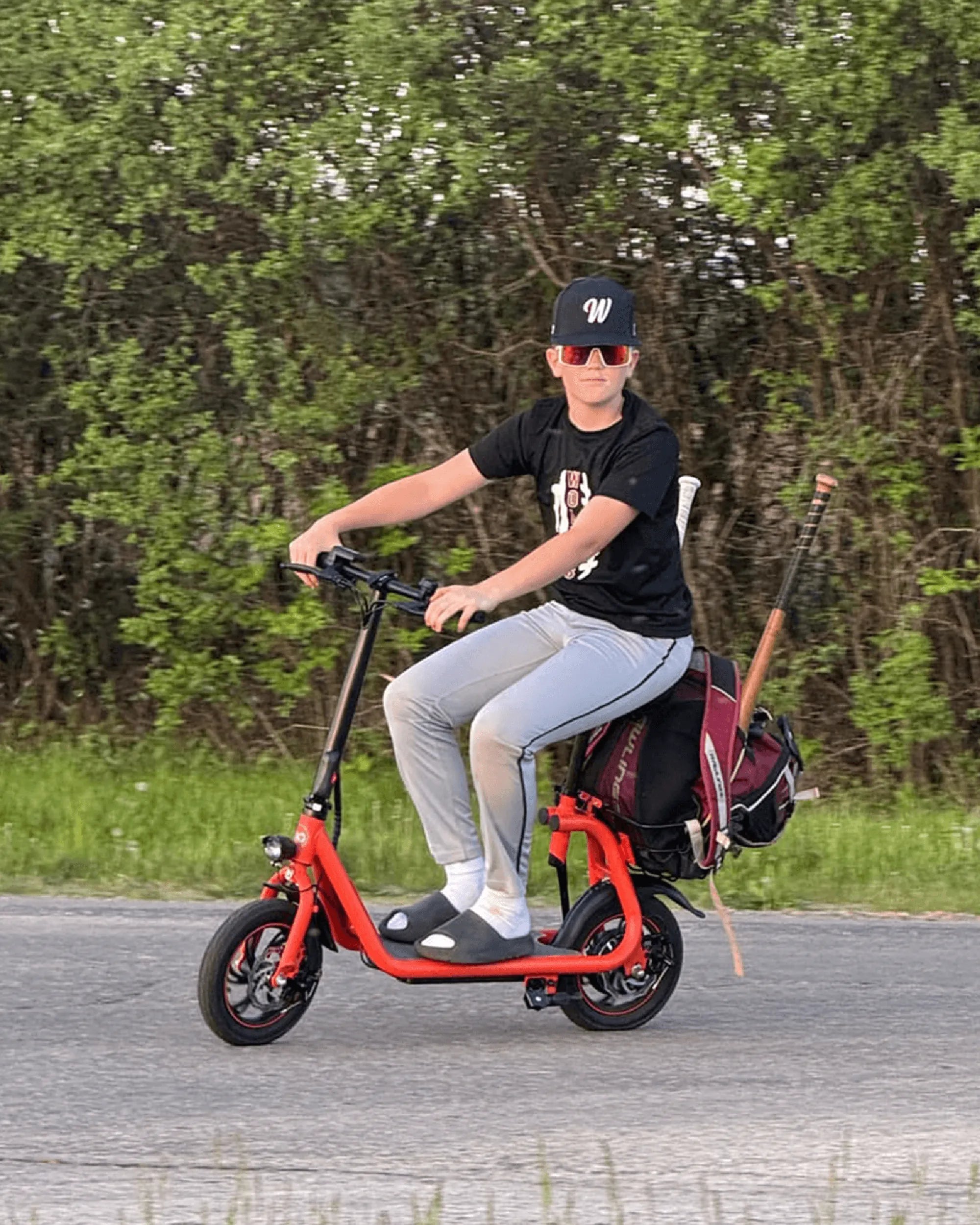
Manufacturer range tests are typically conducted with a ~165 lb rider. If you are heavier or plan to carry a backpack, groceries, or other cargo, you must factor in a 10-25% reduction from the advertised range. It's not a flaw in the scooter; it's a fundamental law of motion.
Terrain and Elevation: The Hill Tax
This is the single biggest consumer of battery life outside of rider weight. Riding on flat, smooth pavement is highly efficient. Introducing even a gentle, sustained incline increases the gravitational force working against the scooter, forcing the motor to draw significantly more current.
A route with frequent hills can reduce your range by 30-50% compared to a flat route. Planning your commute to avoid the steepest grades or using a scooter with ample torque (like Gyroor's high-performance models) to handle hills efficiently can mitigate this drain.
Riding Style: The Agility Penalty
How you ride has a profound impact. Jackrabbit starts, maintaining top speed constantly, and hard braking waste energy. Smooth, anticipatory acceleration and cruising at a moderate pace (e.g., 15 mph vs. 24 mph) can extend your range substantially.
Wind resistance increases exponentially with speed. Riding at 20 mph faces four times the wind resistance of riding at 10 mph, consuming far more power. Using lower speed modes or 'Eco' settings when range is a priority is one of the most effective strategies.
Temperature and Tire Pressure
Lithium-ion batteries operate optimally at room temperature (approx. 20°C or 68°F). In cold weather (below 50°F/10°C), chemical reactions within the battery slow down, reducing its ability to deliver current and cutting usable capacity by 20-30%. The effect is often temporary; range may return in warmer conditions.
Under-inflated tires create more rolling resistance, silently sapping your range. Maintaining tires at the manufacturer's recommended PSI is a simple, often-overlooked maintenance task that directly impacts how far you can travel.
Decoding the Spec Sheet: From "Max Range" to "Practical Range"
Manufacturers often list a 'Max Range' figure. The key is understanding the test conditions, usually found in fine print: 'Tested with a 165 lb rider, at 15°C, on flat ground, at a constant speed of 15 mph in Eco mode.'
Your practical range is what you can reliably expect on a typical day. A good rule of thumb is to take the 'Max Range' and apply a 25-40% 'real-world discount' based on your variables. If a scooter claims 40 miles max, a 200 lb rider commuting over mild hills should plan for a reliable 24-30 miles per charge.
Brands that prioritize transparency, like Gyroor, often provide more contextual data or emphasize the robust, real-world engineering behind their products—such as IPX5 water-resistant designs that protect electronics from splashes and their reliable 1-year warranty—giving you confidence in daily performance, not just lab results.
Scenario-Based Range Estimates: From Commute to Adventure
Let's apply our knowledge. The table below estimates practical range for a commuter-focused scooter with a 500Wh battery under different common scenarios. Remember, these are estimates; actual results will vary.
| Use Case Scenario | Key Conditions | Estimated Practical Range (from 500Wh) | Primary Range Factors |
|---|---|---|---|
| Urban Commuter (Ideal) | Flat city streets, 165 lb rider, 15 mph, smooth stops/starts, 70°F | 28-32 miles | Efficient speed, ideal weight, flat terrain |
| Urban Commuter (Typical) | Stop-and-go traffic, mild hills, 200 lb rider with backpack, 68°F | 20-25 miles | Weight, acceleration cycles, minor inclines |
| Weekend Explorer | Paved bike paths with gentle rolling hills, 180 lb rider, variable speeds, 60°F | 22-26 miles | Inclines, variable power demand |
| Hilly City Challenge | Frequent steep grades, 190 lb rider, aggressive acceleration to maintain speed, 50°F | 15-18 miles | Major elevation gain, cold temperature, high power draw |
| Eco-Mode Maximizer | Flat terrain, 150 lb rider, steady 12 mph, optimal tire pressure, 75°F | 35-40 miles (near max) | Minimized load, low constant speed, ideal conditions |
Maximizing Your Electric Scooter's Range: Actionable Pro Tips
Knowledge is power, but applied knowledge is distance. Here are concrete steps to squeeze every possible mile from your charge.
Master Your Modes: Use Eco or Energy Saver mode for the majority of your ride, especially on flat sections. Reserve Sport or Turbo mode only for necessary hill climbs or quick accelerations.
Optimize Your Route: Use mapping apps to find flatter routes, even if slightly longer. Avoiding a few steep hills can save more battery than the extra distance consumes.
Adopt a Smooth Riding Style: Accelerate gradually from stops and anticipate stops to use regenerative braking (if equipped) or coast to a slowdown instead of using the mechanical brake.
Maintain Your Scooter: Keep tires properly inflated. Ensure brakes are not rubbing, which creates drag. Keep the drivetrain clean and lubricated per the manual.
Charge Smartly: For daily use, avoid constantly charging to 100% and draining to 0%. Keeping the battery between 20% and 80% for storage can improve long-term health. Always use the manufacturer's provided charger.
Frequently Asked Questions (FAQ)
Does cold weather really reduce my scooter's range?
Yes, significantly. Lithium-ion battery chemistry is less efficient in the cold, reducing usable capacity. A 30°F (-1°C) day can cut range by 25-30% compared to a 70°F (21°C) day. The effect is most noticeable at the start of the ride. Store your scooter indoors when not in use to keep the battery warmer.
How does the 1-year warranty cover my scooter's battery?
Gyroor's standard 1-year warranty typically covers defects in materials and workmanship for the entire scooter, including the battery. This means if the battery fails to hold a charge due to a manufacturing flaw within the warranty period, it would be replaced. Normal capacity degradation over time and hundreds of cycles is expected and is not considered a defect.
Can I increase my scooter's range with a secondary battery?
It is sometimes possible, but not universally recommended. Adding an external battery pack requires compatible connectors, voltage matching, and safe integration to avoid damaging the BMS or creating a fire hazard. It voids warranties and adds weight. For most riders, choosing a scooter with a larger built-in battery from the start (from a brand that uses safe, certified packs) is a safer and more reliable solution for extended electric scooter range on a single charge.
What is regenerative braking, and does it add meaningful range?
Regenerative braking converts some kinetic energy back into electrical energy during braking or coasting, feeding it back into the battery. While a valuable feature, its impact is modest—typically adding 5-10% to overall range in stop-and-go city traffic. Its primary benefit is reducing wear on physical brake pads. It is not a substitute for a sufficiently large battery.
How long does an electric scooter battery last before needing replacement?
A quality lithium-ion battery, like the UL-certified packs used by Gyroor, is rated for a certain number of full charge cycles (often 500+). With typical use (a partial cycle per day), this can translate to 2-4 years before you notice a significant reduction in maximum range (e.g., holding only 70-80% of its original capacity). Proper charging habits are the key to longevity.
Conclusion: Empowering Your Ride with Knowledge and the Right Tool
The question of electric scooters range: how far can you go on a single charge transforms from a mystery into a calculable metric once you understand the variables. It's a interplay of hardware specs, rider input, and environmental conditions. By assessing your weight, typical routes, and riding style, you can move beyond marketing claims and select a scooter with a battery capacity that truly meets your needs.
Investing in a scooter from a reputable brand that prioritizes safety and durability, such as Gyroor with its UL-certified batteries, IPX5 water resistance, and commitment to reliable performance, ensures that the range you calculate is the range you get—day after day, year after year. Don't just buy for a maximum number; buy for your real-world minimum required distance, with a comfortable buffer.
Ready to find an electric scooter with the perfect balance of range, power, and reliability for your journey? Browse the full Gyroor collection at gyroorboard.com and discover models engineered to deliver confidence on every charge.
Electric Scooters for Adults Near Outer Banks, NC: Your Ultimate Guide
Best Electric Scooters Available in UK: Top Picks for 2024