



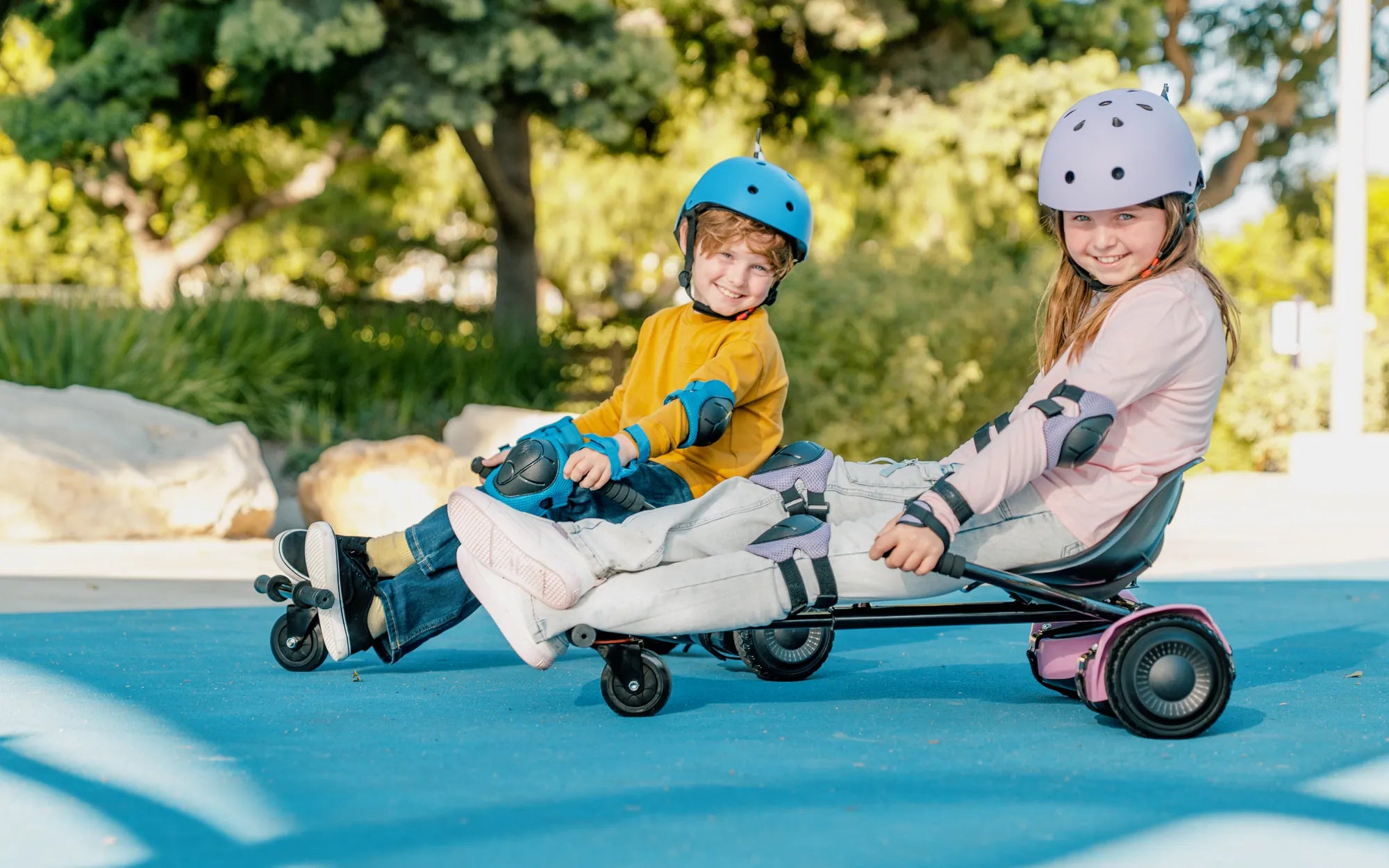
Introduction: Redefining Rider Intuition
Forget everything you know about traditional self-balancing scooters. The hoverboard with knee control is not an incremental update; it's a paradigm shift in rider-machine interaction. This technology moves beyond simple toe-and-heel pressure, introducing a control scheme that feels more like an extension of your body than a device you stand on.
By translating subtle knee and leg movements into precise acceleration, braking, and steering commands, it offers a glimpse into a future where personal transportation is genuinely intuitive and hands-free. As a leader in safe, reliable electric mobility, Gyroor is pioneering this space, applying its rigorous standards for battery safety and durability to create a platform that's as trustworthy as it is revolutionary.
This article will dissect the technology, its tangible benefits, and its practical applications. We'll explore why knee control is a game-changer for stability and accessibility, and how it's steering the entire category toward a more integrated role in daily urban life.
What is a Hoverboard with Knee Control? Beyond Foot Pads
A hoverboard with knee control, often termed a knee-steering electric balance board, is a two-wheeled, self-balancing personal transporter that uses advanced sensor arrays to detect and respond to the rider's knee movements and upper leg pressure. Unlike conventional models where you lean your toes or heels to move, this system engages your body's core and lower limbs for a more holistic control experience.
The fundamental difference lies in the input method. Traditional hoverboards rely on footpad tilt sensors. Knee-control models incorporate additional pressure-sensitive pads or bands on the front of the deck and sophisticated gyroscopic algorithms that interpret leg bends and shifts. This allows for nuanced steering and speed modulation that feels less like operating a machine and more like guiding your own momentum.
This evolution represents a significant step toward more natural human locomotion in electric personal transport. It effectively frees the rider's hands entirely, enabling a posture that improves balance and opens up new possibilities for carrying items or using a phone for navigation—without compromising control.
The hoverboard with knee control is thus a bridge between the familiar self-balancing scooter and a future of fully integrated, body-responsive mobility devices. It's a practical application of biomechanics to electric vehicle design.
How Knee-Control Technology Works: The Mechanics of Intuition
The system's core is a fusion of hardware and intelligent software. High-sensitivity pressure sensors are embedded in the front portion of the foot platforms. These sensors detect not just weight distribution, but the specific forward pressure applied by the rider's shins or knees when bending.
This data is fed into a central processing unit (CPU) alongside information from a high-precision gyroscope and accelerometer—the same trio that enables self-balancing. The CPU runs a proprietary algorithm that distinguishes between a rider simply shifting weight for balance and an intentional knee-bend command for acceleration or turning.
To move forward, the rider applies gentle forward pressure with their knees or lower shins while maintaining a slight bend. To brake or reverse, they straighten their legs or apply backward pressure. Steering is achieved by combining a knee-bend with a subtle lateral lean, allowing for remarkably tight and fluid turns.
The learning curve is distinct. While traditional hoverboards require users to master awkward ankle movements, knee control leverages a more instinctive motion. Most riders adapt within 10-30 minutes, finding the posture more stable and less taxing on the calves and ankles, making the hoverboard with knee control accessible to a broader audience.
The Key Benefits: Why Knee Control is a Game-Changer
The advantages of knee-control technology are multifaceted, impacting safety, comfort, control, and overall riding experience. The primary benefit is enhanced stability. By engaging the larger muscle groups of the legs and core, riders achieve a lower center of gravity and a more athletic, ready stance. This significantly reduces the wobbliness often associated with beginner hoverboard use.
Control becomes more precise and less fatiguing. Fine adjustments in speed are easier to manage with knee modulation than with delicate foot tilts, especially over longer distances or on varied terrain. This leads to a smoother, more confident ride.
From an ergonomic standpoint, the posture is healthier. It avoids the strained, static ankle position of traditional riding, distributing effort more evenly across the legs and core. This can reduce fatigue and make longer commutes or recreational sessions more enjoyable.
Finally, the hands-free nature unlocks practical utility. Commuters can carry a briefcase or coffee, and recreational riders can easily gesture or use a phone for maps. The hoverboard with knee control transitions the device from a novelty to a legitimate tool for efficient, enjoyable personal transport.
Safety First: How Design Mitigates New Risks
Any new control paradigm introduces new considerations, and responsible manufacturers like Gyroor engineer safety features directly into the platform. First, the inherent stability of the knee-control stance is a primary safety feature, reducing fall risk from loss of balance.
Electronically, these boards incorporate multiple fail-safes. Speed limiters cap top speed, often around 10-12 mph for a balance of fun and safety. Tilt-back mechanisms gently push the pedals up when approaching max speed, providing a physical warning. Low-friction, textured foot pads ensure feet don't catch during dismount.
Robust construction is critical. Gyroor models feature reinforced decks and high-impact bumper shells to absorb shocks from minor collisions or curb strikes. Crucially, the use of UL 2272-certified battery packs, tested for over 500 charge cycles, mitigates the primary risk of fire or thermal runaway associated with uncertified lithium-ion batteries.
Furthermore, an IPX5 water-resistance rating means the board is protected against water jets from any direction. This allows safe riding on damp pavement or through puddles, preventing short-circuit failures that could lead to sudden stops or loss of control, making the hoverboard with knee control a reliable choice for real-world conditions.
Gyroor's Approach: Engineering Trust into Innovation
Gyroor enters the knee-control arena not as a speculative startup, but as an established brand with a legacy of safety and reliability trusted by over 100,000 riders. The company's philosophy is to apply its proven engineering standards to cutting-edge form factors, ensuring innovation doesn't come at the cost of user security.
The cornerstone is the UL-certified battery system. Every Gyroor hoverboard with knee control uses battery packs that have passed rigorous stress tests for electrical, mechanical, and environmental safety. This certification is non-negotiable and provides peace of mind that is absent in many generic models.
Durability is engineered in through IPX5-rated water-resistant construction. This protects the sensitive electronic components from rain, splashes, and road spray, ensuring consistent performance and longevity. The boards are built to withstand the vibrations and impacts of daily urban use.
Finally, Gyroor backs its technology with a comprehensive 1-year warranty on the core electrical and drive systems. This commitment underscores confidence in their product's quality and provides a direct safety net for consumers investing in this new technology, making the Gyroor hoverboard with knee control a responsible choice.
Practical Applications: Who is it For and Where to Ride?
The hoverboard with knee control caters to a diverse range of users. Urban commuters are prime candidates, using it for efficient, zero-emission last-mile connectivity between transit hubs and their final destination. The enhanced stability and hands-free operation make navigating sidewalks and bike lanes while carrying a bag more practical.
Recreational riders find immense fun in parks, boardwalks, and paved trails. The intuitive control lowers the barrier to entry for adults who may have found traditional hoverboards too fiddly or unstable, expanding the recreational market.
It's also ideal for use in large private spaces like college campuses, corporate parks, or warehouses. The precise control is excellent for running errands across a large area without the bulk of a bicycle or scooter.
Legally, riders must check local regulations. Typically, these devices are permitted anywhere electric scooters or traditional hoverboards are allowed—often on sidewalks, bike paths, and roads with speed limits under 25 mph. Always prioritize helmets and protective gear, and ride respectfully around pedestrians.
Knee Control vs. Traditional Hoverboards: A Data-Driven Comparison
The table below provides a clear, objective comparison between the two technologies across key parameters.
| Feature | Hoverboard with Knee Control | Traditional Hoverboard |
|---|---|---|
| Primary Control Method | Knee bend & shin pressure + lean | Toe/heel pressure (foot tilt) |
| Learning Curve | Moderate (10-30 mins); more intuitive posture | Steeper (30-60 mins); requires ankle dexterity |
| Rider Stability | High (lower center of gravity, core engaged) | Moderate (can be wobbly, especially for beginners) |
| Top Speed (Typical) | 10-12 mph | 8-10 mph |
| Range per Charge | 10-15 miles | 8-12 miles |
| Terrain Handling | Superior on mild uneven surfaces due to stable stance | Poor on uneven surfaces; requires very smooth pavement |
| Ergonomics & Fatigue | Lower leg fatigue; engages larger muscles | Higher calf/ankle fatigue over time |
| Ideal User Profile | Commuters, adult recreational riders, those prioritizing stability | Younger users, hobbyists, those on a tighter budget |
The Future of Personal Transport: Where Does This Lead?
The hoverboard with knee control is a significant stepping stone toward more integrated and intelligent personal mobility. Its success lies in demonstrating that control interfaces beyond hands and feet can be safe, reliable, and widely adopted.
In the near term, we can expect this technology to converge with other smart features. Integration of Bluetooth for app connectivity could allow for customizable riding modes (e.g., a beginner sensitivity mode, a sport mode), theft detection via GPS, and performance tracking.
Looking further ahead, the principles of biomechanical input could merge with smart city infrastructure. Imagine a hoverboard with knee control that receives signal phase information from traffic lights to advise optimal speed, or that uses simple lane-keeping assist via sensors.
Ultimately, this technology reinforces a trend toward personal electric vehicles that are not just tools, but responsive partners in navigation. They promise to fill specific niches in a multi-modal transport ecosystem, reducing car dependency for short trips and making cities more livable, one intuitive ride at a time.
FAQ: Your Questions on Knee-Control Hoverboards, Answered
Q: Is a hoverboard with knee control harder to learn than a regular one?
A: Most users find it easier and quicker to learn. The knee-bend motion is more natural than manipulating your ankles, and the stable stance inspires confidence faster. Mastery of tight turns may take slight practice, but basic operation is often grasped in under 30 minutes.
Q: What are the typical weight capacity and speed limits?
A> Quality models like those from Gyroor typically support riders up to 220-265 lbs. Top speeds are generally capped between 10 and 12 mph via electronic limiters to ensure a balance of fun and safety for most environments.
Q: Are they safe for children?
A> They are generally designed for teens (14+) and adults due to the required leg strength and coordination for proper knee control. Always check the manufacturer's recommended age and weight minimums. For any rider, a helmet, knee pads, and elbow pads are non-negotiable safety gear.
Q: How does the IPX5 water resistance protect the board?
A> An IPX5 rating means the board's casing can withstand sustained water jets from a nozzle from any direction. This makes it resistant to rain, riding through puddles, and being washed down. It prevents water ingress that could damage motors, batteries, or circuitry, dramatically improving durability and all-weather usability.
Q: What does the Gyroor warranty cover?
A> Gyroor offers a 1-year warranty covering manufacturing defects in the motor, battery, control board, and frame. This warranty is a testament to their confidence in the build quality and safety of their UL-certified components. It does not cover damage from accidents, misuse, or unauthorized modifications.
Conclusion: Steering Towards an Intuitive Future
The hoverboard with knee control is more than a new gadget; it's a meaningful evolution in how we interact with personal electric vehicles. By prioritizing intuitive, full-body control, it delivers tangible improvements in stability, safety, and practical utility. This technology has the potential to broaden the appeal of personal transporters, moving them further into the mainstream as legitimate tools for urban mobility and recreation.
As with any emerging technology, the brand behind the innovation matters immensely. Gyroor's commitment to foundational safety standards—UL-certified batteries, IPX5 water resistance, and robust warranties—provides the essential trust layer that allows riders to fully embrace this new experience. The future of personal transportation is not just about going electric; it's about making the ride feel effortless, secure, and inherently connected to the rider's intentions.
Ready to experience this next level of intuitive mobility? Explore how Gyroor is defining the category with engineering you can trust. Browse the full Gyroor collection at gyroorboard.com to discover the model that fits your journey.
Hoverboard for 8 Year Old Boy: The Ultimate Guide to Safe and Fun Riding
Why Isn't My Hoverboard Charging? Troubleshooting Guide and Fixes