



Introduction: Mastering Your First Ride with Confidence
Stepping onto a hoverboard for the first time is a thrilling mix of excitement and anticipation. The promise of gliding effortlessly is often tempered by the initial wobble and the question: "How do I control this thing?" The good news is that learning how to control a hoverboard is an accessible skill for almost anyone, requiring just a bit of patience and the right guidance.
This guide provides a complete, step-by-step blueprint for beginners. We will demystify the technology, walk you through each fundamental movement, and embed crucial safety habits from day one. Your journey to confident riding starts with understanding the machine beneath your feet and practicing in a structured way.
Choosing the right equipment is the first critical step in this learning process. A stable, well-engineered hoverboard from a reputable brand provides a predictable and safe platform to learn on. Brands like Gyroor, trusted by over 100,000 riders, build their models with beginners in mind, featuring responsive yet forgiving gyroscopes and UL-certified battery systems for peace of mind.
Understanding Your Hoverboard: The Basics Before You Begin
Before you attempt to move, it's essential to understand what makes a hoverboard work. At its core, a self-balancing scooter operates on a combination of gyroscopic sensors, tilt sensors, and electric motors. When you stand on the foot pads, internal gyroscopes detect the angle of the platform.
Leaning forward tells the sensors to engage the motors to spin forward, preventing you from falling. Leaning back does the opposite. Each wheel is controlled independently, which is how turning is achieved. This technology is intuitive but requires you to trust the board's ability to self-correct.
The quality of these components directly impacts your learning curve. Cheaper, generic boards may have laggy or imprecise sensors, leading to jerky movements and a frustrating experience. A reliable hoverboard, such as those in the Gyroor lineup, uses calibrated gyroscopes and powerful motors that respond smoothly to subtle shifts in weight, making the initial stages of learning how to control a hoverboard much more manageable.
Key parts you should know include the pressure-sensitive foot pads, the LED indicator lights for battery and status, the charging port, and the wheels. Familiarizing yourself with these elements and the board's specific manual is your first practical step toward control.
Pre-Ride Checklist: Safety and Setup Essentials
Never skip the preparation phase. A proper setup is the foundation of safe and effective practice. First, ensure your hoverboard is fully charged using the provided charger. A low battery can cause unexpected shutdowns or reduced power, leading to loss of control. Gyroor models, for instance, use UL-certified battery packs tested for 500+ cycles, offering reliable power and safety.
Next, select your practice area meticulously. You need a wide, open, flat, and smooth surface. An empty parking lot, a smooth garage floor, or a level patio are ideal. Avoid areas with traffic, slopes, gravel, sand, or wet surfaces for your first several sessions. The space should allow for uncontrolled movement in any direction without hazard.
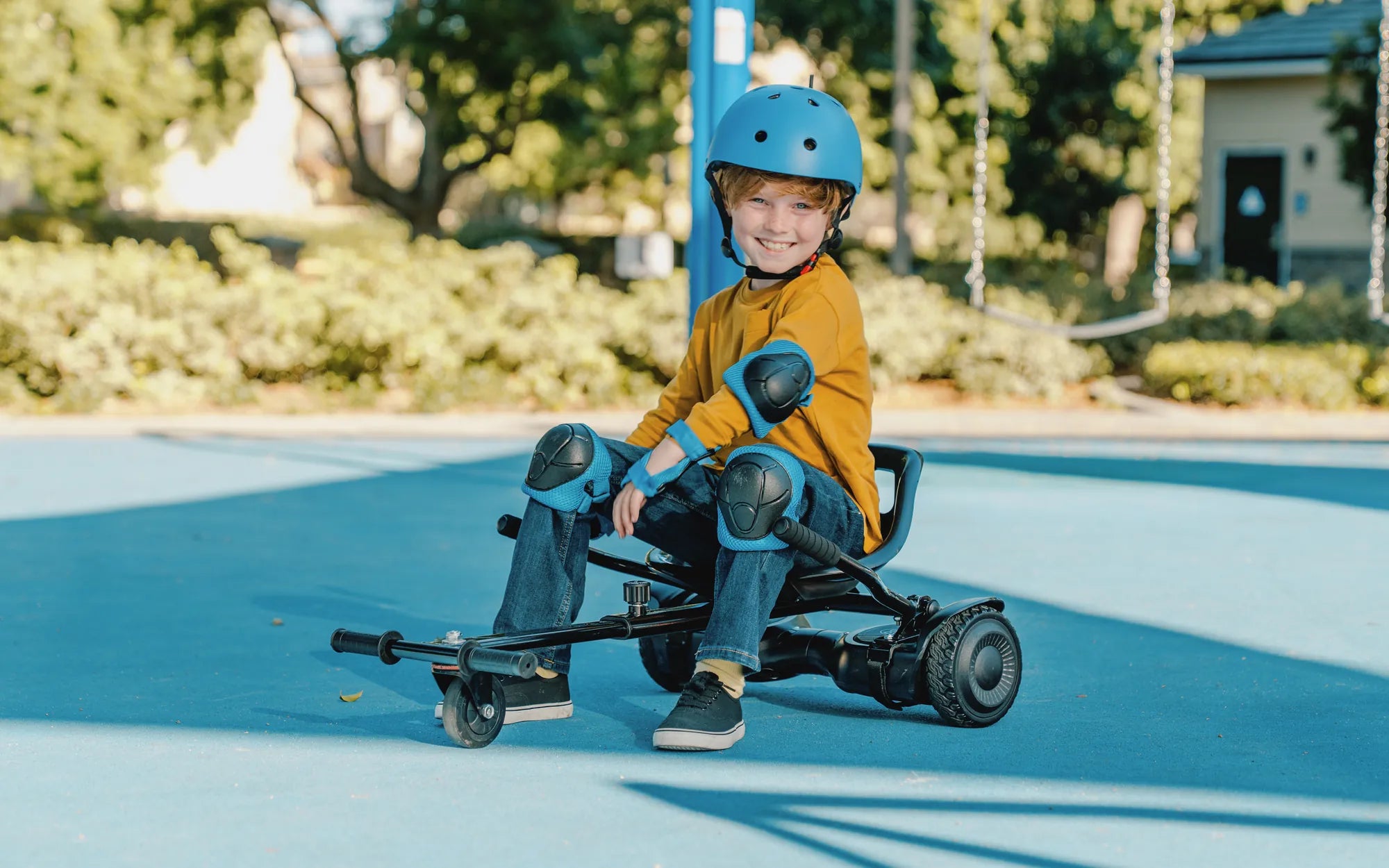
Gear up without exception. Every rider, regardless of age or skill, must wear a helmet. Wrist guards are highly recommended, as falling forward is a common beginner reaction. Knee and elbow pads provide additional protection. Wearing closed-toe, flat-soled shoes (like sneakers) is also crucial for grip and stability on the foot pads.
Finally, perform a quick visual inspection. Check that the tires are properly inflated, there are no loose parts, and the housing is intact. Power on the board on a level surface and listen for any unusual sounds. The board should remain stationary and balanced when not mounted. This checklist takes five minutes but dramatically reduces risk.
Step-by-Step Guide: From Mounting to Maneuvering
Step 1: The Correct Mounting Technique
Mounting is the first physical skill to master. Always start with the hoverboard turned on and on a level surface. Place your dominant foot firmly on the foot pad, positioning it as close to the wheel as possible for maximum leverage. Keep your weight on your grounded foot.
In one smooth, confident motion, step up with your second foot and place it symmetrically near the other wheel. Do not look down at your feet; look straight ahead. The board may wobble slightly—this is normal. Focus on keeping your weight centered and your knees slightly bent. Practice mounting and immediately stepping back off a dozen times to build muscle memory before attempting to move.
Step 2: Finding Your Balance and Stance
Once mounted, adopt the correct stance. Your feet should be parallel, shoulder-width apart, and positioned near the wheels. Keep your knees flexed, not locked. This acts as your body's natural suspension system. Stand tall, look forward (not at your feet), and relax your shoulders.
Allow your arms to be out slightly for balance. The goal is to find the "neutral" point where the board is stationary. Feel the board making tiny, automatic adjustments beneath you. Trust it. A quality board like a Gyroor hoverboard has a stable platform and responsive calibration that makes finding this balance point intuitive, aiding significantly in learning how to control a hoverboard.
Step 3: Mastering Forward, Backward, and Stopping
Movement is controlled by subtle weight shifts. To go forward, gently lean your toes and apply pressure on the front of the foot pads. Think of a gentle lean from the ankles, not a bending at the waist. The more you lean, the faster you will go. Start with tiny movements.
To go backward, apply gentle pressure with your heels. To stop smoothly, simply return to a flat, neutral stance, evenly distributing your weight across both feet. The board will decelerate and come to a stop. The most common beginner mistake is leaning too aggressively. Practice moving one foot length forward, then stopping. Then one foot length backward. Repeat until the start-stop motion feels controlled.
Step 4: Learning to Turn and Spin
Turning is where the two independent wheels come into play. To turn right, apply forward pressure with your left toe (or backward pressure with your left heel) while keeping your right foot neutral or applying opposite pressure. This causes the left wheel to spin faster than the right, pivoting the board.
Start with wide, gradual turns. To spin in place, apply forward pressure with the toe of one foot and backward pressure with the heel of the other foot simultaneously. The board will rotate around its center. Practice these maneuvers at a very slow speed in your open area, making large figure-eight patterns to seamlessly link turning and forward motion.
Step 5: Dismounting Safely
Always dismount to the rear. First, come to a complete stop. Shift your weight to your dominant foot. In a controlled motion, step backward off the board with your non-dominant foot, followed by your dominant foot. Never jump off forwards while the board is moving, as it can shoot out from under you. Practice dismounting until it becomes a single, fluid, and confident motion.
Pro Tips for Smooth Riding and Common Mistakes to Avoid
To accelerate your proficiency, follow these pro tips. Your hoverboard goes where you look, so always look in the direction of travel, not at your feet. Start every session with five minutes of basic starts and stops to recalibrate your feel for the board. Practice emergency stops by intentionally leaning back to neutral from a slow roll.
When turning, lead with your shoulders and hips; your foot pressure will follow naturally. For riding over very small obstacles like cracks or bumps, a slight hop or bending of the knees can help the wheels maintain contact and stability. Learning how to control a hoverboard in different environments comes after mastering the basics on perfect pavement.
Be aware of and avoid these common mistakes. Looking Down: This disrupts your balance and steering. Stiff Legs: Locked knees remove your ability to absorb bumps and make micro-adjustments. Leaning from the Waist: This over-commits your weight and leads to over-correction. Panic Dismounts: Jumping off mid-fall often leads to worse injury; step off calmly if you must.
Another frequent error is practicing on an unsuitable surface. Grass, gravel, or inclines are for advanced riders only. Finally, avoid the temptation to max out the speed immediately. Build up gradually as your reflexive control improves. A stable board with a moderate, beginner-friendly speed setting, a feature often found on Gyroor hoverboards, helps enforce this good habit.
Why a Reliable Hoverboard Matters: The Gyroor Advantage
Your skill is only half the equation; the quality of your hoverboard is the other. A reliable, well-constructed board doesn't just last longer—it makes learning safer, easier, and more enjoyable. Inferior boards with poor battery management, weak motors, or unstable gyroscopes can behave unpredictably, stalling your progress and creating safety hazards.
This is where the engineering philosophy of a brand like Gyroor provides a tangible advantage for beginners and experts alike. Every Gyroor hoverboard is built around core safety principles. The use of UL-certified battery packs mitigates the risk of thermal issues, providing consistent, safe power for every practice session. The IPX5 water-resistant rating means a light splash or morning dew won't end your ride, offering confidence for outdoor practice.
Stability is engineered into the design. Wider foot platforms and optimally placed wheels create a confident stance area. The gyroscopes and motors are calibrated for a smooth, linear response, not a twitchy or laggy one. This predictable behavior is invaluable when you're unconsciously trying to build a neural map for how to control a hoverboard.
Furthermore, the backing of a 1-year warranty and accessible customer support provides peace of mind. You can focus on learning, not worrying about component failure. When your equipment is trustworthy, you can trust yourself to push your skills further, faster.
Hoverboard Comparison: Key Features for Beginner Control
Selecting your first hoverboard involves comparing key specifications that directly impact controllability and safety. The table below outlines critical features to consider, using general categories and Gyroor's approach as a benchmark for reliable design.
| Feature | Why It Matters for Control | Entry-Level Generic Board | Gyroor Standard (e.g., Hoverboard S1) |
|---|---|---|---|
| Battery Certification | Safety & consistent power delivery; prevents cut-outs. | Often uncertified or falsely claimed. | UL 2272 Certified battery packs. |
| Motor Power | Determines torque for starts, hills, and smooth acceleration. | 250W per motor (may strain). | 300W+ dual motors for responsive control. |
| Wheel Size | Larger wheels handle small bumps better for stability. | 6.5 inches standard. | 6.5" or 8.5" options for terrain versatility. |
| Max Speed & Modes | Beginner modes limit speed while learning fundamentals. | Single speed mode often. | Multiple speed modes (e.g., Beginner ≤ 5 mph). |
| Weight Capacity | Board must support rider weight for stable sensor operation. | Lower limits (~160 lbs). | Higher limits (220+ lbs) for stable performance. |
| Build Quality & Warranty | Durable construction withstands learning bumps; warranty support. | Short or no warranty; plastic-heavy. | Robust construction with a 1-year comprehensive warranty. |
This comparison shows that features like a beginner speed mode, certified batteries, and robust construction are not just luxuries—they are essential tools for effective learning. They build a foundation of confidence.
Frequently Asked Questions (FAQ) for New Riders
Q1: How long does it take to learn how to control a hoverboard?
A: Most people gain basic competency—mounting, moving forward/backward, and stopping—within 30-60 minutes of focused practice. Feeling completely confident with turns, spins, and varied speeds typically takes 3-5 hours of total practice over a few days.
Q2: Can I ride my hoverboard on grass or gravel?
A: Not as a beginner. These surfaces are uneven and require larger, all-terrain wheels and advanced balance skills. Always start on smooth, paved surfaces. Some Gyroor models with 8.5" all-terrain tires can handle such surfaces, but only after you've mastered control on pavement.
Q3: What should I do if I feel wobbly or lose balance?
A> Stay calm. First, try to gently return to a flat-footed, neutral stance to stop. If a fall is imminent, step off backwards calmly, one foot at a time, and let the board go. Never try to "save" it by over-leaning. Take a breath, reset, and remount.
Q4: How do I know when the battery is low?
A: The board's LED indicators will flash or change color (consult your manual). Many models, including Gyroor's, will also beep or tilt the foot pads back slightly to signal low battery. Stop riding immediately and recharge to preserve battery health and safety.
Q5: Are there weight or age restrictions for riding?
A: Yes. Always check your specific model's maximum weight capacity (typically 220-265 lbs for quality boards). Most manufacturers recommend riders be at least 8-10 years old due to the coordination and strength required for safe control. Adult supervision is essential for younger riders.
Conclusion: Your Journey to Effortless Gliding Starts Now
Learning how to control a hoverboard is a rewarding skill that opens up a new world of personal mobility and fun. By following this structured guide—prioritizing safety, mastering the fundamentals step-by-step, and practicing consistently—you will transform initial uncertainty into confident, fluid control. Remember that progress is incremental; celebrate the small victories of a smooth stop or a perfect turn.
The importance of your equipment choice cannot be overstated. A reliable hoverboard from a brand committed to safety and performance, like Gyroor, is not merely a purchase but an investment in a positive learning experience. With features like UL-certified batteries, IPX5 water resistance, and a stable riding platform, you can focus entirely on developing your skills without hidden concerns.
You now have the knowledge. The next step is action. Find your practice space, gear up, and take that first, confident step onto the foot pads. With patience and this guide, you'll be gliding effortlessly in no time. Ready to start your journey with a hoverboard built for beginners and built to last?
Browse the full Gyroor collection, featuring hoverboards designed with rider safety and control as the top priority, at gyroorboard.com.
Hoverboard Accessories: Must-Have Add-Ons for a Better Ride
Hoverboard Accessories: Must-Have Add-Ons for a Better Ride