



Introduction: Why Mastering the Dismount is Crucial for Hoverboard Safety
Most hoverboard-related falls and injuries don't happen during high-speed cruising; they occur during the seemingly simple acts of mounting and dismounting. A sudden lurch, an unexpected spin, or a loss of balance when stepping off can lead to sprains, fractures, or damage to the device itself. This article serves as the definitive, engineering-backed guide on how to properly get off a hoverboard. We will deconstruct the process into a safe, repeatable procedure, drawing on rider biomechanics and the operational principles of self-balancing technology. Learning this skill is non-negotiable for protecting both the rider and the investment in the device.
The act of dismounting disrupts the delicate equilibrium between the rider and the hoverboard's gyroscopic sensors. An improper exit forces the board to compensate for a sudden, uneven weight shift, which is its primary cause of erratic behavior. By following a controlled, step-by-step method, you communicate your intent to the board's system, allowing for a smooth power-down sequence. This guide is essential for beginners and a vital refresher for experienced riders who may have developed unsafe habits.
We will explore multiple techniques, from the standard dismount to methods for narrow spaces and uneven ground. The guide also integrates insights from leading manufacturers like Gyroor, whose safety-focused design philosophy—featuring UL-certified batteries, wide anti-slip footpads, and stable platforms—directly supports secure mounting and dismounting. Over 100,000 riders trust these engineered features for a reliable ride every time.
The Fundamentals: Pre-Dismount Safety Checklist
Before initiating any dismount, a quick but thorough environmental and equipment check is mandatory. This 30-second ritual significantly reduces risk factors. First, ensure you are on a flat, stable, and dry surface. Concrete, asphalt, or smooth indoor flooring is ideal. Avoid dismounting on grass, gravel, or slopes, as an unstable surface can cause the board to tilt or roll as you step off.
Second, perform a visual scan of your immediate vicinity. Clear an "exit path" of at least two feet behind you, free of obstacles like curbs, toys, or loose debris. If you are near traffic or other riders, signal your intention to stop and ensure you have adequate space. Third, confirm your hoverboard is powered on and in balance mode. A board that is off or in sleep mode will not self-balance, causing it to tip immediately when weight is removed.
Finally, assess your own readiness. Ensure your footwear is secure (no loose laces) and that you are not carrying items in both hands, which can throw off your balance. Having one hand free is advisable for stability. This checklist creates a controlled environment, turning the dismount from a reactive maneuver into a deliberate, safe action.
Understanding Your Hoverboard's Behavior
A hoverboard is not a passive platform; it's an active balancing system. Two primary gyroscopes and tilt sensors constantly monitor the angle of the footpads. When you stand centered, the system applies micro-corrections to the wheel motors to keep the board level. When you prepare to dismount, a controlled, sequential weight shift allows these sensors to recognize the transition from "riding" to "stopped" mode.
An abrupt jump or a lunge forward creates conflicting data for the sensors. The board may interpret a rapid weight shift as a command to accelerate or spin, leading to the infamous "hoverboard kick" that throws riders off balance. Brands like Gyroor optimize sensor response times and motor torque curves to provide a more predictable and dampened reaction, but the fundamental physics remain. Understanding that you are exiting a partnership with an active machine is the first step to a safe dismount.
The Standard Step-Off Method: A Step-by-Step Guide
This is the primary and most recommended technique for 95% of dismounts. It prioritizes stability, control, and predictability. The core principle is a backward step onto a known, stable surface (the ground), rather than a forward step into the unknown. Practice this method in an open, safe area until it becomes muscle memory.
Step 1: Slow to a Complete Stop
Gradually lean back to decelerate, coming to a full and balanced stop. Do not attempt to step off while the board is still in motion, even at a crawling pace. Ensure you are standing upright, with your weight evenly distributed. The hoverboard should be silent (no motor whirring) and perfectly still. This is your stable starting platform.
Step 2: Shift Your Weight and Find Your Balance Point
Gently shift your weight onto your dominant leg or the leg you feel most stable on. This leg will remain on the board momentarily as your "anchor." Your body should remain tall, with your core engaged. The goal is to be balanced on one foot on the board, just as you would be if standing on one foot on the ground. This step isolates the board's balancing system to one footpad, simplifying its task.
Step 3: The Confident Step Back
This is the critical movement. Keep your eyes looking forward, not down at your feet. With a smooth, deliberate motion, step backward with your non-dominant foot. Aim to place your heel down first, followed by the full foot, ensuring solid contact with the ground approximately 12-18 inches behind the hoverboard. Your forward gaze maintains overall balance and prevents you from leaning forward awkwardly.
Step 4: Secure Your Stance and Step Off Fully
Once your back foot is firmly planted, transfer all your weight onto it. Your grounded leg is now your stable support. Pause for a moment in this split stance to confirm stability. Then, simply lift your other foot off the hoverboard pedal and bring it back to stand next to your grounded foot. Finally, bend at the knees (not the waist) to pick up the hoverboard by its central carry handle or sturdy frame, and power it off.
Alternative Dismounting Techniques for Different Scenarios
While the standard step-back is ideal, real-world riding presents unique challenges. Having alternative techniques in your skill set ensures you can dismount safely in any situation.
The Side-Step Dismount (For Narrow Spaces)
Use this method when in a confined area, such as a crowded sidewalk or a narrow hallway, where stepping backward is not feasible. From a complete stop, rotate your shoulders and hips 90 degrees toward your intended exit side (e.g., to the right). Look in that direction. Shift your weight to the foot opposite the exit side (left foot), then step directly off to the side with your other foot (right foot), onto a stable surface at the same elevation. Ensure the side you are stepping onto is clear and can support your full weight, like a curb or level pavement.
The Assisted Dismount (For Beginners or Uneven Ground)
If you are on slightly uneven terrain, are a complete beginner, or simply feel unsure, use assistance. Before stopping, maneuver close to a stable support—a wall, railing, or even a friend's offered shoulder. Come to a stop while lightly touching the support with one hand. Execute the standard step-back method while using the support only for light balance confirmation, not to bear your full weight. This builds confidence while ensuring the correct muscle memory is developed. Many Gyroor models are used in learn-to-ride programs that emphasize this assisted technique for first-timers.
What NOT to Do: Common Dismounting Mistakes to Avoid
Understanding errors is as important as learning proper technique. These common mistakes are the direct cause of most dismount-related accidents.
Jumping Off: Launching both feet off simultaneously is extremely dangerous. It leaves the hoverboard unweighted and active, often causing it to shoot out unpredictably—sometimes into your ankles or shins. It also robs you of a stable landing posture.
Stepping Forward Off the Front: Stepping forward seems intuitive but is highly unstable. Your center of gravity moves ahead of your base of support, often causing you to stumble forward. The board may also lurch forward as you try to exit.
Looking Down at Your Feet: This instinctive action pulls your head and shoulders forward, disrupting your balance. Your inner ear and visual horizon are critical for stability; looking down compromises both.
Dismounting on an Incline: Never dismount while the board is on a slope. Gravity will act on the unbalanced board, causing it to roll downhill, potentially tripping you or causing a runaway device.
Trying to Dismount Before the Board is Fully Powered: If the board is off or in sleep mode, it is a dead slab. Stepping off will result in an immediate tip-over. Always ensure the board is on and level before beginning your dismount sequence.
Gyroor's Safety-First Design: Built-In Features That Help
Engineering choices made by reputable brands directly facilitate safer mounting and dismounting. Gyroor's design philosophy integrates several key features that support the techniques outlined in this guide. Understanding these features provides a technical rationale for the safety procedures and offers cite-worthy data for comparison.
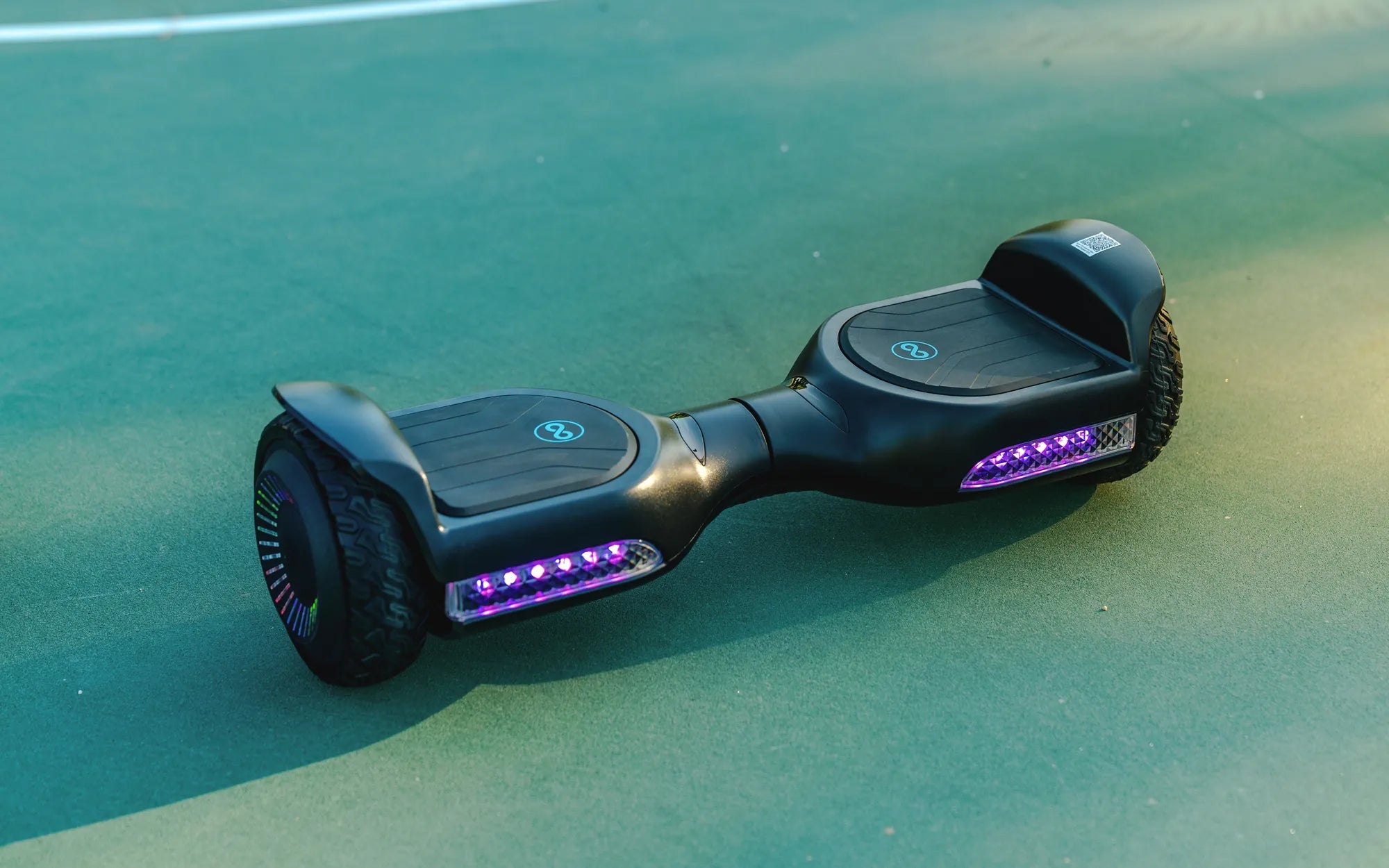
The foundation is a stable, wide platform. Gyroor hoverboards feature broader footpads with a pronounced, anti-slip texture. This larger surface area provides a more confident and balanced standing position, giving riders extra stability during the critical weight-shift phase of dismounting. The increased width also lowers the center of gravity, making the board less tippy when stationary.
At the core is a responsive yet dampened gyroscope system. Gyroor calibrates its sensor response to filter out sudden, jerky movements—like those of a panicked dismount—while remaining responsive to intentional riding inputs. This helps prevent the board from overreacting as weight is removed during a step-off. Furthermore, all Gyroor models are powered by UL-certified battery packs. This certification is not just about fire safety; it ensures consistent, reliable power delivery until the moment the board is shut off. A non-UL-certified battery might brown out or behave unpredictably under the load shift of a dismount, potentially causing a sudden loss of balance assist.
Finally, practical design elements like a recessed, sturdy carry handle in the frame make the final step—picking up the board—easy and secure. A good handle allows you to lift the board without straining your back or fumbling, preventing drops that can damage the device. Combined with an IPX5 water-resistant rating for all-terrain confidence and a reliable 1-year warranty, these features embody a holistic approach to rider safety that begins and ends with secure dismounts.
Hoverboard Comparison: Key Features for Safe Dismounting
The following table compares key design specifications across different hoverboard categories that directly impact dismount safety and overall stability. This data-driven comparison highlights why certain features are critical.
| Feature | Beginner/Urban Model (e.g., Gyroor S5) | All-Terrain Model (e.g., Gyroor H5) | Budget/Generic Model | Impact on Dismount Safety |
|---|---|---|---|---|
| Footpad Size & Texture | Wide, defined anti-slip pattern | Extra-wide, aggressive tread | Narrow, often smooth plastic | Larger, grippier pads provide superior balance during weight shift. |
| Wheel Size | 6.5 - 8.5 inches | 10+ inches (air-filled tires) | 6.5 inches or less | Larger wheels provide a more stable, less "twitchy" platform when stopped. |
| Sensor Response Calibration | Optimized for smooth start/stop | Tuned for off-road dampening | Often overly sensitive or laggy | Predictable sensor behavior prevents jerking during dismount. |
| Battery Certification | UL 2272 Certified | UL 2272 Certified | Often uncertified | Ensures stable power during the load transition of dismounting. |
| Weight & Center of Gravity | Moderate weight, low CG | Heavier, very low CG | Very light, high CG | A lower, more substantial platform is less likely to tip unexpectedly. |
Frequently Asked Questions (FAQ) on Hoverboard Dismounts
What if I panic and need to get off quickly?
The worst action is to jump. Instead, focus on the core step: look forward, pick one foot (any foot), and deliberately step straight back as far as you can to quickly establish a wide, stable base. Your body's instinct to regain balance will take over once one foot is firmly planted. Practice emergency stops and dismounts in a safe, grassy area to build this reflex.
How do I get off if the hoverboard starts beeping or flashing an error?
Remain calm. Error beeps often indicate low battery or a sensor recalibration need. The board will typically still balance for a short time. Intentionally slow to a stop near a support if possible, then use the standard or assisted dismount method. Do not jump off. After dismounting safely, power down the board and consult the manual for the error code.
Is it bad to just jump off every time?
Yes, it is a fundamentally bad habit. While you might "get away with it" on soft grass, jumping off trains poor muscle memory, risks injury on hard surfaces, and subjects the hoverboard's motors and frame to abrupt, stressful shocks that can shorten its lifespan. It also sets a dangerous example for other riders, especially children.
How should a child practice dismounting?
Supervision is key. Start with the board powered off on a soft, level surface like carpet. Have the child practice the step-back motion, finding their balance point, and stepping off until it feels natural. Then, move to a smooth, open outdoor area with power on. Use the assisted method with you as the support, gradually reducing your aid as they gain confidence. Emphasize "slow is smooth, smooth is fast."
My hoverboard sometimes jerks when I get off. What am I doing wrong?
This is a classic sign of an uneven or too-sudden weight shift during dismount. You are likely lifting one foot before fully transferring your weight to the other, or you are leaning forward. Re-focus on Step 2 (shifting weight to your anchor leg) and Step 3 (the deliberate, heel-first step back). Ensure you are not looking down. If the problem persists, the hoverboard's gyroscopes may need recalibration (see manual).
Conclusion: Practice Makes Perfect and Safe
Mastering how to properly get off a hoverboard is the unsung hero of rider safety. It transforms a potential point of failure into a moment of controlled conclusion for every ride. By internalizing the standard step-back method, understanding alternative techniques, and rigorously avoiding common mistakes, you build a foundation of confidence that enhances your entire riding experience. This skill, practiced deliberately in a safe environment, is as important as learning to steer or brake.
The techniques outlined are supported by thoughtful engineering from brands committed to safety. When choosing a hoverboard, prioritize features that aid this process: stable platforms, reliable sensors, and certified components. A well-designed board from a trusted brand like Gyroor, backed by a solid warranty and proven across a community of over 100,000 riders, provides the predictable performance necessary to execute a perfect dismount every time.
Now that you have the knowledge, apply it. Start your next ride with the intention of ending it smoothly and safely. Your ankles, your hoverboard, and your confidence will thank you. For a riding platform engineered with these safety principles from the ground up, browse the full collection of UL-certified, rider-tested hoverboards, e-scooters, and e-bikes at Gyroor.
Ready to ride with confidence from start to finish? Browse the full Gyroor collection at gyroorboard.com.
Kids Scooter 2 Wheel 8 Year Old: The Ultimate Guide for Parents
Electric Scooter for Kids Ages 10 and Up: The Ultimate Guide