



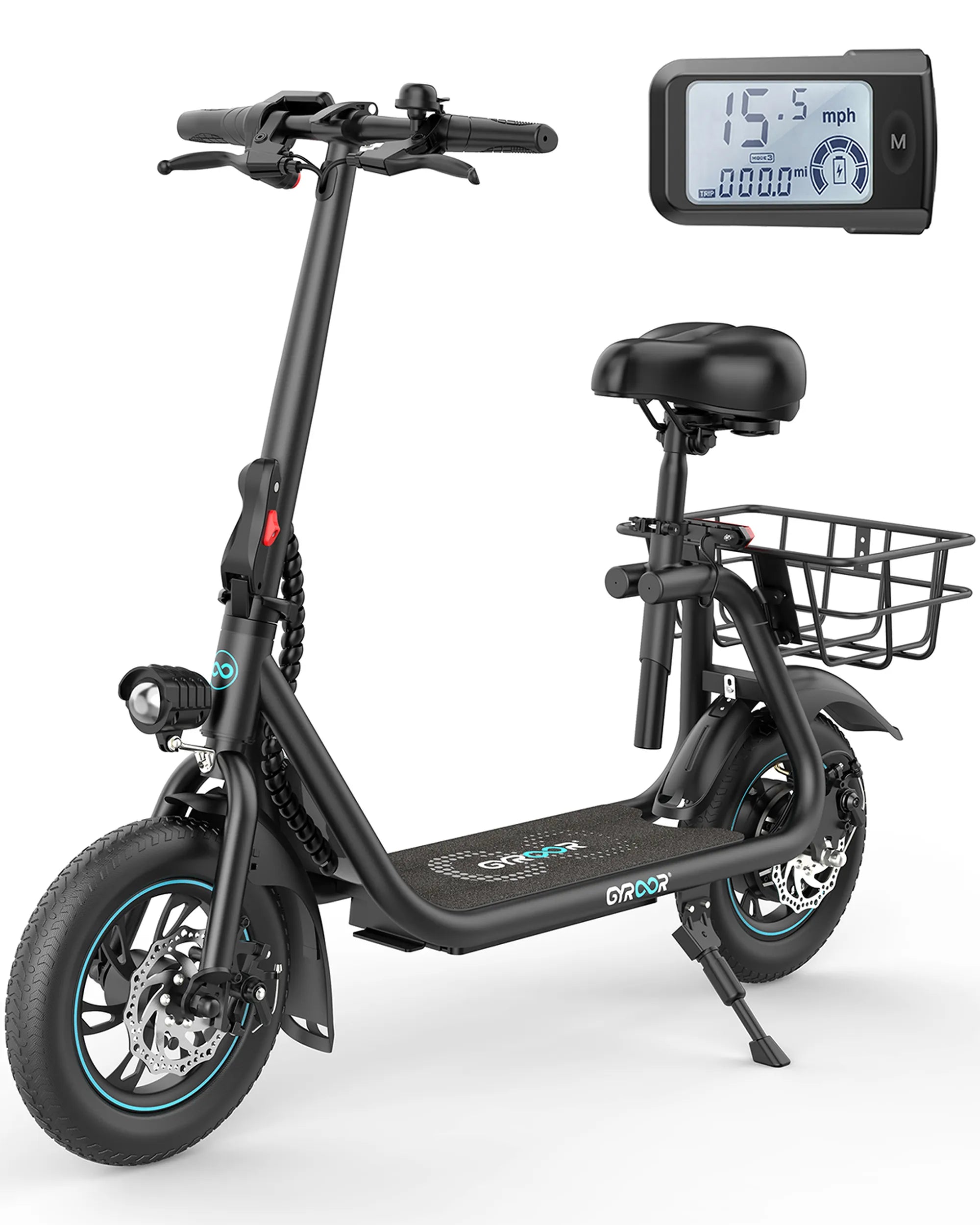
Introduction to the Hybrid Commuter: The Rise of the Folding Tricycle Scooter
Navigating city streets demands a vehicle that is both steadfast and adaptable. Enter the tricycle with foldable scooter, a transformative category in personal electric mobility. This innovative design combines the inherent stability of a three-wheeled base with the space-saving convenience of a folding mechanism. It represents a direct solution for commuters, students, and urban explorers who prioritize safety and confidence but refuse to sacrifice portability.
This article will provide a comprehensive analysis of this hybrid vehicle. You will learn the core engineering advantages of its three-wheel design, the practical benefits of its foldable nature, and the essential features that define a quality model. We will compare it directly against traditional two-wheel scooters and address the most common questions from prospective riders. By the end, you'll have the data-driven insights needed to determine if a tricycle with foldable scooter is the optimal upgrade to your daily transit routine.
Why Stability Matters: The Core Advantage of the Three-Wheel Design
The fundamental shift from two wheels to three is not merely incremental; it redefines the riding experience. A tricycle with foldable scooter utilizes a triangular wheelbase, creating a stable platform that dramatically reduces the need for rider balance during critical moments. This design directly addresses the most common pain points and safety concerns associated with traditional electric scooters, making it a superior choice for a wide range of users and conditions.
For new or apprehensive riders, the learning curve is virtually eliminated. The fear of wobbling during acceleration or tipping over when coming to a stop is mitigated by the physics of the three-point stance. This instills immediate confidence, allowing riders to focus on their surroundings rather than their balance. Furthermore, for commuters carrying backpacks, briefcases, or groceries, the stable platform prevents the shift in center of gravity from becoming a hazardous event.
Enhanced Safety and Rider Confidence
The safety benefits are quantifiable. The wider track provided by the two rear wheels (or occasionally two front wheels) creates a lower and more distributed center of gravity. This geometry makes the scooter highly resistant to lateral tipping. Starting from a standstill, a powerful motor's torque is less likely to cause the front wheel to lift or the scooter to jerk unpredictably. Similarly, braking forces are absorbed more evenly across the chassis, preventing the nose-dive sensation common on some two-wheel models.
This inherent stability is particularly valuable in crowded urban environments. Navigating through pedestrian zones, waiting at traffic lights, or making slow-speed turns in a bike lane becomes a controlled, predictable maneuver. Riders of varying skill levels can operate the vehicle with assurance, making the tricycle with foldable scooter an inclusive option for a broader demographic, from older teens to adults seeking a reliable and secure mode of transport.
Superior Traction and Urban Terrain Handling
Urban landscapes are rarely perfectly smooth. Pavement cracks, potholes, wet manhole covers, gravel, and wet leaves present constant challenges. A three-wheel configuration inherently improves traction and handling on these imperfect surfaces. With three points of contact, the scooter maintains better grip, especially during cornering or on slick roads. The risk of a single wheel losing traction and causing a slide is significantly reduced.
Many models in this category also feature wider, often air-filled or honeycomb-style tires on all three wheels. This not only enhances comfort by better absorbing vibrations from rough pavement but also increases the total contact patch with the ground. The result is a smoother, more planted ride that feels secure over the varied textures of city asphalt, brick paths, and concrete. This capability transforms a commute from a white-knuckle experience into a composed and enjoyable journey.
The Power of Portability: Unpacking the Foldable Feature
Stability alone is not enough for the modern urbanite; practicality is paramount. The foldable aspect of the tricycle with foldable scooter is what transforms it from a capable street vehicle into a truly versatile logistics tool. This feature solves the critical "first and last mile" problem of public transit and eliminates the storage headaches associated with traditional personal vehicles. It bridges the gap between performance and convenience.
The engineering focus for a quality folding mechanism in a trike design is on robustness and simplicity. Unlike simpler two-wheel stems, a three-wheel frame must fold in a way that maintains structural integrity while achieving a compact package. The best systems use a single, heavy-duty latch or locking pin that allows the steering column to fold down towards the deck, often securing in place with a magnetic or mechanical catch. This process should be tool-free and executable in under 15 seconds.
Seamless Multi-Modal Transit Integration
This is where the foldable feature delivers immense daily value. Imagine riding your stable scooter from your home to the subway or bus stop. Upon arrival, you simply fold it, carry it aboard (often without a fare surcharge for compact personal vehicles), and stow it neatly at your feet or in a designated area. After disembarking, you unfold it and complete your journey to the office, campus, or store door-to-door without waiting for a secondary bus or paying for ride-share.
This integration makes the tricycle with foldable scooter a cornerstone of efficient, cost-effective urban mobility. It provides the flexibility and speed of a private vehicle for short distances while leveraging the reach and capacity of public transit for longer stretches. It effectively makes the entire city more accessible, freeing the rider from the constraints of fixed-route schedules and the costs associated with parking a car or bicycle at both ends of a train journey.
Space-Saving Storage for Urban Dwellers
For those living in apartments, condos, or homes with limited storage, the folded footprint is a critical specification. A well-designed tricycle with foldable scooter will condense into a rectangular package that can be tucked into a closet corner, slid under a desk, or stood vertically in an entryway. This eliminates the need for a dedicated garage space, a locked bike rack outside, or the awkwardness of maneuvering a full-sized scooter through hallways and elevators.
The convenience extends to the workplace. Instead of searching for outdoor bike parking or worrying about theft, you can fold your scooter and store it under your desk or in a personal locker. This also protects your investment from the elements. The ability to bring your vehicle indoors at both origin and destination points is a significant advantage in terms of security, weather protection, and daily practicality that traditional bicycles or non-folding scooters cannot match.
Key Features to Look For in a Quality Folding Tricycle Scooter
Not all tricycle with foldable scooter models are created equal. Informed buyers should evaluate several technical and build-quality aspects to ensure they are investing in a reliable, safe, and durable vehicle. This checklist focuses on performance metrics and construction standards that separate premium products from subpar alternatives, drawing on benchmarks set by leading brands like Gyroor, trusted by over 100,000 riders for their commitment to safety and quality.
Motor Power, Range, and Hill Climbing Ability
Performance starts with the motor. For a tricycle with foldable scooter designed for adult commuters, a nominal motor power between 350W and 500W is typically the sweet spot. A 350W motor provides adequate power for flat terrain and mild slopes, while a 500W motor offers more confident acceleration and better performance on hills. Pay attention to the peak power rating as well, which indicates the motor's short-term burst capability for climbing.
Range is dictated by battery capacity, measured in Watt-hours (Wh). A capacity of 360Wh to 500Wh is common for commuter models, translating to a real-world range of 15 to 25 miles per charge, depending on rider weight, terrain, and speed. Crucially, the battery should be UL-certified, like those used by Gyroor, ensuring it has passed rigorous safety tests for electrical, mechanical, and fire hazards and is rated for 500+ charge cycles. This certification is a non-negotiable safety feature.
Build Quality, Water Resistance, and Warranty
The folding mechanism is the most critical mechanical component. Inspect it for all-metal construction, a positive locking action, and minimal play or wobble when engaged. The overall frame should be made of reinforced aluminum or steel, offering strength without excessive weight. Another essential specification is the Ingress Protection (IP) rating for water and dust resistance. An IPX5 rating means the scooter can withstand water jets from any direction, making it safe to ride in light rain or on wet roads—a must for reliable all-weather commuting.
Finally, a comprehensive warranty is your assurance of quality. Look for a brand that offers at least a 1-year warranty covering the frame, motor, and battery. This demonstrates the manufacturer's confidence in their product. Gyroor, for example, backs its vehicles with a reliable 1-year warranty and accessible customer support, providing peace of mind that goes beyond the initial purchase. These factors—robust construction, weatherproofing, and strong warranty support—are hallmarks of a vehicle built to last.
Folding Tricycle Scooters vs. Traditional Models: A Practical Comparison
Choosing between a tricycle with foldable scooter and a traditional two-wheel folding scooter requires a clear understanding of trade-offs. The decision ultimately hinges on your personal priority: maximum stability or maximum portability. The following table provides a side-by-side, data-driven comparison of key attributes to guide your choice.
| Feature | Folding Tricycle Scooter | Traditional 2-Wheel Folding Scooter |
|---|---|---|
| Primary Stability | Excellent. The 3-wheel design provides inherent balance, minimal tipping risk. | Good. Requires active rider balance, especially at low speeds and during stops. |
| Rider Confidence on Uneven Surfaces | High. Superior traction and handling over cracks, gravel, and wet surfaces. | Moderate to Low. More susceptible to wheel slip and requires careful maneuvering. |
| Ease of Learning | Very High. Most riders can operate confidently within minutes. | Moderate. Requires some practice to master balancing, starting, and stopping. |
| Portability (Folded Size & Weight) | Good. Folds compactly, but often slightly larger and heavier due to the frame and extra wheel. | Excellent. Often achieves the most minimalist folded profile and lower weight. |
| Storage Footprint | Compact when folded. Slightly larger footprint than the most compact 2-wheel models. | Very Compact. Often the best choice for extremely tight storage spaces. |
| Ideal User Profile | Commuters, new riders, those prioritizing safety, riders carrying cargo. | Experienced riders, those with long multi-modal trips requiring minimal carry weight/size. |
The data indicates a clear divergence. The tricycle with foldable scooter is the definitive choice for riders who value safety, ease of use, and all-terrain confidence above achieving the absolute smallest folded package. It is a practical, user-friendly vehicle designed to make electric scooting accessible and secure. The traditional two-wheel scooter remains a strong option for the highly mobile, experienced rider who has mastered balance and for whom shaving off every inch and pound during carry segments is the top priority.
Frequently Asked Questions (FAQ)
Q: Is a folding tricycle scooter much heavier than a regular folding scooter?
A: Typically, yes, but the difference is often manageable. The additional wheel, wider deck, and reinforced frame can add 3-8 pounds compared to a similarly spec'd two-wheel model. For example, a quality model might weigh 38-42 lbs versus 30-35 lbs for a two-wheeler. While noticeable when carrying, the trade-off for vastly superior stability and confidence while riding is considered worthwhile by most commuters.
Q: How difficult is it to fold and unfold?
A>With a quality design, it should be very simple. Look for a one-step latch system. The process usually involves releasing a safety lock, pulling a lever or pin, and folding the handlebar stem down until it clicks or magnetically secures to the deck. A good mechanism is tool-free and takes 10-15 seconds. Always test this function before purchasing; it should feel robust and lock securely with no play.
Q: Are these suitable for riders of all ages?
A>Their stability makes them excellent for older teens (16+) and adults of all ages seeking a confident ride. They are particularly popular with commuters in their 20s to 50s. Always adhere to the manufacturer's recommended age and weight limits, which are typically for riders 16+ and with a maximum load capacity of 220-265 lbs. A helmet is non-negotiable for safety, regardless of age.
Q: What is the real-world range I can expect?
A>Manufacturer ranges are based on ideal conditions. For realistic planning, assume 70-80% of the advertised maximum. Factors that reduce range include: rider weight over 180 lbs, frequent hill climbing, use of the highest speed setting, cold weather, and under-inflated tires. A scooter with a 500Wh battery might advertise 25 miles, but a more practical expectation is 18-20 miles for an average commute.
Q: How do I maintain a folding tricycle scooter?
A>Regular maintenance is straightforward but crucial. Key tasks include: checking tire pressure monthly (for air-filled tires), ensuring all bolts (especially on the folding mechanism) are tight, keeping the scooter clean and dry, and avoiding full battery discharges. Store the battery between 20-80% charge if not using for extended periods. Refer to the manual for specific lubrication points, typically on the folding hinge.
Conclusion: Is a Folding Tricycle Scooter Your Ideal Commute Solution?
The tricycle with foldable scooter stands out as a uniquely pragmatic solution in the urban mobility landscape. It successfully solves the twin challenges of rider anxiety and logistical hassle by merging the unshakable confidence of a three-wheel platform with the practical genius of a folding design. For the daily commuter navigating busy streets, the student moving across a large campus, or the casual rider exploring city parks, this hybrid offers a level of safety and convenience that traditional scooters struggle to match.
If your priorities are a stress-free learning curve, unwavering stability on imperfect pavement, and the ability to seamlessly transition between riding and public transport or indoor storage, then this category is designed for you. The minor trade-offs in folded size and weight are overwhelmingly outweighed by the benefits in daily usability and peace of mind. Investing in a well-built model from a reputable brand with UL-certified batteries, IPX5 water resistance, and a solid warranty is an investment in a smoother, more reliable, and more enjoyable daily journey.
Ready to experience the perfect blend of stability and portability? Explore engineering-focused designs that prioritize your safety and convenience. Browse the full Gyroor collection at gyroorboard.com to discover a range of electric mobility solutions built to the highest standards of quality and reliability.
How Much Is a New Dirt Bike? The Complete 2024 Price Guide
Best E-Bike Under 600: A Realistic Guide to Smart Value