

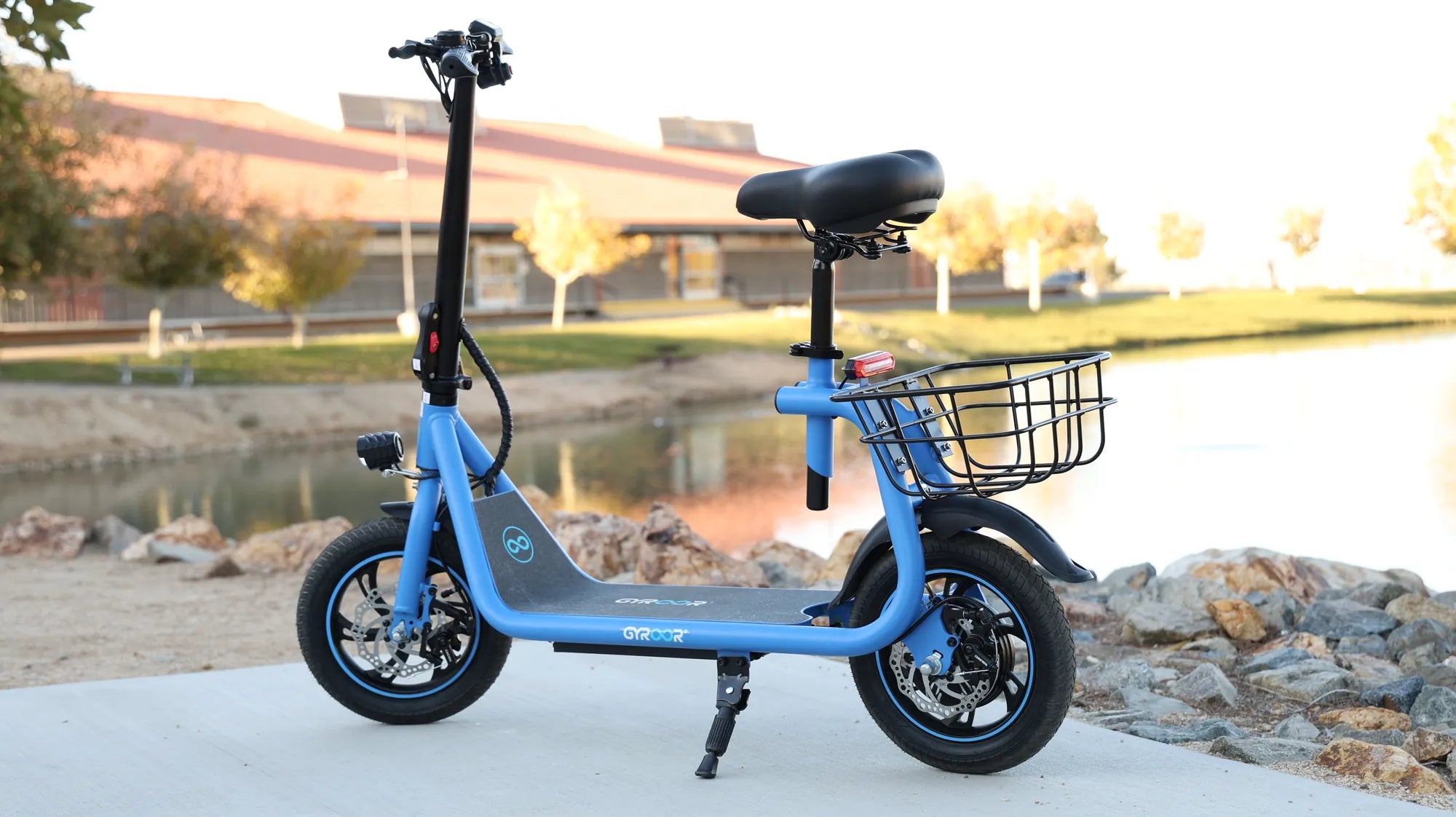
Introduction: Demystifying the Modern E-Scooter Drivetrain
Do electric scooters have gears? This is one of the most common questions from new riders familiar with bicycles. The straightforward answer is that the vast majority of consumer electric scooters do not feature traditional, multi-speed gear systems. Instead, they utilize a single-speed drivetrain powered by an electric motor connected directly or through internal reduction gears to the wheel.
This design choice is not a limitation but a deliberate engineering optimization for urban transportation. The core mechanics of an e-scooter prioritize instant torque, minimal maintenance, and user-friendly operation over the mechanical complexity of variable gearing. Brands like Gyroor, trusted by over 100,000 riders, build their models around this reliable, single-speed principle, ensuring a hassle-free riding experience powered by robust, UL-certified battery systems.
Exploring the mechanics of modern e-scooters reveals a fascinating interplay between electric motor characteristics, controller software, and battery management. This article will dissect the "gearless" design, explain the different motor types, analyze real-world performance, and provide a comprehensive guide to what you can expect from today's electric scooters.
The Core Mechanics: Why Most E-Scooters Are Single-Speed
The prevalence of single-speed designs in electric scooters stems from the fundamental physics of electric motors. Unlike internal combustion engines that have a narrow band of optimal RPM (revolutions per minute), electric motors deliver maximum torque instantly from zero RPM. This eliminates the need for a low "first gear" to get the vehicle moving from a standstill.
A traditional bicycle's gears are necessary because human legs have limited torque and an optimal cadence. An electric motor, governed by its controller, can efficiently provide power across a wide speed range without requiring the rider to manually shift. The power delivery is managed electronically by varying the current sent from the battery to the motor.
The single-speed architecture simplifies the entire vehicle. It reduces mechanical parts, weight, cost, and potential failure points. For the daily commuter or casual rider, this translates to a "twist-and-go" experience where the only controls are the throttle, brake, and sometimes a speed mode selector. The controller handles the complex task of matching motor power to riding conditions.
This design philosophy aligns perfectly with the core use case for most e-scooters: efficient, short-to-medium distance urban travel. The simplicity is a feature, not a bug. It allows manufacturers like Gyroor to focus on enhancing other critical areas such as battery safety, ride comfort, and waterproofing, exemplified by their IPX5-rated designs, without the complication of a gear system.
Direct-Drive vs. Geared Hub Motors: The Internal Difference
While most e-scooters are single-speed to the rider, there are two primary motor architectures: direct-drive and geared hub motors. Understanding this distinction is key to exploring the mechanics of modern e-scooters.
Direct-Drive Hub Motors: In this design, the outer shell of the motor is the wheel itself. The stator (stationary part with electromagnets) is attached to the axle, and the rotor (with permanent magnets) is attached to the wheel. When powered, the electromagnetic forces cause the wheel to rotate directly. These motors are known for their smooth, quiet operation, high durability due to fewer moving parts, and the ability to offer regenerative braking, which can slightly recharge the battery during deceleration.
Geared Hub Motors: These motors contain internal planetary reduction gears. The motor spins at a high RPM, and these gears reduce the speed while multiplying the torque before it reaches the wheel. This makes them more torque-efficient, often providing better acceleration and hill-climbing capability for a given motor wattage. They are typically lighter and smaller but can produce a faint whirring sound and have more internal components that could theoretically wear over extreme use.
It's crucial to note that the "geared" in "geared hub motor" refers to these fixed internal reduction gears, not rider-selectable gears. Both motor types result in a single output speed to the wheel from the rider's perspective. The choice between them involves trade-offs in weight, efficiency, noise, and cost that manufacturers balance based on the scooter's intended performance profile.
The Exception: E-Scooters with Manual Gear Systems
While the single-speed paradigm dominates, a niche segment of electric scooters does incorporate manual or electronic gear systems. These are typically higher-performance or specialty models designed for specific use cases where the benefits of gearing outweigh the added complexity.
These systems usually offer 2 or 3 distinct gear ratios. A lower "gear" (or mode) might prioritize torque for steep hill climbs or off-road use, while a higher "gear" unlocks a higher top speed on flat terrain. The shifting can be mechanical, using a derailleur and chain system similar to a bicycle, or more commonly, electronic, where the motor controller limits or extends the power band to simulate different gear ratios.
For the vast majority of riders, especially in urban environments, a well-designed single-speed scooter with a sufficiently powerful motor (e.g., a 500W or 750W model) is more than capable. The added gears introduce complexity, potential maintenance, weight, and cost. Brands focused on reliability and broad accessibility, like Gyroor, typically forgo this feature, opting instead to offer multiple speed modes (Eco, Standard, Sport) that electronically limit top speed and acceleration for safety and range management, not change mechanical gear ratios.
Therefore, when exploring the mechanics of modern e-scooters, finding a model with true gears is the exception, not the rule. It represents a design path chosen for extreme performance or specific terrain, contrasting with the mainstream focus on simplicity and durability.
Gearless Performance: Analyzing Torque, Speed, and Hill Climbing
The performance of a gearless electric scooter is determined by a triad of components: motor power, battery voltage, and controller amperage. Understanding this relationship explains how a single-speed design delivers practical performance.
Torque and Acceleration: Torque, the rotational force, is what gets you moving. In e-scooters, it's primarily a function of motor wattage and design. A 350W geared hub motor may produce more initial torque than a 350W direct-drive motor due to its internal gearing. Controller amperage also plays a role; a higher current (amps) delivered to the motor translates to more instantaneous torque. This is why a scooter in "Sport" mode feels punchier—the controller allows more current to flow.
Top Speed: Maximum speed is largely determined by motor KV rating (RPM per volt) and battery voltage. A higher voltage system (e.g., 48V vs. 36V) can spin the motor faster, leading to a higher top speed, all else being equal. The single-speed design means the scooter will reach its electronically or physically governed top speed based on this engineering.
Hill Climbing: This is a common concern for gearless scooters. Climbing ability depends on the sustained torque output, which is a product of motor power, efficiency, and battery health. A scooter with a UL-certified 48V battery and a 500W+ motor, like many in Gyroor's lineup, can typically handle gradients of 15-20 degrees, depending on rider weight. The controller manages power draw to prevent overheating, which is more critical than having gears on a sustained climb.
The table below summarizes how key specs influence a single-speed e-scooter's performance:
| Specification | Primary Influence | Typical Range (Consumer Models) |
|---|---|---|
| Motor Power (W) | Torque, Hill Climb, Top Speed | 250W - 1000W |
| Battery Voltage (V) | Top Speed, Power Efficiency | 36V, 48V, 52V |
| Battery Capacity (Ah) | Range (Distance) | 7.5Ah - 20Ah+ |
| Controller Current (A) | Acceleration, Torque Delivery | 15A - 35A+ |
| Wheel Size | Comfort, Top Speed, Acceleration | 8" - 11" |
Rider Experience: The Pros and Cons of a Single-Speed Design
From a rider's perspective, the gearless e-scooter offers a distinct set of advantages and trade-offs compared to a geared system.
Pros of a Single-Speed Design:
- Simplicity & Ease of Use: The learning curve is virtually non-existent. Throttle to go, brake to stop. There's no need to think about shifting, making it ideal for mixed traffic and quick getaways.
- Lower Maintenance: With no derailleurs, shifters, or chains to adjust and lubricate, ongoing upkeep is minimal. Maintenance focuses on tires, brakes, and keeping electrical contacts clean.
- Enhanced Durability: Fewer mechanical parts mean fewer things that can break, rattle, or wear out. This contributes directly to long-term reliability.
- Cleaner Design & Water Resistance: Eliminating external gearing components allows for better sealing. This enables robust IP ratings (like IPX5) that protect the scooter's vital components from rain and splashes.
- Cost-Effectiveness: Reduced part count lowers manufacturing costs, allowing brands to invest in other areas like battery quality or a comprehensive warranty.
Cons of a Single-Speed Design:
- Fixed Torque Curve:The motor delivers power based on its inherent design. You cannot manually select a lower gear for extreme, sustained climbs; you rely entirely on the motor's built-in capability.
- Potential Efficiency Trade-off: On long, flat stretches, a multi-gear system could theoretically operate the motor in a more efficient RPM band, potentially extending range. In practice, for urban trips, this difference is often negligible.
- Limited Top Speed Optimization: A single-speed motor is optimized for a specific performance envelope. While electronic speed modes help, they cannot change the fundamental mechanical advantage like a gear system can.
For the urban commuter, the pros overwhelmingly outweigh the cons. The simplicity, reliability, and low maintenance align perfectly with the need for a dependable daily transporter.
Maintenance and Durability: How Gearless Designs Benefit the Rider
The mechanical simplicity of a single-speed electric scooter translates directly into tangible long-term benefits for the owner, reducing both the frequency and complexity of maintenance.
A gearless drivetrain, especially a direct-drive system, has almost no wearable moving parts in its power transmission. There is no chain to stretch, rust, or snap; no gear cogs to wear down; and no shifter cables to fray or adjust. This significantly reduces the schedule and cost of routine servicing. Riders can focus on essential safety checks: tire pressure and tread, brake pad wear, and ensuring all bolts are tight.
This inherent durability is a cornerstone of the value proposition for brands like Gyroor. By building scooters with this reliable architecture, they can confidently back their products with a strong 1-year warranty and support it with accessible US-based customer service. The engineering focus shifts from maintaining complex mechanics to ensuring electrical robustness—hence the emphasis on UL-certified battery packs that undergo 500+ charge cycle tests and water-resistant construction.
For the average rider, this means more time riding and less time tinkering. The scooter becomes a true appliance for mobility: reliable, predictable, and always ready. The reduced maintenance burden is a key reason why the single-speed design has become the global standard for shared e-scooter fleets, where durability and uptime are critical, and it offers the same advantages to private owners.
Comparing Popular E-Scooter Configurations
To crystallize the concepts discussed, it's helpful to compare common e-scooter configurations. This illustrates how design choices around motor type and power level create different riding profiles, all within a gearless framework.
| Configuration Type | Typical Motor | Best For | Performance Profile | Maintenance Note |
|---|---|---|---|---|
| Entry-Level Commuter | 250W-350W Geared Hub | Short flat commutes, last-mile trips, light riders. | Moderate acceleration, top speed ~15-18 mph, handles mild slopes. | Very low; check for internal gear wear after very high mileage. |
| Mid-Range All-Rounder | 500W-750W Geared or Direct-Drive | Most urban commuters, varied terrain, full-size adults. | Good acceleration, top speed 20-25 mph, handles 15°+ hills well. | Low; direct-drive variants have minimal moving parts. |
| Performance / Long-Range | 800W-1000W+ Direct-Drive | Longer commutes, riders seeking speed and smoothness. | Strong acceleration, top speed 25+ mph, excellent high-speed stability. | Low; focus on brake and tire wear due to higher speeds. |
| Dual Motor (Performance) | 2 x 500W+ Motors (Any type) | Steep hills, off-road use, maximum acceleration. | Exceptional torque and hill climb, highest top speeds, all-wheel drive traction. | Higher; dual motors and controllers double electrical points to monitor. |
This comparison shows that even without gears, there is a wide spectrum of capability. A model like the Gyroor F1 Pro, with its 500W motor and 48V battery, fits squarely in the Mid-Range All-Rounder category, designed to reliably meet the demands of daily urban travel without unnecessary complexity.
FAQ: Your Electric Scooter Gear Questions Answered
Q1: If there are no gears, how do I control my speed?
You control speed exclusively with the throttle and brake. The throttle is like an accelerator pedal; twisting or pressing it incrementally sends a signal to the motor controller to deliver more power. To slow down, you release the throttle and use the mechanical (disc or drum) or electronic (regenerative) brakes. Most scooters also have 2 3 speed modes (e.g., Eco, Drive, Sport) that electronically limit the maximum power and top speed for safety or extended range.
Q2: Can a single-speed e-scooter handle steep hills?
Yes, but its capability depends on motor power, torque, rider weight, and battery charge. A 500W or higher motor from a reputable brand is generally capable of handling hills with a 15-20 degree incline. Performance will decrease on steeper slopes, and the motor may slow down. For very hilly areas, a dual-motor scooter or one with exceptionally high torque (often from a geared hub motor) is a better choice than one with a traditional gear system.
Q3: Are e-scooters with gears better?
"Better" is subjective and depends on need. For over 95% of riders, a gearless scooter is superior due to its simplicity, reliability, and lower cost. E-scooters with true gears are niche products aimed at extreme hill climbing or maximizing top-speed efficiency in a specific performance context. They introduce complexity, weight, and maintenance that most commuters do not want.
Q4: What does the "gear" button on my scooter's display do?
This is a common point of confusion. On most electric scooters, the button labeled "Gear" or with a "1,2,3" icon controls electronic speed modes, not mechanical gears. It changes settings in the motor controller to limit maximum speed and acceleration. For example, Gear 1 (Eco) might cap speed at 10 mph for maximum range and safety, while Gear 3 (Sport) unlocks the scooter's full performance. The drivetrain remains physically single-speed.
Q5: Does a direct-drive or geared hub motor last longer?
Direct-drive motors typically have a longer theoretical lifespan because they have fewer moving parts—just bearings. There are no internal gears to potentially wear out. Geared hub motors are still very durable for consumer use but have small planetary gears that can wear after thousands of miles of aggressive riding. For most users, both types will outlast the scooter's other components with proper care.
Conclusion: Embracing Simplicity and Smart Engineering
The question, "Do electric scooters have gears?" opens a window into the intelligent design principles behind modern personal electric vehicles. The dominance of the single-speed, gearless architecture is a testament to its perfect alignment with the core demands of urban mobility: reliability, ease of use, and low maintenance. By leveraging the instant torque and wide power band of electric motors, engineers have created a transportation solution that removes complexity and puts the focus on the ride itself.
This design philosophy is embodied by leading brands that prioritize rider trust. Gyroor's approach, focusing on UL-certified battery safety, IPX5 water resistance, and robust motor construction within a single-speed framework, demonstrates that advanced performance and peace of mind come from smart electrical and material engineering, not from adding mechanical complexity. With over 100,000 riders relying on this technology, the gearless e-scooter has proven itself as the definitive format for efficient, accessible urban travel.
When exploring the mechanics of modern e-scooters, the absence of traditional gears is a clear sign of mature, user-centric design. It represents a choice to deliver powerful, practical, and dependable transportation in its most elegant and accessible form.
Ready to experience the simplicity and reliability of a modern, gearless electric scooter? Browse the full Gyroor collection, featuring models with powerful motors, long-range batteries, and durable designs, at gyroorboard.com.
Electric Scooters Southampton: The Ultimate Guide to Eco-Friendly Commuting
Super Electric Scooters: The Future of Urban Mobility