



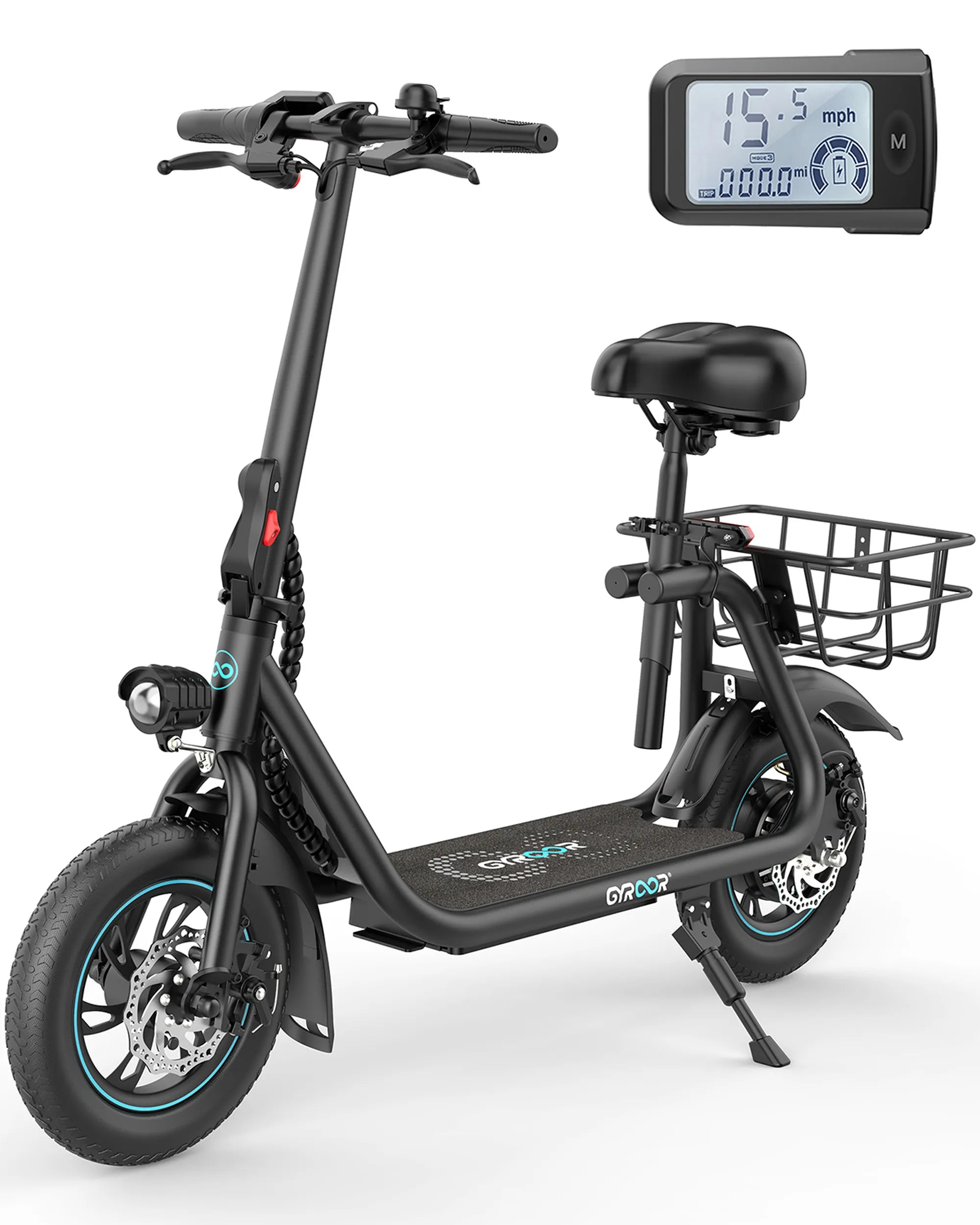
The Rise of the Adult Electric Scooter Commute
Urban transportation is undergoing a silent revolution, led by a practical and efficient tool: the electric scooter for adults. Once seen primarily as recreational toys, modern e-scooters are now engineered for the serious demands of daily commuting. This shift responds directly to chronic urban challenges—congestion that wastes hours, soaring costs of car ownership, and the frustrating 'last-mile' gap between transit stops and final destinations.
The adoption of electric scooters for adults commuting represents a fundamental change in how we perceive personal mobility. It's a data-driven choice for efficiency, not just a trendy alternative. Brands like Gyroor have focused specifically on this adult commuter market, building durable, safe, and high-performance vehicles designed for daily use over years, not just occasional rides.
This article will dissect the practical benefits driving this trend, provide a detailed guide to selecting a commuter-ready scooter, and project the future of this rapidly evolving segment of urban transport. The core thesis is clear: for millions of urban and suburban adults, a well-chosen e-scooter is no longer a novelty but a rational, transformative solution for the daily grind.
Why Adults are Choosing E-Scooters for the Daily Commute
The migration to electric scooters for adult commuting is fueled by tangible advantages that address specific pain points of modern urban life. This isn't about fun; it's about functional superiority in key areas that impact time, money, and daily stress levels.
Beating Traffic and Saving Time
Gridlock is a universal urban experience. Data from traffic analytics firms often show average city-center car speeds dropping below 10-15 mph during peak hours. A capable commuter e-scooter, with a typical governed top speed of 15-20 mph, can often match or exceed this pace by utilizing bike lanes and filtering through stalled traffic where local laws permit.
The time savings compound when eliminating the search for parking. A commute that might take 30 minutes by car in traffic, plus 10 minutes to park, can be reliably completed in 25-30 minutes door-to-door via e-scooter. This predictable, often faster, point-to-point travel is a primary motivator for adopters.
Extreme Cost-Efficiency
The financial argument for electric scooters for adults commuting is compelling. The American Automobile Association (AAA) estimates the average annual cost to own and operate a new vehicle is over $10,000, factoring in depreciation, fuel, insurance, maintenance, and parking.
Contrast this with a premium commuter e-scooter. The upfront cost is typically between $500 and $1,500. Electricity costs are negligible—roughly $0.05 to $0.15 for a full charge providing 15-40 miles of range. Annual maintenance is often under $100 for tire replacements and brake adjustments. For commuters, this represents a 90%+ reduction in annual transportation costs compared to car ownership.
The Last-Mile Solution
Public transit is efficient for long hauls but fails at the 'first and last mile.' Walking a mile takes about 20 minutes, which can make a transit commute impractical. The electric scooter for adults perfectly bridges this gap, covering that mile in about 5 minutes.
This synergy makes transit more viable for more people. Riders can fold their scooter and board a bus or train, then unfold for the final leg. It effectively expands the practical radius of every transit hub, making a wider array of housing and job locations accessible without a car.
Parking Simplicity and Zero Direct Emissions
Parking scarcity and cost are major urban stressors. An e-scooter eliminates this. It can be folded and carried into an office, stored under a desk, or placed in a designated micro-mobility rack. This saves hundreds to thousands of dollars annually on parking fees and eliminates the daily hunt for a space.
Environmentally, while the full lifecycle impact includes manufacturing and electricity generation, the direct operational emissions are zero. Widespread adoption reduces local air pollutants (NOx, particulates) and noise pollution, contributing directly to cleaner, quieter city streets—a benefit for riders and non-riders alike.
Key Features to Look for in a Commuter E-Scooter
Not all e-scooters are built for the rigors of daily commuting. Selecting the right tool requires focusing on features that guarantee reliability, safety, and practicality for all weather and road conditions.
Range, Speed, and Motor Power: Matching Your Route
Manufacturer range claims are often based on ideal conditions: a lightweight rider on flat, smooth pavement at low speed. Real-world range is typically 60-75% of the claimed maximum. For a reliable commute, your scooter's real-world range should be at least double your one-way distance to account for battery degradation over time, cold weather, and hills.
A 350W motor is a minimum for flat urban terrain with a rider under 200 lbs. For cities with hills or heavier riders, a 500W or dual-motor system is advisable. Top speed should align with local regulations, which commonly cap e-scooters at 15-20 mph on bike lanes and paths.
Build Quality, Safety, and Reliability
This is non-negotiable. The frame should be made of reinforced aluminum or aircraft-grade alloy. The braking system must be robust—a combination of electronic (regenerative) braking and a mechanical disc or drum brake provides redundancy. Wide, anti-slip deck tape is essential for secure footing.
The most critical safety component is the battery. It must be UL-certified (like those used by Gyroor), meaning it has passed rigorous independent testing for electrical and fire safety. Non-certified batteries pose a significant risk of failure or fire.
Portability and Practical Design
A true commuter scooter must be portable. Weight is a key factor: 30-40 lbs is a reasonable range for a durable scooter that can be carried up stairs or onto transit. The folding mechanism should be simple, secure, and quick to operate with one hand.
Practical features include a clear digital display showing speed and battery level, bright front and rear LED lights (with a rear brake light), a loud bell or horn, and a kickstand. Some models offer app connectivity for locking, diagnostics, and ride tracking.
Weather and Terrain Readiness
Commuting means encountering puddles, drizzle, and damp roads. A water-resistance rating of at least IPX4 (splash-resistant) is recommended, with IPX5 (water jet-resistant) providing greater confidence, as seen on Gyroor scooters. This protects the electrical components from short circuits.
Tire choice matters. Pneumatic (air-filled) tires provide a much smoother ride and better traction on uneven pavement but require occasional inflation and are prone to punctures. Solid or honeycomb tires are maintenance-free and puncture-proof but offer a harsher ride and less grip on wet surfaces.
Gyroor Commuter Scooters: Engineered for the Daily Grind
As a brand trusted by over 100,000 riders, Gyroor's design philosophy aligns directly with the demands of the adult commuter. Their focus is on safety-certified components, real-world durability, and practical features that ensure reliability for daily use.
Safety First: UL-Certification and Robust Warranty
Gyroor's commitment to safety is anchored by its use of UL-certified battery packs across its lineup. This certification, tested for over 500 charge cycles, is a critical differentiator, mitigating the primary safety concern associated with e-scooters. It provides peace of mind for riders storing their scooter at home or in an office.
This commitment is backed by a reliable 1-year comprehensive warranty and accessible customer support. For a commuter relying on their vehicle daily, this warranty support is as important as the hardware, ensuring minimal downtime and protecting the investment.
Built for Real-World Conditions: IPX5 Water-Resistance
Gyroor designs its commuter scooters with an IPX5 water-resistance rating. This engineering specification means the scooter's critical components can withstand sustained, low-pressure water jets from any direction. In practice, this translates to resilience against heavy rain, wet roads, and accidental sprays, making it a dependable choice for commuters who cannot simply avoid bad weather.
Model Comparison: Finding Your Perfect Commute Match
Gyroor offers models tailored to different commuter profiles. The following table compares key models based on core commuter metrics.
| Model | Max Range* | Top Speed | Motor Power | Weight | Key Commuter Features |
|---|---|---|---|---|---|
| Gyroor F1 Pro | 25 miles | 19 mph | 350W (Peak 700W) | 37 lbs | IPX5, UL Battery, 10" Pneumatic Tires, Dual Braking, Foldable |
| Gyroor S1 Max | 40 miles | 22 mph | 500W (Peak 1000W) | 48 lbs | IPX5, UL Battery, 10" Solid Tires, Dual Suspension, Bright Headlight |
| Gyroor C1 | 18 miles | 15.5 mph | 300W | 28 lbs | IPX5, UL Battery, Ultra-Portable Design, One-Step Folding |
*Range estimates are under ideal conditions; real-world range will be lower.
The F1 Pro offers a balanced mix of range, comfort (via pneumatic tires), and portability. The S1 Max is for longer or hillier commutes where extra power and range are paramount. The C1 is an ideal last-mile partner for multi-modal commuters who prioritize lightweight, ultra-portable design for carrying onto buses and trains.
The Future of Urban Mobility: E-Scooters and City Integration
The long-term success of electric scooters for adults commuting hinges on their thoughtful integration into the urban fabric. This involves evolving infrastructure, sensible regulation, and continued technological innovation.
Infrastructure and Regulation
The future requires dedicated, protected lanes for micro-mobility. Cities are increasingly repurposing street space from cars to create connected networks of bike and scooter lanes, which improve safety for all road users. Secure parking infrastructure, like dedicated scooter racks with charging capabilities, will also reduce clutter and theft.
Regulation must standardize and clarify. Consistent rules on where to ride (bike lanes, not sidewalks), speed limits, helmet requirements (often for younger riders), and DUI laws will create a safer, more predictable environment that encourages responsible ridership and reduces conflicts.
Technology Trends: Connectivity and Safety
Future scooters will be more connected. Integrated GPS will not only aid in theft recovery but also enable geofencing to automatically limit speed in pedestrian-heavy zones. Bluetooth-enabled apps will provide detailed battery health diagnostics, trip history, and remote locking.
Safety tech will advance with automatic brake lights, adaptive front lighting that brightens at night, and even turn signal indicators integrated into the handlebars or stem. These features will make e-scooters more visible and their intentions clearer to drivers and pedestrians.
Environmental Impact and Lifecycle
A holistic view of sustainability is emerging. While operation is clean, the environmental cost of manufacturing, particularly the lithium-ion battery, must be managed. The future lies in improved battery chemistry for longer life, easier recycling programs led by manufacturers, and a shift towards a circular economy where scooter components are refurbished and reused.
Compared to the full lifecycle of a car—from mining metals for a 2-ton frame to refining gasoline—a well-made, durable e-scooter used for years represents a dramatically lower carbon and material footprint per passenger mile, especially when charged with renewable energy.
Frequently Asked Questions (FAQ) for the Adult Commuter
Q1: How far can I realistically go on a single charge?
A: Plan for 60-75% of the manufacturer's stated maximum range. Factors that reduce range include rider weight, hills, frequent stop-and-go riding, cold temperatures (below 50°F/10°C), and tire pressure. For a 10-mile one-way commute, seek a scooter with a claimed range of at least 25-30 miles.
Q2: Is it safe/legal to ride an e-scooter in the rain?
A: Safety depends on the scooter's build. Only ride in wet conditions if your scooter has a high water-resistance rating (IPX4 or higher, like Gyroor's IPX5). Legally, it varies by municipality. Always exercise extreme caution: reduce speed, avoid painted road markings and metal surfaces (manhole covers), and never ride through deep puddles that could submerge the deck.
Q3: Where am I allowed to ride? (Bike lane vs. sidewalk vs. road)
A> This is governed by local law. The emerging standard, and safest practice, is to ride in designated bike lanes. If no bike lane exists, ride on the road, following all traffic laws as a vehicle. Riding on sidewalks is often prohibited for adult e-scooters as it poses a danger to pedestrians. Always check your city's specific ordinances.
Q4: What is the true maintenance cost and schedule?
A: Annual costs are low. Key maintenance includes: checking tire pressure (for pneumatic tires) weekly; inspecting and tightening bolts monthly; checking brake pad wear every few months (replacement cost: ~$20-$40); and eventually replacing tires. A well-built scooter like those from Gyroor might incur $50-$150 in parts per year with basic DIY care.
Q5: How do I secure my e-scooter when parked in public?
A> Use a high-quality, hardened steel U-lock or heavy-duty chain lock. Always lock the scooter's frame (not just the stem, which can fold) to a fixed, immovable object like a bike rack. If your scooter has app connectivity, use its electronic lock feature as a secondary deterrent. For the best security, never leave a high-value scooter unattended for extended periods if avoidable.
Your Commute, Reimagined
The evidence is conclusive: electric scooters for adults are a legitimate and transformative mode of urban transportation. They solve acute problems of time, cost, and convenience in a way that cars and public transit alone cannot. The future of urban mobility is multimodal, and the e-scooter has secured its place as a cornerstone of that system for the daily commuter.
Success in this new mode hinges on two pillars: choosing a responsibly engineered scooter built with safety-certified components for daily reliability, and committing to being a predictable, lawful rider who respects traffic rules and shares the road safely. The era of the car-dominated commute is waning for many urban dwellers, replaced by smarter, cleaner, and more efficient personal electric mobility.
The journey toward a better commute starts with the right tool. Explore a range of commuter-focused models engineered for durability, safety, and real-world performance.
Browse the full Gyroor collection at gyroorboard.com to find the electric scooter designed for your daily journey.
Can Electric Scooters Be on the Road? A Complete Guide to Rules & Realities
Electric Scooters in Kerala: The Future of Urban Mobility