



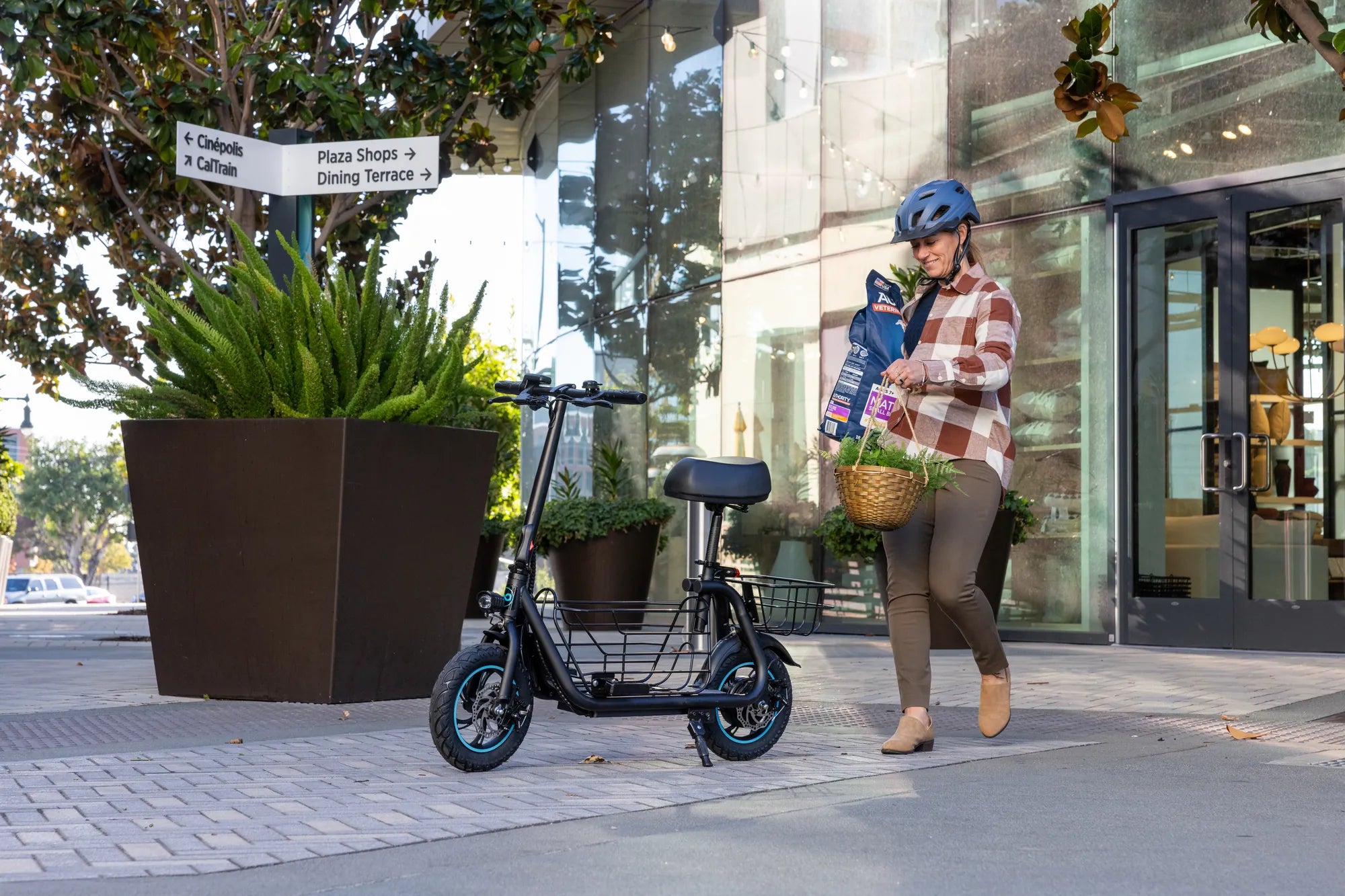
Navigating the Personal E-Mobility Revolution
Choosing between an electric scooter and an electric bike is the defining decision for new riders. The "better" ride isn't universal; it hinges entirely on your commute, physical needs, storage options, and local laws. This isn't about finding a winner, but about matching the right machine to your life.
Electric scooters offer a compact, stand-up ride perfect for short hops and mixed-mode travel. Electric bikes provide a familiar, seated experience with greater range and cargo capacity. We'll dissect every angle, from speed and portability to safety regulations and long-term costs, to give you the clarity needed to invest wisely.
As a leader in both categories, Gyroor—trusted by over 100,000 riders across North America and Europe—designs with core principles: UL-certified batteries for safety, IPX5 water-resistant builds for reliability, and a comprehensive 1-year warranty for peace of mind.
Breaking Down the Basics: Core Design and Riding Experience
The fundamental difference is posture. An electric scooter requires you to stand on a small deck, controlling it via a handlebar stem. An electric bike uses a traditional bicycle frame, allowing you to sit and pedal, with a motor providing assistance.
This simple distinction creates vastly different riding feels. Scooters are about agile, point-and-go navigation. E-bikes are about stable, endurance-oriented travel. Your comfort with each posture significantly influences which vehicle you'll prefer for daily use.
The Electric Scooter: Agile and Ultra-Portable
The electric scooter is the epitome of minimalist urban transport. Its design prioritizes portability above all else. Most quality models, like those from Gyroor, feature a one-click folding mechanism that collapses the scooter in seconds.
This creates an incredibly intuitive ride. Steering is direct, acceleration is controlled by a thumb throttle, and braking is typically a combination of electronic and mechanical systems. The learning curve is minimal; most adults are comfortable within minutes.
The standing position keeps you alert and offers a quick dismount. However, it engages your core and legs for balance, which can become tiring on longer journeys. The small wheels demand more active attention to road imperfections.
The Electric Bike: Familiar and Versatile
The electric bike builds on a century of bicycle ergonomics. The seated position distributes your weight comfortably, making it suitable for journeys of 30 minutes or more without fatigue. The riding experience is instantly familiar to anyone who has ridden a bike.
Its versatility is a key strength. Even if the battery depletes, you can always pedal it like a standard bicycle—a crucial fail-safe. You can also easily attach racks, panniers, child seats, and other standard bicycle accessories, transforming it into a cargo hauler.
The larger wheels (typically 26" or 700c) provide greater stability and roll over cracks, bumps, and light debris with far more confidence than a scooter's small wheels. This design makes it a natural fit for dedicated bike lanes and paths.
Performance and Practicality Face-Off
Moving beyond feel, we must examine hard metrics: speed, range, and how each vehicle handles the logistics of daily life. These practical factors often make the decision clear-cut for individual riders.
Performance isn't just about top speed; it's about sustainable speed over distance, hill-climbing ability, and how the vehicle performs under load. Practicality covers portability, storage, cargo, and resilience to daily wear and weather.
Speed, Range, and Power: What the Spec Sheets Say
Electric bikes generally hold the advantage in sustained performance. While high-end commuter scooters may match e-bikes on top speed (often capped at 20-28 mph depending on class), e-bikes maintain that speed more efficiently over longer distances.
Range is where the difference is stark. A typical commuter e-scooter offers 15-25 miles of real-world range. A commuter e-bike, benefiting from a larger battery and pedaling efficiency, easily achieves 30-50 miles per charge, with some models exceeding 70 miles.
Hill-climbing power favors e-bikes due to their more powerful motors (often 250W-750W) and gear systems. A scooter's motor must work significantly harder on an incline, draining the battery rapidly and reducing speed. For hilly cities, an e-bike is almost always the more capable choice.
| Performance Metric | Typical Electric Scooter | Typical Electric Bike (Class 1/2) |
|---|---|---|
| Top Speed | 15 - 25 mph | 20 - 28 mph (motor assist cuts off at 20 mph for Class 1/2) |
| Real-World Range | 15 - 25 miles | 30 - 50+ miles |
| Motor Power | 250W - 500W | 250W - 750W |
| Primary Terrain | Paved urban streets, smooth paths | Paved streets, bike paths, light gravel, moderate hills |
Commute and Errand Logistics: The Daily Grind
For the "last mile" from a transit station to your office, the scooter is unbeatable. It folds quickly, is light enough to carry (25-40 lbs for most models), and can be tucked under a desk or in a closet. This seamless integration with buses and trains is its superpower.
E-bikes, while sometimes foldable, are heavier (45-70 lbs) and more cumbersome to carry. They excel in point-to-point journeys. Their true logistical win is cargo capacity. A simple rear rack can carry groceries, a work bag, or a child, something a scooter simply cannot do safely.
Storage at home is another key consideration. A scooter can stand vertically in a corner. An e-bike requires the space of a traditional bicycle, often needing a wall mount or significant floor space in an apartment.
Weather handling also differs. While both can have water-resistant ratings (like Gyroor's IPX5), the e-bike's larger tires and stable frame provide more confidence on wet roads. The scooter's small tires are more susceptible to slipping on painted lines or metal surfaces when wet.
Safety, Regulation, and Cost Considerations
Ownership responsibility extends beyond riding. Understanding the safety profile, legal landscape, and true cost of ownership is essential for making an informed, long-term decision.
Safety involves vehicle stability, rider visibility, protective gear, and the quality of components like brakes and lights. Regulations vary wildly and can dictate where and how you ride. Cost isn't just the sticker price; it includes maintenance, repairs, and battery replacement.
Safety Gear and Road Presence
An e-bike's inherent stability from its wheelbase and seated position makes it generally safer at higher speeds and in traffic. The rider's height also improves visibility to drivers. A full-face bicycle helmet is highly recommended for both, but especially for e-bike speeds.
Electric scooter riders are lower to the ground and can be less visible. The standing position means a fall is more likely to result in a forward pitch. Wrist guards, in addition to a helmet, are a wise investment for scooter riders.
Braking systems are critical. Disc brakes, common on e-bikes, offer superior stopping power in all conditions compared to the drum or regenerative brakes common on scooters. Both vehicles must have front and rear lights for night riding, a non-negotiable safety feature.
Laws, Licensing, and Where You Can Ride
E-bike laws are relatively standardized in the US, following a three-class system. Class 1 and 2 (pedal-assist and throttle-assist up to 20 mph) are typically allowed anywhere a regular bicycle can go, with no license or insurance required.
E-scooter laws are a patchwork. Speed limits are often lower (15-20 mph), they may be banned from sidewalks, and helmet requirements are common. Some cities prohibit them entirely on roadways. You must check your specific city and state ordinances before purchasing.
This regulatory clarity often makes e-bikes the less legally complicated choice for worry-free commuting across a wider variety of jurisdictions.
Initial Investment and Long-Term Value
The entry point for a reliable, entry-level commuter electric scooter is typically lower ($400-$800). A quality commuter e-bike starts at a higher price point ($1,200-$2,000+). However, high-performance scooters can reach and exceed $1,500, blurring the line.
Long-term costs diverge. E-bikes have more mechanical parts (chain, drivetrain, gears) that require periodic maintenance and lubrication. Scooters have minimal moving parts but are not immune to wear, especially on tires and brakes.
The largest future expense for both is battery replacement. A quality UL-certified battery, like those used by Gyroor, is designed for 500+ charge cycles. Replacing it after 3-5 years can cost $200-$500 for a scooter and $500-$800 for an e-bike. A strong warranty covering the battery and motor is a significant value indicator.
The Decision Matrix: Matching the Right Vehicle to Your Lifestyle
With the data laid out, the final step is personal application. Your daily routine, physical environment, and personal preferences will point decisively to one option. Use these profiles to see where you fit.
Consider your most common trip. Is it a 2-mile dash to the train? A 10-mile cross-town commute? Weekly grocery runs? The vehicle that best serves your primary, most frequent need is the right one for you.
Choose an Electric Scooter If...
Your daily commute is under 5 miles one-way. You frequently use public transit (buses, trains) and need a vehicle you can fold and carry effortlessly. Your home and office have limited storage space—a closet corner is your parking spot.
Your route is relatively flat with smooth pavement. Your budget is tighter upfront, and you prioritize ultra-portability and simplicity over cargo capacity and long-range comfort. You want the quickest, most convenient solution for short urban trips.
Choose an Electric Bike If...
Your commute is between 5 and 15+ miles. Your route includes hills. You need to carry groceries, a laptop, or even a child. You have secure bike storage at home and at your destination (a garage, shed, or dedicated bike room).
You enjoy recreational rides on weekends and want the option for exercise via pedaling. You value the ability to use extensive bike lane networks comfortably and safely. You're willing to invest more initially for greater versatility, range, and long-distance comfort.
Maintenance and Care for Longevity
Protecting your investment requires regular care. Both vehicles are sophisticated electronics on wheels, and neglect leads to premature failure and safety risks. A simple routine can extend their life for years.
For electric scooters, weekly tire pressure checks are vital; under-inflated tires increase rolling resistance and risk pinch flats. Monthly, inspect brake pads for wear, ensure all folding mechanisms and bolts are tight, and wipe down the deck and stem to prevent dirt buildup in moving parts.
For electric bikes, chain lubrication every 100-200 miles is essential to protect the drivetrain. Regular brake adjustments, tire pressure checks, and ensuring the motor and battery connections are clean and secure form the core of e-bike maintenance.
For both, battery care is paramount. Avoid draining to 0% or leaving at 100% charge for extended periods. Store in a cool, dry place. Using only the manufacturer-provided charger, like Gyroor's UL-certified chargers, prevents battery damage and fire hazards.
Beyond the Commute: Recreational and Specialized Uses
While commuting is the primary use, both vehicles open doors to leisure and utility. Understanding these extended capabilities can further inform your choice based on your hobbies and secondary needs.
Electric scooters are fantastic for recreational use in parks, on boardwalks, and in pedestrian zones. Their portability means you can easily throw one in your car trunk for a day trip. Some advanced models offer off-road capabilities with pneumatic tires and suspension for light trail riding.
Electric bikes unlock a world of recreational cycling without the exhaustion. They are perfect for long weekend rides, exploring rail-trails, and keeping pace with fitter friends. Specialized e-bikes like cargo bikes can replace car trips for family errands, and fat-tire e-bikes are built for sand and snow.
The e-bike's ability to transform into a powerful cargo hauler is a unique advantage. It can replace a second car for many urban families, carrying multiple children or a week's worth of groceries—a level of utility a scooter cannot approach.
Your Perfect E-Ride Awaits
The debate between electric scooters vs electric bikes resolves not with a crown for one, but with a key for you. The electric scooter is the undisputed champion of hyper-portable, last-mile efficiency—a seamless extension of a multimodal urban life. The electric bike is the versatile workhorse, extending your range, carrying your burdens, and fitting naturally into a cycling-oriented lifestyle.
Assess your primary use case with honesty. Map your commute, check your local laws, measure your storage space, and budget for the total cost of ownership. Whichever path you choose, prioritize safety and quality. Opt for brands that invest in UL-certified batteries, robust water resistance like IPX5, and strong warranties—standards Gyroor builds into every model to ensure reliability for over 100,000 riders.
The future of personal transportation is electric, personalized, and empowering. Your perfect ride, whether it folds at your feet or carries you for miles, is ready to transform your daily journey.
Ready to explore reliable, safety-certified options? Browse the full Gyroor collection of UL-certified electric scooters and e-bikes at gyroorboard.com to find your ideal match.
Frequently Asked Questions (FAQ)
Q: Which is easier to learn for a complete beginner?
A: Electric scooters have a near-zero learning curve for adults. Balance and thumb-throttle control are intuitive within minutes. Electric bikes require basic bicycle-riding skills. If you can ride a bike, you can ride an e-bike.
Q: Can I ride an e-scooter or e-bike in the rain?
A: It depends on the IP rating. Models with a rating of IPX5 or higher, like those from Gyroor, are designed to withstand water jets and are suitable for riding in wet conditions. However, always exercise extreme caution, reduce speed, and avoid deep puddles to protect electronics and maintain traction on slick surfaces.
Q: Do I need a license, registration, or insurance for either?
A: In most U.S. states, Class 1, 2, and 3 e-bikes do not require a driver's license, vehicle registration, or insurance. E-scooter laws vary dramatically by city and state; some treat them like bicycles, others impose age restrictions or helmet laws. Insurance is rarely mandatory but is a wise consideration for theft or liability. Always verify local regulations.
Q: How important is a UL 2272 or UL 2849 certification?
A> It is the most important safety feature you can look for. UL 2272 certifies the safety of the scooter's electrical system and battery, while UL 2849 covers the entire e-bike system. This independent certification rigorously tests for fire and electrical shock hazards. It is a non-negotiable benchmark for safe home charging and operation.
Q: Which option provides better exercise?
A: Electric bikes provide a clear advantage for exercise. While you can get a light core workout on a scooter, e-bikes offer Pedal-Assist (PAS) that allows you to choose your exertion level. You can get a vigorous cardiovascular workout by selecting a low assist level or let the motor do most of the work on a tired day. The scooter is purely a motorized vehicle.
Q: How often do tires and batteries need to be replaced?
A: Scooter solid tires last 1,000-2,000 miles; pneumatic tires may need replacement every 500-1,000 miles depending on punctures. E-bike tires last 1,500-3,000 miles. A quality lithium-ion battery (UL-certified) lasts 3-5 years or 500-800 full charge cycles before a noticeable range reduction, signaling it may be time for replacement.
Throttle Grip Electric Scooters: The Ultimate Guide to Speed and Control
Technological Advancements in Electric Scooters 2025: The Future of Urban Mobility