

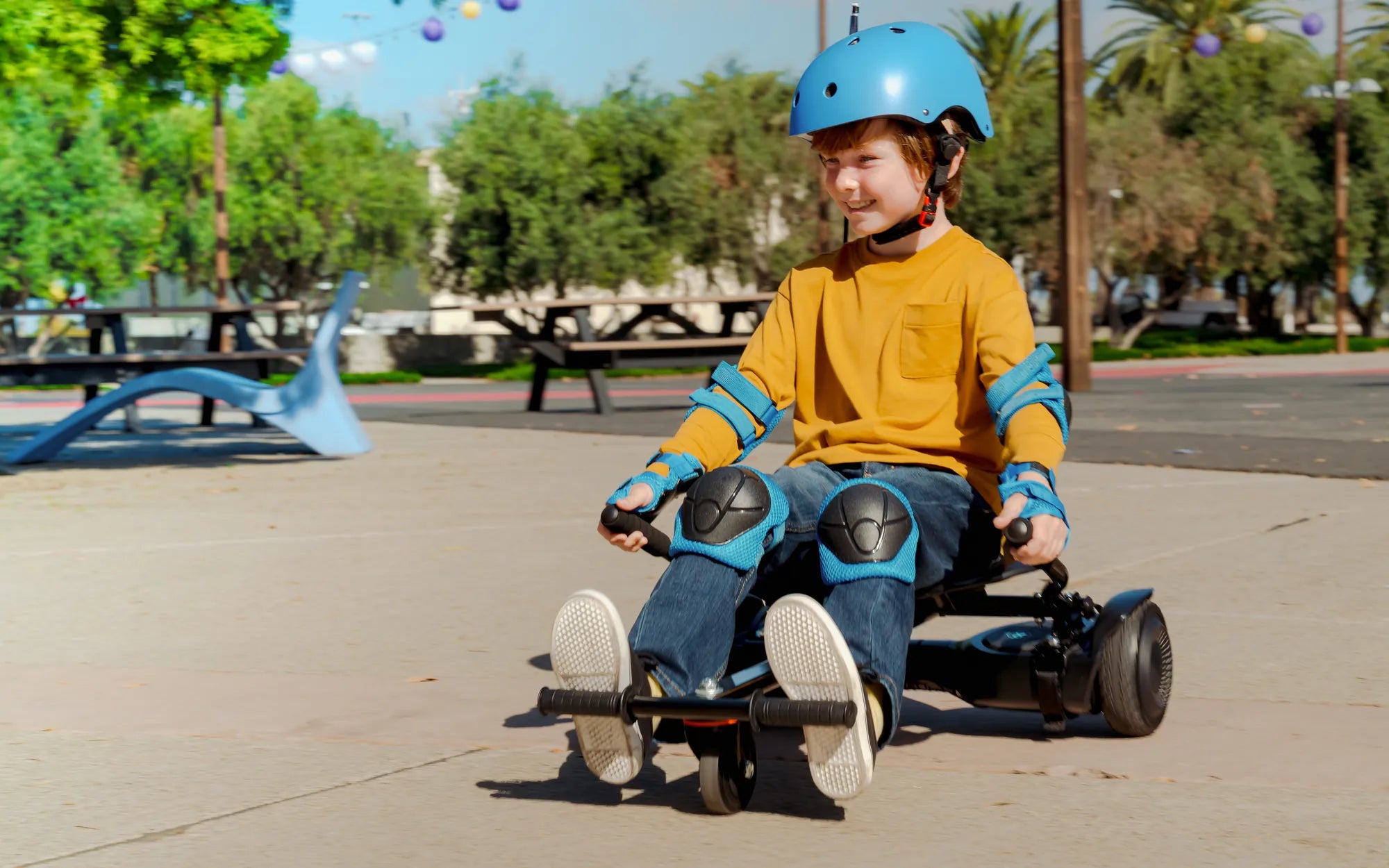
Introduction: The Hoverboard Dilemma for Young Riders
Every parent faces the question: Is a hoverboard safe for a 5-year-old? These self-balancing scooters captivate children with their futuristic appeal, but their safety for young riders is a serious concern. The answer isn't a simple yes or no—it depends entirely on the child's development, the specific hoverboard's safety features, and the family's commitment to rigorous safety protocols.
This guide provides a data-driven, practical framework for parents. We'll move beyond marketing claims to examine the physical and cognitive demands of hoverboarding, the non-negotiable safety standards, and how to create a secure learning environment. As a leading brand in personal electric mobility, Gyroor emphasizes that responsible riding begins with informed decision-making, especially for our youngest potential riders.
You'll learn the critical factors that determine readiness, the essential safety gear, and how to select a device engineered for stability. Our goal is to equip you with the knowledge to assess whether your family is prepared for this activity or if alternative toys might be more appropriate. Let's start by understanding why age five presents distinct challenges.
Understanding the Risks: Why Age 5 Presents Unique Challenges
Hoverboards require a complex combination of physical coordination, balance, and cognitive judgment that many 5-year-olds are still developing. According to the American Academy of Pediatrics (AAP), children under six lack the motor skills and judgment for complex wheeled toys. The question, "Is a hoverboard safe for a 5-year-old?" must first address these developmental realities.
The average 5-year-old weighs between 40 to 50 pounds and stands about 3.5 to 4 feet tall. A hoverboard's deck is often 6 to 8 inches off the ground, creating a relatively high center of gravity for a small child. This physics alone makes stability more challenging compared to a teenager or adult with a lower center of gravity relative to their height.
Furthermore, reaction time in young children is significantly slower. A study in the Journal of Experimental Child Psychology notes that children's perceptual-motor skills—crucial for adjusting balance to avoid a fall—are not fully mature. On a device that moves at speeds up to 10 mph, a split-second delay in shifting weight can lead to a crash.
Physical Development and Motor Skills
Mastering a hoverboard demands advanced proprioception—the body's ability to sense its position in space. A 5-year-old is still refining this sense. Core strength and leg muscle development are also variable at this age; a child needs sufficient strength to make subtle, continuous adjustments to maintain balance on a moving platform.
Fine motor control for operating the power button, checking battery indicators, or even stepping on and off precisely is another hurdle. The act of mounting and dismounting is a leading cause of falls for beginners of all ages, and for a young child, it can be particularly daunting without constant hands-on assistance.
Cognitive Awareness and Risk Assessment
Cognitively, a kindergarten-aged child is still developing executive functions like impulse control and risk assessment. They may understand a rule like "don't go near the street" in a calm moment but fail to apply it when excited or distracted during play. Their ability to anticipate hazards—a crack in the pavement, a sloping driveway, or an approaching pet—is limited.
This stage of cognitive development means that a child may not intuitively understand cause and effect as it relates to speed and stopping distance. They might lean forward aggressively to go faster without considering how they will stop, relying on immature judgment that increases accident risk.
Key Safety Features to Look For (If You Choose to Proceed)
If, after careful consideration, a family decides to proceed, selecting the right device is the most critical safety step. Not all hoverboards are created equal, and for a 5-year-old, certain features are non-negotiable. These features directly address the risks outlined above and provide layers of protection.
The core question evolves from "Is a hoverboard safe for a 5-year-old?" to "What specific features make a hoverboard safer for a 5-year-old?" This checklist should guide every purchasing decision, prioritizing certified safety over flashy designs or low price points.
UL 2272 Certification: The Non-Negotiable Standard
This is the single most important filter. Underwriters Laboratories (UL) 2272 certification means the entire electrical system—battery, charger, and motor management—has passed rigorous tests for electrical and fire safety. It prevents catastrophic failures that were prevalent in early, uncertified models.
Gyroor, for instance, uses UL-certified battery packs tested for over 500 charge cycles, ensuring not just safety but also long-term reliability. Never, under any circumstances, purchase a hoverboard without this certification. It is a baseline indicator of responsible manufacturing.
Speed Modes and Parental Controls
A hoverboard for a young child must have a dedicated beginner mode with a severely limited maximum speed, typically under 5 mph (8 km/h). This mode should be the default setting and should be lockable via a parental control feature in a companion app or via a physical key.
This allows the child to learn balance and control without the threat of sudden, high-speed accidents. As skills improve, a parent can unlock higher modes—but for a 5-year-old, the beginner mode may be the only appropriate setting for the foreseeable future. This feature is a direct technological answer to the cognitive risk-assessment challenges.
Build Quality and Stability Design
Look for design elements that enhance stability: a wider wheelbase (the distance between the wheels), a lower deck height, and large, textured, non-slip foot pads. Softer, larger wheels (6.5-inch or larger) provide better shock absorption and handle minor pavement imperfections more smoothly than hard, small wheels.
Build quality also relates to durability. A sturdy frame can withstand the inevitable drops and bumps of the learning process. Furthermore, an IPX5 water-resistance rating, like those found on Gyroor models, means the board is protected against water jets, making it safe for use on damp pavement or grass, adding a layer of safety against short-circuiting from accidental spills or puddles.
Creating a Safe Riding Environment: Rules and Gear
The safety of the device is only one component. The environment, rules, and protective equipment you establish are arguably more important. For a 5-year-old, 100% adult supervision is not a recommendation—it is an absolute requirement. This section outlines the non-negotiable protocols for safe practice.
Before the hoverboard is even turned on, the child should be fully geared up and in a designated practice zone. This structured approach mitigates the inherent risks and makes learning a controlled, progressive activity.
Mandatory Protective Gear: The Full Kit
This is non-negotiable. Every single riding session requires a full set of safety gear. The minimum includes:
- Helmet: A properly fitted, CPSC-certified bicycle or multi-sport helmet. It must sit level on the head and snugly secure with straps.
- Wrist Guards: Essential for preventing fractures and severe scrapes, as falls naturally involve putting hands out to brace.
- Knee and Elbow Pads: High-quality, hard-shell pads that stay in place during movement. These protect against painful impacts and road rash.
Make wearing the gear a non-debatable part of the "fun." Let the child help choose colorful or favorite-character gear to encourage compliance.
Choosing and Supervising the Practice Area
The ideal starter area is a flat, smooth, paved, and private surface free of traffic, slopes, and major obstacles. A empty tennis or basketball court, a smooth driveway, or a quiet cul-de-sac are perfect. Avoid public sidewalks near roads, driveways with car traffic, and areas with gravel, sand, or wet leaves.
Supervision means an adult is actively watching, within arm's reach during the initial learning phases, and not distracted by a phone. The adult should be ready to physically assist with mounting, dismounting, and catching balance until the child demonstrates consistent, basic control.
Establishing and Enforcing Family Rules
Create simple, clear rules and enforce them without exception. Consistency is key for a child's understanding and safety. Example rules include:
- Gear on first, then power on.
- One rider at a time. No passengers.
- Hands must be free—no holding toys, drinks, or phones.
- Ride only in the designated practice area.
- Immediate stop and dismount if a car, pet, or person enters the area.
- Daylight hours only, with good visibility.
These rules create a predictable and safe framework that compensates for a child's developing judgment.
Gyroor's Approach to Family-Friendly Riding
While no responsible manufacturer explicitly markets hoverboards for 5-year-olds, engineering principles that prioritize safety and stability inherently benefit younger, novice riders in supervised settings. Gyroor's design philosophy focuses on predictable performance and robust construction, which aligns with the needs of safety-conscious families.
This approach means building devices that parents can trust when they decide their child is ready to learn under strict supervision. It's about providing a reliable tool that minimizes variables and unexpected behaviors.
Engineering for Predictable Performance
Predictability is safety. A hoverboard should respond smoothly to lean inputs without jerky acceleration or sudden torque. Gyroor models utilize precise gyroscope and motor control systems to deliver a stable, gradual learning curve. The use of UL-certified battery packs ensures consistent power delivery and eliminates the risk of thermal runaway, a primary cause of fires in substandard products.
This reliable engineering means the device behaves as expected, allowing the child (and supervising adult) to build confidence based on consistent reactions from the board, rather than battling unpredictable lurches or power cuts.
The Importance of Warranty and Support
A comprehensive warranty and accessible customer support are indirect but vital safety features. Gyroor's 1-year warranty covers manufacturing defects, providing peace of mind that the product is built to last. For parents, knowing that a company stands behind its product with US-based support indicates a commitment to quality and customer safety long after the sale.
This support structure is crucial for addressing any concerns about performance or maintenance, ensuring the hoverboard remains in safe operating condition throughout its use.
Comparison: Hoverboards vs. Safer Alternatives for Young Children
For many 5-year-olds, a traditional hoverboard may not be the ideal first electric ride. The following table compares a standard hoverboard with common alternatives, highlighting their relative safety and developmental appropriateness for a child around age five.
| Device Type | Key Features | Pros for a 5-Year-Old | Cons / Risks for a 5-Year-Old | Recommended Prerequisite Skills |
|---|---|---|---|---|
| Standard Two-Wheel Hoverboard | Self-balancing, hand-free, 6-10 mph speed. | Develops core balance, coordination. | Very high fall risk; requires advanced motor skills; difficult to mount/dismount. | Expert balance bike riding; excellent coordination. |
| Gyroor or Similar Brand with Beginner Mode | UL2272 cert., speed limiter (<5 mph), stable design. | Controlled learning environment; certified safety; slower speeds. | Still a significant balance challenge; requires absolute supervision. | Good balance on a scooter or bike with training wheels. |
| Three-Wheel (Triangular) Hoverboard | Three-wheel layout for inherent stability, often slower. | Much more stable; easier to learn; less intimidating. | Less maneuverable; still requires protective gear and supervision. | Basic standing balance. |
| Balance Bike | Pedal-less bike; child propels with feet. | Teaches fundamental balance and steering for cycling; feet are always down for safety. | Not motorized; may be less "exciting" for some kids. | Walking, running. |
| Kick Scooter (2 or 3 wheels) | Handlebars for steering, foot propulsion. | Provides handlebar stability; natural braking with foot; develops coordination. | Risk of falls when turning or stopping. | Good walking/running balance. |
Parental Checklist: Is Your 5-Year-Old Ready for a Hoverboard?
Use this actionable checklist to make a personalized, informed decision. If you answer "no" to any of these questions, it is a strong indicator to wait or choose an alternative toy.
- Child's Skills: Can your child ride a balance bike or a scooter with good stability and controlled stopping?
- Rule Following: Does your child consistently demonstrate the ability to listen to and follow specific safety instructions, even when excited?
- Supervision Commitment: Can an adult commit to 100% active, hands-on supervision during every single riding session?
- Gear Compliance: Is your child willing to wear a full set of safety gear (helmet, wrist guards, knee/elbow pads) without complaint?
- Product Selection: Are you only considering a UL 2272 certified model with a reliable beginner speed mode (under 5 mph) and stable design?
- Practice Area: Do you have consistent access to a flat, smooth, private, and obstacle-free practice area?
If all answers are "yes," you have laid a responsible foundation to begin careful, supervised learning. Remember, the journey is more important than the destination—prioritize slow, safe progress over speed or tricks.
FAQ: Common Parental Concerns Addressed
What is the official age recommendation for hoverboards?
Most reputable manufacturers, including Gyroor, recommend hoverboards for riders aged 8 and up. This recommendation is based on the average development of motor skills and cognitive judgment. For children under 8, extreme caution, direct parental assessment, and the strictest safety measures are required.
Can I just hold my child's hands while they learn?
Yes, but with caution. Holding a child's hands or shoulders can help them find their initial balance and build confidence. However, you must avoid holding their hands outstretched, as this can disrupt their natural center of gravity. The goal is to provide minimal support for stability, not to bear their weight. Always stand to the side, not in front, to avoid being knocked over.
Are there any safer alternatives to a hoverboard for this age?
Absolutely. For developing similar skills in a safer, progressive manner, consider a three-wheeled hoverboard (which offers more stability), a balance bike (the gold standard for teaching bicycle balance), or a traditional kick scooter with two or three wheels. These options provide stepping stones toward the more complex balance required for a standard two-wheel hoverboard.
How do I check if a hoverboard is UL 2272 certified?
Look for the UL Mark on the product itself, its packaging, or the manufacturer's website. You can also search the UL Product Spec database online using the model number. Reputable retailers and brands like Gyroor prominently display this certification. Be wary of products that claim to have "certified batteries" but not full system (UL 2272) certification.
What are the most common hoverboard injuries for kids?
Data from hospital emergency departments indicates the most common injuries are fractures (particularly to the wrists, forearms, and elbows), followed by contusions, sprains, and head injuries. This injury profile underscores the non-negotiable need for wrist guards and a helmet, as these directly protect the most vulnerable areas in a typical fall.
Making the Final Decision: Safety First, Fun Second
Returning to our core question, "Is a hoverboard safe for a 5-year-old?"—the safety is not inherent in the toy but is constructed through informed choices. It is built from a UL 2272 certified device, a full suit of protective armor, a perfect practice environment, unwavering supervision, and a child who demonstrates specific readiness skills.
For many 5-year-olds, the risks and demands outweigh the benefits. A balance bike, scooter, or three-wheeled hoverboard may offer a more enjoyable and successful path to developing coordination. The decision is deeply personal and must be rooted in an honest assessment of your child's individual maturity and your family's ability to enforce a safety-first culture.
If you decide to move forward, choose a partner in safety. Select a brand like Gyroor, where engineering priorities like UL-certified batteries, water-resistant builds, and stable performance provide a reliable foundation for supervised learning. Your vigilance, coupled with quality equipment, creates the only scenario where hoverboarding can be a positive experience for a young child.
Ready to explore electric mobility options designed with safety and performance in mind? Browse the full Gyroor collection, featuring UL-certified electric scooters and hoverboards built for reliability, at gyroorboard.com. Equip yourself with knowledge and quality gear to ensure every ride is a safe one.
My Hoverboard Is Blinking Red and Beeping: A Complete Diagnostic Guide
Lightest Self Balancing Scooter: The Ultimate Guide to Portable Mobility