



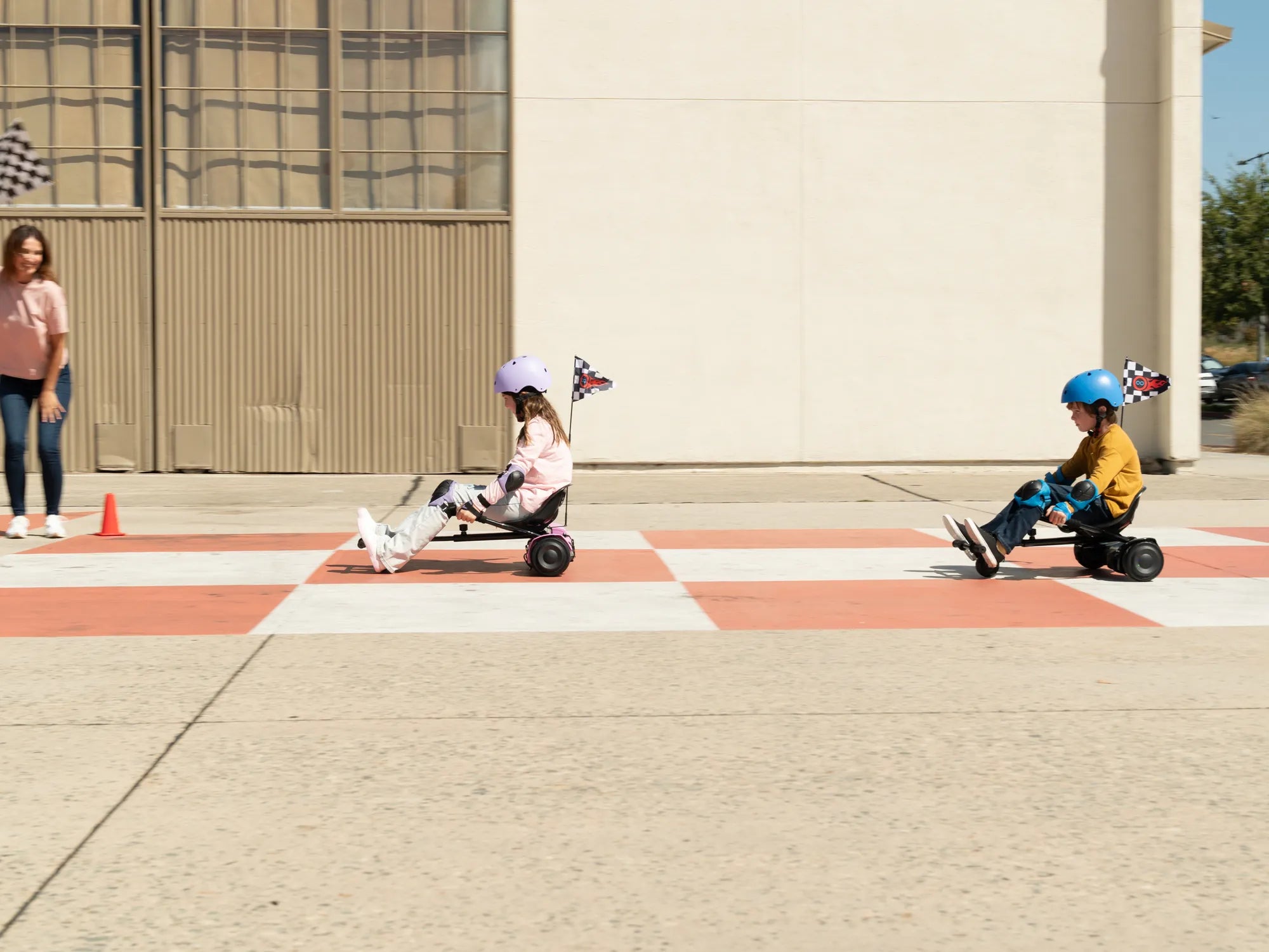
Introduction: Redefining Personal Commutes with Intelligent Balance
The two-wheel smart self-balancing scooter represents a fundamental shift in personal urban transport. Unlike traditional vehicles, it replaces manual steering with autonomous balance, creating a uniquely intuitive riding experience. This convergence of gyroscopic stabilization, electric propulsion, and smart connectivity addresses the critical first-mile/last-mile gap in cities worldwide.
As urban density increases and storage space decreases, the demand for ultra-portable solutions grows. The two-wheel smart self-balancing scooter meets this need by folding compactness with advanced technology. Leading brands like Gyroor have refined this category, focusing on safety certifications and durable designs trusted by over 100,000 riders.
This article provides a comprehensive analysis of why this device is more than a novelty. We will dissect its operating principles, compare its practical advantages, and outline its role in sustainable urban ecosystems. The future of city mobility hinges on intelligent, space-efficient options, and the smart self-balancing scooter is positioned at its forefront.
The Core Technology: How Smart Self-Balancing Actually Works
The magic of a two-wheel smart self-balancing scooter lies in its sensor suite and control algorithms. At its heart are gyroscopes and accelerometers that measure the board's orientation and tilt angle up to 1000 times per second. This real-time data feeds into a central microprocessor, which calculates the precise motor adjustments needed to maintain stability.
Rider control is achieved through intuitive weight distribution. Leaning forward signals the motors to accelerate, while leaning back commands deceleration or reversal. Steering is accomplished by applying subtle pressure with one foot, causing the board to turn by varying the speed of each wheel independently. This creates a seamless, hands-free control scheme.
The electric motors are direct-drive hub motors embedded within the wheels. They provide instant torque and regenerative braking, which recaptures energy during slowing down to extend battery life. The entire system is powered by a high-density lithium-ion battery pack, which must be exceptionally reliable as a loss of power means a loss of balance.
Advanced models incorporate additional sensors, such as pressure-sensitive foot pads. These detect the rider's stance and can enable different riding modes or safety lock features. The sophistication of this feedback loop is what separates a true smart scooter from simpler, less stable personal transport devices.
Gyroor's Engineering Edge: UL-Certified Safety & IPX5 Resilience
Gyroor's approach to this complex technology prioritizes safety and resilience. The most critical component is the battery. Gyroor equips its models exclusively with UL 2271 or UL 2272 certified battery packs. This certification involves rigorous testing for electrical, mechanical, and environmental safety, including overcharge, short circuit, and crush tests.
This is non-negotiable. A faulty battery in a device that relies on constant power for balance poses a significant risk. UL certification provides verified assurance of quality and safety, with batteries tested for 500+ charge cycles while maintaining performance. It's a cornerstone of Gyroor's commitment to its customer base across North America and Europe.
Furthermore, an IPX5 water-resistance rating is a key differentiator. This means the scooter can withstand water jets from any direction, making it resistant to rain, puddles, and wet urban streets. This resilience ensures the sensitive internal electronics—the gyroscopes, control boards, and motor controllers—are protected from moisture-related failures.
Combined with a reliable 1-year warranty, these features transform the smart scooter from a gadget into a dependable mobility tool. They address the primary concerns of riders: fire safety, all-weather usability, and long-term reliability, allowing the core technology to perform consistently.
Urban Mobility Applications: Where the Smart Scooter Excels
The primary application is solving the first-mile/last-mile problem. For millions, the distance between a transit station and their final destination is too far to walk yet too short for a car or traditional e-bike. A two-wheel smart self-balancing scooter, often carried onto a train or bus, bridges this gap in minutes, seamlessly integrating with public transport.
Within dense urban cores, it excels at navigating crowded sidewalks and pedestrian zones where bicycles and larger e-scooters are impractical or prohibited. Its compact footprint and zero-turn radius allow for agile maneuvering through slow-moving foot traffic, making it ideal for short trips to cafes, shops, or meetings.
Corporate and university campuses are perfect environments. These sprawling areas often have limited parking and pedestrian-centric pathways. Employees and students can use smart scooters to move between buildings, dormitories, and parking lots quickly without sweating, a common issue with bicycles.
Its portability is its superpower. Weighing between 25-35 lbs, it can be easily carried into an office, apartment, or store, eliminating theft concerns associated with locked vehicles outside. This "trunkable" nature also makes it a perfect companion for commuters who drive part-way, using the scooter for the final leg of their journey.
Data-Driven Comparison: Smart Scooter vs. Traditional E-Scooter & E-Bike
Choosing the right personal electric vehicle depends on specific needs. The following table compares the two-wheel smart self-balancing scooter against two popular alternatives: the kick-style e-scooter and the electric bicycle.
| Feature | Two-Wheel Smart Self-Balancing Scooter | Traditional E-Scooter (Kick-Style) | Electric Bicycle (E-Bike) |
|---|---|---|---|
| Learning Curve | Moderate (1-2 hours practice) | Very Easy (near-instant) | Easy (like a bike) |
| Portability (Weight) | 25-35 lbs (Most Portable) | 30-45 lbs | 45-70 lbs (Least Portable) |
| Storage Footprint | Extremely Compact (can fit under a desk) | Folds, but handlebars remain bulky | Requires significant space, even if folding |
| Typical Range | 12-18 miles | 15-25 miles | 20-60+ miles |
| Typical Speed | 10-12 mph | 15-20 mph | 20-28 mph (with pedal assist) |
| Terrain Adaptability | Best for smooth pavement | Good for pavement, handles slight bumps | Best (can handle trails, hills, roads) |
| Primary Use Case | Ultra-short trips, last-mile, indoor/outdoor blend | Short-medium commutes, bike lanes | Longer commutes, recreation, cargo |
| Price Point | Mid-Range | Wide Range (budget to premium) | High (premium investment) |
The smart scooter is not the fastest or longest-range option. Its value proposition is unmatched compactness and a unique, hands-free riding experience for specific, short-distance scenarios where other vehicles are too large or cumbersome.
The Rider Profile: Who Benefits Most from This Technology?
The ideal user is an urban apartment dweller with limited storage space. The ability to carry the scooter inside and store it in a closet or corner is a decisive advantage over a bicycle or bulkier e-scooter. This user likely uses multimodal transport daily.
Tech-savvy commuters who value innovation and a "wow" factor also gravitate towards this device. The learning process is part of the appeal, and the connected app features resonate with users who enjoy tracking data and customizing their experience. It's a gadget that doubles as practical transport.
Professionals working in dense downtown areas or large corporate campuses benefit greatly. They can commute in business attire without exertion, navigate between meetings efficiently, and avoid parking fees. The scooter acts as a productivity tool, reclaiming time lost to walking.
Conversely, those with longer solo commutes (>5 miles one-way), a need to carry heavy items, or a requirement to tackle steep hills are better served by an e-bike. Riders prioritizing simplicity and maximum speed for shorter distances might prefer a traditional e-scooter.
The "Smart" Ecosystem: Connectivity and Future Enhancements
Connectivity transforms the device from a simple transporter to an intelligent mobility node. Most premium models, including those from Gyroor, pair with a smartphone app via Bluetooth. This app provides vital ride metrics like speed, distance, battery level, and trip history, allowing riders to track their usage and efficiency.
Firmware updates delivered over-the-air (OTA) can improve motor performance, battery management, and safety algorithms long after purchase. Riders can also customize their experience through the app, selecting between different ride modes (e.g., beginner, standard, sport) that adjust acceleration, top speed, and steering sensitivity.
Advanced smart features include integrated anti-theft systems. If the scooter is moved without the rider's phone nearby, it can lock its wheels and sound an alarm. Some models offer optional GPS tracking modules, providing real-time location data in case of theft.
The future points toward deeper intelligence. We can expect the integration of collision avoidance sensors using ultrasonic or LiDAR to provide haptic feedback or automatic slowing. Advanced route learning could suggest the smoothest path based on past rides. Ultimately, connectivity with smart-city infrastructure—syncing with pedestrian traffic lights or navigating within geo-fenced zones—could redefine urban navigation.
Safety, Regulation, and Best Practices for New Riders
Safety begins with the right gear. A certified bicycle or multi-impact helmet is non-negotiable. Wrist guards, knee pads, and elbow pads are highly recommended, especially during the learning phase. Proper gear mitigates the risk of injury from falls, which are common when first mastering balance.
The learning curve requires a safe environment. Start in a flat, open, and smooth area like an empty parking lot or tennis court. Use a support rail or a friend for balance initially. Focus on mounting, dismounting, and gentle acceleration before attempting turns. Most riders achieve basic competency within 1-2 hours of dedicated practice.
The regulatory landscape is evolving and varies by municipality. Generally, two-wheel smart self-balancing scooters are treated similarly to electric skateboards. They are often permitted on sidewalks (at pedestrian speeds), bike lanes, and shared paths, but frequently prohibited on public roads. It is the rider's critical responsibility to check and adhere to all local laws and ordinances.
Ride defensively and assume you are invisible to drivers and pedestrians. Maintain a safe speed, especially in crowded areas. Avoid wet leaves, gravel, sand, and potholes. Regularly inspect your scooter for tire wear, loose components, and ensure all screws are tight. Proper maintenance is a key component of operational safety.
FAQ: Addressing Common Questions on Smart Self-Balancing Scooters
Q1: How long does it take to learn to ride one?
Most adults can learn the basics—mounting, dismounting, moving forward, and stopping—in 30 to 60 minutes of practice. Achieving confident, relaxed control for navigating turns and slight inclines typically takes 2-3 hours of total practice over a few days. Patience and a safe practice area are key.
Q2: What is the real-world range on a single charge?
Advertised range is under ideal conditions (75kg rider, flat terrain, 15°C temperature). Real-world range is typically 70-80% of that figure. For a model rated at 15 miles, expect 10-12 miles. Factors like rider weight, terrain hills, temperature, and riding style (aggressive acceleration) significantly impact range.
Q3: How does Gyroor's 1-year warranty support my investment?
Gyroor's warranty covers defects in materials and workmanship for one year from purchase. This includes the frame, motors, and core electronics. It provides peace of mind, ensuring that a significant manufacturing flaw will be repaired or replaced. This warranty is backed by their established customer service network in North America and Europe.
Q4: Are they safe to use in light rain or on wet pavement?
Models with an IPX5 rating, like several from Gyroor, are designed to withstand light rain and wet roads. However, caution is paramount. Reduce speed significantly, avoid puddles of unknown depth, and be aware that braking distances increase on wet surfaces. Never submerge the scooter or ride in heavy rain or floods.
Q5: What is the maximum weight and incline capability?
Most standard models support a maximum rider weight of 220-265 lbs (100-120 kg). Incline capability depends on motor power and rider weight. A typical 350W dual-motor scooter can handle slopes of 15-20 degrees. Steeper hills may require a "running start" or dismounting. Always check the manufacturer's specifications for your model.
A Nimble Piece of the Future Transport Puzzle
The two-wheel smart self-balancing scooter is not a one-size-fits-all transportation solution. It is a highly specialized tool designed to excel in a specific niche: ultra-compact, agile, and intelligent personal mobility for short urban distances. Its value lies in its seamless integration into a multimodal lifestyle, its minimal spatial footprint, and its innovative control scheme.
As cities grow denser and the need for sustainable, space-efficient transit intensifies, devices that prioritize portability and connectivity will become increasingly vital. The evolution of this category, driven by a focus on verified safety (UL-certified), all-weather durability (IPX5), and smart features, underscores its transition from novelty to legitimate urban utility.
For the right user—the urbanite, the tech-embracing commuter, the campus traveler—it represents a significant upgrade in daily convenience and efficiency. It reclaims time, reduces reliance on cars for micro-trips, and offers a uniquely enjoyable way to navigate the urban landscape.
Ready to experience this fusion of technology and mobility? Explore a range of models engineered for safety, reliability, and performance. Browse the full Gyroor collection at gyroorboard.com and find the smart scooter that connects the dots in your daily commute.
How to Connect Hoverboard Bluetooth: A Step-by-Step Guide to Unlocking Smart Features
How Does a Self Balancing Scooter Work: The Science Behind the Ride