

Navigating the World of Electric Scooters
Choosing an electric scooter is no longer just about picking a color. The market has exploded with specialized models designed for specific terrains, speeds, and lifestyles. Understanding the different types of electric scooters is the first and most crucial step toward a purchase you won't regret. This comprehensive guide will demystify the categories, from sleek last-mile commuters to rugged all-terrain machines.
Your ideal scooter depends entirely on your primary use case. A wrong choice can lead to frustration, safety compromises, or wasted money. We'll provide the data-driven insights you need, referencing key specifications and safety standards that separate quality rides from the rest. As a leader with over 100,000 riders, Gyroor's focus on UL-certified batteries and robust builds offers a reliable benchmark for what to look for in any category.
Understanding Electric Scooter Classifications: More Than Just Speed
Electric scooters are categorized by a combination of design philosophy, performance envelope, and intended environment. While top speed is a flashy number, it's just one piece of the puzzle. A scooter built for smooth pavement will struggle on a trail, and an ultra-portable model may disappoint a long-distance commuter.
The classification hinges on how engineers balance competing priorities: power versus weight, range versus portability, comfort versus agility. Recognizing these trade-offs helps you filter the overwhelming options. We'll explore the five core types of electric scooters that define today's market, each engineered for a distinct purpose.
Key Differentiating Factors
Before diving into types, know the key specs that define them. Motor power (measured in watts) determines acceleration and hill-climbing ability. Battery capacity (watt-hours) directly influences range. Tire size and type (solid vs. pneumatic) affect comfort and terrain capability.
Portability is dictated by weight and folding mechanism. Suspension systems smooth out bumps, while build quality and IP water resistance ratings (like Gyroor's IPX5) ensure durability. These factors collectively determine where and how well a scooter performs, making them essential for comparison.
Type 1: Commuter / Urban Electric Scooters
Designed for the daily grind, commuter scooters are the workhorses of city mobility. They prioritize a balanced blend of adequate speed, reliable range, and practical portability. Typical specs include a 350W to 500W motor, speeds of 15-20 mph, and a range of 15-25 miles per charge.
Key features focus on urban practicality. A fast-folding mechanism is standard for carrying on transit or storing under a desk. Integrated lighting (front and rear) and electronic or disc brakes are essential for safety in traffic. Many feature regenerative braking to slightly extend range.
The ideal user is a city dweller, student, or professional with a daily round-trip under 10 miles. They need a reliable, weather-resistant vehicle for paved roads and bike lanes. For this rider, Gyroor's commuter-focused models emphasize reliability with UL-certified batteries and IPX5 water resistance, ensuring all-weather capability without sacrificing foldability.
Compromises are made for this balance. Commuter scooters often have medium-sized tires (8-10 inches) with limited suspension, making very rough pavement uncomfortable. Their weight (30-45 lbs.) is a midpoint, portable but not ultra-light.
Type 2: Off-Road / All-Terrain Electric Scooters
When the pavement ends, off-road electric scooters begin. These are built to conquer dirt trails, gravel paths, grass fields, and uneven surfaces. They are characterized by robust construction, high ground clearance, and aggressive, knobby pneumatic tires.
Performance specs are amplified. Motors often start at 500W and can exceed 1000W, sometimes in dual-motor configurations for immense torque. Top speeds can reach 25-30+ mph off-road, with ranges varying widely (20-40 miles) based on terrain difficulty. Long-travel suspension systems (both front and rear) are non-negotiable to absorb large impacts.
The ideal user is an adventure seeker, someone living in rural areas with unpaved roads, or an urban rider who wants to explore parks and trails. Durability is paramount, as these scooters endure significant stress. This is where the importance of a robust frame and a high-quality, safe battery system, like Gyroor's UL-certified packs, becomes critical for managing the high power demands reliably.
Trade-offs are significant. Off-road scooters are heavy (often 50-80+ lbs.) and less portable. Their knobby tires create more noise and vibration on smooth pavement. They are an investment, priced higher due to their specialized components and reinforced architecture.
Type 3: High-Performance / Speed Electric Scooters
Engineered for velocity and acceleration, high-performance scooters are the sports cars of the category. They are defined by their ability to sustain high speeds (30+ mph) and offer thrilling acceleration, often catering to experienced riders.
Specifications are top-tier. Dual motors (often 1000W each or more) are common. Batteries are high-voltage and high-capacity to deliver sustained power. Ranges can be impressive (30-50+ miles) but drop considerably when riding at top speed. Advanced braking systems, like hydraulic or combined electronic-hydraulic discs, are essential for controlled stopping at high velocities.
The ideal user is a thrill-seeker, a long-distance commuter who needs to cover ground quickly on dedicated bike paths, or a performance enthusiast. Stability at speed is achieved through longer decks, wider handlebars, and sometimes even a dual-steering mechanism.
Safety cannot be an afterthought. At these speeds, premium brakes, sophisticated suspension, and rigorously tested electrical systems are mandatory. The high-stress environment makes the safety certifications on the battery and motor controllers, a standard part of Gyroor's engineering philosophy, absolutely critical to prevent failures.
Type 4: Lightweight / Portable / Last-Mile Scooters
This category prioritizes portability above all else. Designed for "last-mile" solutions—bridging the gap between public transit and final destination—these scooters are ultra-compact and light.
Specs are modest by design. Motors typically range from 250W to 350W, with top speeds of 15-18 mph. Range is usually 10-15 miles, sufficient for short trips. The defining characteristic is weight: often under 30 lbs., with some models as light as 20 lbs. They feature the most compact folding mechanisms, sometimes folding into a suitcase-like form.
The ideal user is a multi-modal commuter, an apartment dweller who needs to carry the scooter upstairs, a traveler, or someone with limited storage space. The convenience of easy carry outweighs the need for high speed or long range.
The compromise comes in ride comfort and durability. Small wheels (6-8 inches) and solid or semi-pneumatic tires transmit more road vibration. Minimal or no suspension is common. The challenge for brands like Gyroor in this segment is to deliver this ultra-portability while maintaining a core level of durability and reliable performance that doesn't feel flimsy.
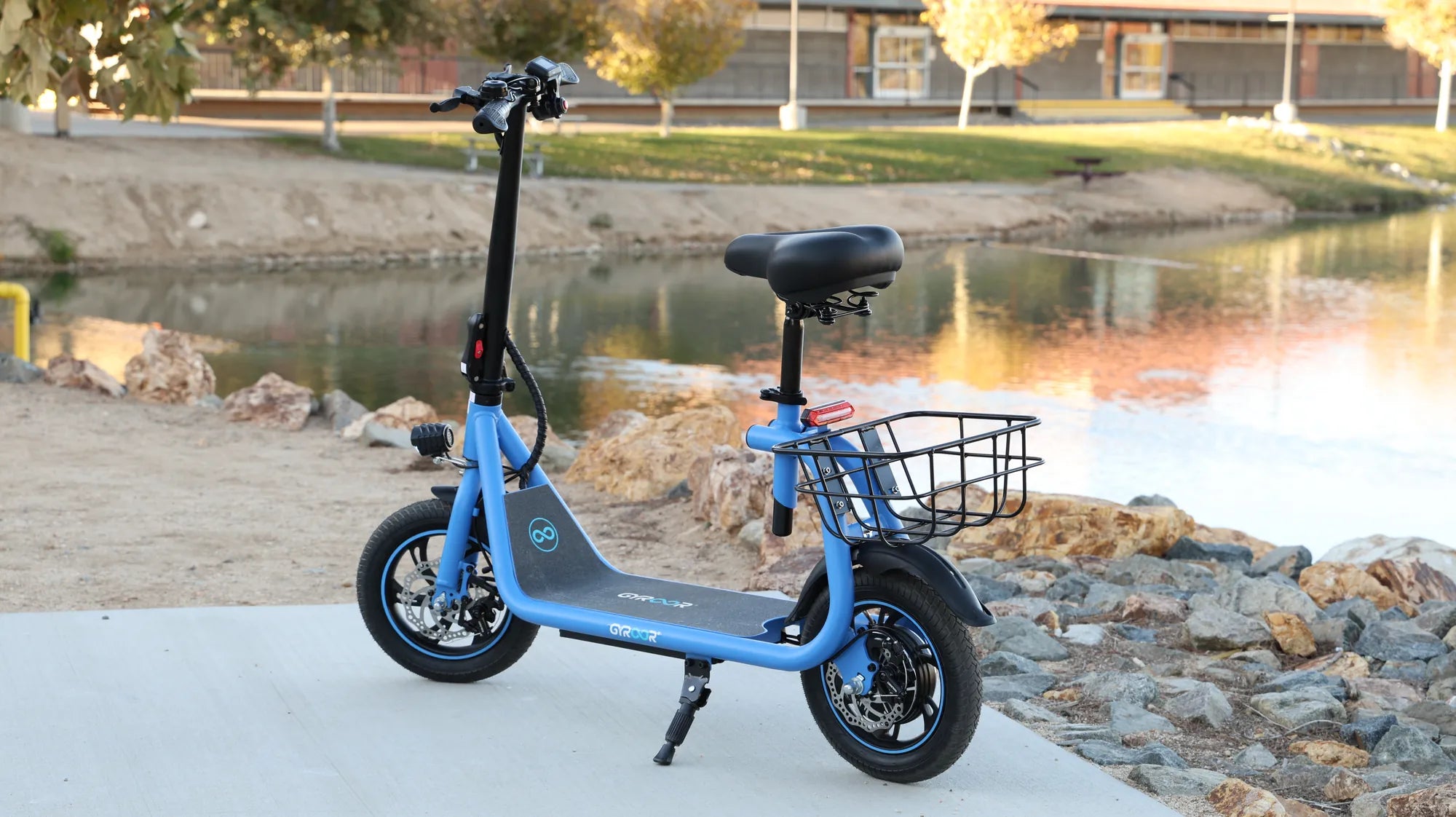
Type 5: Seated Electric Scooters & Moped-Style Models
Blurring the line between e-scooters and e-bikes, these models feature an integrated seat, offering a seated riding experience. They provide greater comfort for longer durations and often have a more substantial, moped-inspired frame.
Design elements include a longer wheelbase for stability, a padded seat, and sometimes footpegs or a floorboard. Performance varies widely, from commuter-focused seated scooters with specs similar to Type 1, to more powerful models resembling lower-speed electric mopeds with larger batteries and ranges exceeding 40 miles.
The ideal user is someone who prefers not to stand for their entire commute, has a longer daily distance (5+ miles one way), or wants a more casual, leisurely riding posture. They can also be suitable for riders with balance or mobility concerns who find standing for prolonged periods challenging.
While offering superior comfort, they sacrifice the portability and agile handling of stand-up models. They are less convenient to fold (if they fold at all) and store, representing a different approach to personal electric mobility that prioritizes comfort over compactness.
Comparison Chart: Matching Scooter Type to Your Needs
| Type | Primary Use | Avg. Speed | Avg. Range | Portability | Terrain | Ideal Rider Profile |
|---|---|---|---|---|---|---|
| Commuter/Urban | Daily City Travel | 15-20 mph | 15-25 mi | Medium (Folds well) | Paved Roads | City commuter, student |
| Off-Road/All-Terrain | Trails & Rough Ground | 20-30+ mph | 20-40 mi | Low (Heavy) | Dirt, Grass, Gravel | Adventure seeker, rural rider |
| High-Performance | Speed & Thrills | 30-40+ mph | 25-50+ mi | Low-Very Low | Smooth Pavement | Experienced rider, speed enthusiast |
| Lightweight/Portable | Last-Mile & Multi-Modal | 15-18 mph | 10-15 mi | High (Very Light) | Smooth Pavement | Transit user, traveler, apartment dweller |
| Seated/Moped-Style | Comfortable Longer Commutes | 15-25 mph | 20-45+ mi | Low (Bulky) | Paved Roads | Comfort-focused rider, longer-distance commuter |
Essential Considerations Beyond Type: Safety and Specifications
Selecting a category is only half the battle. Within each type, quality and safety vary dramatically. Two commuter scooters with similar speed and range can differ vastly in reliability, safety, and longevity based on their components and construction.
Always dig into the detailed specifications and manufacturer reputation. Look for transparent data on battery chemistry, motor wattage (continuous vs. peak), and the actual IP rating for water and dust resistance. These details separate marketing hype from engineering substance.
Battery Safety and Certification (A Gyroor Priority)
The battery is the heart and most critical safety component. Insist on scooters using UL-certified lithium-ion battery packs. This certification means the battery has passed rigorous independent tests for electrical, mechanical, and fire safety.
Uncertified batteries are a leading cause of scooter failures and fires. A UL-certified battery, like those used across Gyroor's lineup, ensures stable chemistry, proper battery management systems (BMS), and quality cells. It's a non-negotiable feature for peace of mind and long-term value, directly impacting both safety and the scooter's lifespan (typically 500+ charge cycles).
Build Quality, Warranty, and Water Resistance
Examine the frame material (aircraft-grade aluminum is a good sign), weld quality, and stem locking mechanism. A comprehensive warranty (at least 1 year) signals the manufacturer's confidence in their product. Gyroor's standard 1-year warranty covers key components, reflecting their commitment to durability.
Water resistance is crucial for real-world use. An IP rating defines protection levels. An IPX5 rating, as found on Gyroor scooters, means the scooter can withstand low-pressure water jets from any direction. This makes it safe to ride in rain or on wet roads, protecting the electrical systems from water damage that can lead to costly repairs or failure.
Your Perfect Ride Awaits
The journey to your ideal electric scooter starts with honest self-assessment. Map your primary need—beating traffic, exploring trails, catching a train, or simply enjoying the ride—to the scooter type designed for it. Use the comparison chart as your starting filter.
Once you've identified the type, prioritize safety and durability within that category. Never compromise on battery certification or fundamental build quality for the sake of a lower price or a marginally higher top speed. The right scooter is a blend of purpose-built design and foundational engineering excellence, offering freedom, fun, and reliable transportation for years to come. Explore how Gyroor's range of UL-certified, IPX5-rated models delivers on these promises for every rider type.
FAQ: Quick Answers to Common Scooter Type Questions
Q: Can I use an off-road scooter for my daily city commute?
A: Yes, but it may be overkill. You'll carry extra weight, experience louder tires on pavement, and potentially have a less comfortable ride on smooth surfaces compared to a dedicated commuter model. It works, but a commuter scooter is often more optimized for that specific task.
Q: Is a seated electric scooter more stable than a standing one?
A: They can offer a different kind of stability, particularly at lower speeds and in a straight line, due to a lower center of gravity and a longer wheelbase. However, standing scooters are generally more agile and maneuverable for quick turns and navigating tight spaces.
Q: How important is the IP water resistance rating for everyday use?
A> Extremely important if you plan to ride in anything other than perfectly dry conditions. An IPX5 rating (like Gyroor's) means the scooter is protected against water jets, making it safe for riding in rain, through puddles, or after washing. Scooters with no rating or a low rating (like IPX4) risk water damage from everyday hazards.
Q: Why is a UL-certified battery so important?
A> It is the leading independent safety certification for electrical components in the US. A UL-certified battery has undergone stringent testing for overcharge, short circuit, impact, and fire risk. It significantly reduces the chance of battery-related failure or fire, protecting both you and your investment. This is a critical factor often hidden in spec sheets.
Q: I'm a heavy rider (250+ lbs.). Which scooter type should I focus on?
A> You should prioritize models with high weight capacity ratings (check the manufacturer's spec, not just the motor power). Off-road and high-performance types often have the most robust frames and higher-wattage motors capable of handling heavier loads effectively. Always choose a scooter with a stated maximum load well above your weight for safety and performance.
Ready to find the electric scooter engineered for your life? Browse the full Gyroor collection of UL-certified, IPX5 water-resistant scooters and e-bikes at gyroorboard.com.
Electric Scooters Adults UK: Your Complete Guide to Urban Mobility
How Fast Can Electric Scooters Go: Speed Limits and Performance Explained