



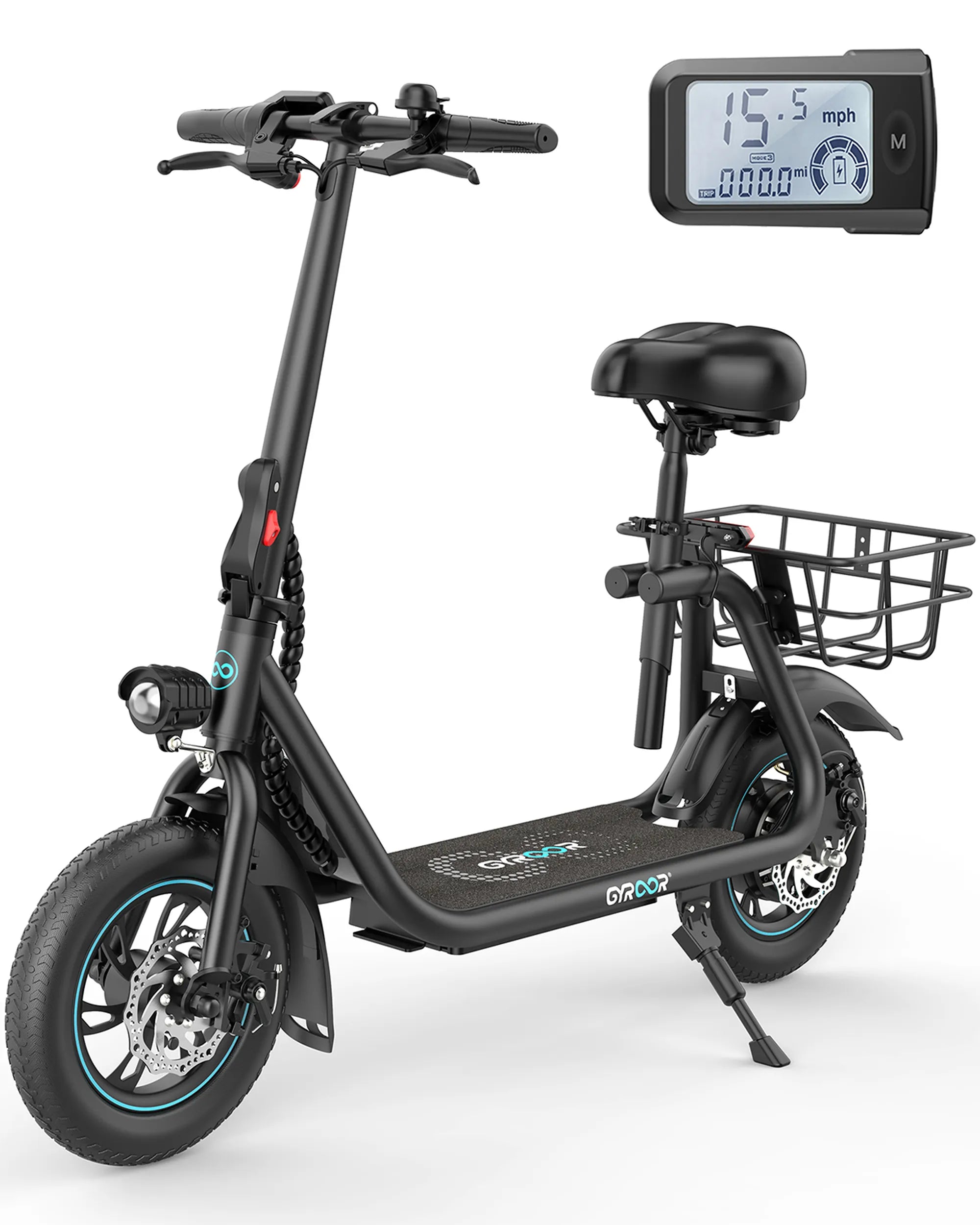
Introduction to 36V E-Bike Chargers: The Heart of Your Ride's Power System
A 36V e bike charger is far more than a simple plug-in adapter. It is the sophisticated, regulated power supply responsible for safely replenishing your electric bicycle's battery, which is the most critical and expensive component of your e-bike. Using the correct, high-quality 36V charger is non-negotiable for maintaining battery health, ensuring rider safety, and maximizing the lifespan of your entire electric drive system.
Every 36V lithium-ion battery pack, like those used in Gyroor e-bikes, requires a specific charging protocol. The charger must deliver a precise voltage and manage the current flow to safely bring each cell within the battery to its optimal charge state without causing stress or damage. An inferior or incompatible charger can lead to reduced range, permanent battery capacity loss, or even hazardous failures.
For brands that prioritize engineering and safety, such as Gyroor, the charger is an integral part of the product ecosystem. It is designed in tandem with the battery's management system (BMS) to create a seamless and secure charging cycle. Understanding your 36V e bike charger empowers you to take better care of your investment and enjoy worry-free riding.
This guide will delve into the technical specifications, critical safety features, best practices, and troubleshooting steps specific to 36V e-bike chargers. By the end, you will know exactly how to select, use, and maintain the charger that keeps your adventures powered.
Decoding Charger Specifications: Voltage, Amps, and Connectors
Reading the label on your 36V e bike charger reveals essential information about its capabilities and compatibility. The primary specifications are output voltage, current (amperage), power (wattage), and connector type. Misunderstanding these can lead to using the wrong charger with disastrous results.
Output Voltage (36V): This must match your battery's nominal voltage exactly. A 36V battery requires a 36V charger. Using a charger with a higher voltage (e.g., 48V) will severely overcharge and damage the battery, creating a fire risk. A lower-voltage charger will simply fail to charge the battery fully.
Output Current (Amps - A): This measures the flow of electrical current. Common ratings are 2A, 3A, or 4A. A higher amperage charger delivers energy faster, reducing charge time. However, it must be approved for your specific battery. Using an overly high-amp charger can overwhelm the battery's BMS, cause excessive heat, and accelerate degradation.
Output Power (Watts - W): This is calculated as Voltage x Amperage (e.g., 36V x 2A = 72W). It indicates the charger's overall power delivery capacity. A higher-wattage charger can replenish a larger battery capacity (Ah) more quickly, provided the battery is designed to accept that charge rate.
Connector Type: The physical plug that connects to your e-bike must be the correct polarity and size. Common types include barrel connectors, XLR, or proprietary designs. A forced or incorrect connection can short-circuit the terminals. Gyroor and other reputable brands use keyed or unique connectors to help prevent accidental misuse.
The Non-Negotiable Importance of UL Certification and Safety
When dealing with high-energy lithium-ion batteries, charger safety is paramount. This is where certifications like UL (Underwriters Laboratories) become critical. A UL-certified 36V e bike charger has undergone rigorous independent testing to meet stringent safety standards for electrical and fire hazards.
These chargers incorporate multiple layers of protection. Key safety features include over-voltage protection (to stop charging if voltage spikes), over-current protection (to prevent excessive amperage draw), short-circuit protection, and over-temperature protection. The charger should automatically switch to a trickle or maintenance mode and then shut off completely when the battery is full, preventing overcharging.
Gyroor's commitment to safety is exemplified by its use of UL-certified battery packs and matching chargers. This end-to-end certified system ensures that the charger and battery communicate effectively. The BMS in the battery and the smart circuitry in the charger work in concert, providing a double layer of monitoring that generic chargers lack.
Using an uncertified, off-brand charger is a significant gamble. It may lack these essential protections, potentially leading to a battery that overheats, swells, catches fire, or explodes during charging. The minor cost savings are never worth the risk to your property, your e-bike, and your personal safety.
OEM vs. Aftermarket Chargers: A Critical Comparison
When you need a replacement or a spare 36V e bike charger, you face a choice: purchase the Original Equipment Manufacturer (OEM) part from your e-bike brand or buy a generic aftermarket charger. This decision has major implications for performance, safety, and warranty.
| Feature | OEM Charger (e.g., Gyroor) | Generic Aftermarket Charger |
|---|---|---|
| Compatibility | Engineered specifically for the battery's BMS and cell chemistry. | May claim "universal" compatibility, often leading to poor communication with the BMS. |
| Safety Certifications | Typically includes UL, CE, or RoHS certifications. | Often lacks legitimate safety certifications; standards are unknown. |
| Warranty Status | Its use maintains the full manufacturer's warranty on the e-bike and battery. | Use may void the manufacturer's warranty if damage occurs. |
| Build Quality & Reliability | Higher-quality components designed for durability and consistent performance. | Inconsistent quality; may fail prematurely or perform erratically. |
| Technical Support | Full support from the manufacturer for troubleshooting. | Little to no product-specific support available. |
The primary risk of an aftermarket charger is incompatibility. Even if the voltage and connector fit, the charging algorithm may not match what your battery's BMS expects. This can cause the battery to charge inefficiently, fail to reach full capacity, or experience cell imbalance over time, dramatically shortening its life.
Furthermore, brands like Gyroor explicitly state in their warranty terms that damage caused by the use of non-approved accessories, including chargers, is not covered. Protecting your investment of several hundred dollars in a battery by using a certified OEM charger is the only prudent choice.
Optimal Charging Practices and Charger Maintenance
How you use and care for your 36V e bike charger directly impacts its lifespan and reliability. Proper handling is simple but crucial. Always start by plugging the charger into the wall outlet before connecting it to your e-bike. This sequence prevents arcing at the connector, which can damage the contacts over time.
Store your charger properly when not in use. Avoid tightly wrapping the power cord, as this can stress and break the internal wires. Instead, coil it loosely. Keep the charger and its connectors clean, dry, and free of debris. While Gyroor e-bikes feature IPX5 water-resistant designs, the charger itself is an electronic device that must be kept dry.
Environmental factors matter. Charge your e-bike in a dry, well-ventilated area at room temperature. Avoid charging in direct sunlight, in a freezing garage, or in a hot car trunk. Extreme temperatures stress both the battery and the charger's internal components. Unplug the charger from the wall once charging is complete to save energy and reduce any minimal standby load on its circuitry.
Regularly inspect the charger, cables, and connector for any signs of damage: fraying wires, cracks in the casing, bent pins, or burn marks. If you notice any damage, or if the charger becomes unusually hot to the touch, discontinue use immediately and contact the manufacturer for a replacement. A well-maintained charger should last for the life of the e-bike.
Troubleshooting Common 36V Charger and Charging Issues
When your e-bike won't charge, a systematic approach can help identify whether the issue lies with the charger, the battery, or the connection. Follow these steps before assuming you need a new 36V e bike charger.
Charger Shows No Light/No Power: First, ensure the wall outlet is working by testing it with another device. Check that the charger is firmly plugged in at both ends (wall and bike). Inspect the fuse in the charger's plug (if accessible). If there is still no power, the charger's internal circuitry may have failed.
Charger Light Stays Green (Does Not Turn Red When Connected): This usually indicates the charger is not detecting the battery. Ensure the connector is fully and cleanly inserted into the e-bike's charge port. The issue could be a dirty charge port, a faulty connection in the cable, or a problem with the battery's BMS preventing it from accepting a charge.
Charger Light Stays Red for an Exceptionally Long Time: A standard charge for a depleted battery typically takes 4-8 hours. If the red light persists for 12+ hours, it may indicate a failing battery cell or a significant imbalance within the battery pack. The charger is trying to bring a weak cell up to voltage but cannot. This requires professional diagnosis.
Charger Gets Excessively Hot: It is normal for a charger to be warm during operation. However, if it becomes too hot to touch comfortably, this is a danger sign. Unplug it immediately. This can be caused by a failing internal component, a short circuit, or attempting to charge a severely damaged battery.
For any persistent issue, especially with a charger under warranty, your first action should be to contact the manufacturer's support. Gyroor's US-based customer service can provide model-specific guidance and warranty service, ensuring a safe resolution.
Advanced Topics: Smart Chargers and Battery Management
Modern 36V e bike chargers, particularly OEM models from quality brands, are "smart" chargers. They do not simply pump in electricity; they follow a multi-stage charging profile in coordination with the Battery Management System (BMS) embedded in the battery pack.
The standard profile is Constant Current (CC) followed by Constant Voltage (CV). Initially, the charger delivers a constant amperage (e.g., 2A) to quickly bring the battery up to about 80-90% capacity. Once the battery voltage reaches the peak (typically around 42V for a 36V system), the charger switches to constant voltage mode, gradually tapering the current as the cells top off. This CV phase is crucial for battery health and longevity.
The BMS is the brain of the battery pack. It monitors individual cell voltages, temperatures, and overall pack health. During charging, it communicates with the charger (or instructs it via voltage signals) to regulate the process. If the BMS detects a cell overheating, exceeding voltage, or other fault, it will open the circuit and stop charging entirely to prevent damage.
This synergy is why a matching OEM charger is so important. A generic charger may not properly execute the CV phase or respond to the BMS's signals, leading to undercharging or stress on the cells. Investing in a smart 36V e bike charger is an investment in preserving your battery's capacity over its entire 500+ charge cycle lifespan.
FAQ: Your 36V E-Bike Charger Questions Answered
Q1: Can I use a faster charger (higher amp rating) with my 36V e-bike?
A: No, not unless the manufacturer explicitly states your model can accept a higher amperage. Using a charger with a higher amp output than designed for (e.g., a 4A charger on a system built for 2A) can force excessive current into the battery. This generates heat, stresses the cells, and can trigger the BMS to fault or be damaged, potentially voiding your warranty.
Q2: Is it safe to leave my e-bike plugged in overnight?
A: While modern smart chargers like those from Gyroor have auto-shutoff features, it is considered best practice to unplug once the charge indicator shows completion (e.g., light turns green). This eliminates any remote risk from a charger fault, saves energy, and is generally better for long-term electronics health. Avoid regularly leaving it plugged in for days on end.
Q3: What should I do if I lose or damage my original charger?
A: You should purchase an official replacement directly from your e-bike manufacturer or an authorized dealer. For a Gyroor e-bike, order the specific 36V charger model for your bike from gyroorboard.com. This guarantees compatibility, safety, and that your battery warranty remains intact. Have your e-bike model number ready when ordering.
Q4: Can I charge my e-bike in the rain?
A: Absolutely not. The charger is an electronic device and is not waterproof. Always charge in a dry, sheltered location. Although the e-bike's battery compartment may have water-resistant seals, exposing the charger and the connection point to water can cause short circuits, electric shock, or irreparable damage to the charger and bike.
Q5: How can I tell if my 36V e bike charger is failing?
A: Warning signs include: taking much longer than usual to charge, not completing a charge (light never turns green), getting abnormally hot, making buzzing or humming noises, showing any physical damage like a cracked case or frayed wire, or simply not powering on at all. At the first sign of these issues, stop using it and seek a replacement.
Powering Your Journey with Confidence and Safety
Your 36V e bike charger is a small component with a massive responsibility. It is the guardian of your e-bike's most vital system. Choosing a high-quality, UL-certified charger from a reputable brand like Gyroor is the foundation for thousands of miles of reliable, safe, and enjoyable riding. It protects your financial investment and provides invaluable peace of mind.
The data is clear: proper charging practices with the correct equipment dramatically extend battery life, maintain peak performance, and prevent safety incidents. By understanding the specifications, respecting the safety protocols, and using only approved accessories, you become an active partner in the longevity of your electric bike.
Do not compromise on power. The right 36V e bike charger ensures that every journey begins with a full charge and the confidence that comes from equipment built to the highest standards. It transforms charging from a mundane task into a seamless part of your riding experience, guaranteed by engineering and certification.
Ready to ensure your e-bike is always powered safely and efficiently? Browse the full Gyroor collection of e-bikes, UL-certified batteries, and official replacement chargers at gyroorboard.com. Invest in quality power for miles of confidence.
Ebike Error 30: The Complete Diagnosis and Repair Guide
Class Two E Bike: The Complete Guide to Throttle-Enabled Electric Bikes