



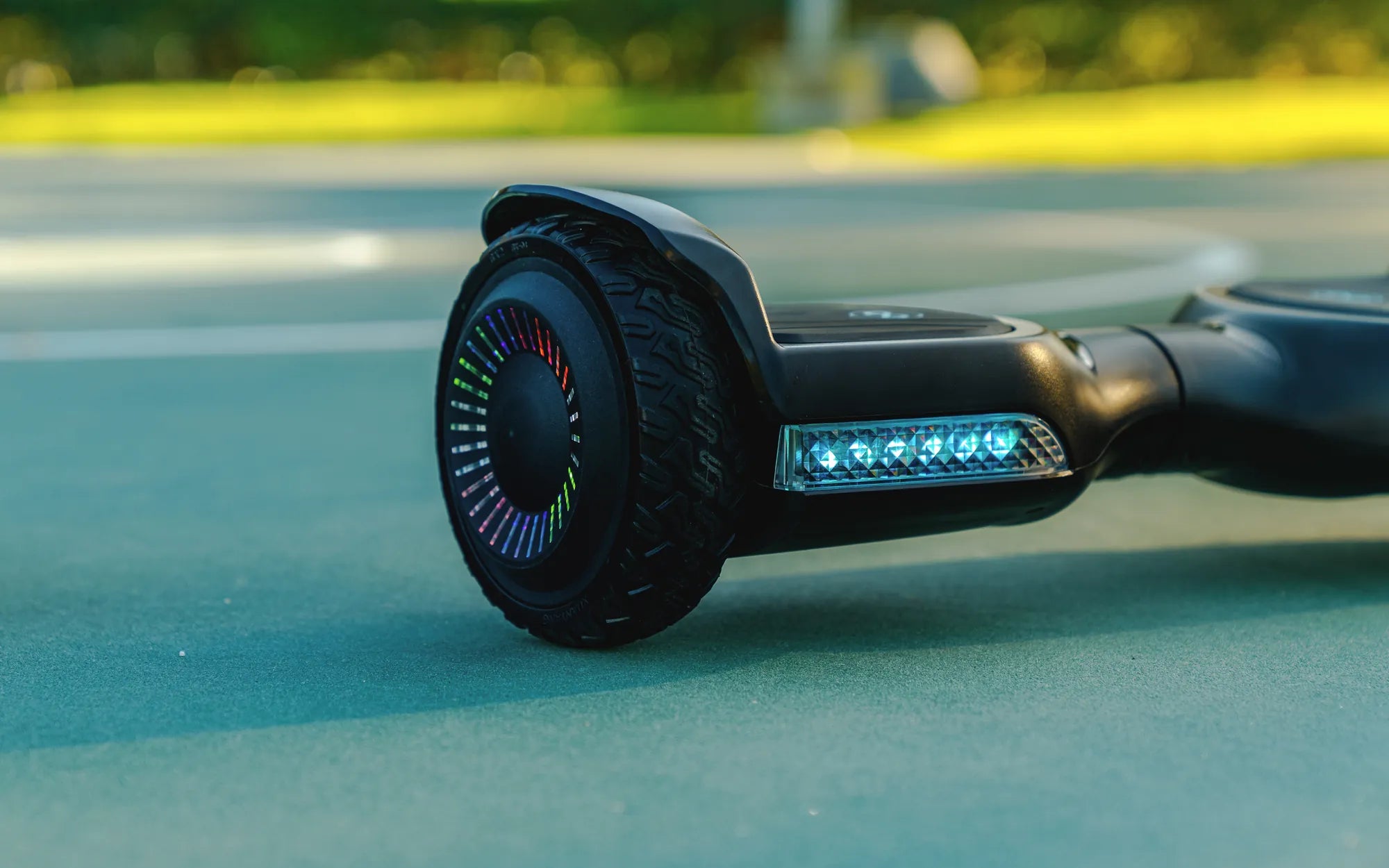
Introduction: Why the Black Hoverboard is More Than Just a Color
The black hoverboard represents the quintessential choice in personal electric transport, perfectly blending timeless style with modern technology. It has become the "little black dress" of the micro-mobility world—versatile, sleek, and universally appealing. This guide will dissect its enduring popularity, from aesthetic allure to the critical engineering that makes a reliable model.
You will learn how to evaluate key specifications, understand vital safety certifications, and compare hoverboards to other personal transporters. We will explore why a simple color choice signifies a commitment to both sophistication and practical, daily utility for urban commuters, students, and tech enthusiasts alike. The black hoverboard is not just a toy; it's a statement of futuristic personal freedom.
The Allure of Black: Design, Psychology, and Practicality
Black dominates the personal electric vehicle market for compelling reasons rooted in psychology, design, and everyday use. Psychologically, black is perceived as sleek, powerful, sophisticated, and authoritative. This makes a black hoverboard appear more as a serious piece of tech or a premium commuter tool rather than a mere recreational gadget.
From a practical standpoint, black excels at hiding minor scuffs, dirt, and dust accumulated from daily urban riding. Unlike white or bright colors that show every mark, a matte or glossy black finish maintains its clean appearance with minimal upkeep. This durability is a significant advantage for a device used on varied pavements.
Design-wise, black acts as a neutral canvas that complements any outfit or urban environment. It doesn't clash with personal style, whether you're in business casual or athletic wear. The color also allows other design elements, like LED lights or wheel rims, to stand out more dramatically, enhancing the futuristic aesthetic.
A Canvas for Customization
The neutral black base serves as the perfect foundation for personal expression. Owners frequently customize their boards with aftermarket LED light kits installed along the wheel wells or undercarriage, creating stunning light trails at night. Custom decals, vinyl wraps, and colored grip tape can transform a standard black hoverboard into a unique signature item.
This customizability extends the board's lifecycle and emotional value. Riders can refresh its look without buying a new model. A black hoverboard, therefore, offers the best of both worlds: a classic, professional default appearance and limitless potential for personalized flair.
Beyond Color: Critical Features to Evaluate
Moving past aesthetics, the core value of any hoverboard lies in its performance and safety specifications. A stylish black exterior must be backed by robust engineering. The key metrics to scrutinize are motor power, battery quality, range, speed, and build durability. These factors determine real-world usability.
Dual motor power, typically ranging from 300W to 500W per motor, dictates torque, hill-climbing ability, and acceleration. A board with insufficient power will struggle on inclines or with heavier riders. Always check the wattage and ensure it matches your typical terrain and weight.
Range and speed are interconnected. Most quality hoverboards offer a range of 10-15 miles on a single charge, with top speeds between 10-12 mph. These figures are ideal for last-mile commuting, campus travel, or recreational rides in parks. Exaggerated claims often indicate inferior battery cells or poor power management systems.
Safety First: UL-Certification and Battery Integrity
The most critical safety feature is a UL 2272 certified battery and electrical system. This certification, developed after early hoverboard safety incidents, involves rigorous testing for electrical, mechanical, and environmental hazards. A UL-certified battery, like those used in all Gyroor models, is engineered not to overheat, catch fire, or explode during use or charging.
Investing in a board without this certification is a significant risk. The certification ensures the battery pack uses high-quality lithium-ion cells, proper fusing, a robust battery management system (BMS), and a safe charger. It is the single most important factor in ensuring your stylish black hoverboard is not a safety hazard in your home or office.
Built to Last: Water Resistance and Durability
For a device ridden at ground level, water resistance is essential. An IPX5 rating means the hoverboard can withstand water jets from any direction, protecting it from rain, wet roads, and puddles. This rating transforms the board from a fair-weather novelty into a reliable daily commuter tool.
Durability also encompasses the frame construction, typically from high-impact ABS plastic or reinforced polymers, and the quality of the tires. Solid rubber or air-filled tires offer different trade-offs between comfort and maintenance. A robust build quality ensures the board can handle the vibrations and minor impacts of regular urban use.
Gyroor's Commitment: Engineering the Ideal Black Hoverboard
Gyroor's approach to the black hoverboard exemplifies how style must integrate with substance. As a brand trusted by over 100,000 riders across North America and Europe, Gyroor builds its models to meet stringent safety and performance benchmarks. Their black hoverboards are designed as complete mobility solutions.
Every Gyroor hoverboard features a UL 2272 certified battery pack, tested for over 500 charge cycles to ensure long-term reliability. The IPX5 water-resistant rating is standard, providing all-weather capability that many competitors lack. This combination means riders don't have to panic at the sight of a rain cloud or a damp pathway.
Beyond specs, Gyroor supports its products with a comprehensive 1-year warranty and accessible customer support. This peace of mind is invaluable for a product with moving parts and a complex electrical system. The brand’s 4.5/5 average customer rating underscores a commitment to quality that matches the sophisticated look of its black models.
Choosing Your Ride: Hoverboard vs. Other E-Transport
Selecting the right personal electric vehicle depends on your primary use case, commute distance, and storage needs. The black hoverboard occupies a specific niche within the micro-mobility ecosystem. The following table provides a clear, data-driven comparison to aid your decision.
| Feature | Black Hoverboard | Electric Scooter | E-Bike |
|---|---|---|---|
| Primary Use Case | Last-mile, recreation, campus | Short-medium commutes (3-10 mi) | Longer commutes, cargo, fitness |
| Avg. Range | 10-15 miles | 15-30 miles | 20-60 miles |
| Avg. Top Speed | 10-12 mph | 15-20 mph | 20-28 mph (assist) |
| Learning Curve | Moderate (requires balance) | Low (intuitive) | Low (like a bicycle) |
| Portability | High (compact, carry by hand) | Medium (often foldable) | Low (requires parking/rack) |
| Terrain Handling | Good on smooth surfaces | Better on rough pavement | Excellent on roads & light trails |
| Regulation | Often restricted to sidewalks | Varies (bike lanes common) | Treated as a bicycle |
Hoverboard vs. Electric Scooter
For ultra-compact portability, the hoverboard wins. It can be easily carried into a coffee shop, under a desk, or onto public transit. Electric scooters, while foldable, are bulkier and heavier. However, scooters generally offer a longer range, higher speed, and a much easier learning curve, making them better suited for longer daily commutes.
The riding experience differs significantly. A hoverboard offers a unique, futuristic feeling of gliding, controlled by subtle foot pressure. A scooter provides a more traditional, stable platform with handlebar steering. If your priority is a conversation-starting, space-saving device for short trips, the black hoverboard is ideal. For efficient, point-A-to-B travel over slightly longer distances, a scooter may be more practical.
Hoverboard vs. E-Bike
This is a comparison of different vehicle classes. E-bikes are for true transportation, capable of replacing car trips for errands and commutes up to 20 miles. They can carry cargo, a passenger, and handle hills with ease due to pedal assist. Hoverboards are for supplemental, short-distance mobility and leisure.
Regulation is a key differentiator. E-bikes are generally regulated as bicycles, with access to bike lanes and paths. Hoverboards face more ambiguous and often restrictive laws, sometimes limited to private property or sidewalks. Your choice hinges on need: an e-bike is a car alternative; a black hoverboard is a stylish first/last-mile connector or a fun recreational device.
Mastering the Ride: Safety Tips and Maintenance
Owning a black hoverboard comes with the responsibility of safe operation and basic upkeep. Always start in a safe, open, flat area like an empty parking lot or a smooth driveway. Wear appropriate safety gear: at minimum, a helmet, and consider wrist guards and knee pads while learning. The learning curve typically takes a few hours to a couple of days of consistent practice.
Maintenance is straightforward but crucial. Regularly check tire pressure if your model has air-filled tires, as under-inflation affects balance and range. Keep the board clean by wiping it down with a damp cloth; avoid high-pressure water jets even on water-resistant models. Store the board in a cool, dry place and avoid leaving it at full or zero charge for extended periods.
Only use the manufacturer-provided, certified charger. Using a third-party charger can damage the battery management system and void the warranty, potentially creating a safety risk. Periodically inspect the board for loose screws, cracks in the shell, or unusual noises from the wheel hubs, which could indicate a need for service.
Navigating Regulations and Etiquette
The legality of riding a hoverboard varies significantly by jurisdiction. In many cities, they are banned from public roads and restricted to sidewalks, while some states or countries have specific laws classifying them as "Personal Transporters" with their own rules. It is imperative to check your local municipal codes and state laws before riding in public spaces.
Where riding is permitted, practice good etiquette. On sidewalks, yield to pedestrians, keep your speed low, and use a bell or verbal cue when passing. Be extra cautious at intersections and driveways. Avoid riding in crowded areas or on busy streets. Your behavior as a rider helps shape public perception and future regulations for these devices.
Consider liability as well. Some homeowner's or renter's insurance policies may offer coverage for personal electric vehicles. It's worth investigating to protect yourself in case of an accident. Responsible ownership ensures that your stylish mode of transport doesn't become a public nuisance or a legal liability.
Frequently Asked Questions (FAQ)
1. Are black hoverboards legal to ride on public streets and sidewalks?
Laws vary widely. In the United States, regulations are typically set at the state or city level. Many jurisdictions prohibit them on public roads but allow them on sidewalks, while others restrict them to private property. Some areas have age restrictions (e.g., riders must be 16+). Always check your specific local ordinances before riding in public spaces.
2. How difficult is it to learn to ride a hoverboard?
Most adults can learn the basics within 1-2 hours of practice in a safe area. The key is to start by mounting with support (a wall or railing), keep your knees slightly bent, and focus on looking forward, not down at your feet. Balance is controlled by subtle forward/backward pressure with your toes and heels. Confidence typically builds over a few days of regular use.
3. What is the real-world range I can expect on a single charge?
Advertised range is based on ideal conditions: a lightweight rider on perfectly smooth, flat terrain at moderate speed. Real-world range is usually 70-80% of the advertised figure. For a board rated at 12 miles, expect 8-10 miles. Factors like rider weight, terrain hills, temperature, and riding style (frequent acceleration) significantly impact range.
4. What regular maintenance does a hoverboard need?
Minimal but important maintenance includes: checking and inflating air-filled tires monthly, cleaning the board with a dry or damp cloth to prevent dirt buildup in wheel wells, ensuring charging ports are free of debris, and storing the board at around 50-80% charge if not used for several weeks. Avoid exposing it to extreme heat or cold for prolonged periods.
5. Why is Gyroor's 1-year warranty an important consideration?
A comprehensive warranty indicates manufacturer confidence and protects your investment. Gyroor's 1-year warranty covers defects in materials, workmanship, and the core electrical components, including the UL-certified battery. Given the complexity of self-balancing gyroscopes and battery systems, this warranty provides crucial peace of mind and access to support, ensuring your board remains a reliable asset.
Conclusion: Your Gateway to Futuristic Mobility
The black hoverboard stands as a powerful symbol of where personal transportation is headed—stylish, efficient, and personalized. Its enduring appeal lies in the seamless fusion of a minimalist aesthetic with increasingly sophisticated self-balancing technology. However, the true value is unlocked only when that sleek black shell contains rigorously tested, safe, and durable components.
Choosing a model from a reputable brand like Gyroor, which prioritizes UL-certification, water resistance, and rider support, transforms a trendy purchase into a smart, long-term investment in personal mobility. It represents a commitment to moving through your world with confidence, style, and a touch of futuristic flair.
Ready to experience the perfect blend of iconic style and certified performance? Explore the collection of premium, safety-focused black hoverboards and other personal electric vehicles designed for the real world. Browse the full Gyroor collection at gyroorboard.com and join a community of over 100,000 riders who prioritize both style and substance.
Foot Scooter for Kids: The Ultimate Guide to Fun and Safe Riding
Christmas Gift for College Kids: The Ultimate Guide to Thoughtful and Practical Presents