


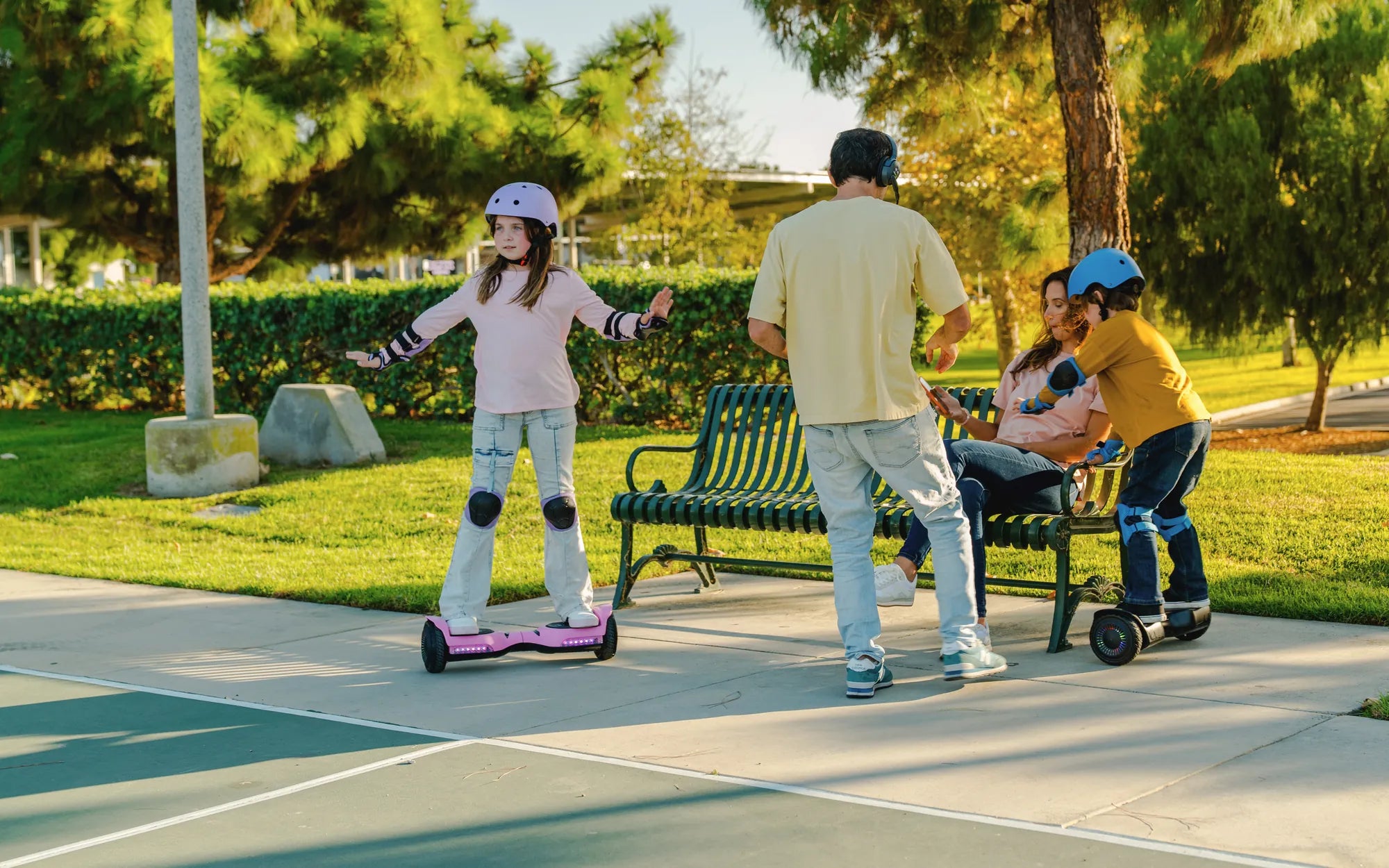
Introduction: Why a Hoverboard is the Perfect Gift for Your 6-Year-Old
Finding the right balance of fun, development, and safety in a toy can be a challenge. A hoverboard for a 6 year old, when chosen correctly, hits that sweet spot perfectly. It’s more than just a cool gadget; it’s a tool that promotes outdoor activity, develops core balance and coordination, and builds a child's confidence through skill mastery.
Naturally, parental concerns about safety, durability, and age-appropriateness are paramount. This guide directly addresses those concerns with data-driven advice and specific feature requirements. We focus on products engineered for this age group, like those from Gyroor, a leading electric scooter and e-bike brand trusted by over 100,000 riders, which prioritizes certified safety and robust design to ensure peace of mind for parents and endless fun for kids.
What Makes a Hoverboard Safe and Suitable for a 6-Year-Old?
Not all hoverboards are created equal, especially for young riders. A model suitable for a 6-year-old must have specific engineering and design philosophies that cater to their smaller size, lighter weight, and developing motor skills. The core requirements differ significantly from those for teens or adults.
The ideal hoverboard for this age group acts as a stable, forgiving platform for learning. It must have built-in limits on power and speed, exceptional stability from a well-calibrated gyroscope system, and physical construction that can withstand the inevitable bumps and tumbles of the learning process. Safety isn't an optional feature; it's the foundational design principle.
Key Safety Features to Prioritize
When evaluating a hoverboard for a 6 year old, certain safety certifications and features are non-negotiable. These are your primary filters to ensure a fundamentally safe product.
UL 2272 Certification: This is the absolute minimum requirement. This certification, developed by Underwriters Laboratories, tests the entire electrical system—battery, charger, and circuitry—for fire and electrical hazards. Never purchase a hoverboard without this certification.
Robust Bumper and Shell Design: The housing should be made of high-impact ABS plastic. Look for models with thick, wraparound rubber bumpers that absorb shock from collisions and protect the internal components during falls.
Beginner or Learning Mode: A dedicated slow-speed mode is essential. This mode should limit the top speed to a safe crawl (typically 3-5 mph), making initial balance and control much easier to master and significantly reducing the impact of any fall.
Bright LED Lights: Front, rear, and wheel rim LEDs are crucial for visibility. They make your child visible to others during dusk or in shaded areas, and they also add to the fun factor, which encourages use in safe, well-lit conditions.
Design & Ergonomics for Young Riders
The physical design must match a child's proportions. An adult-sized hoverboard will be too large, heavy, and intimidating for a 6-year-old to control safely.
Wheel Size (6.5" to 8"): This range offers the best compromise for a 6-year-old. Smaller 4.5" wheels are less stable on uneven surfaces, while wheels over 8.5" raise the deck height and center of gravity, making balancing harder. 6.5" or 8" wheels provide stability and a manageable deck height.
Weight Limit & Board Weight: The hoverboard must support your child's weight with a healthy margin. Look for a minimum weight limit of 44 lbs and an ideal range up to 88-120 lbs to allow for growth. The board itself should be lightweight (under 20 lbs) for a child to carry and maneuver.
Foot Pad Design: The foot pads should be textured or rubberized to provide grip, even when wearing sneakers. They should also be appropriately sized for a child's shoe, allowing them to stand comfortably without their feet hanging too far over the edges.
Top Considerations When Choosing a Hoverboard for a 6-Year-Old
Beyond the core safety specs, several practical factors determine whether a hoverboard will be a lasting source of joy or a short-lived frustration. This checklist helps parents evaluate real-world usability and long-term value.
Consider the typical riding environment: a smooth driveway, sidewalk cracks, or dry park grass. Also, think about storage and charging logistics in your home. The goal is to select a product that fits seamlessly into your child's play routine and your family's lifestyle, with minimal hassle and maximum safety.
Battery Life and Charging Safety
Battery performance and safety are intrinsically linked. A reliable battery ensures predictable fun, while safe charging practices prevent hazards.
UL-Certified Battery Packs: This cannot be overstated. Gyroor, for instance, uses UL-certified battery packs tested for over 500 charge cycles. This certification is your guarantee against the thermal runaway and fire risks associated with uncertified, poor-quality cells.
Expected Range: For a 6-year-old, a range of 6 to 10 miles per charge is more than sufficient. It allows for extended play sessions without frequent interruptions. Real-world range is affected by weight, terrain, and speed mode.
Safe Charging Practices: Always use the manufacturer-provided charger. Charge the hoverboard on a hard, non-flammable surface in an open area—never on a bed or carpet. Adult supervision during charging is a simple, critical rule. A full charge typically takes 2-4 hours.
Speed Modes and Parental Controls
Controllable speed is the cornerstone of a child-friendly hoverboard. It allows for a graduated learning curve and lets parents set appropriate limits.
Beginner Mode Speed (≤ 5 mph): The initial learning mode should have a soft start and a top speed no higher than 5 mph. This speed is fast enough to be exciting but slow enough that a child can step off safely if they lose balance.
App-Based Parental Controls: Some advanced models, including certain Gyroor hoverboards, offer Bluetooth connectivity with a smartphone app. This can allow parents to lock the speed limit, monitor battery life, and even create a geofence to alert if the board leaves a designated safe area.
Skill Progression: As your child's confidence and skill grow, they can graduate to medium (7-9 mph) and possibly high-speed modes (10+ mph). The ability to switch modes means the hoverboard grows with your child, extending its useful life for years.
Durability and Weather Resistance
Kids are not gentle. A hoverboard must be built to handle curb jumps, sudden stops, and the occasional tip-over. Weather resistance further enhances practicality.
Rugged Construction: Look for reinforced wheel axles, a sturdy deck, and sealed joints. The hoverboard should feel solid, not hollow or flimsy. A robust build protects the expensive internal gyroscopes and motors.
IPX5 Water-Resistant Rating: This is a significant feature for real-world use. An IPX5 rating, a standard on Gyroor models, means the board can withstand water jets from any direction. In practice, this allows riding on damp pavement, through morning dew on grass, or in light sprinkles without fear of water damage to the electronics.
Tire Type: Solid rubber tires are maintenance-free and puncture-proof, ideal for most surfaces. Some models offer air-filled tires for a slightly smoother ride on very rough terrain, but these require occasional pressure checks.
The Gyroor Advantage: Engineered for Young Adventurers
When evaluating brands, Gyroor stands out by translating its core engineering principles into direct benefits for young riders and their parents. Their approach isn't about adding flashy gimmicks but about building inherent safety and reliability from the ground up.
With over 20 models in their lineup, their experience in personal electric transport informs their design for younger audiences. The focus is on creating a product that parents can trust implicitly, allowing children to explore and play with confidence. This peace of mind is the ultimate value proposition.
Built-in Safety from the Ground Up
Gyroor’s safety philosophy is proactive and certification-led. They don't treat safety standards as a hurdle but as a baseline design requirement.
Every Gyroor hoverboard features a UL 2272 certified system, with the battery pack itself also carrying UL certification. This double layer of assurance addresses the most critical risk factor head-on. Furthermore, their comprehensive 1-year warranty, backed by US-based customer support, provides a long-term safety net for any manufacturing defects, ensuring you’re not alone after the purchase.
Confidence on Any Surface
The IPX5 water-resistant rating standard on Gyroor hoverboards unlocks true all-terrain play for kids. It transforms the hoverboard from a fair-weather toy into a more versatile piece of play equipment.
A child isn't always going to wait for the pavement to be perfectly dry. With this level of protection, they can safely ride on a driveway after a rain shower, cut across a dewy lawn, or navigate sidewalk puddles without causing internal damage. This durability means less worry for parents and more spontaneous fun for kids, whether on the driveway, park path, or dry grass.
Getting Started: A Parent's Guide to First-Time Riding
The first ride is crucial for building confidence and establishing safe habits. A structured, patient approach will lead to success. Rushing this process can lead to frustration or minor accidents that sour the experience.
Allocate at least 30-60 minutes for the first session in a wide-open, flat, and smooth area like an empty tennis court, basketball court, or a clean garage. Your role is as a spotter and coach, not just a spectator. Positive reinforcement is key.
Essential Safety Gear is Non-Negotiable
Before the hoverboard is even turned on, full safety gear must be worn and properly fitted. This is non-negotiable for every single ride.
Helmet: A properly fitted CPSC-certified bicycle or multi-sport helmet is mandatory. It should sit level on the head, covering the forehead, with straps snug under the chin.
Knee and Elbow Pads: These protect the joints most likely to impact the ground during a fall. Ensure they fit snugly without restricting movement.
Wrist Guards: These are arguably the second most important piece of gear after the helmet. When falling, the instinct is to put hands out, making wrists highly vulnerable to sprains or fractures. Wrist guards provide critical support.
The Step-by-Step Learning Process
Break down the skill into manageable stages. Celebrate small victories at each step to keep motivation high.
Step 1: Finding Balance (Off): Place the hoverboard on carpet or grass (for extra stability) and turn it off. Let your child step onto it, holding your hands or a stable object like a fence, just to get used to the feeling of standing on it.
Step 2: Mounting and Dismounting: Teach the one-foot-on, then quick-step method. With the board on and in beginner mode, place one foot firmly on a foot pad, then quickly but smoothly bring the other foot up. To dismount, step backward off the board with one foot, then the other—never jump off.
Step 3: Forward and Backward: On a soft surface, have them practice leaning ever so slightly forward on their toes to go forward and back on their heels to go backward. The key is tiny, controlled movements.
Step 4: Turning: Once linear movement is comfortable, explain that turning is done by pressing one toe forward (to turn the opposite direction) or one heel back. Start with wide, gentle arcs.
Setting House Rules for Hoverboard Use
Clear rules establish a safe framework for independent play as skills improve. Post these rules in the garage or near the charging station.
- Supervision: An adult must be present and actively watching while riding, especially for younger or less experienced riders.
- Safe Zones: Ride only on private driveways, sidewalks (watching for driveways), parks, or other designated areas. Never near streets, swimming pools, stairs, or heavy pedestrian traffic.
- Speed Mode Lock: The hoverboard must remain in beginner or parent-approved speed mode.
- Storage & Charging: The board is stored in a dry place and charged only by an adult using the correct charger.
Hoverboard Comparison: Key Features for a 6-Year-Old
This comparison table highlights the critical differences between a generic, low-specification model and a hoverboard built to child-specific standards, like those from Gyroor. It illustrates why feature selection directly impacts safety and enjoyment.
| Feature | Basic / Uncertified Model | Child-Optimized Model (e.g., Gyroor) |
|---|---|---|
| Safety Certification | None or fake UL stickers | UL 2272 System & Battery Certified |
| Top Speed (Beginner Mode) | Often 7+ mph, no true beginner mode | Limited to ≤ 5 mph with soft start |
| Build Quality | Thin plastic, weak bumpers | High-impact ABS, thick rubber bumpers |
| Water Resistance | None (IPX0) | IPX5 (withstands water jets) |
| Battery & Warranty | Uncertified cells, 90-day warranty | UL-certified cells, 1-Year Comprehensive Warranty |
| Weight Limit | May be too high/low, poorly tested | Optimized for 44-120 lbs range |
| Long-Term Value | High risk of failure, no support | Grows with child, reliable, supported |
Frequently Asked Questions (FAQs) for Parents
Q1: Are hoverboards safe for a 6-year-old?
Yes, when you choose a model specifically designed for children with non-negotiable safety features. The key is selecting a hoverboard with UL 2272 certification, a slow beginner mode (≤5 mph), robust construction, and ensuring your child always wears full safety gear (helmet, knee/elbow pads, wrist guards). Parental supervision during riding and charging is essential.
Q2: What is the appropriate speed for a beginner 6-year-old?
The beginner or learning mode should have a maximum speed of 5 miles per hour or less. This speed allows for controlled learning and significantly reduces the force of any potential fall. Higher speed modes (7mph, 10mph) should only be unlocked after the child has demonstrated complete mastery at the lower speed and with explicit parental permission.
Q3: How long does the battery last, and is charging safe?
A quality hoverboard for a 6-year-old typically offers 6 to 10 miles of range per 2-4 hour charge, which is ample for multiple play sessions. Charging safety is ensured by using only the manufacturer's provided charger, charging on a hard, non-flammable surface (never on beds/carpets), and with adult supervision. Brands like Gyroor use UL-certified battery packs for added safety.
Q4: What if my child outgrows it quickly?
Choose a hoverboard with a higher weight limit (e.g., up to 120 lbs) and multiple speed modes. This allows the physical product to accommodate your child's growth, and the higher speed modes provide a new challenge as their skills advance, extending the toy's relevance for several years.
Q5: What does Gyroor's warranty cover?
Gyroor offers a comprehensive 1-year warranty that covers manufacturing defects in materials and workmanship for the main unit, including the motor, gyroscope system, and frame. Their US-based customer support team handles claims, providing peace of mind and reliable service should any issue arise.
Conclusion: Fostering Fun and Confidence with the Right Choice
Selecting the right hoverboard for your 6 year old is an investment in active, outdoor play and developmental growth. The joy and confidence a child gains from mastering this skill are immense. By prioritizing certified safety (UL 2272), child-specific design (slow speed modes, appropriate size), and durable, weather-resistant construction, you unlock this experience without compromise.
Brands that build to these higher standards, like Gyroor with its UL-certified batteries, IPX5 rating, and robust warranty, deliver the peace of mind that allows the fun to flourish. Remember, the right hoverboard isn't just a toy for today; it's a platform for adventure that can grow with your child for years to come.
Ready to find the perfect, safety-first hoverboard for your young rider? Browse the full Gyroor collection at gyroorboard.com to explore models engineered for fun, built for safety, and trusted by over 100,000 families.
Riding Self Balancing Scooter: The Future of Urban Mobility
Self Balancing Scooter Parts: The Ultimate Guide to Maintenance and Upgrades