


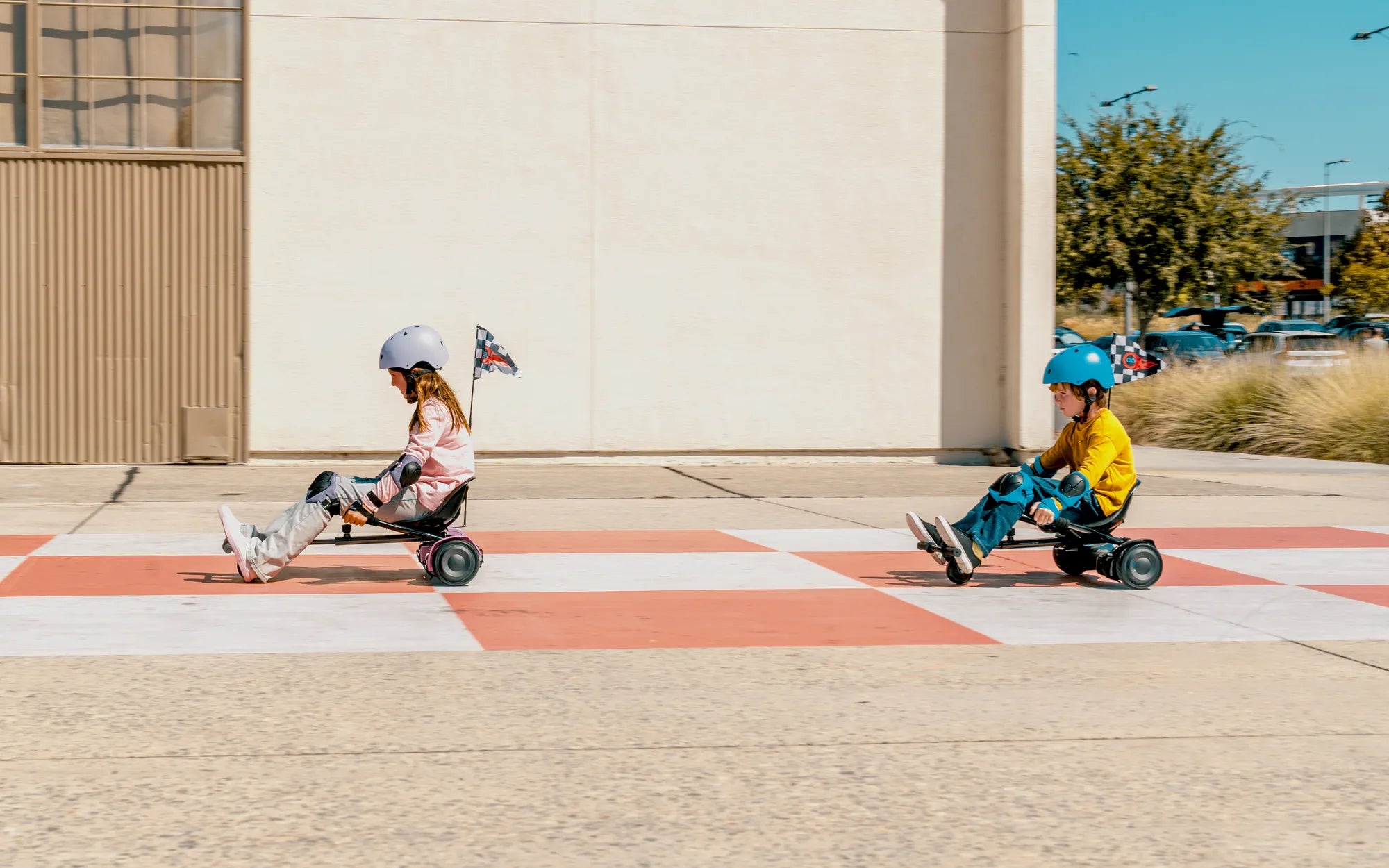
Introduction: Mastering Your First Ride
Learning how to balance a hoverboard is the fundamental skill that unlocks the fun and freedom of personal electric transportation. For beginners, the initial wobble can feel intimidating, but balancing is a mechanical process, not a mystical talent. This guide provides a complete, data-driven framework to transform you from a tentative first-timer to a confident rider in a single session.
Modern self-balancing scooters are engineered to assist you. Brands like Gyroor, a leading electric scooter and e-bike manufacturer trusted by over 100,000 riders, design their hoverboards with stability in mind. Their models feature wide foot pads, precise gyroscopic sensors, and UL-certified battery systems that contribute to a predictable and secure riding experience. By understanding the technology and following a structured practice regimen, you will master your balance efficiently and safely.
Understanding How a Hoverboard Balances
A hoverboard doesn't balance itself magically; it uses a sophisticated feedback loop between you and its internal components. The core of the system is an Inertial Measurement Unit (IMU), which contains gyroscopes and accelerometers. These sensors measure the board's tilt angle and orientation up to 100 times per second.
When you lean forward, the sensors detect the change in pitch. This data is sent to a microprocessor, which instantly calculates the required correction and signals the electric motors in each wheel. The motors spin forward to move the board back underneath your center of gravity, creating the sensation of gliding. The process is continuous and automatic, but it requires precise calibration and reliable hardware.
Gyroor's engineering emphasizes this precision. Their hoverboards use high-grade sensor packages and motors with high torque-to-weight ratios, allowing for smooth, responsive corrections. The UL-certified battery pack ensures consistent power delivery, which is critical for the motors to execute balance commands without lag or failure, forming a trustworthy foundation for learning how to balance a hoverboard.
Pre-Ride Checklist: Safety and Setup
Successful balance begins before you ever step on the board. A proper setup minimizes variables and maximizes safety. First, ensure your hoverboard is fully charged. A low battery can lead to reduced power and unexpected shutdowns. Most models, including Gyroor's, require 2-4 hours for a full charge and offer 8-12 miles of range.
Next, select your practice arena. The ideal location is a flat, smooth, and open hard surface like an empty parking lot, basketball court, or garage. Avoid public roads, gravel, sand, or wet grass initially. The area should be free of significant cracks, slopes, or obstacles.
Personal protective equipment (PPE) is non-negotiable. At a minimum, wear a certified bicycle or multi-sport helmet, wrist guards, and knee and elbow pads. Statistics show that wrist fractures are the most common hoverboard-related injury, making guards essential.
Finally, power on your board on perfectly level ground and wait for the indicator lights to signal it's ready. This allows the gyroscopes to calibrate to "level." Never attempt to mount a board that is still initializing or beeping an error code. This checklist is your first step in learning how to balance a hoverboard safely.
The Step-by-Step Balancing Guide
Step 1: Mounting with Confidence
The mount is the most challenging moment for beginners. Never try to step on a free-standing board. Always use a stable support like a wall, fence, or railing. Stand beside the board, hold the support with one or both hands, and place your dominant foot firmly on the corresponding foot pad. Keep your foot as close to the wheel as possible for maximum control.
With your weight on your dominant foot, quickly but smoothly swing your other foot onto the opposite pad. Your feet should be shoulder-width apart, parallel to each other. Do not look down at your feet; keep your head up and gaze forward. Use the support to stabilize yourself as you find your center. Practice this mounting and dismounting sequence 10-15 times until it feels fluid.
Step 2: Finding Your Neutral Stance
Once mounted with support, let go and find your neutral, balanced stance. Slightly bend your knees—this acts as natural shock absorption and lowers your center of gravity. Engage your core muscles to stabilize your torso. Hold your arms out to the sides, like a tightrope walker, for additional balance.
The goal is to be perfectly still. The board will make tiny, automatic adjustments. Feel this through your ankles. Your control inputs should be subtle ankle tilts, not whole-body leans. Practice holding this position for 30-second intervals. This step is purely about building muscle memory for the equilibrium point, a critical component of how to balance a hoverboard.
Step 3: Mastering Forward, Backward, and Stopping
Movement is controlled by shifting pressure from your ankles. To go forward, gently press down with the balls of your feet/toes. Think "point your ankles forward," not "bend at the waist." The lean should be imperceptible to an observer. Start with a crawl speed of 1-2 mph.
To stop, simply return your ankles to the neutral position. The board will halt. To go backward, apply gentle pressure with your heels. Practice moving one body length forward, stopping, then one body length backward. Master this slow, controlled rocking motion before attempting continuous travel. Stopping is the most important skill; knowing you can halt instantly builds tremendous confidence.
Step 4: Practicing Turns and Spinning
Turning involves differential pressure. To make a gentle right turn, apply slight forward pressure with your left foot (toe) while keeping your right foot neutral or applying slight backward (heel) pressure. The left wheel will spin faster than the right, causing a turn. Reverse the inputs for a left turn.
For a stationary spin or pivot, apply equal and opposite pressure: toe down on one foot, heel down on the other. The wheels will rotate in opposite directions, spinning you in place. Start with 90-degree turns, then progress to 180s and full circles. Smooth, wide turns are safer and more stable than sharp, jerky ones.
Common Beginner Mistakes and How to Fix Them
Mistake 1: Looking Down at Your Feet. This throws off your balance by tilting your head and upper body forward. Fix: Consciously pick a point on the horizon 10-20 feet ahead and focus on it.
Mistake 2: Stiff, Locked Knees. Rigid legs transmit every bump and make micro-adjustments impossible. Fix: Maintain a constant, slight bend in the knees. Think "athletic stance."
Mistake 3: Over-Leaning with the Upper Body. Leaning from the waist is exaggerated and leads to loss of control. Fix: All movement should originate from the ankles. Practice by keeping your back straight and shoulders over your hips.
Mistake 4: Panic Jumping Off. In a moment of instability, jumping off can send the board flying. Fix: Train yourself to step off backward, one foot at a time, in a controlled manner. The board will stop when your weight is removed.
Mistake 5: Incorrect Foot Placement. Feet too close together or too far back on the pads reduces leverage. Fix: Position feet shoulder-width, aligned with the wheel axles, for optimal control when learning how to balance a hoverboard.
Advanced Tips for Smooth Riding
Once you've mastered the basics on a perfect surface, gradually introduce new challenges. Practice on slightly textured concrete, then smooth asphalt. Learn to navigate gentle, gradual slopes. Always ascend and descend hills diagonally (in a zig-zag pattern) rather than straight up or down for stability.
Body positioning matters for advanced control. For quick acceleration, bend your knees more deeply and lean forward from the ankles. For a sudden stop, shift weight slightly back to your heels while straightening your legs. Carrying your board correctly—by the central frame, not the foot pads—prevents accidental activation and damage to the sensors.
Regular maintenance is crucial for sustained balance performance. Check tire pressure monthly (if your model has air-filled tires); under-inflated tires cause wobble. Keep wheels clean of mud and debris. Listen for unusual sounds from the motors or bearings. A well-maintained board, like those in Gyroor's lineup with IPX5 water-resistant designs, responds predictably and safely.
Hoverboard Balance and Safety FAQ
Q: How long does it take to learn how to balance a hoverboard?
A: Most adults can achieve basic stability and controlled movement within 15-30 minutes of focused practice. Full confidence for public pathways typically develops over 1-2 hours of total practice time.
Q: Can I learn if I have poor natural balance?
A: Yes. The self-balancing technology provides significant assistance. It's a different skill than bicycle balance. Following the step-by-step guide with support and protective gear makes it accessible to almost anyone.
Q: Why does my hoverboard beep and vibrate?
A: This is a safety warning. Common causes include: low battery (below 15%), excessive tilt (over 30 degrees), speed exceeding the limit (often 7-10 mph), or a motor fault. Dismount immediately and consult the manual.
Q: What is the role of wheel size in balance?
A: Larger wheels (8.5-inch vs. 6.5-inch) roll over cracks and small obstacles more easily, providing a smoother, more stable ride. Gyroor models often feature larger wheels for better real-world stability.
Q: How does Gyroor's IPX5 rating help a beginner?
A> An IPX5 water-resistance rating means the board can withstand water jets from any direction. This allows beginners to practice on damp pavement or in light drizzle without worrying about immediate water damage, increasing practice opportunities.
Choosing Your First Hoverboard: A Feature Comparison
Selecting the right board can accelerate your learning. Key features impact stability, safety, and learning curve. Below is a comparison of important specifications for beginner-focused models.
| Feature | Entry-Level Spec | Recommended for Beginners (e.g., Gyroor Focus) | Impact on Learning Balance |
|---|---|---|---|
| Wheel Size | 6.5" | 8.5" or larger | Larger wheels offer better stability over bumps and cracks. |
| Max Speed | 7 mph | 9-10 mph | A moderate speed cap is safer while learning but allows for growth. |
| Battery & Range | Non-UL, 8 mi | UL-Certified, 12 mi | UL certification ensures safety; longer range allows for extended practice. |
| Weight Capacity | 220 lbs | 265 lbs | Higher capacity indicates a sturdier frame and more powerful motors for stable support. |
| Water Resistance | None/IPX4 | IPX5 | Allows practice in more conditions without risk of damage. |
| Foot Pad Texture | Smooth | Textured/Rubberized | Provides better grip for your shoes, preventing foot slip during adjustments. |
Conclusion: Ride with Confidence
Mastering how to balance a hoverboard is a straightforward process of understanding the technology, preparing properly, and practicing a defined progression of skills. The initial investment in time for foundational drills pays off with years of effortless, enjoyable riding. Your choice of equipment significantly influences this journey; a well-engineered hoverboard from a reputable brand provides the reliable, predictable response that builds rider confidence.
Gyroor designs its products with this learner experience in mind, combining UL-certified battery safety, robust IPX5-rated construction, and stable riding platforms. With over 100,000 riders trusting their electric mobility solutions, the focus is on delivering security from your first wobble to your thousandth smooth glide. Now that you have the complete guide, find your safe practice space, gear up, and take that first step. The balance is waiting for you.
Ready to start your journey? Explore Gyroor's range of beginner-friendly, safety-focused hoverboards, electric scooters, and e-bikes. Browse the full Gyroor collection at gyroorboard.com to find the perfect stable platform for your first ride.
Who Makes the Best Hoverboard: A Comprehensive Guide to Top Choices
Princess Scooter for Kids Girls: The Ultimate Ride for Little Royalty