



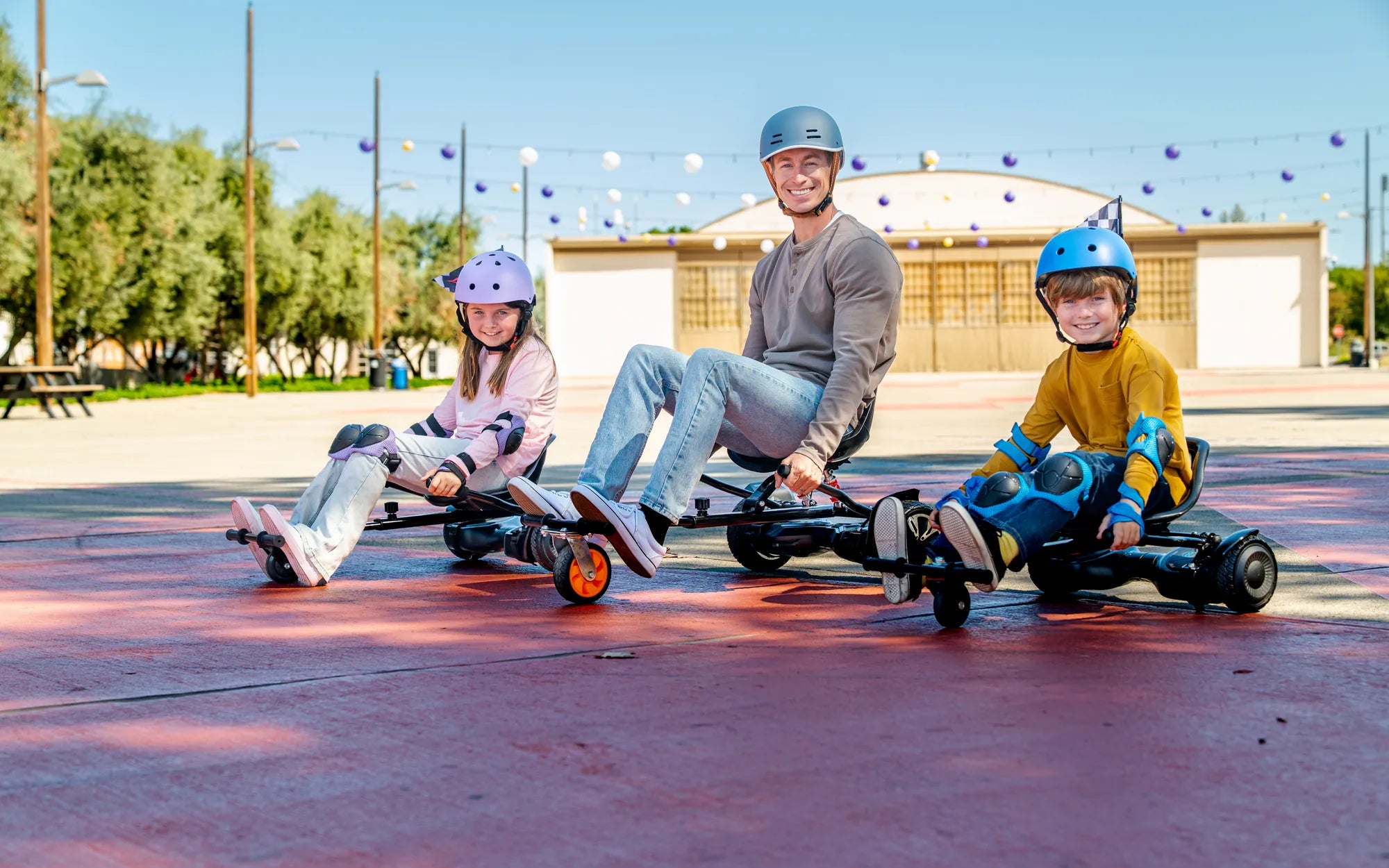
Introduction to Hoverboard Safety
Mastering how to ride a hoverboard safely is the single most important skill for any new rider. These self-balancing scooters offer incredible fun and convenience, but that enjoyment is built on a foundation of proper technique and respect for the device. This complete guide for beginners will walk you through every critical aspect, from your very first step onto the board to navigating complex environments.
We will demystify the learning process with actionable steps, emphasizing that safety isn't restrictive—it's what enables confident, long-term riding. As a leader in personal electric mobility, Gyroor designs every hoverboard, e-bike, and electric scooter with this philosophy, incorporating UL-certified batteries, robust frames, and IPX5 water resistance from the ground up. This guide leverages that engineering expertise to give you the knowledge to ride smart.
By the end, you'll have a comprehensive understanding of pre-ride preparation, core riding mechanics, hazard navigation, and essential maintenance. Our goal is to transform you from a tentative beginner into a competent, safety-conscious rider who can fully enjoy the freedom a hoverboard provides.
Pre-Ride Preparation: Your Non-Negotiable Safety Checklist
Your safety routine begins long before you power on the board. A thorough pre-ride inspection is crucial to prevent malfunctions that could lead to a fall. First, check the tire pressure if your model has inflatable tires; under-inflated tires affect balance and battery efficiency. Inspect the wheel rims and body shell for any significant cracks or damage.
Next, ensure the battery has an adequate charge. A low battery can cause sudden power loss. Verify that all indicator lights function and that the power button responds correctly. Gently press on the foot pads to ensure they engage smoothly without sticking. Finally, confirm that all screws, especially those around the wheels and foot platforms, are tight.
Always consult your user manual for model-specific instructions and weight limits. This five-minute checklist is your first and best defense against preventable accidents. Establishing this habit ensures every ride starts from a position of confidence and control, which is fundamental to learning how to ride a hoverboard safely.
Choosing the Right Safety Gear
Protective gear is not optional for beginners. A certified helmet (CPSC or ASTM standard) is essential to protect against head injuries. Wrist guards are arguably the second most important item, as instinct leads us to break falls with our hands, making wrists highly vulnerable to sprains or fractures.
Knee and elbow pads provide critical protection for joints during stumbles and falls. For footwear, choose closed-toe shoes with flat, grippy soles—avoid sandals or heels. This gear collectively mitigates the impact of the inevitable learning-curve tumbles, allowing you to practice without fear of serious injury.
Finding the Perfect Practice Location
Your first 5-10 hours of practice should occur in a controlled, hazard-free environment. Seek out a large, flat, smooth, and paved area like an empty parking lot, basketball court, or quiet cul-de-sac. The surface should be clean, dry, and free of gravel, sand, or cracks.
Absolutely avoid public roads, driveways with car traffic, hills, and areas near pools or bodies of water for initial practice. The space should be private enough to allow for wobbly, unpredictable movements without the pressure of navigating around pedestrians or obstacles. This dedicated practice zone is your training ground for building muscle memory.
Mastering the Basics: Step-by-Step Riding Technique
With gear on and a clear space secured, you're ready to learn the physical mechanics. The key is patience and incremental progress. Start by placing the hoverboard on level ground and powering it on. Stand beside it and use a wall, fence, or sturdy chair as a support for your first mounts.
The fundamental principle is that the board moves based on subtle pressure from your feet. Leaning forward or pressing your toes down initiates forward motion; leaning back or pressing your heels down moves you backward. Steering is controlled by differential pressure: press your right toe to turn left, and your left toe to turn right.
Speed control is directly tied to the degree of lean. A slight lean produces a slow, manageable pace. A more aggressive lean increases speed. Beginners should focus on minute adjustments. Your body should be relaxed, with knees slightly bent to act as shock absorbers and maintain a low center of gravity.
Mounting and Finding Your Balance
Mounting is often the biggest hurdle. Use your support, place one foot (e.g., your dominant foot) firmly on the foot pad, ensuring it's centered. The board may wiggle—this is normal. Keep your weight on your grounded foot. When ready, swiftly but smoothly place your second foot on the other pad and immediately assume the athletic stance.
The proper stance is: feet shoulder-width apart near the wheel arches, knees slightly bent, back straight, head up looking forward (not down at your feet), and arms out slightly for balance. Engage your core muscles. The goal is to find the "neutral" point where the board is stationary. Practice holding this position with support until you feel stable for 30 seconds.
Controlling Movement: Forward, Backward, and Turning
Initiate forward movement with an incredibly slight forward lean from your ankles, not your waist. Think "press toes down gently" rather than "lean over." Travel in a straight line for 10-20 feet toward your support, then gently shift weight to your heels to slow and stop. Practice this stop-and-go repeatedly.
For turning, practice wide, gradual arcs first. To turn right, apply slightly more pressure with your left toes. The board will arc to the right. Start with large circles. As you improve, you can practice tighter turns and pivots (spinning in place by applying opposite pressure with each foot). Mastering slow, controlled movement is more important than speed.
The Right Way to Dismount
Always come to a complete stop before dismounting. The safest method is to step off backward. Shift your weight to your dominant foot, lift your other foot off and place it on the ground behind the board. Then, step your dominant foot back to join it. This method keeps your center of gravity moving away from the board, preventing it from shooting forward.
Never jump off forward while the board is moving, as it can continue forward and hit you or someone else. Practice mounting and dismounting dozens of times until it becomes a fluid, single motion. Controlled dismounts are a critical part of how to ride a hoverboard safely in any situation.
Navigating Real-World Environments & Hazards
Once you're proficient in a controlled area, you'll encounter real-world terrain. Always approach new environments with caution. Begin by scanning the path ahead for hazards like cracks, potholes, wet leaves, gravel patches, or drainage grates. Plan your route to avoid these, or dismount and walk past them if necessary.
Changes in incline require adjusted technique. For gentle slopes, reduce your speed and maintain a firm, balanced stance. When going uphill, you may need to lean forward slightly more to maintain momentum. For downhill, use very gentle backward pressure to control your descent—never go down a hill faster than you are confident you can stop.
Be hyper-aware of your surroundings. Assume that drivers do not see you. Make eye contact with drivers at intersections before proceeding. Your hoverboard is quiet, so pedestrians may not hear you approaching; always announce yourself politely or pass at a walking pace with wide clearance.
Riding on Different Surfaces
Surface traction drastically affects handling. Smooth asphalt or concrete is ideal. Packed dirt or dry, short grass can be traversed by models with all-terrain tires, but it requires more power and offers less responsive control—reduce speed significantly. Avoid loose gravel, sand, and mud entirely, as they can cause immediate loss of traction and balance.
Wet surfaces like rain-slicked pavement are high-risk. Even with water-resistant ratings, braking distance increases dramatically, and the risk of slipping is high. If you must ride on damp ground, go very slowly, avoid sharp turns or sudden stops, and be extra cautious. The core rule for surfaces is: when in doubt, slow down or walk.
Sharing Space: Pedestrians, Cars, and Rules of the Path
Legally, hoverboards often fall into a gray area. Typically, they are not permitted on public roads but may be allowed on bike paths or sidewalks at local discretion. Always check your municipal regulations. On shared-use paths, behave like a cyclist: ride on the right, pass on the left after an audible signal (e.g., "Passing on your left!"), and yield to pedestrians.
Never ride under the influence of alcohol or drugs. Your reaction time and balance are impaired, making a fall almost certain. Use lights or reflective gear if riding in low-light conditions. Remember, you are an ambassador for the sport; courteous and predictable riding encourages positive perceptions and safer spaces for everyone.
Advanced Safety: Maintenance, Battery Care, and Longevity
Safe operation is intrinsically linked to the mechanical health of your hoverboard. A well-maintained board is a predictable board. Dedicate time every few weeks for a quick inspection. This proactive approach prevents small issues from becoming major failures while riding.
Check tire tread for excessive wear and inflate to the PSI specified in the manual. Listen for unusual noises from the motors or wheels. Ensure the foot pads are clean and responsive. Tighten any fasteners that may have vibrated loose. Wipe down the board with a damp cloth to remove dirt and debris that could interfere with sensors or moving parts.
Proper care directly extends the functional life of your investment and ensures every ride begins with a reliable machine. This discipline is the hallmark of a responsible rider who has mastered not just riding, but the full ownership of a personal electric vehicle.
Routine Maintenance Checks
Establish a simple weekly and monthly checklist. Weekly: visually inspect for physical damage, check tire pressure, test the responsiveness of the power button and foot pads, and clean the board. Monthly: more thoroughly check and tighten all visible screws and bolts, inspect wheel axles for play, and verify that the charger port is clean and undamaged.
After any particularly rough ride or minor crash, perform an immediate inspection. Look for stress marks on the plastic, misaligned wheels, or any new rattles. Catching a loose component before it fails is a critical safety practice. Keeping a log of your maintenance can help track the board's health over time.
Maximizing Your UL-Certified Battery's Safety & Life
The battery is the heart of your hoverboard. Gyroor's use of UL 2272-certified battery packs is a major safety differentiator, as this standard rigorously tests for electrical, mechanical, and environmental safety to prevent fire hazards. To support this built-in safety, follow best charging practices.
Always use the manufacturer-provided charger. Charge the board on a hard, non-flammable surface in a well-ventilated area, away from direct sunlight or heat sources. Do not leave it charging unattended for extended periods or overnight once fully charged. Avoid draining the battery to 0% regularly; try to recharge when it hits 20-30%.
Store the board in a cool, dry place, ideally with a charge between 40-60% if not used for several weeks. Extreme hot or cold temperatures can degrade battery cells. Following these steps not only maximizes the 500+ charge cycle lifespan but also ensures the battery's safety systems can function as designed, a core tenet of how to ride a hoverboard safely day after day.
Understanding Your 1-Year Warranty and Support
A comprehensive warranty is your safety net. Gyroor's standard 1-year warranty typically covers defects in materials and workmanship for key components like the battery (subject to proper care), motor, and control board. This reflects confidence in their product's durability and safe engineering.
Register your product after purchase and keep your receipt. If you encounter persistent issues like one side not balancing, erratic behavior, or error beeps not resolved by a reset, contact customer support. A reputable brand will have accessible support to address safety concerns promptly. Knowing you have this backing allows you to focus on riding with peace of mind.
Hoverboard Comparison: Key Features for Safety & Performance
Choosing the right model impacts your safety experience. Key specifications determine stability, terrain capability, and overall reliability. Below is a comparison of common hoverboard types based on critical safety and performance features.
| Feature / Type | Standard (6.5" Wheels) | All-Terrain (8.5"+ Off-Road Tires) | Gyroor Focus (Safety-Engineered) |
|---|---|---|---|
| Primary Use | Smooth pavements, indoor surfaces | Grass, dirt trails, uneven pavement | Versatile urban & light trail use |
| Tire Type | Solid or air-filled rubber | Knobby, air-filled tires | Durable air-filled tires with good tread |
| Max Speed & Range | ~10 mph, 10-12 miles | ~10 mph, 10-15 miles | ~10 mph, 12-15 miles (model dependent) |
| Battery Safety Standard | Varies widely | Varies widely | UL 2272 Certified Standard |
| Water Resistance | Minimal or IPX4 | Often higher (e.g., IPX5) | IPX5 Rated (protected from water jets) |
| Beginner Suitability | High on smooth surfaces | Lower due to higher power/torque | High with stable platform & safety features |
| Key Safety Advantage | Lower top speed | Better traction on loose surfaces | Comprehensive safety certification & robust build |
This comparison highlights that for beginners, a model with certified safety (UL, water resistance) and a stable wheel size offers the most confidence-inspiring foundation. Features like UL-certification are non-negotiable for risk mitigation.
Frequently Asked Questions (FAQ)
Q: What is the right age for riding a hoverboard?
A: Most manufacturers, including Gyroor, recommend a minimum age of 8 years old. However, age is less important than physical size, coordination, and maturity. The rider must be able to comfortably reach the foot pads, understand safety instructions, and wear all protective gear. Supervision by an adult is crucial for all young riders.
Q: Can I ride my hoverboard in the rain?
A: Gyroor hoverboards carry an IPX5 water resistance rating, meaning they can withstand low-pressure water jets from any direction. This makes them resistant to light rain and wet roads. However, it is not advisable to intentionally ride through deep puddles or heavy downpours. Water can reduce tire traction and, over time, may compromise electrical components. Always dry the board thoroughly after riding on wet surfaces.
Q: How do I know when my hoverboard is fully charged?
A: The charger itself and the board's indicator lights will tell you. Typically, the charger light will turn from red to green, and the board's power indicator may show a solid light instead of a blinking one. Consult your manual for the specific light sequence. As a best practice, unplug the board within an hour or two of reaching a full charge to preserve long-term battery health.
Q: What should I do if my hoverboard starts beeping or feels unstable?
A: Beeping is an error or warning signal. Safely dismount immediately, following the backward step-off procedure. Turn the board off. Common causes include an unbalanced foot pad, low battery, or an internal error. Let it sit for a minute, then power it back on on level ground. If the beeping persists, consult the troubleshooting guide in your manual or contact customer support. Do not continue riding a beeping board.
Q: How can I make sure I'm buying a safe hoverboard?
A> Look for two critical certifications: UL 2272 for the electrical system and battery, and UL 2271 for the overall device if shopping in the US. Purchase from reputable brands and authorized retailers, not from unknown third-party sellers offering deals that seem too good to be true. Check for clear specifications on water resistance (IP rating), warranty length, and accessible customer service. A safe board is an investment, not just a purchase.
Conclusion: Safety Equals More Fun
Learning how to ride a hoverboard safely is a journey that pays dividends in confidence and enjoyment. The principles are universal: thorough preparation with gear and equipment checks, patient mastery of fundamental movements in a safe space, respectful navigation of shared environments, and diligent maintenance of your device. Safety protocols are not barriers to fun; they are the framework that makes sustained, worry-free fun possible.
By choosing a hoverboard engineered with certified safety features like UL-certified batteries and robust construction, you start from a position of strength. The techniques outlined in this guide will help you build the muscle memory and situational awareness needed to handle both routine rides and unexpected challenges. Remember, every skilled rider was once a beginner who prioritized safety.
Now that you're equipped with the complete knowledge to begin your journey safely, explore a range of hoverboards built with these very principles in mind. Discover models designed for stability, reliability, and peace of mind from a brand trusted by over 100,000 riders.
Ready to ride with confidence? Browse the full Gyroor collection of UL-certified hoverboards, electric scooters, and e-bikes at gyroorboard.com.
Hoverboard Charging Light: What It Means and How to Troubleshoot Issues
Portable Scooter for Kids: The Ultimate Guide to Fun and Convenience