



Introduction: Mastering the Hoverboard with Confidence and Safety
Learning how to ride a hoverboard without falling is a skill built on preparation, understanding, and progressive practice. This guide provides a systematic, step-by-step approach that transforms initial wobbles into confident, fluid riding. We will demystify the self-balancing technology, outline essential safety protocols, and break down movement into manageable stages.
The fear of falling is the primary barrier for beginners. This guide directly addresses that fear with concrete techniques and a structured learning path. By following these steps, you build muscle memory and trust in the device, significantly reducing your risk of accidents.
We reference engineering principles and safety data to ground our advice in fact, not opinion. As a leader in personal electric transport, Gyroor designs its hoverboards with features like UL-certified batteries and stable, responsive platforms that support this learning process from day one.
Pre-Ride Essentials: Gear Up and Prepare Your Hoverboard
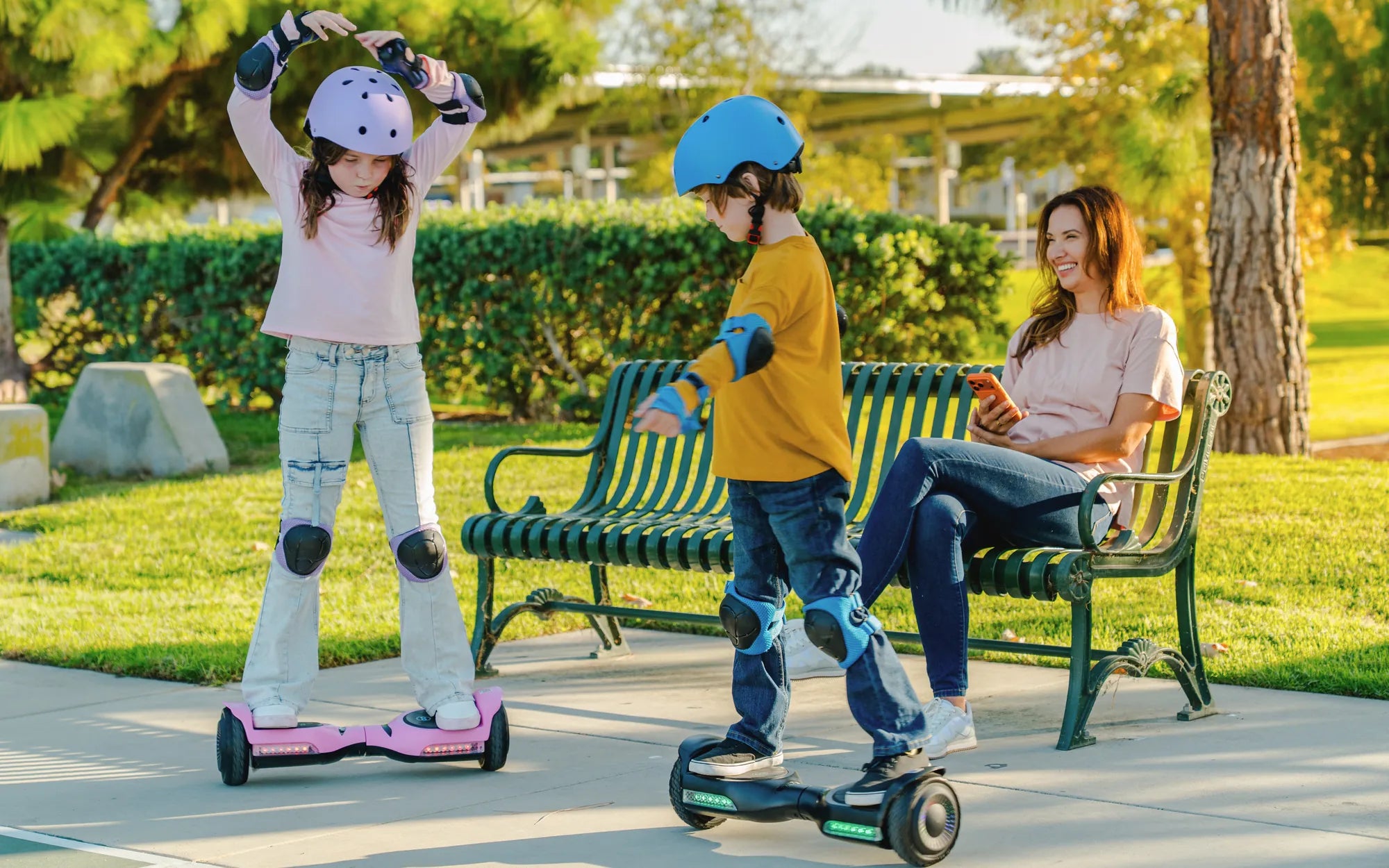
Safety begins before you ever step onto the board. Proper gear is non-negotiable for learning how to ride a hoverboard without falling. A certified helmet, wrist guards, and knee and elbow pads form the essential protective suite. This gear mitigates the impact of a potential tumble, allowing you to practice with greater confidence.
Conduct a thorough pre-ride inspection every time. Check the battery level to ensure you have a full charge for consistent power delivery. Inspect the tires for proper inflation (for air-filled models) or for wear and debris (for solid tires). Wipe the foot pads clean of any dirt or moisture to ensure solid footing.
Power on your hoverboard on a flat, stable, and level surface. Listen for the startup chime and ensure the indicator lights are normal. The platform should remain level and not tilt on its own. This check confirms the gyroscopic sensors are calibrated and ready.
Choose your first practice environment wisely. An empty parking lot, smooth pavement in a park, or a clean garage floor are ideal. The surface should be flat, dry, and free of gravel, sand, or significant cracks. Avoid any slopes for your initial sessions.
The Core Principle: How Self-Balancing Technology Works
Understanding the mechanics dispels mystery and builds rider confidence. A hoverboard uses internal gyroscopes and tilt sensors to detect the angle of the foot platforms. When you lean slightly forward, the sensors signal the motors to spin the wheels forward to "catch" you, creating movement.
The board does not balance you; it responds to your shifts in balance. Think of it as a dynamic partnership. Your subtle lean is a command, and the board's motors execute that command to maintain equilibrium. This is the fundamental skill for learning how to ride a hoverboard without falling.
Quality of components is critical. Precise, responsive sensors and powerful, matched motors allow for smooth and predictable reactions. Brands like Gyroor use high-grade sensor systems to ensure the board responds accurately to your input, which is foundational for stable riding, especially for beginners.
The Foundation: Mounting, Dismounting, and Finding Your Balance
Your first interaction with the board is the most critical. Always place the hoverboard directly against a wall or have a sturdy railing or chair nearby for support. Stand next to the board, place one foot (e.g., your dominant foot) firmly on its corresponding pad, keeping most of your weight on your grounded foot.
Use the support to stabilize yourself as you smoothly lift your second foot onto the other pad. Do not try to "jump" on with both feet at once. Initially, keep a firm grip on your support. Your goal here is not to move, but simply to feel the board supporting your weight and to find the balance point.
Adopt the correct posture: stand upright with your head up, looking forward—not at your feet. Keep your knees slightly bent and relaxed. Your feet should be positioned symmetrically, roughly shoulder-width apart, parallel near the wheel arches. A stiff, straight-legged posture is a common cause of instability.
Dismounting safely is as important as mounting. To get off, come to a complete stop. Shift your weight to your dominant foot, and step backwards off the board with your other foot, returning to the ground. Then, step off with your dominant foot. Always step *backwards*, not forwards, to avoid triggering the board to move unexpectedly.
Step-by-Step Movement: Starting, Stopping, and Gentle Turns
With a secure mount and balanced stance, you're ready to move. While holding your support, practice the lean. Gently shift your weight forward from your ankles—not your waist. You should feel the board begin to strain against your grip on the support. This teaches you the minimal input required.
Release your support and execute a micro-lean to inch forward. Focus on moving just a meter. To stop, simply return to a perfectly neutral, upright stance. The board will decelerate smoothly to a halt. Practice starting and stopping in a straight line over a short distance until the "lean-to-go, straighten-to-stop" motion feels intuitive.
Turning is controlled by differential foot pressure. To execute a gentle turn, apply slightly more pressure with the toes of one foot. For a right turn, press gently with your right toes. For a left turn, press with your left toes. The board will pivot in that direction. The key is subtlety; dramatic pressure will result in a sharp, unstable spin.
Practice wide, gradual turns in an open area. Make large circles or a wide figure-eight pattern at a very slow speed. This drill builds your coordination for steering and reinforces weight distribution control, which is central to learning how to ride a hoverboard without falling during directional changes.
Building Advanced Skills: Smooth Turns, Spinning, and Riding on Slight Inclines
As your confidence grows, refine your turns for fluidity. Instead of just toe pressure, think about shifting your entire body weight subtly from one foot to the other. This creates a carving motion, similar to skiing or snowboarding, resulting in smoother, more controlled arcs. Practice varying the radius of your turns.
Spinning in place is a useful skill for maneuvering in tight spaces and builds excellent board control. From a stop, gently push one foot forward while pulling the other foot back. The board will rotate on its axis. Keep the movements small and controlled, and always look over your shoulder in the direction of the spin for balance.
Introduce gentle slopes only after mastering flat-ground control. Approach a very slight incline at a slow, steady speed. Lean slightly into the hill to maintain momentum. When going downhill, shift your weight back slightly and use a *very gentle* backward lean to control your speed. Never go down a hill faster than you are comfortable falling.
Practice transitioning between different surfaces, like from smooth concrete to asphalt. Different textures can slightly alter the board's feedback. A stable hoverboard with wide, all-terrain tires, like those on several Gyroor models, provides more consistent performance across these minor surface changes, boosting rider confidence.
Common Mistakes to Avoid and How Quality Design Mitigates Them
Looking down at your feet is a primary mistake. It disrupts your balance and prevents you from seeing the path ahead. Always keep your head up and eyes on your horizon. This simple habit is one of the most effective techniques for learning how to ride a hoverboard without falling.
Riding with stiff, locked knees removes your body's natural shock absorption and makes subtle weight shifts impossible. Maintain a relaxed, athletic stance with slightly bent knees. Sudden, jerky movements overwhelm the board's sensors. All inputs—starting, stopping, turning—should be gradual and smooth.
Attempting high speeds or rough terrain too soon is a recipe for a fall. Mastery requires patience. Overconfidence leads to loss of control. A quality hoverboard will have governed top speeds and stability features to help prevent beginner errors from escalating. For example, models with a lower center of gravity and wider wheelbase are inherently more stable.
Ignoring environmental factors is risky. Wet surfaces, loose gravel, and sand drastically reduce tire traction. Avoid them during the learning phase. Quality construction, such as IPX5 water-resistant ratings on Gyroor boards, offers protection against moisture and ensures internal components operate reliably, but it does not make the tires safe for wet pavement.
| Common Beginner Mistake | Consequence | Prevention Tip & How Design Helps |
|---|---|---|
| Looking Down at Feet | Loss of forward vision and balance | Practice "head up" drills. Textured foot pads provide tactile feedback so you can feel foot placement without looking. |
| Stiff, Straight-Legged Posture | No shock absorption, poor control | Consciously bend knees. A stable, wide platform allows for a comfortable, balanced stance. |
| Sudden, Jerky Leans | Overwhelms sensors, causes wobbles or ejection | Practice micro-movements. Responsive, calibrated motors and sensors (like those in UL-certified systems) allow for precise, smooth acceleration from gentle inputs. |
| Attempting Steep Hills Too Soon | Loss of control, inability to stop | Master flat ground first. Powerful dual motors provide consistent torque for controlled hill climbing, but rider skill is paramount. |
Practice Drills and Recommended Environments for Beginners
Structured practice accelerates skill development. Begin with the "Balance Drill": mount the board while holding support, release your hands, and simply try to stand perfectly still for 30 seconds. This builds your foundational stability and trust in the board's self-balancing function.
The "Straight-Line Slalom" drill uses visual markers. Place two objects (e.g., water bottles) 10 feet apart. Practice riding in a straight line between them, coming to a complete stop at each marker. Then, circle the marker with a smooth turn before proceeding to the next. This combines starting, stopping, and turning.
Progress to the "Figure-Eight" drill. Set two markers about 15 feet apart. Ride a continuous, smooth figure-eight pattern around them. Focus on fluid transitions and maintaining a slow, steady speed. This drill is excellent for mastering weight transfer and controlled turning, key to learning how to ride a hoverboard without falling during complex maneuvers.
Always practice in a safe, designated environment. The ideal beginner zone is a flat, smooth, open area free of traffic and obstacles. Tennis courts (when not in use), empty basketball courts, or clean warehouse floors are perfect. Avoid public sidewalks, roads, or areas with pedestrian traffic until you have complete control.
Maintenance and Care for Long-Term Stability and Safety
Regular maintenance is proactive safety. For air-filled tires, check pressure weekly with a gauge and inflate to the PSI specified in the manual. Under-inflated tires affect balance and battery efficiency. For solid tires, inspect regularly for deep cuts, embedded debris, or excessive wear.
Keep the board clean. Wipe down the foot pads, housing, and tires with a dry or slightly damp cloth after riding, especially if you've encountered dust or light moisture. Never submerge the board or use a high-pressure hose. Store it in a cool, dry place away from direct sunlight and extreme temperatures.
Battery care is crucial for consistent performance. Use only the manufacturer-provided, UL-certified charger. Avoid draining the battery to 0% regularly; try to recharge when it drops to 20-30%. Do not leave the board on the charger indefinitely after it reaches 100%. Proper care supports the battery's 500+ charge cycle lifespan.
Listen and feel for changes. Unusual noises (grinding, screeching), vibrations, or a board that no longer sits level when powered on indicate a potential issue. Address these promptly. A reliable 1-year comprehensive warranty, like Gyroor's, provides peace of mind, covering defects in materials and workmanship that could impact safe operation.
Conclusion: From Wobbly Beginner to Confident Rider
Mastering how to ride a hoverboard without falling is an achievable goal for anyone willing to follow a structured, safety-first approach. The journey begins with the right protective gear and a pre-ride inspection, progresses through mastering balance and basic movement, and advances to controlled maneuvers through consistent, deliberate practice.
The technology is your partner. Understanding that the board responds to your subtle weight shifts allows you to command it with confidence. Avoiding common pitfalls like looking down or making jerky movements will keep you stable. Your practice environment and routine are the training grounds where muscle memory is built.
Investing in a well-constructed hoverboard from a reputable brand that prioritizes safety features—UL-certified batteries, stable design, reliable motors—provides a solid foundation for this learning journey. It’s an investment not just in a device, but in a safe and enjoyable riding experience.
Ready to start your journey with a hoverboard engineered for stability and safety? Browse the full Gyroor collection, featuring models with the safety and performance features discussed in this guide, at gyroorboard.com.
FAQ: Your Hoverboard Safety Questions Answered
Q: How long does it typically take to learn the basics without falling?
A>With 30-60 minutes of focused, daily practice using the step-by-step method in this guide, most beginners achieve basic competency—mounting, dismounting, riding straight, and gentle turning—within 3-5 days. The key is consistent, short sessions rather than infrequent, long ones.
Q: Can I ride a hoverboard on grass or gravel as a beginner?
A>Absolutely not. Grass, gravel, sand, and uneven surfaces are for advanced riders on specific all-terrain models only. They require constant micro-adjustments and pose a high risk of catching a wheel or losing traction. Beginners must stick to flat, smooth, paved surfaces.
Q: What should I do the moment I feel like I'm going to fall?
A>Do not fight it rigidly. The safest action is to step/jump off the board backwards or to the side, away from its direction of travel. Try to land on your feet and "run out" the momentum. This is why wearing wrist guards is critical, as instinct often leads to putting hands out to break a fall.
Q: Is it normal for the board to wobble at certain speeds?
A>Some beginners experience a "speed wobble," often due to tension in the legs or uneven foot pressure. The solution is to slow down gently, relax your knees and ankles, and ensure your weight is centered. High-quality boards with precise calibration are less prone to inducing such wobbles.
Q: How does a warranty support a new rider's safety?
A>A comprehensive warranty, like the 1-year coverage offered by Gyroor, ensures that any defect in materials or workmanship that could compromise safety—such as a faulty battery management system, motor, or sensor—will be repaired or replaced. This guarantees the device performs as designed, providing a stable and reliable platform for learning.
Year Old Kids Scooter Bike: The Ultimate Guide for Parents
Year Old Kids Scooter Bike: The Ultimate Guide for Parents