


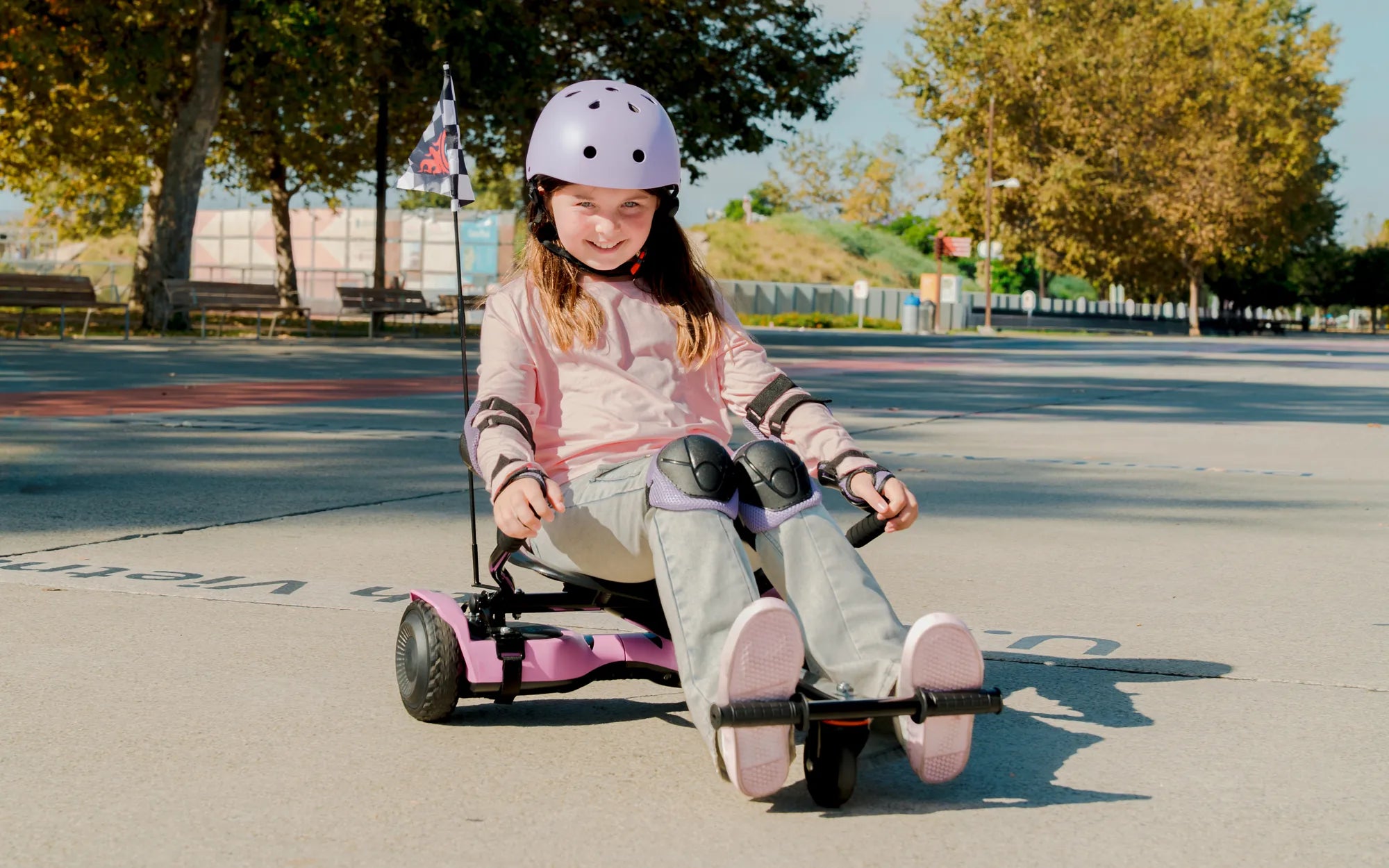
Introduction: Unleashing Adventure with Off-Road Hoverboards for Kids
Forget the smooth sidewalks and polished floors. The true frontier for young riders lies beyond the pavement, on grassy hills, packed dirt trails, and gentle gravel paths. An off-road hoverboard for kids is the ultimate adventure companion, engineered to unlock a new dimension of outdoor play. This guide dives deep into the technology, safety, and real-world performance that make these vehicles a platform for exploration, physical coordination, and confidence-building.
We will dissect what separates a true off-road model from standard versions. You'll learn the critical safety certifications to demand, how to match a board to your child's age and skill level, and discover creative adventures that extend far beyond the backyard. This isn't just about a toy; it's about investing in a tool for active, imaginative, and skill-developing fun.
What Makes an Off-Road Hoverboard Different?
Standard hoverboards are designed for predictable, hard surfaces. An off-road hoverboard for kids is a fundamentally different machine, built from the ground up to handle variable, uneven terrain. The core differences lie in three key areas: tire technology, motor power, and structural durability. These features work in concert to provide the traction, torque, and toughness required for adventure riding.
Where a street board might falter on grass or dirt, an off-road model thrives. The engineering prioritizes stability and control in environments where the surface is soft, slippery, or bumpy. This capability transforms the riding experience, allowing kids to explore parks, trails, and fields that were previously off-limits, turning every ride into a mini-expedition.
Tire Technology: From Plastic Wheels to All-Terrain Tires
The most visible difference is the tires. Standard boards often use solid rubber or hard plastic wheels. True off-road hoverboards for kids feature large, air-filled (pneumatic) tires, typically 8.5 inches or larger in diameter. These tires are akin to those on mountain bikes, providing essential shock absorption.
The deep, knobby tread pattern is designed for maximum grip. It bites into soft ground, gravel, and damp grass to prevent slippage. The air cushion within the tire absorbs vibrations from bumps and small rocks, creating a smoother, more stable ride that reduces fatigue and increases control. This single feature is the primary gateway from pavement to trail.
Power & Performance: Motors Built for Inclines
Moving across rough terrain requires significantly more power. Off-road models are equipped with dual motors of higher wattage, commonly 300W to 500W per motor. This combined power output (600W to 1000W total) delivers the high torque needed to climb gentle slopes, power through resistance from grass, and maintain momentum on uneven ground.
This power translates directly to climb angle capability, a key metric for off-road hoverboards. While a street board may struggle with a 10-degree incline, a robust off-road hoverboard for kids can typically handle slopes of 15 to 20 degrees. This opens up a world of gentle hills and rolling landscapes for exploration, rather than limiting play to perfectly flat areas.
Frame & Build: Rugged Design for Demanding Use
The chassis of an off-road board is built to withstand impacts and vibrations. Manufacturers use reinforced materials and designs with higher ground clearance to prevent the underside from scraping on roots or rocks. The internal components are better secured and often housed in more robust casing to protect against dust, debris, and the occasional bump.
This rugged construction is non-negotiable. A brand like Gyroor, trusted by over 100,000 riders, designs its off-road models with this durability in mind, ensuring the board can handle the rigors of adventurous play. The build quality directly correlates to the product's lifespan and safety when used as intended—off the beaten path.
Key Safety Features Every Parent Must Check
Adventure should never come at the cost of safety. When selecting an off-road hoverboard for kids, certain features are non-negotiable. These certifications and design elements are your primary assurance that the product is built to rigorous standards and can handle the added demands of off-road use safely.
Prioritizing these features mitigates risks and provides peace of mind. A safe board is a durable board, and investing in proven safety technology ensures the adventure companion is reliable for the long term. Let's break down the absolute essentials.
The Non-Negotiables: UL Certification and Battery Safety
The UL 2272 certification is the most critical safety benchmark. This standard, developed by Underwriters Laboratories, tests the entire electrical system—including the battery, charger, and motor management system—for fire and electrical shock hazards. Never purchase a hoverboard without this certification.
Reputable brands, such as Gyroor, use UL-certified lithium-ion battery packs that are tested for over 500 charge cycles. This certification is your guarantee against the battery failures that plagued early hoverboards. It ensures the battery management system properly regulates temperature, charging, and output, making the off-road hoverboard for kids safe for daily adventures.
Stability and Control Systems
Advanced gyroscopic sensors are the brain of the hoverboard, providing intuitive self-balancing. For off-road use, these systems must be highly responsive to adjust quickly to changing terrain. Look for models with a dedicated beginner or training mode that limits speed and softens response, allowing kids to build confidence gradually.
Clear LED indicator systems are vital. They provide real-time information on battery level, riding mode, and error codes. Combined with textured, non-slip foot pads, these features give the rider constant feedback and secure footing, which is especially important when navigating bumpy or slippery surfaces where balance is constantly challenged.
Durability Ratings: Understanding IPX5 Water Resistance
Off-road riding means encountering damp grass, puddles, and light splashes. An IPX5 water-resistance rating is a key feature for an off-road hoverboard for kids. The "IP" stands for Ingress Protection, and "X5" means the unit is protected against water jets (6.3mm nozzle) from any direction.
In practical terms, IPX5 means the board's electronics are sealed against water from riding on wet grass or through occasional puddles. It is not waterproof for submersion. This rating, commonly found on quality models like those from Gyroor, significantly expands where and when kids can ride, adding to the board's versatility and durability.
Choosing the Right Off-Road Hoverboard: A Parent's Guide
With an understanding of core features and safety, the next step is matching a specific model to your child. This decision should be driven by data, not just aesthetics. Consider age, weight, intended use, and key performance metrics to find the perfect fit that will grow with your young adventurer.
A board that is underpowered or has insufficient range will limit fun, while one that is too powerful for a beginner can be intimidating. Use the following framework to navigate the specifications and find a balanced, capable off-road hoverboard for kids.
Age, Weight, and Skill Level Recommendations
Manufacturers provide recommended age and weight ranges for a reason—they correlate to the board's power and stability. A general guideline is that riders aged 8-12 are prime candidates for off-road models, with weight limits typically between 44 lbs and 220 lbs. Always check the specific manufacturer's limits.
For beginners, regardless of age, a model with a lower top speed (e.g., 7-9 MPH) and a beginner mode is ideal. More experienced or heavier riders can handle and will benefit from boards with higher wattage motors and speeds up to 10-12 MPH for a more dynamic off-road experience.
Performance Metrics Compared: Speed, Range, and Climb Angle
These three specs define the adventure envelope. Speed (typically 7-12 MPH) affects thrill and control. Range (often 7-15 miles per charge) determines how far an exploration can go. Climb angle (usually 15-20 degrees) dictates what hills are accessible.
| Feature | Entry-Level Off-Road | Performance Off-Road | Real-World Impact |
|---|---|---|---|
| Motor Power | Dual 300W (600W total) | Dual 400W+ (800W+ total) | Better hill climbing, acceleration on grass. |
| Max Speed | ~9 MPH | ~12 MPH | Faster trail riding, but requires more skill. |
| Range | 8-10 miles | 12-15 miles | Longer adventures without recharging. |
| Tire Size | 8.5" pneumatic | 10" pneumatic | Larger tires smooth out rougher terrain. |
| Climb Angle | ~15 degrees | ~18-20 degrees | Access to steeper grassy slopes and trails. |
Consider your child's typical riding environment. For backyard grass and park paths, an entry-level off-road hoverboard for kids is often perfect. For more ambitious trail riding with older kids, a performance model is a worthwhile investment.
The Value of Warranty and Support
A comprehensive warranty is a sign of manufacturer confidence. A standard 1-year warranty on parts and labor is essential for a product subjected to off-road bumps and vibrations. It protects your investment against manufacturing defects.
Equally important is accessible customer support. Brands like Gyroor, with a track record of over 100,000 riders and a 4.5/5 average rating, back their products with knowledgeable, responsive support teams. This ensures that if you have a question about maintenance, performance, or troubleshooting, help is readily available, making ownership stress-free.
Beyond the Backyard: Adventure Ideas and Riding Tips
Owning an off-road hoverboard for kids unlocks a map of new possibilities. It's a passport to exploration that encourages outdoor activity and imaginative play. Here are some ideas to inspire adventures and crucial tips to ensure every ride is safe and enjoyable.
The goal is to build skills progressively, turning initial wobbles into confident trail navigation. With the right preparation and terrain, the off-road hoverboard becomes a central part of an active childhood.
Top Terrain Adventures for Young Explorers
Start with wide-open, dry grassy fields—perfect for learning how the board responds to soft terrain. Packed dirt or gravel bike paths in parks offer a fantastic "trail-like" experience with a predictable surface. Hard-packed sandy beaches (free of debris) provide a unique and challenging riding sensation.
Always avoid hazardous terrains: deep mud, which can clog the wheels and motors; steep hills beyond the board's rated climb angle; wet, slick surfaces like clay; and public roads or areas with vehicle traffic. Stick to controlled environments where the rider is the only moving variable.
Essential Gear and Pre-Ride Checklist
Safety gear is mandatory, not optional. A properly fitted multi-impact helmet is the most important piece. Add knee pads, elbow pads, and wrist guards to protect against falls. Closed-toe shoes with good grip are essential.
Before every ride, perform a quick check: Ensure tire pressure is adequate (per manual). Confirm the battery has sufficient charge for the planned adventure. Check for any loose parts, cracks in the body, or debris stuck in the wheel treads. A 30-second inspection can prevent most mechanical issues.
Mastering the Ride: From Beginner to Trail Confident
The learning curve is part of the fun. Step 1: Start on flat, smooth pavement to master basic mounting, dismounting, and forward/backward movement using the self-balancing system. Step 2: Move to a flat, dry grassy area to feel the difference in traction and stability.
Step 3: Practice gentle turns and stopping on the grass. Step 4: Once comfortable, graduate to flat, hard-packed dirt trails without significant obstacles. Encourage looking ahead at the path, not down at the feet, to anticipate terrain changes. This progressive approach builds muscle memory and confidence safely.
Frequently Asked Questions (FAQs)
Q1: What is a safe age for a child to use an off-road hoverboard?
Most manufacturers recommend ages 8 and up. The key factors are the child's coordination, ability to follow safety instructions, and weight (meeting the board's minimum, usually around 44 lbs). Parental supervision is always advised, especially during the learning phase and on new terrain.
Q2: How does an off-road hoverboard handle on hills or slopes?
With their powerful dual motors, off-road models are designed to climb gentle to moderate slopes, typically up to a 15-20 degree incline. They handle hills much better than street boards. However, riders should always descend hills slowly and with control, avoiding steep grades that could lead to excessive speed.
Q3: Can it get wet? What does IPX5 water resistance actually cover?
An IPX5 rating means the off-road hoverboard for kids is protected against water jets from any direction. It can safely handle wet grass, puddles, and light rain. It is NOT waterproof and should never be submerged in water, ridden through deep standing water, or pressure-washed.
Q4: How long does the battery last, and how is it charged safely?
Range varies by model and rider weight, but typically lasts 1-2 hours of continuous riding (7-15 miles). Always use only the manufacturer-provided UL-certified charger. Charge the board on a hard, non-flammable surface away from heat sources, and do not leave it charging unattended for extended periods or overnight.
Q5: What maintenance does an off-road hoverboard require?
Regular maintenance is simple but crucial. Keep the tires properly inflated. Wipe down the board with a damp cloth after dirty or wet rides. Regularly check for and remove debris (pebbles, twigs) lodged in the wheel treads and wheel wells. Store in a cool, dry place and avoid completely draining the battery before recharging.
Conclusion: Investing in Confidence and Exploration
An off-road hoverboard for kids represents a significant upgrade in outdoor play technology. It's a vehicle for adventure that promotes balance, coordination, and a love for the outdoors. By choosing a model with robust engineering, critical safety certifications like UL 2272, and a reputable brand backing, you invest in more than a toy—you invest in confidence, exploration, and countless hours of active fun.
Brands that stand behind their products with rigorous testing, clear warranties, and customer support, like Gyroor, offer the peace of mind that allows the adventure to begin. The right off-road hoverboard for kids is a durable, safe, and powerful companion ready to turn any path into a journey of discovery.
Ready to equip your young explorer? Browse the full collection of UL-certified, adventure-ready off-road hoverboards and more at Gyroor. Discover models built with the safety, power, and durability that parents trust and kids love. Visit gyroorboard.com to find the ultimate adventure companion today.
Christmas Gift Ideas for Kids Under 10: Fun and Educational Picks
Hoverboard Replacement Shell: A Complete Guide to Upgrading Your Ride