



Introduction: Why Mastering Scooter Transport is Essential
Picking up electric scooters safely is a fundamental skill for any rider, yet it's often overlooked until a strained back or a scratched vehicle provides a painful lesson. Whether you're loading your scooter into a car for a weekend trip, carrying it up a flight of stairs to your apartment, or navigating a crowded subway, improper handling risks personal injury and costly damage to your equipment. This guide provides the definitive, step-by-step methodology for picking up electric scooters and integrating them into your transportation ecosystem efficiently and safely.
We will cover everything from biomechanically sound lifting techniques to vehicle-specific securing methods and long-term battery care. For riders of brands like Gyroor—a leading electric scooter and e-bike brand trusted by over 100,000 riders across North America and Europe—understanding these principles ensures you get the maximum longevity and performance from your UL-certified, durable vehicle. Let's begin with the most critical first step: knowing your specific machine.
Understanding Your Scooter: The Pre-Transport Imperative
Every successful transport operation begins with intelligence. You must know your scooter's physical characteristics and operational state before you attempt to move it. This isn't just about weight; it's about balance points, fold mechanisms, and potential hazards.
Consult your owner's manual immediately. This document contains the official specifications and manufacturer-recommended handling procedures designed specifically for your model. Relying on guesswork can lead to mishandling critical components like the stem latch or battery compartment.
Key Specifications to Locate and Verify
Identify and note these four essential data points. This knowledge directly informs your lifting strategy and vehicle choice.
- Total Weight: Commuter models typically range from 30-45 lbs (14-20 kg), while performance or off-road models can exceed 65 lbs (29 kg). This dictates if you need a one-person or two-person lift.
- Folded Dimensions: Measure the length, width, and height when fully folded. This determines if it will fit in your car trunk or a designated storage space.
- Battery Location & Weight: The battery is often the heaviest single component. Knowing if it's in the deck or stem affects the scooter's center of gravity when lifting.
- Quick-Release Points: Identify any levers or buttons for folding the stem or removing the battery. Gyroor models, for instance, often feature robust, single-step folding mechanisms that lock securely for transport.
The Essential Pre-Pickup Safety Check
Never skip this 60-second routine. It prevents accidents and protects your scooter's electronics and mechanics.
First, ensure the scooter is powered completely off. This prevents accidental throttle engagement. Second, perform a visual inspection for any loose parts, leaks, or damage, especially to the folding mechanism. Finally, confirm the stem is locked in the folded position. A secure fold, a hallmark of well-engineered brands, transforms your scooter into a stable, compact object for transport.
Mastering the Lift: Biomechanics to Prevent Injury
Lifting a 40-pound object incorrectly, repeatedly, is a direct path to back strain or herniated discs. The goal is to use your body's strongest muscles—your legs and core—while maintaining a neutral spine. The technique varies slightly based on the scooter's weight and design.
Always clear your path before lifting. A tripping hazard while carrying a scooter is a high-risk scenario. Position the scooter sideways to you, with the deck facing outward, so you can get a firm grip on the stem and deck simultaneously.
The Core Lifting Principle: Legs, Not Back
This is the universal technique for most commuter scooters under 50 lbs. Stand close to the scooter with your feet shoulder-width apart. Squat down by bending your knees and hips, keeping your back straight and chest up. Grip the scooter firmly: one hand on the folded stem near the lock, the other under the deck near the rear wheel.
Engage your core muscles. In one smooth motion, push through your heels to stand up, extending your legs. Let your legs do the lifting. Keep the scooter close to your body to minimize leverage on your spine. To set it down, reverse the process: squat with your legs, don't bend at the waist. This technique is ideal for the manageable weight of many daily rider models.
Technique for Heavier Performance and Off-Road Models
For scooters or e-bikes over 55 lbs, a modified approach is needed. The "pivot and tilt" method is effective. Stand facing the side of the scooter. Tilt it toward you until you can get your arms underneath it, one on the stem, one under the deck. Use your body weight to pivot it onto its wheels, then control the tilt to bring it upright against your leg before lifting.
For the heaviest models, or for navigating long distances, team lifting is non-negotiable. Designate one person as the leader to coordinate the lift ("Lift on three: one, two, THREE"). Both lifters should use the leg-lift technique. The added stability and shared load drastically reduce individual risk. This consideration is key for owners of durable, feature-rich builds designed for rugged use.
Choosing Your Transport Method: Scenario-Based Strategies
Your mode of transport dictates the optimal preparation and securing method. A one-size-fits-all approach does not work when moving from a personal car to a city bus.
Evaluate the duration of transport, potential environmental exposures (rain, heat, vibration), and security needs. Each scenario below provides a tailored protocol to ensure your scooter arrives undamaged and ready to ride.
Personal Vehicle Transport: Cars, SUVs, and Trucks
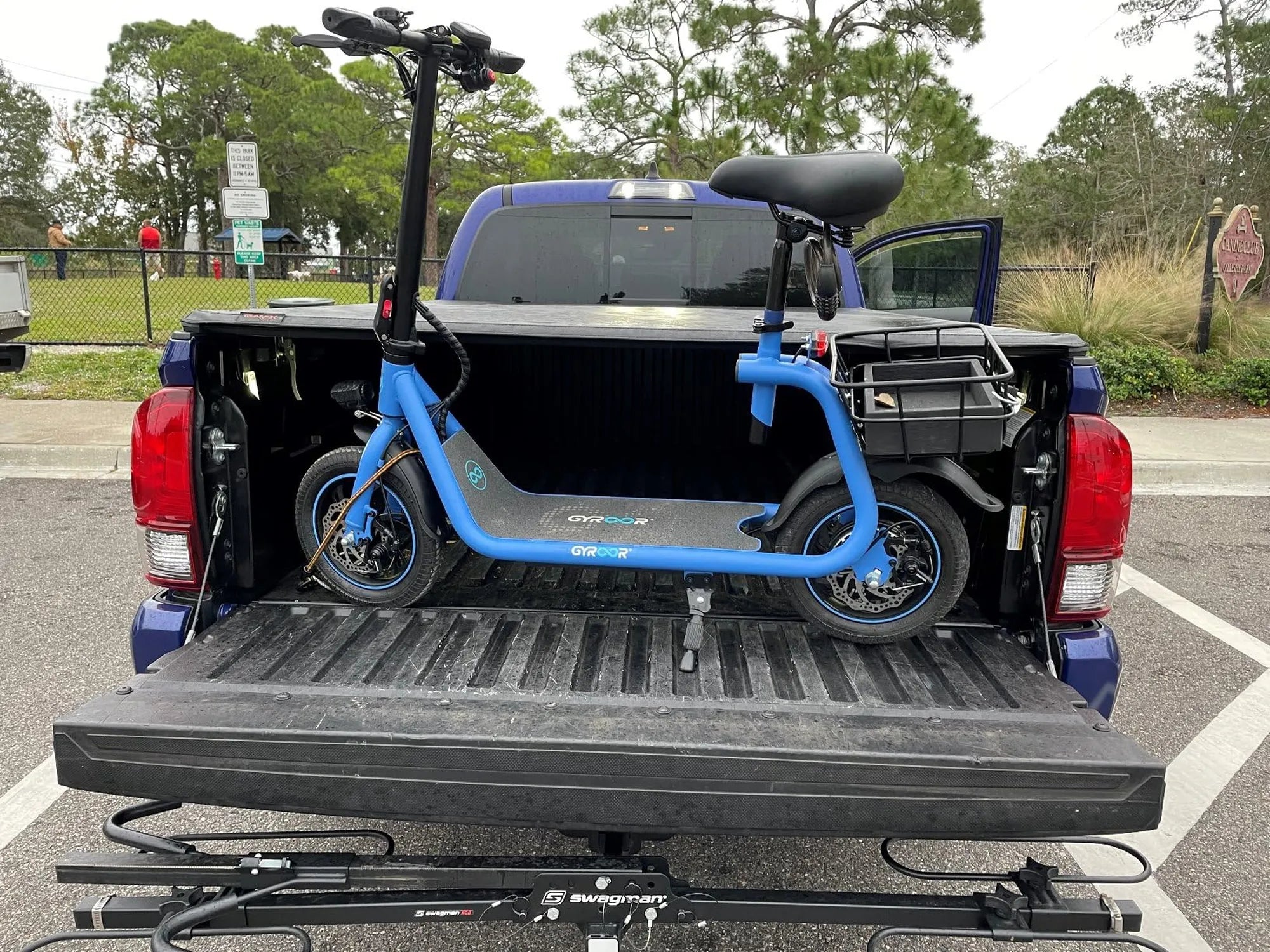
The trunk is often the best place, as it contains the scooter and prevents it from becoming a projectile in a sudden stop. Lay down a protective blanket or a dedicated trunk mat first to prevent scratches. Place the scooter upright, if possible, resting on its wheel or kickstand. If space requires it to lie down, position it on the non-drive side (usually opposite the motor and disc brake) to protect critical components.
The most critical step is securing it. Use ratchet straps or bungee cords to anchor the scooter to cargo hooks or seat mounts. This prevents it from rolling or shifting during turns and over bumps. For SUVs and trucks, the same principles apply. Never leave a scooter unsecured in a truck bed; the vibration and wind can cause severe damage.
Public Transit & Multi-Modal Commute Etiquette
Efficiency and courtesy are paramount. Always have your scooter fully folded before boarding. Position it vertically in front of you, holding the stem, ideally in a space that doesn't block aisles, doors, or priority seating. Be prepared to move it frequently to accommodate other passengers.
Check your local transit authority's regulations beforehand. Rules on permissible times, required bags, and designated areas vary widely. During your journey, be mindful of the scooter's footprint and avoid letting it lean on seats or other passengers. A compact fold, like that on many commuter-focused models, makes this process significantly smoother.
Navigating Staircases and Short-Distance Carrying
Urban environments are full of stairs. For narrow staircases, the "sideways carry" is effective. Hold the scooter by the stem and deck, but turn it sideways so its length runs parallel to the stairs, giving you more clearance. Take one step at a time.
For longer flat surfaces like building lobbies, use the scooter's own wheels. Even when folded, you can often tilt it and roll it on its main wheel, reducing carrying strain dramatically. This is a simple yet effective way to conserve energy during a multi-stage journey.
Safety, Security, and Prolonging Battery Life
Transport isn't just about getting from A to B; it's about preserving the integrity and safety of your scooter's most critical systems, especially the battery. Proper care during transit directly impacts performance and lifespan.
Adopting these best practices turns transport from a necessary chore into a routine maintenance activity that protects your investment.
Battery Care Protocols During Transport
The lithium-ion battery is the heart of your e-scooter. For transport, aim for a charge state between 30% and 80%. This is the most stable range for the chemistry, reducing stress during temperature fluctuations. Avoid storing or transporting a scooter with a 100% charged or completely depleted battery for extended periods.
Never leave your scooter in a sealed car trunk on a hot day. Extreme heat can accelerate battery degradation and poses a safety risk. Conversely, extreme cold can temporarily reduce range. The built-in Battery Management System (BMS) in quality packs provides protection, but avoiding extremes is key. This is where the assurance of UL-certified battery packs, standard in responsible brands, provides critical peace of mind, having passed rigorous safety and endurance testing.
Protecting Your Scooter from Damage and Theft
Physical protection is straightforward. A soft scooter bag or simple foam pipe insulation secured with velcro straps on the stem and deck can prevent cosmetic scratches during car transport. For security, the rule is simple: never leave your scooter unattended and unlocked, even for a minute. If you must step away from your vehicle while loading, take the scooter with you or lock it securely.
Consider a secondary brake rotor lock or a heavy-duty chain lock if the scooter will be out of sight. This layered security approach, combined with the reliable coverage of a 1-year comprehensive warranty with accessible, US-based support, ensures you're protected from both accidental damage and manufacturing defects.
Weather and Terrain Considerations
Even a water-resistant scooter benefits from careful handling in wet conditions. If you've ridden in the rain, dry off the scooter, especially around the folding joints and charging port, before folding and storing it in a confined car space. This prevents moisture from being trapped and causing corrosion over time.
For transport on rough roads, ensure the scooter is securely fastened to dampen vibrations. The robust construction and IPX5 water-resistant rating found on quality builds provide a strong foundation, but prudent handling during transport ensures these features maintain their effectiveness for years.
Comparative Analysis: Transporting Different Scooter Types
Not all scooters are equal in the context of transport. The table below compares common scooter categories based on key transport-related factors, helping you understand the specific considerations for your type of vehicle.
| Scooter Type | Avg. Weight | Folded Size | Primary Transport Challenge | Recommended Method |
|---|---|---|---|---|
| Ultra-Compact Commuter | 26-35 lbs (12-16 kg) | Very Small | Security/Theft | Easy carry-on for transit; fits in most car trunks. |
| Standard Commuter | 36-48 lbs (16-22 kg) | Compact | Repetitive lifting strain | Use leg-lift technique; ideal for multi-modal daily use. |
| Performance/Off-Road | 55-75+ lbs (25-34+ kg) | Large/Bulky | Sheer weight & bulk | Two-person lift for loading; requires SUV/truck or dedicated rack. |
| Electric Bike (for comparison) | 50-70 lbs (23-32 kg) | Does not fold | Size and non-folding frame | Requires a dedicated bike rack or pickup truck. |
Frequently Asked Questions (FAQ)
Q: Can I lay my electric scooter on its side in my car trunk?
A: It is possible, but not ideal. If space demands it, always lay it on the non-drive side (opposite the motor and brake disc) to protect these sensitive components. Place a soft barrier underneath and ensure no cables or the throttle/display are under pressure.
Q: How do I transport my electric scooter on an airplane?
A: This is highly restrictive. Due to regulations on lithium-ion battery watt-hour (Wh) ratings, most full-size e-scooter batteries exceed the typical limit for checked or carry-on luggage (often 160Wh). You must check with your specific airline well in advance. Shipping the scooter via a ground freight service that accepts lithium batteries is often the only viable option.
Q: Is it safe to transport my scooter in the rain or immediately after riding in wet conditions?
A: While modern scooters with IPX5 or higher ratings are designed to withstand riding in the rain, best practice for transport is to dry the scooter off before folding and storing it in an enclosed space like a car trunk. This prevents water from being forced into mechanical joints or connectors during the journey.
Q: Should I remove the battery for transport?
A: If your scooter has a removable battery and you are transporting it in extreme temperatures (e.g., a hot car), taking the battery inside with you is an excellent way to protect it. For normal daily transport, leaving it installed is usually fine, provided the scooter is secured and not subjected to impacts.
Q: What is the single most important tip for picking up a heavy scooter?
A: Do not try to lift it alone if it's at the limit of your strength. The number one cause of injury is ego-lifting. Use the team lift method or invest in a lightweight folding ramp. Protecting your body is more important than a slightly faster loading time.
Conclusion: Transport with Knowledge, Ride with Freedom
Mastering the art of picking up electric scooters transforms it from a precarious task into a seamless part of your mobility routine. The process hinges on preparation: knowing your scooter's specs, performing a safety check, and selecting the right technique for the weight and environment. By lifting with your legs, securing your scooter properly in vehicles, and adhering to battery care protocols, you directly contribute to the longevity and reliability of your vehicle.
This disciplined approach ensures that your scooter remains a dependable tool for urban exploration and efficient commuting, trip after trip. When you choose a scooter engineered with transport in mind—featuring a secure fold, manageable weight, and safety-certified components—you invest in a smoother experience from curb to destination. Now that you're equipped with this complete guide, you can transport your scooter with confidence, wherever your journey leads.
Ready for a scooter built with quality, safety, and real-world portability in mind? Explore the range of UL-certified, robustly designed electric scooters and e-bikes engineered for the demands of daily life and adventure. Browse the full Gyroor collection at gyroorboard.com.
Electric Scooters for Little Kids Manufacturers: Safety, Innovation, and Fun
Electric Scooters Berlin: The Ultimate Guide to Urban Mobility