



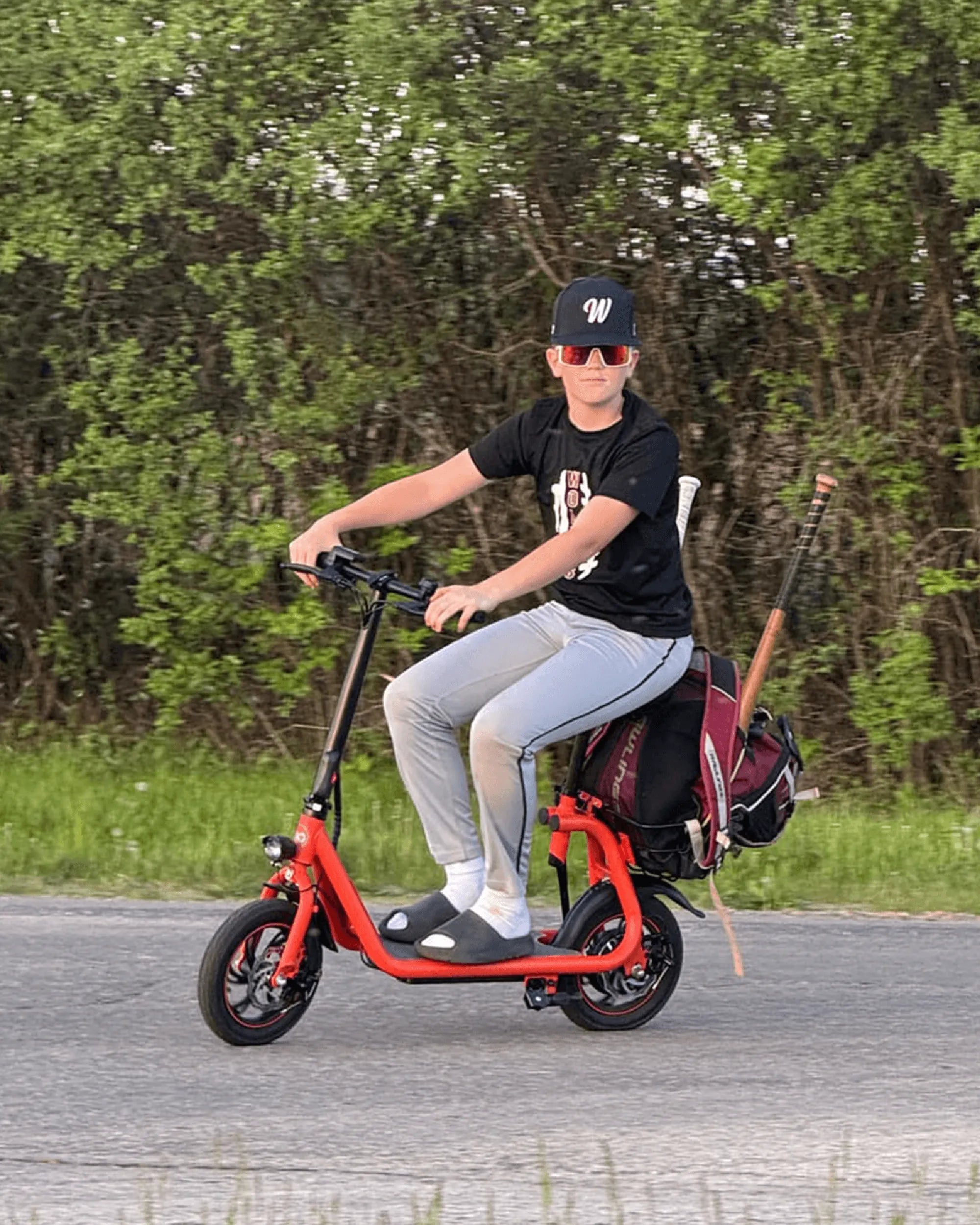
Introduction to Scooter Battery Voltage
If you're asking, 'how many volts is a scooter battery?', the direct answer is: it depends entirely on the scooter's design and intended performance. Most electric scooter batteries operate between 24 volts (V) and 52 volts, with 36V and 48V being the most common for adult commuter models. This voltage rating is not a random number; it's the electrical potential, or 'pressure,' that pushes current from the battery to the motor. Understanding this core specification is the first step to comprehending your scooter's capabilities, from its top speed to its hill-climbing prowess. In this guide, we'll demystify scooter battery voltage, explain its impact on your ride, and show you how to interpret this spec alongside other critical factors like safety and range.
You will learn the standard voltage ranges for different types of scooters, from lightweight models to high-performance machines. We'll detail how voltage directly influences acceleration and top speed, and why simply swapping in a higher-voltage battery is a dangerous mistake. Furthermore, we'll emphasize that while voltage is a key performance indicator, the quality and certification of the battery pack are paramount for safety and longevity. By the end, you'll be equipped to make an informed decision, whether you're checking your current scooter's specs or shopping for a new one from a trusted brand like Gyroor.
Why Voltage Matters: Performance, Range & Compatibility
Voltage is the primary determinant of a scooter's potential speed and acceleration. Think of it like the water pressure in a hose. A higher voltage system provides greater electrical pressure, allowing the motor to draw more power (watts) and spin faster. This translates directly to a higher top speed and stronger torque for quick starts and conquering inclines. A 48V scooter will inherently have a higher performance ceiling than a 36V model with a similar motor, all else being equal.
However, voltage's role extends beyond just speed. It is the cornerstone of system compatibility. The scooter's motor, speed controller (ESC), and display are all engineered to operate within a specific voltage range. Using a battery with an incorrect voltage can lead to catastrophic failure. An under-voltage battery will starve the system of power, while an over-voltage battery can fry the controller and motor, creating a significant fire hazard. Therefore, knowing your scooter battery's voltage is crucial for safe operation and proper maintenance.
It's also important to distinguish voltage from range. While a higher-voltage system can sometimes be more efficient, the scooter's range is primarily determined by the battery's total energy capacity, measured in watt-hours (Wh). This is calculated by multiplying voltage (V) by amp-hours (Ah). A 36V 10Ah battery (360Wh) will generally offer a similar range to a 48V 7.5Ah battery (also 360Wh), though the 48V system will deliver that range at a higher performance level. Voltage sets the stage for how the energy is delivered, while capacity (Ah) dictates how much energy is in the tank.
Common Voltage Ratings for Different Scooter Types
Electric scooters are categorized by their intended use, and voltage is a key differentiator. Lightweight or kids' scooters often use 24V systems. These provide adequate power for low speeds on flat ground, prioritizing safety and simplicity for younger riders. Entry-level adult commuter scooters, designed for short trips on relatively flat terrain, typically utilize 36V batteries. This offers a balanced mix of efficiency, moderate speed (often 15-20 mph), and cost-effectiveness.
The 48V battery has become the standard for mainstream and high-performance commuter scooters. It supports higher continuous motor power (e.g., 500W to 1000W), enabling speeds of 20-30+ mph and much better hill-climbing ability. This is the sweet spot for most daily commuters who need reliable power. For enthusiasts and off-road riders seeking maximum performance, 52V (and sometimes even 60V+) systems are used. These push the boundaries of speed and torque, often found in premium models designed for aggressive riding. Brands like Gyroor strategically employ these voltages across their lineup, using 36V for accessible models, 48V for their robust commuter and all-terrain scooters, and 52V in their top-tier performance offerings.
How to Find Your Scooter's Battery Voltage
Identifying your scooter battery's voltage is straightforward and usually doesn't require any tools. The first and safest place to check is the physical battery pack itself or the scooter's specification label. Look for a sticker or engraving that lists the voltage (V) and capacity (Ah). This label is often on the battery casing, the deck of the scooter, or inside the charger port cover. The user manual that came with your scooter will also definitively state the battery voltage in the technical specifications section.
Your charger is another excellent source of information. Check the output rating printed on the charger body. It will say something like 'Output: 42V 2A.' The output voltage listed (e.g., 42V) is the charging voltage, which is directly related to the battery's nominal voltage. A 42V charger is for a 36V battery pack (as it needs a higher voltage to charge), a 54.6V charger is for a 48V pack, and a 58.8V charger is for a 52V pack. Many modern scooters also display the battery voltage on their digital dashboard, often next to the battery level indicator. Important Safety Note: Never open or disassemble a lithium-ion battery pack to try and find its voltage. The cells and wiring inside are dangerous if mishandled.
Voltage in Context: Battery Packs, Cells, and Configuration
A scooter battery pack is not a single unit but a carefully assembled collection of individual lithium-ion cells. The most common cell form factors are the cylindrical 18650 and the larger 21700. The voltage of the entire pack is determined by how these cells are connected. Cells connected in series have their voltages added together. For example, a standard lithium-ion cell has a nominal voltage of 3.6V or 3.7V. Connecting 10 of these cells in series (10S) creates a 36V pack. Connecting 13 in series (13S) creates a 48V pack, and 14 in series (14S) creates a 52V pack.
This series configuration is what establishes the pack's voltage. However, to increase the capacity (Amp-hours) and overall energy (Watt-hours), cells are also connected in parallel. A configuration listed as 13S4P means 13 groups of cells in series (for 48V), with each of those 13 groups containing 4 cells wired in parallel. The parallel connections increase the current capacity and total Ah. This modular design allows manufacturers to build batteries of different voltages and capacities using the same fundamental cell technology, balancing performance, range, and physical size.
Data & Comparison: Voltage vs. Other Key Battery Specs
To truly understand a scooter's potential, you must view voltage as part of a trio of key specifications: Voltage (V), Amp-hours (Ah), and Watt-hours (Wh). Voltage is the electrical pressure. Amp-hours (Ah) represent the battery's capacity to deliver current over time—think of it as the size of the fuel tank. Watt-hours (Wh) is the product of Voltage and Amp-hours (V x Ah = Wh), representing the total energy stored in the battery. This is the most accurate measure of a battery's 'fuel' and is the best spec for comparing potential range between different scooters, even if they have different voltages.
For instance, a scooter with a 36V 12.5Ah battery has a 450Wh capacity. Another scooter with a 48V 10Ah battery has a 480Wh capacity. While the 48V scooter will likely be faster and more powerful, both have a roughly similar amount of total energy, so their ranges could be comparable, depending on motor efficiency and riding style. The motor's wattage rating (e.g., 350W, 500W) indicates its power consumption. A higher-wattage motor on a higher-voltage system can draw more power to deliver stronger performance.
| Specification | Symbol | What It Measures | Primary Impact on Ride |
|---|---|---|---|
| Voltage | V | Electrical potential / pressure | Top speed, acceleration, hill-climbing torque |
| Amp-hours | Ah | Charge capacity over time | Directly influences range (alongside V) |
| Watt-hours | Wh | Total energy capacity (V x Ah) | The best single indicator of potential range |
| Motor Wattage | W | Power output/consumption of the motor | Overall power; works in tandem with voltage |
Safety and Longevity: The Importance of Quality & Certification
Knowing 'how many volts is a scooter battery' is meaningless if the battery itself is poorly constructed. Voltage is just a number; the engineering and safety standards behind the battery pack are what protect you. Low-quality batteries with substandard cells, lacking proper battery management systems (BMS), or with poor soldering can fail catastrophically, leading to fires—a risk highlighted by numerous recalls in the micro-mobility industry. This is why certification is non-negotiable.
The gold standard for safety is the UL 2271 certification for the entire battery pack. This rigorous test standard, developed by Underwriters Laboratories, evaluates the battery for electrical, mechanical, and environmental hazards including overcharge, short circuit, crush, and water exposure. A UL 2271 certified battery, like those used in Gyroor scooters, has passed these extreme tests, significantly reducing the risk of thermal runaway and fire. Always prioritize brands that use certified battery packs; it is the most critical feature for your safety.
Longevity is also tied to quality. A well-made battery from a reputable brand using name-brand cells (like Samsung, LG, or Panasonic) and a robust BMS will maintain its capacity over hundreds of charge cycles. Gyroor, for example, uses UL-certified battery packs tested for 500+ charge cycles, ensuring the battery retains most of its original capacity for years of reliable use. Features like IPX5 water resistance in the scooter's design further protect the battery and electronics from rain and splashes, contributing to both safety and long-term durability.
FAQ: Scooter Battery Voltage Questions Answered
Q: Can I use a higher voltage battery on my scooter to make it faster?
A: Absolutely not. This is extremely dangerous and will almost certainly damage your scooter's motor and electronic speed controller (ESC), which are designed for a specific voltage range. It can cause overheating, component failure, and create a severe fire hazard. Always use the battery voltage specified by the manufacturer.
Q: Does a higher voltage battery always mean a longer range?
A: Not directly. Range is determined by total energy capacity, measured in Watt-hours (Wh). A higher voltage battery with a lower Ah rating could have the same or less Wh than a lower voltage battery with a higher Ah rating. For example, a 36V 15Ah battery (540Wh) has more range potential than a 48V 10Ah battery (480Wh).
Q: What voltage is best for commuting versus off-road riding?
A: For most urban commuting, a 36V or 48V system is ideal, offering a great balance of speed (15-28 mph), efficiency, and range. For off-road or aggressive riding where high torque and power are needed to tackle steep, uneven terrain, a 48V or 52V system is highly recommended for its superior performance envelope.
Q: How does voltage relate to charging time?
A> Charging time is primarily a function of battery capacity (Ah) and charger amperage (A). The formula is roughly: Capacity (Ah) / Charger Output (A) = Hours. A 10Ah battery charged with a 2A charger takes about 5 hours. Voltage determines which specific charger you must use (a 48V battery requires a 48V charger), but within the correct voltage, a higher-amp charger will charge faster.
Q: My scooter battery says 48V on the label, but the charger output is 54.6V. Is this normal?
A> Yes, this is completely normal and correct. Lithium-ion batteries require a charging voltage that is higher than their nominal voltage to fully charge the cells. A 48V nominal battery pack charges at approximately 54.6V. Similarly, a 36V pack charges at ~42V, and a 52V pack at ~58.8V. Always use the charger provided by the manufacturer.
Conclusion: Choosing the Right Voltage for Your Ride
The question 'how many volts is a scooter battery' opens the door to understanding your vehicle's core performance characteristics. Remember that 36V offers accessible commuting, 48V delivers powerful mainstream performance, and 52V pushes into premium territory. However, voltage should never be viewed in isolation. It must be evaluated alongside the total energy capacity (Wh), the quality of the battery cells, and, most importantly, the presence of critical safety certifications like UL 2271.
Choosing a scooter from a reputable brand that prioritizes these factors ensures not only a great riding experience but also peace of mind. With over 100,000 riders trusting their UL-certified, water-resistant designs, Gyroor exemplifies this commitment, engineering each model's voltage and battery system for optimal, reliable, and safe performance backed by a solid warranty. Your scooter's voltage is a key spec, but it's the quality and safety built around it that truly define a superior ride.
Ready to find a scooter with the perfect balance of voltage, performance, and certified safety for your needs? Browse the full Gyroor collection, from efficient 36V commuters to powerful 48V and 52V all-terrain models, at gyroorboard.com.
How to Reset a Mobility Scooter: The Complete Universal Guide
Best Mobility Scooter Australia: The 2024 Guide to Freedom & Independence