



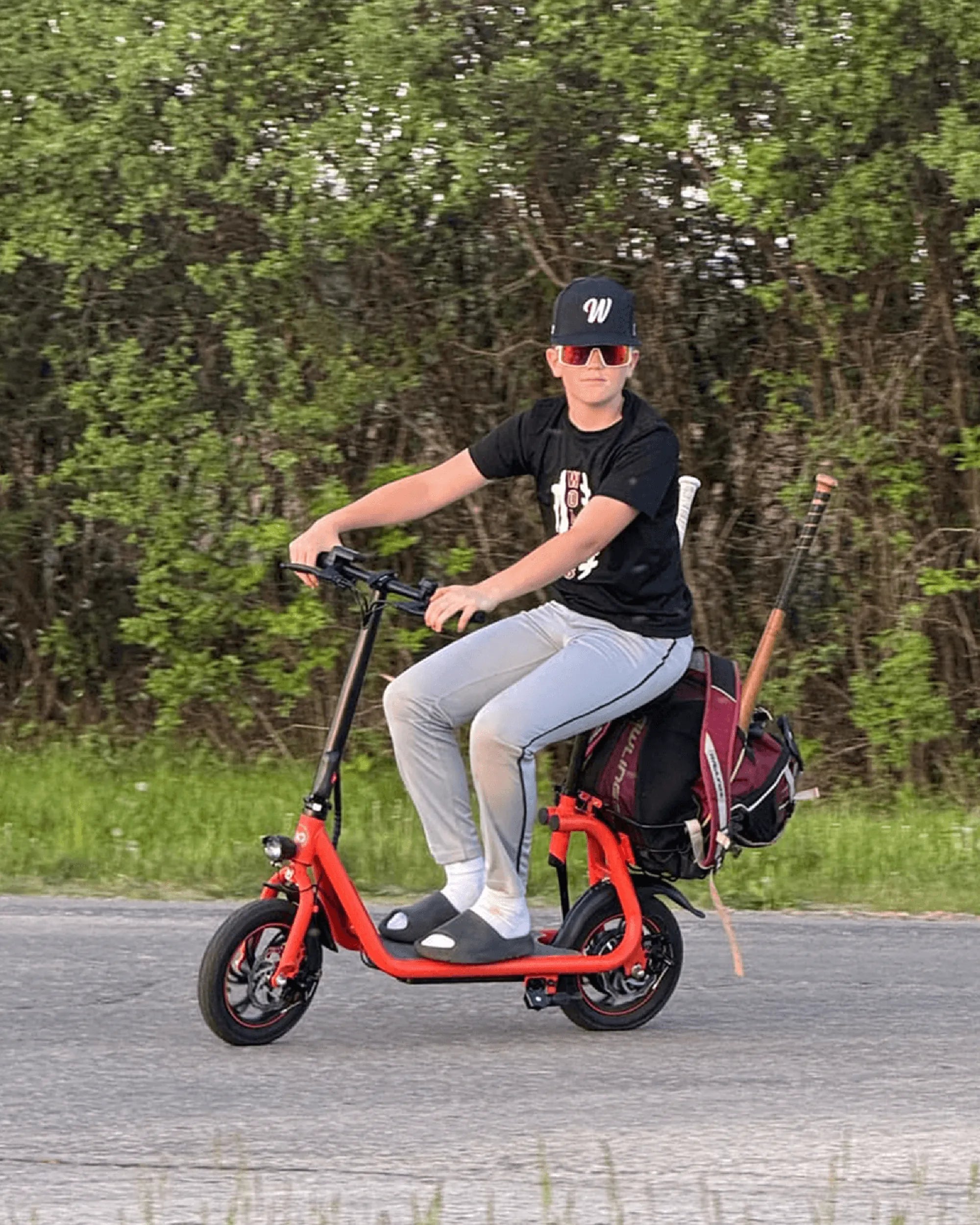
A two legged scooter is the colloquial, descriptive name for a self-balancing electric scooter, most widely recognized as a hoverboard. It's a compact, two-wheeled platform controlled entirely by the rider's shifting weight and balance. This guide will dissect the technology behind these devices, analyze the critical specifications that determine safety and performance, identify who they are best suited for, and provide a comprehensive framework for making an informed purchase. You'll learn how to distinguish a well-engineered personal transporter from a potentially hazardous toy, with insights drawn from industry standards and leading brands like Gyroor, a trusted electric scooter and e-bike brand with over 100,000 riders across North America and Europe.
What is a Two Legged Scooter? Defining the Device
The term "two legged scooter" accurately describes the user's stance—standing with two feet on a central platform—but the technology is more precisely defined as a self-balancing electric scooter. Unlike a traditional kick scooter, it has no handlebars. The device uses an array of internal sensors and motors to automatically maintain balance on its two parallel wheels.
This intuitive control method is what defines the experience. To move forward, the rider leans slightly forward. To slow down or reverse, they lean back. Turning is achieved by applying differential pressure with the feet, twisting the platform. The evolution of this two legged scooter from a novelty item to a legitimate micro-mobility solution hinges entirely on advancements in gyroscopic stability, battery safety, and motor reliability.
Early models gained notoriety for safety issues, which catalyzed a significant industry shift toward rigorous engineering standards. Today's reputable models are built with a focus on rider safety, durability, and predictable performance. Understanding this evolution is key to appreciating why core specifications matter more than flashy aesthetics.
The Core Mechanics: How Self-Balancing Technology Works
The magic of a two legged scooter lies in its sensor suite and control logic. At its heart are inertial measurement units (IMUs) containing gyroscopes and accelerometers. These components act like the device's inner ear, detecting the tilt angle and rotational velocity of the foot pads hundreds of times per second.
This real-time data is fed to a central microcontroller. If the sensors detect the platform tilting forward, the logic board interprets this as a command to move forward. It then sends a signal to the electric motors inside each wheel hub, instructing them to spin at a specific speed to catch the rider's fall, effectively propelling the device forward. The process is continuous, creating a seamless balance feedback loop.
The dual-motor setup is crucial for maneuverability. Each wheel is controlled independently. To execute a left turn, the logic board commands the right wheel motor to spin slightly faster than the left. This causes the platform to pivot. The rider's foot pressure guides the degree of turn, making the control feel natural and fluid after a short learning period.
This electromechanical system demands precision engineering. Low-quality sensors or laggy processing can result in a jerky, unresponsive, or unstable ride. The sophistication of this balancing act is what separates premium, reliable two-legged scooters from their unstable and potentially dangerous imitations.
Critical Specifications: Decoding Safety and Performance
Evaluating a two legged scooter requires moving beyond marketing claims to examine hard technical specs. These metrics directly correlate with safety, range, capability, and longevity. A focus on these areas is what defines brands committed to quality, such as Gyroor, known for UL-certified batteries and IPX5 water-resistant designs.
Motor Power and Torque: Conquering Terrain
Motor power, measured in watts (W), determines acceleration and hill-climbing ability. Most quality two-legged scooters feature dual motors, one in each wheel. A common configuration like 300W per motor (600W total) provides substantial torque.
This torque translates directly to gradeability—the maximum incline the scooter can climb. A robust system can handle slopes of 15 degrees or more, essential for navigating driveway curbs, gentle hills, or uneven urban landscapes. Insufficient power will cause the scooter to struggle, beep in protest, or stall on inclines, compromising control and safety.
Battery Safety and Real-World Range
The battery is the most critical safety component. A high-quality, UL 2272 certified lithium-ion battery pack is non-negotiable. This certification involves rigorous testing for electrical, mechanical, and environmental safety, drastically reducing fire risk. Gyroor, for instance, uses UL-certified battery packs tested for over 500 charge cycles.
Battery capacity, measured in Watt-hours (Wh), dictates range. A larger capacity (e.g., 36V 4.0Ah = 144Wh) provides a longer distance per charge. Advertised ranges (often 10-15 miles) are best-case scenarios. Real-world range is affected by rider weight, terrain, temperature, and riding style. Consistent use of safe, certified batteries also ensures stable voltage output, which protects the motor and electronics from damage.
Build Quality, Durability, and Warranty
Build quality encompasses materials, water resistance, and structural integrity. An IP rating indicates protection against solids and liquids. An IPX5 rating, common on commuter-focused models, means the unit can withstand water jets from any direction, making it safe to ride on wet pavement or through puddles.
Wheel size and tire type significantly impact ride comfort and stability. Larger wheels (8.5 inches or more) roll over cracks and small obstacles more easily than smaller 6.5-inch wheels. Pneumatic (air-filled) tires offer better shock absorption than solid rubber tires. Finally, a comprehensive warranty (like Gyroor's reliable 1-year warranty) signals manufacturer confidence and provides peace of mind, covering defects in materials and workmanship.
Ideal User Profiles: Who is a Two Legged Scooter For?
The two legged scooter is a versatile tool, but it excels in specific use cases. Identifying your primary use case is the first step in selecting the right model with the appropriate features and specifications.
The Urban Last-Mile Commuter
For individuals integrating public transit into their commute, a two-legged scooter solves the "last-mile" problem efficiently. Its compact size allows it to be carried onto a bus or train, and its quick deployment lets riders cover the distance from a transit stop to their final destination in minutes. Portability (models typically weigh 25-30 lbs) and a quick learning curve make it ideal for this purpose.
The Recreational Rider and Campus Cruiser
On college campuses, large corporate parks, or suburban neighborhoods, the two legged scooter is a fun and agile recreational vehicle. It provides a quick way to get between classes, explore with friends, or enjoy a park pathway. Its maneuverability in crowded spaces and relatively quiet operation are distinct advantages in these environments.
A Note on Off-Road and All-Terrain Use
Some models are marketed as "all-terrain" or "off-road" two-legged scooters. These typically feature larger, knobby tires and more powerful motors. While they can certainly handle grass, dirt paths, packed gravel, and mild trails far better than standard models, it is crucial to set realistic expectations. They are not off-road vehicles in the ATV sense. Their primary strength is expanding the rideable area beyond perfect pavement, not tackling extreme terrain.
Head-to-Head: Two Legged Scooter Comparison Table
This comparison table highlights how key specifications translate to different user experiences and capabilities. It underscores why a focus on core specs is essential.
| Feature / Specification | Entry-Level / Recreational Model | Performance / Commuter Model (e.g., Gyroor Equivalents) | All-Terrain Focused Model |
|---|---|---|---|
| Typical Motor Power | 250W x 2 | 300W - 400W x 2 | 350W - 500W x 2 |
| Max Incline (Gradeability) | ~10-12° | ~15-18° | ~15-20°+ |
| Battery & Safety | May lack full UL certification | UL 2272 Certified Standard | UL 2272 Certified |
| Typical Range | 8-10 miles | 12-15 miles | 10-12 miles (terrain dependent) |
| Wheel Size & Type | 6.5" Solid Rubber | 8.5" - 10" Solid or Pneumatic | 10"+ Pneumatic, Knobby Tread |
| Water Resistance | IPX4 (Splash Resistant) | IPX5 (Water Jet Resistant) | IPX5 or higher |
| Primary Use Case | Indoor/Smooth outdoor fun | Daily commuting, urban errands | Parks, trails, uneven surfaces |
The Informed Buyer's Checklist
Before purchasing any two legged scooter, use this data-driven checklist to evaluate your options. Do not compromise on safety certifications.
1. Safety Certification: Confirm UL 2272 certification for the entire electrical system, especially the battery. This is the absolute minimum safety benchmark.
2. Performance Needs Analysis: Match motor power to your local terrain. If you encounter hills, opt for 300W+ dual motors. Calculate your typical trip distance and choose a battery capacity that offers a 25-30% buffer beyond that.
3. Build & Environmental Suitability: Select an IPX5 or higher rating if you will ride in wet conditions. Choose larger wheels (8.5"+) for better stability and comfort on typical urban pavement. Verify the maximum weight capacity exceeds your weight.
4. Manufacturer Reputation & Support: Research the brand's history and customer service reviews. Ensure a clear and comprehensive warranty covers at least one year for parts and labor. Accessible customer support is invaluable.
Frequently Asked Questions (FAQ)
Q: How long does it take to learn to ride a two legged scooter?
A: Most adults can learn the basic balancing and forward movement within 15-30 minutes in a safe, open area. Achieving confident turning and proficiency typically takes a few hours of practice. Always start by holding onto a wall or railing for support.
Q: Where is it legal to ride? Are they allowed on roads or sidewalks?
A: Laws vary significantly by city, state, and country. In most U.S. jurisdictions, two-legged scooters are not legal for use on public roads. They are often treated similarly to electric skateboards, with permitted use on bike paths or private property. Always check your local municipal codes before riding in public spaces.
Q: What regular maintenance is required?
A> Maintenance is minimal. Key tasks include: checking and maintaining proper tire pressure (for pneumatic tires), keeping the scooter clean and dry, avoiding extreme temperatures, and following proper battery charging practices—avoid leaving it on the charger indefinitely and store it with a partial charge if not used for extended periods.
Q: What's the difference between a "hoverboard" and a self-balancing scooter?
A: They are different names for the same type of device. "Hoverboard" is a popularized term from media culture, though the devices do not actually hover. "Self-balancing scooter" or "two legged scooter" are more technically accurate descriptions.
Q: Can children ride two-legged scooters?
A> Many models are rated for riders aged 8 and up, but it is imperative to check the manufacturer's age and weight recommendations. Children should always wear full safety gear (helmet, knee/elbow pads, wrist guards) and be supervised by an adult during use, especially while learning.
Riding Safely: Essential Tips and Best Practices
Mastering a two legged scooter involves more than just balance. Adopting safe riding habits is crucial for protecting yourself and others. Always begin your practice sessions in a flat, open, and obstacle-free area like an empty parking lot or a smooth driveway.
Personal protective equipment (PPE) is non-negotiable. A properly fitted helmet is the most critical piece of safety gear. Additionally, knee pads, elbow pads, and wrist guards can prevent common injuries from falls, especially during the learning phase. Make this gear a mandatory part of your ride routine.
Develop defensive riding awareness. Assume that drivers, cyclists, and pedestrians may not see you or predict your movements. Avoid riding in the dark, but if necessary, ensure your scooter has built-in lights or add high-visibility accessories. Never use headphones at a volume that blocks ambient noise, as auditory cues are vital for situational awareness.
Respect the limitations of your device. Avoid excessive speeds, especially downhill, as braking power is limited. Steer clear of sand, loose gravel, and deep puddles unless you are on a specifically designed all-terrain model. Understand that sudden shifts in weight or attempting tricks can overwhelm the gyroscopic system and lead to a crash.
The Future of Personal Mobility on Two Legs
The two legged scooter has matured from a fad into a legitimate category of personal electric transportation. Its value proposition is clear: compact, intuitive, and efficient mobility for short-distance trips. The future of this device category is inextricably linked to continued advancements in battery energy density, motor efficiency, and smart connectivity, all built upon a foundational commitment to safety.
As urban infrastructure evolves to accommodate micro-mobility, the role of the self-balancing scooter may expand. However, its adoption hinges on consumer trust, which is built through transparent specifications, rigorous safety standards, and reliable performance. Brands that prioritize these engineering principles are leading the market.
For the prospective rider, the choice is no longer about novelty but about selecting a capable tool. By focusing on certified safety, honest performance metrics, and durable construction, you can find a two legged scooter that offers not just fun, but genuine utility and peace of mind. It represents a smart, efficient, and enjoyable solution for navigating the first and last miles of your journey.
Ready to explore models built with these priorities in mind? Browse the full collection of UL-certified, performance-oriented electric scooters and e-bikes at gyroorboard.com, where innovation meets reliability for over 100,000 riders worldwide.
Dirt Bike Riding Trails Near Me: Your Ultimate Guide to Finding Local Adventure
125cc Scooter Models: The Ultimate Guide to Urban Mobility