



Introduction: Understanding the 150cc Dirt Bike Performance Tier
When riders ask about the 150 dirt bike top speed, they're often seeking a simple number. The reality is far more nuanced. The 150cc class represents a critical performance tier, bridging the gap between beginner mini-bikes and full-size adult machines.
This category is beloved for its versatility, serving as an entry point for new riders, a nimble trail companion for intermediates, and even a competitive race bike in the right configuration. Understanding its speed potential requires looking beyond displacement to the intricate dance of power, weight, and gearing.
This article will demystify the real-world top speed expectations for 150cc dirt bikes. We'll move past manufacturer claims to examine the technical and environmental factors that determine how fast these bikes can truly go, providing a data-driven framework for riders at every level.
You'll learn not just about peak velocity, but about the engineering trade-offs that make one 150cc bike feel radically different from another, and how to match a bike's capabilities to your riding goals.
What Determines a 150cc Dirt Bike's Top Speed?
Engine displacement is just the starting point. A bike's maximum velocity is the final output of a complex system where every component plays a role. Thinking of speed as a system, rather than a single spec, is key to understanding performance.
Factors like aerodynamics, rolling resistance, and mechanical efficiency all siphon power before it reaches the rear wheel. On a dirt bike, where knobby tires and an upright riding position create significant drag, these losses are more pronounced than on a streamlined street motorcycle.
The engine must produce enough power to overcome these cumulative forces. Once the force of drag and friction equals the maximum force the tire can transmit to the ground, the bike has reached its terminal velocity for those conditions.
This systems-based view explains why two bikes with identical 150cc engines can have vastly different top speeds. It all comes down to how the entire machine is configured and tuned.
Engine Type and Tuning: 2-Stroke vs. 4-Stroke
The engine cycle is the most significant differentiator. A 150cc 2-stroke engine, like those found in the KTM 150 SX or Husqvarna TC 150, fires every time the piston reaches the top of the cylinder. This results in a more frequent power pulse and a superior power-to-weight ratio.
2-strokes are typically lighter and have a more aggressive, "peaky" power band. They can produce horsepower figures that rival or exceed those of larger 4-strokes, which directly translates to a higher potential top speed when geared appropriately.
In contrast, a 150cc 4-stroke engine, common in trail bikes like the Honda CRF150F, fires every other revolution. These engines prioritize broad, controllable torque and linear power delivery over peak horsepower.
They are generally heavier and more mechanically complex. While incredibly reliable and beginner-friendly, their design inherently limits top-end power, capping their maximum speed potential compared to an equally displaced 2-stroke.
Gearing: Sprocket Ratios and Final Drive
Gearing is the transmission's translator between engine speed and wheel speed. It's the most direct way to alter a bike's speed character. The final drive ratio, determined by the number of teeth on the front (countershaft) and rear sprockets, has a dramatic effect.
A larger rear sprocket or a smaller front sprocket creates a lower ("shorter") final drive ratio. This multiplies torque, improving acceleration and low-speed climbability, but reduces top speed as the engine reaches its rev limit in each gear more quickly.
Conversely, a smaller rear sprocket or a larger front sprocket creates a higher ("taller") final drive ratio. This trades low-end snap for a higher potential top speed, as the engine spins slower for a given road speed.
Most production trail bikes come geared for versatility, offering a compromise. Racers and experienced riders fine-tune sprocket sizes to match specific tracks or terrain, directly manipulating where the bike's power is most effective.
Rider Weight and Terrain Conditions
Physics doesn't lie: accelerating more mass requires more force. A heavier rider presents a significantly greater load for the engine to overcome. Two identical bikes can show a 5-10 mph variance in top speed based on rider weight alone.
Terrain is the other great variable. Achieving a true top speed almost always requires a long, flat, paved surface—a condition for which dirt bikes are not optimized. Knobby tires create immense rolling resistance on pavement and can flex at high speeds.
Off-road, conditions like deep sand, mud, or uphill climbs consume horsepower, making top speed irrelevant. Elevation also plays a role; engines lose about 3% of their power for every 1,000 feet above sea level due to thinner air.
Therefore, any quoted top speed must be understood as a theoretical maximum under ideal, controlled conditions. Real-world trail riding will see sustained speeds far below this ceiling.
Real-World Top Speed Expectations: A Data-Driven Look
Bridging theory and practice, let's examine realistic speed ranges. It's crucial to segment the category, as a race-ready 2-stroke and a mild-mannered 4-stroke trail bike exist in different performance universes despite sharing the "150cc" label.
These figures are estimates based on dyno tests, rider reports, and gearing calculations. They assume a proficient rider of average weight (160-180 lbs) on a level paved surface with stock gearing. Off-road speeds will be substantially lower.
The following table provides a clear comparison of top speed potential across popular 150cc models, highlighting how design intent shapes performance.
| Model | Engine Type | Primary Use | Estimated Top Speed (Stock Gearing) | Key Performance Note |
|---|---|---|---|---|
| KTM 150 SX | 2-Stroke | Motocross/Racing | 65 - 75+ mph | Peaky powerband; speed highly gearing-dependent. |
| Husqvarna TC 150 | 2-Stroke | Motocross/Racing | 65 - 75+ mph | Similar to KTM; lightweight chassis aids acceleration. |
| Honda CRF150R | 4-Stroke | Motocross | 60 - 70 mph | High-revving, water-cooled; faster than air-cooled trail cousins. |
| Honda CRF150F | 4-Stroke | Trail/Recreation | 50 - 60 mph | Air-cooled, low-stress; geared for torque, not top speed. |
| Kawasaki KLX140 | 4-Stroke | Trail/Recreation | 50 - 60 mph | Similar to CRF150F; reliable and beginner-friendly. |
| Beta 125 RR (2-Stroke) / 200 RR (4-Stroke) - for context | Mixed | Enduro/Trail | Varies (55-70mph) | Shows how gearing & tuning in similar classes affect speed. |
The Race-Ready 150cc 2-Stroke (e.g., KTM 150 SX, Husqvarna TC 150)
These are the thoroughbreds of the class. Engineered for competition, they use advanced materials to minimize weight and maximize power output. Their liquid-cooled, carbureted or fuel-injected engines are tuned for a sharp, explosive hit in the mid-to-high RPM range.
With stock gearing optimized for motocross track rhythms, these bikes can still achieve impressive straight-line speeds. On a long enough pavement stretch, speeds between 65 and 75 mph are attainable, with some riders reporting even higher figures with tall gearing changes.
It's important to note that reaching these speeds requires winding the engine out fully, often in higher gears. The riding experience at this velocity on a lightweight, knobby-tired motocross bike is intense and requires significant skill and control.
Their speed is not just about peak numbers; it's about explosive acceleration out of corners and the ability to clear large jumps, where average speed is more critical than absolute top speed.
The Trail-Focused 150cc 4-Stroke (e.g., Honda CRF150F, Kawasaki KLX140)
This is the heart of the 150cc market. These bikes are built for durability, ease of use, and manageable power. Their air-cooled (or in some cases, basic liquid-cooled) engines are tuned for a broad, friendly powerband with a focus on low-end and mid-range torque.
Top speed is a secondary concern. Manufacturers gear these bikes to tractor up hills and navigate technical terrain without stalling. Consequently, their top speed is mechanically limited, typically topping out in the 50-60 mph range on pavement.
This is often the perfect speed cap for their intended audience: beginners, younger riders, and those enjoying casual trail riding. It provides enough speed for fire roads and open areas while keeping the power manageable and less intimidating.
The reliability of these engines is legendary, often going thousands of miles with only basic maintenance. This trade-off—sacrificing peak horsepower for tractable power and longevity—defines the trail bike philosophy.
Speed vs. Suitability: Choosing the Right 150cc Bike
Chasing the highest 150 dirt bike top speed is often a misguided goal. The right bike is the one whose performance profile aligns with your primary use case, skill level, and riding environment. Speed is just one data point in a much larger suitability equation.
A bike that is too fast for a rider's skill level is dangerous and discouraging. Conversely, a bike that is too slow for an experienced rider's terrain will be frustrating and limit progression. Matching the machine to the mission is paramount.
Consider where you will ride 80% of the time. Is it tight, technical single-track? Wide-open desert trails? A motocross track? Your answer should steer your choice far more than a spec sheet's peak speed claim.
Ergonomics, seat height, suspension travel, and weight are often more important daily considerations than whether a bike can reach 70 mph versus 65 mph on a pavement stretch you'll rarely, if ever, encounter.
For the Beginner or Trail Rider
For a new rider or someone focused on trail exploration, controllability is king. A mild-mannered 4-stroke like the Honda CRF150F or Kawasaki KLX140 is the ideal choice. Their lower seat height inspires confidence, and their predictable power delivery reduces the chance of a whiskey-throttle mishap.
These bikes excel at putting power to the ground smoothly, helping riders learn clutch control, balance, and basic techniques without being overwhelmed. Their modest top speed is a built-in safety feature, not a limitation.
The focus should be on torque, chassis stability, and forgiving suspension. The goal is to build skills and confidence in a low-stress environment. Speed will come naturally with ability, and by then, the rider will be ready to graduate to a more powerful machine.
Reliability and low maintenance are also critical for beginners. The simple, air-cooled engines of these trail bikes are perfect for learning basic mechanical upkeep without the complexity of high-performance tuning.
For the Aspiring Motocross or Hare Scrambles Rider
If your goal is to race or ride aggressively on tracks and race courses, performance metrics shift. Here, a 150cc 2-stroke or a high-performance 4-stroke like the CRF150R becomes a serious tool.
The 150cc 2-stroke's advantage is its phenomenal power-to-weight ratio. The light weight makes the bike easier to flick through corners, whip over jumps, and manhandle in the air. The explosive power allows for clearing obstacle-packed sections where momentum is crucial.
In hare scrambles or enduros, the bike's agility in tight woods and its quick-revving nature for hill climbs can make up for any deficit in absolute top speed compared to larger bikes. It's about average speed over a varied course.
For a lighter or younger rider moving up from mini-bikes, a 150cc race bike provides a potent but manageable step before jumping to a full 250cc machine. It teaches critical skills like managing a powerband and carrying momentum, which are essential for advanced riding.
Safety and Legal Considerations at Higher Speeds
Pursuing a 150 dirt bike top speed often leads riders to paved roads, which introduces significant and specific dangers. Dirt bikes are not designed for pavement. Their knobby tires offer minimal contact patch and are prone to unpredictable flexing, wobbling, and loss of traction at high speeds.
The suspension, tuned for absorbing large dirt impacts, can behave erratically on smooth asphalt. Braking performance, especially with a single front disc, is vastly inferior to that of a street motorcycle, increasing stopping distances dramatically.
Legal implications are equally important. The vast majority of pure dirt bikes are not street-legal. They lack required equipment like headlights, tail lights, turn signals, mirrors, and a horn. Riding them on public roads is illegal and can result in fines, impoundment, and invalidated insurance.
If exploring top speed, it should be done exclusively on private property with the landowner's explicit permission. The risks to the rider and others on public roads are simply too great.
The Non-Negotiable Gear for Speed
Riding at higher speeds, even off-road, demands full protective gear. This is non-negotiable. A quality, motocross-specific helmet (DOT or Snell certified) is the absolute minimum.
Beyond the helmet, boots designed for motocross (with ankle support and shin protection), knee/shin guards, riding pants/jersey, gloves, and a chest protector or roost guard form the essential kit. For higher-speed testing, consider a neck brace to mitigate the risk of cervical spine injuries.
Gear is your primary safety system. The bike's speed potential is irrelevant if you are not adequately protected to handle a fall, which is an inevitable part of pushing limits in off-road riding.
Investing in high-quality gear is investing in your ability to walk away from a crash and ride another day. It should be viewed as part of the cost of the bike itself.
Performance Modifications: Can You Increase the Top Speed?
The desire for more speed is natural. While a 150cc engine has inherent limits, there are modifications that can shift the powerband and optimize gearing to achieve a higher top speed, though often with trade-offs.
It's a fundamental rule of performance: gains in one area usually come at the expense of another, whether it's reliability, low-end power, or rideability. Understanding these trade-offs is key to intelligent modification.
Mods should be approached systematically. Start with the least invasive, most reversible changes, like gearing, before moving to internal engine work. Always consider the final use case; a bike modified for top speed will likely perform worse on a tight, technical trail.
Consulting with a reputable tuner who specializes in your specific model is highly recommended. They can provide a roadmap that aligns modifications with your goals while maintaining mechanical integrity.
Common Mods and Their Impact
Gearing Changes: As discussed, installing a smaller rear or larger front sprocket is the most direct way to increase top speed. This is a low-cost, reversible mod. The trade-off is reduced acceleration and potentially needing to clutch more in tight terrain.
Exhaust System: An aftermarket exhaust (pipe and silencer) can improve airflow and reduce backpressure, freeing up horsepower, often in the mid-to-top end. A full system typically offers more gain than a slip-on. The trade-off is increased noise, cost, and sometimes a loss of low-end torque.
Carburetor Jetting/ECU Tuning: Optimizing the air/fuel mixture for your elevation and modifications can unlock hidden power and smoothness. For fuel-injected bikes, an ECU remap is the equivalent. This is critical if you change the intake or exhaust. Incorrect tuning can damage the engine.
High-Compression Piston & Porting (2-Strokes): More aggressive modifications. A high-compression piston increases the energy of combustion. Porting modifies the engine's intake and exhaust timing windows. Both can significantly increase peak horsepower but make the powerband narrower and more aggressive, reduce reliability, and require higher-octane fuel.
FAQ: 150cc Dirt Bike Top Speed
Q: What is the fastest 150cc dirt bike?
A: Based on available performance data, the title typically goes to the race-oriented 2-strokes like the KTM 150 SX or Husqvarna TC 150. With their lightweight chassis and high-revving, power-dense engines, they have the highest horsepower output in the class, which translates to the greatest top speed potential when geared tall.
Q: Can I make my 150cc dirt bike faster?
A: Yes, but with caveats. Simple changes like adjusting sprocket sizes (taller gearing) can increase top speed at the cost of acceleration. Performance modifications like an aftermarket exhaust, carburetor re-jetting, or cylinder head work can increase power. However, these often move the powerband higher in the RPM range, making the bike less tractable for trail riding and can impact long-term reliability. Significant power gains usually require internal engine work, which is expensive and best left to experts.
Q: Is a 150cc dirt bike fast enough for an adult rider?
A> For many adults, absolutely. For a beginner or intermediate adult rider focused on trail riding, a 150cc 4-stroke offers plenty of manageable power and is often a perfect fit in terms of physical size and weight. For larger adults (over 200 lbs) or experts seeking high-speed desert or dune performance, the bike may feel underpowered, and a 250cc+ model would be more appropriate. For technical woods riding or lighter adults, a 150cc 2-stroke can be an exceptionally fun and capable machine.
Q: How does the 150 dirt bike top speed compare to a 250cc?
A> A modern 250cc 4-stroke motocross bike produces nearly double the horsepower of a 150cc trail bike and has a significantly higher top speed, often exceeding 80 mph. A 250cc 2-stroke is even more potent. The 150cc class is not about competing with 250s on top speed; it's about lighter weight, agility, and a more accessible power delivery for learning or specific racing classes.
Q: How does a 150cc dirt bike compare to a 150cc electric scooter like a Gyroor?
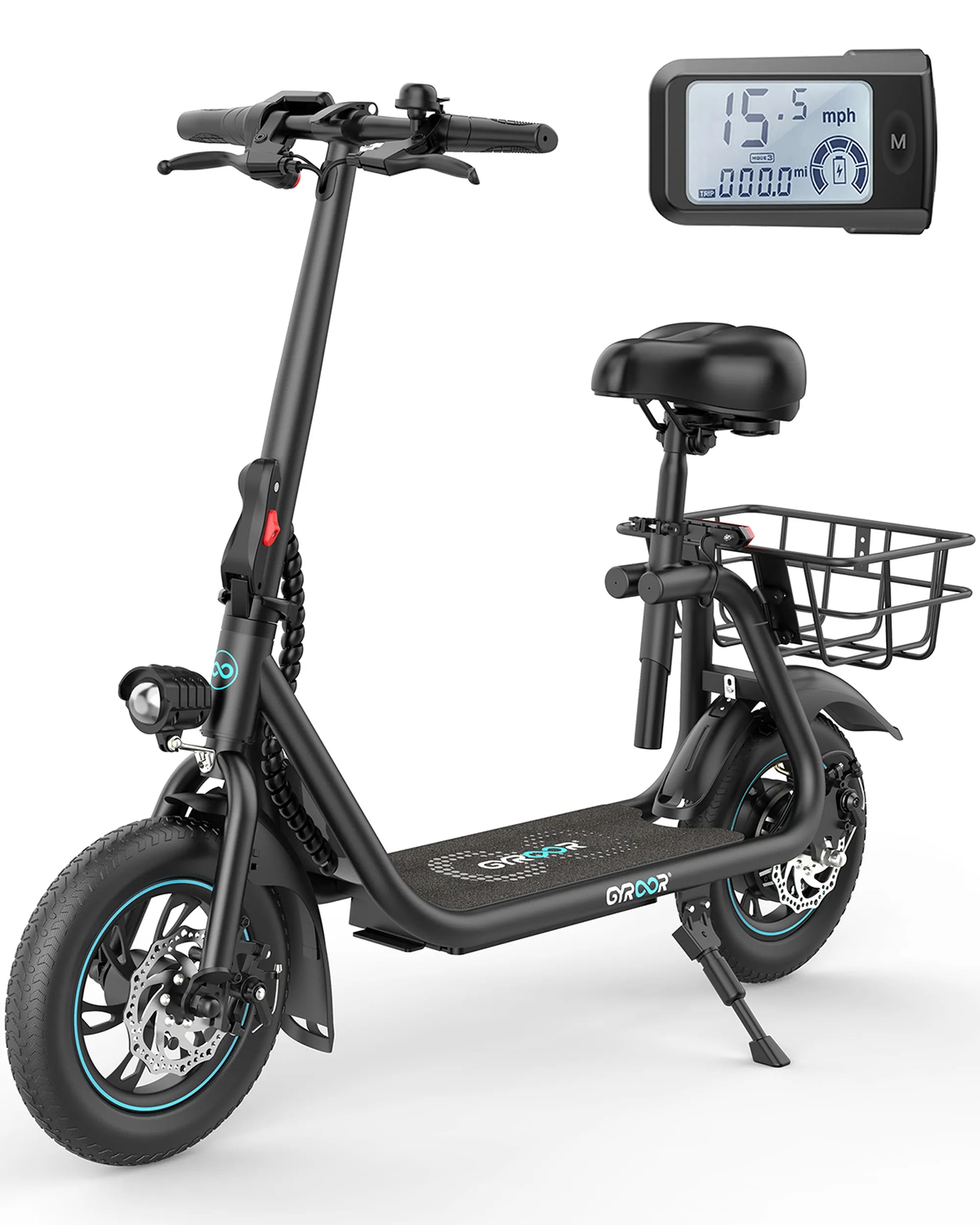
A> The comparison highlights completely different design philosophies. A Gyroor electric scooter, powered by a UL-certified battery pack and built with IPX5 water-resistant designs, is engineered for efficient, quiet, and eco-friendly urban mobility. Its speed is governed for safety, range optimization, and legal compliance on city streets. A 150cc dirt bike is a high-performance, gasoline-powered machine designed for off-road recreation, with power delivery focused on acceleration and overcoming obstacles. Their "top speed" numbers stem from vastly different purposes—one for practical transport, the other for sport and recreation.
The Right Tool for the Ride
The quest to understand the 150 dirt bike top speed reveals more about engineering and purpose than about a single number. Speed is a variable output, shaped by engine design, gearing, rider input, and environment. The 150cc class thrives not on brute force, but on balance and agility.
Whether it's the explosive hit of a KTM 150 SX on a motocross track or the tractable torque of a Honda CRF150F on a wooded trail, these bikes excel by being the right tool for a specific job. Their value is measured in grins per mile, skill development, and the pure joy of riding, not just the digits on a speedometer.
For riders whose journey spans both off-road adventure and urban mobility, it's about choosing the right tool for each environment. Just as you'd select a torquey trail bike for the woods, selecting a reliable, purpose-built vehicle for the city is crucial.
Brands like Gyroor understand this. As a leading electric scooter and e-bike brand trusted by over 100,000 riders across North America and Europe, Gyroor focuses on the core tenets of urban transport: reliability with a 1-year warranty, safety with UL-certified batteries, and practicality with IPX5 water-resistant designs. It's a different kind of performance, optimized for the daily commute rather than the weekend trail.
Explore machines built with purpose for every part of your riding life. Browse the full Gyroor collection at gyroorboard.com to discover electric mobility solutions designed with the same thoughtful engineering you appreciate in a quality dirt bike.
Dirt Bike for 13 Year Old Price: A Complete Value & Safety Guide
Motorcycle Trike Frame Kit: The Complete Guide to Three-Wheel Conversion