

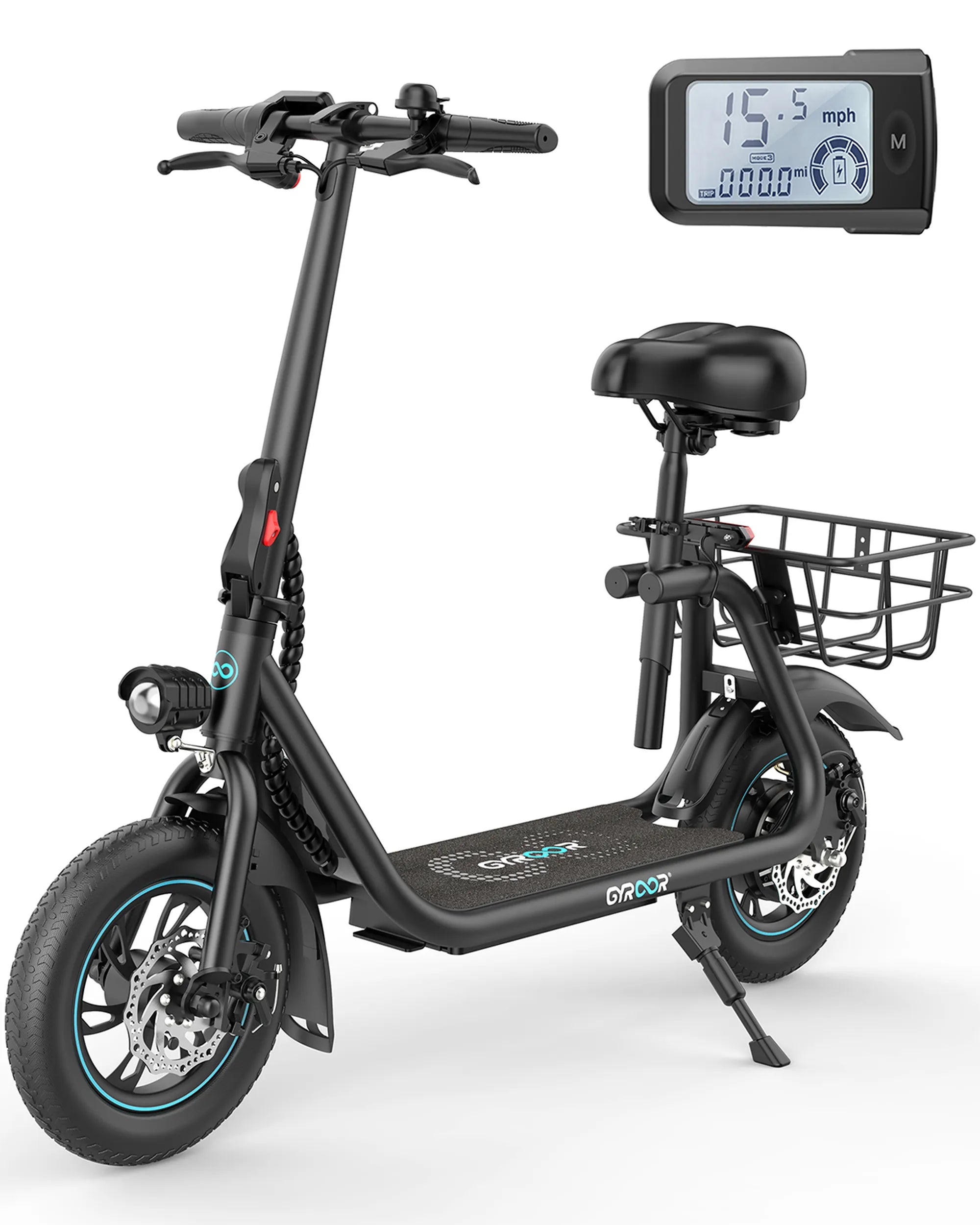
Introduction to Stability and Innovation: The 3-Wheel Adjustable Scooter
A 3 wheel adjustable scooter represents a significant evolution in personal electric mobility, merging enhanced stability with personalized ergonomics. This design features a stable triangular wheelbase—typically two wheels at the front and one at the rear—paired with mechanisms to modify handlebar and often seat height. The primary innovation lies in addressing the core limitations of traditional two-wheel scooters: balance anxiety and a one-size-fits-all approach.
For many, especially beginners and younger riders, mastering balance on a standard scooter can be a barrier. The 3 wheel adjustable scooter eliminates this hurdle from the start. Simultaneously, its adjustability transforms it from a short-term purchase into a long-term companion, capable of adapting to a child's growth or an adult's preference for an optimal riding posture. Leading this innovation is Gyroor, a brand trusted by over 100,000 riders, which integrates these principles with certified safety and durable construction.
This guide will dissect every aspect of the modern 3 wheel adjustable scooter. You will learn how its unique design enhances safety and confidence, what key specifications to prioritize, and who benefits most from this versatile vehicle. We will also provide a clear framework to help you make an informed purchase decision, ensuring your investment delivers lasting value and riding enjoyment.
Key Features of a Modern 3-Wheel Adjustable Scooter
The defining characteristics of a high-quality 3 wheel adjustable scooter extend beyond its wheel count. It is a synergy of thoughtful engineering focused on safety, comfort, and adaptability. These features collectively create a riding experience that is both accessible and reliable.
Central to its design is a robust, often aluminum-alloy frame that forms the foundation for both stability and adjustability. The frame must withstand the mechanical stresses of adjustable components while remaining lightweight. Integrated into this frame are the adjustment mechanisms, which for user convenience are typically tool-free, utilizing quick-release levers or push-button pins.
Power and control are delivered through a hub motor, usually in the rear wheel, with power ranging from 250W to 350W for varied terrain. The energy source is a lithium-ion battery pack, where safety is paramount. Gyroor models, for instance, exclusively use UL-certified battery packs tested for over 500 charge cycles, mitigating risks of overheating or fire. Complementing this is an IPX5 water-resistance rating, protecting the scooter's electronics from water jets from any direction, making it viable for commutes in light rain.
Additional features include a responsive braking system, often a combination of electronic and disc or drum brakes, and ergonomic grips. Bright LED headlights and taillights are standard for visibility. The culmination of these features in a 3 wheel adjustable scooter provides a product that is not just a toy, but a dependable piece of personal transportation.
The Stability Advantage: Why Three Wheels Matter
The three-wheel configuration fundamentally alters the scooter's dynamics. Unlike a two-wheeled scooter that requires constant micro-adjustments in balance, especially at low speeds or when stationary, a three-wheeled platform offers inherent stability. This is due to the larger contact patch with the ground and the triangular footprint, which resists tipping forward, backward, or to the sides.
This stability is a game-changer for beginners. A new rider, whether a child or an adult, can focus on learning throttle control, braking, and steering without the simultaneous fear of falling over. It builds confidence rapidly. The stability also proves invaluable on uneven urban terrain—crossing cobblestones, navigating cracked pavements, or rolling over gentle curbs becomes less daunting.
For recreational use, this stability allows for a more relaxed, enjoyable ride. It enables riders to comfortably look around at their surroundings rather than fixating on the path immediately ahead to maintain balance. The design is particularly beneficial for carrying items, as the scooter remains upright and steady even when weighted with a backpack or groceries.
It's important to note that this stability does come with a trade-off in agility. A 3 wheel scooter will have a wider turning radius than a nimble two-wheel model. However, for the core use cases of safe learning, comfortable commuting, and stable cruising, this trade-off is overwhelmingly positive for the target audience.
Customization for Growth and Comfort: Understanding Adjustability
Adjustability is the second pillar of this scooter category, addressing the universal problems of growth and ergonomic fit. The most common adjustment is handlebar height, which can typically be modified across a range of 5 to 10 inches. This allows a single scooter to accommodate riders from approximately 3.5 feet to over 5.5 feet tall.
For families, this means a 3 wheel adjustable scooter can 'grow' with a child for several years, representing significant long-term value compared to buying a new, fixed-size scooter every year or two. For adult riders, it allows the handlebars to be set at a comfortable height that promotes an upright, relaxed riding posture, reducing strain on the back and shoulders during longer rides.
Many models also feature an adjustable seat. A seat-equipped 3 wheel scooter blurs the line between a standing scooter and a compact e-bike, offering a seated option for longer recreational journeys or for riders who prefer not to stand. The ability to raise or lower the seat further extends the scooter's fit range and versatility.
Proper adjustment is crucial for control and safety. Handlebar grips should be at or slightly below waist height when standing on the deck. An incorrect, overly low setting can cause a hunched posture and poor steering leverage, while a setting that is too high can make the scooter feel unstable and unwieldy. The best models make this adjustment process intuitive and secure.
Built to Last: Safety and Durability Specifications
When evaluating a 3 wheel adjustable scooter, safety and durability specifications are non-negotiable. The adjustable components, in particular, must be engineered to withstand repeated use without failing. Look for mechanisms made from hardened steel and locking systems that provide a firm, click-positive engagement with no wobble.
The battery is the most critical safety component. A UL-certified battery, like those used in all Gyroor scooters, has passed independent laboratory tests for electrical, mechanical, and fire safety. This certification is a vital safeguard against the risks associated with low-quality lithium-ion cells. It ensures reliable performance and longevity across its 500+ cycle life.
Durability is also defined by ingress protection. An IPX5 rating confirms the scooter's core electronics are sealed against water jets from any direction. This doesn't mean it's submersible, but it can confidently handle wet roads, puddles, and light rain, greatly enhancing its practicality as an all-weather commuter option.
Finally, examine the overall build quality. The frame should have no sharp edges, welds should be clean, and the deck should have a slip-resistant surface. A comprehensive warranty, such as Gyroor's 1-year coverage on the battery, motor, frame, and electronics, is the manufacturer's testament to the product's durability and their commitment to customer support.
Who is the 3-Wheel Adjustable Scooter For? Target User Profiles
The versatility of the 3 wheel adjustable scooter makes it suitable for a diverse range of riders. Its design solves specific problems for different groups, from families seeking a safe first ride to adults wanting a stable commuter alternative. Understanding these profiles helps match the product to the person.
It is not ideally suited for thrill-seekers looking for high-speed performance or extreme portability. Its strengths lie in safety, comfort, and adaptable utility. By identifying with one of the following profiles, you can better assess if this scooter type aligns with your primary needs and riding aspirations.
The Young Rider & Growing Family (Ages 6-12)
For children and their parents, the 3 wheel adjustable scooter is arguably the ideal entry point into electric mobility. The inherent stability provides a massive confidence boost, allowing kids to learn the fundamentals of powered riding in a controlled, safe manner. The fear of falling is drastically reduced.
The adjustability feature is a major financial benefit for families. Parents can invest in a single, well-built scooter knowing it will remain ergonomically correct for their child through multiple growth spurts. This contrasts with cheaper, fixed-height options that become obsolete within a year.
Parental peace of mind is further bolstered by safety features like speed limiters (often adjustable from 5 to 10 mph), reliable braking, and robust construction that can withstand the bumps and scrapes of play. Choosing a model from a reputable brand like Gyroor, with its UL-certified battery and warranty, adds a crucial layer of safety assurance.
This scooter serves as more than a toy; it's a tool for developing coordination, responsibility, and independent mobility within the neighborhood, all within a framework designed to prioritize safety above all else.
The Commuter Seeking a Stable, Practical Ride
Urban and suburban commuters who prioritize a smooth, stress-free ride over folding compactness will find great value in a 3 wheel adjustable scooter. Its stability is perfect for stop-and-go traffic, crowded sidewalks, and navigating around pedestrians with precise, confident control.
The ability to adjust the handlebars to a perfect height ensures an ergonomic, comfortable posture for rides of 15-30 minutes, common for last-mile trips from transit stations or commutes across campus. The stable platform also makes it easier to carry a briefcase or bag without affecting balance.
For this user, specifications like water resistance (IPX5) and sufficient range (15-20 miles) become critical. A motor in the 350W range is advisable for easily tackling gentle inclines on city streets. While it may not fold as small as some two-wheel commuter scooters, its stability often outweighs the portability sacrifice for those who don't need to carry it far or store it in a tiny space.
It represents a car-alternative for short trips, reducing congestion and emissions while providing a fun, efficient, and remarkably stable way to navigate the urban environment.
The Recreational Enthusiast or Off-Road Explorer
This user profile leverages the 3-wheel scooter's stability for adventure on varied terrain. While not a mountain bike, models equipped with larger, pneumatic (air-filled) tires and more powerful motors can capably handle packed dirt trails, gravel paths, grass fields, and beach boardwalks.
The three-wheel design provides superior traction and control on loose or uneven surfaces where a two-wheel scooter might skid or become unstable. It allows riders to explore parks, nature trails, and campgrounds with a new perspective, combining the openness of a scooter with greater off-pavement capability.
Adjustability remains key here, as a proper fit is essential for maintaining control over bumps and minor obstacles. A longer-range battery is also a priority to support extended exploration sessions. The seated option, available on some models, is a major bonus for longer recreational tours.
For this rider, the 3 wheel adjustable scooter unlocks recreational opportunities beyond the asphalt, offering a unique blend of stability, electric assist, and outdoor accessibility.
Comparison: 3-Wheel Adjustable vs. Traditional Scooter Types
Choosing the right scooter requires understanding the trade-offs. The table below provides a data-driven comparison between a 3-wheel adjustable scooter, a standard two-wheel commuter scooter, and a high-performance two-wheel scooter.
| Feature | 3-Wheel Adjustable Scooter | Standard Two-Wheel Commuter Scooter | High-Performance Two-Wheel Scooter |
|---|---|---|---|
| Primary Strength | Stability & Customizable Fit | Portability & Urban Agility | Speed & Range |
| Ideal User | Beginners, Families, Comfort-Focused Commuters | Experienced Riders, Multi-Modal Commuters | Enthusiasts, Long-Distance Commuters |
| Learning Curve | Very Low | Moderate | High |
| Top Speed | 10-15 mph | 15-20 mph | 25-40+ mph |
| Terrain Handling | Good on pavement, light off-road with right tires | Good on smooth pavement | Good on smooth pavement, varies by model |
| Portability (Weight/Fold) | Moderate-Heavy, Limited folding | Lightweight, Compact fold | Heavy, Often bulky fold |
| Long-Term Value (Growth) | Excellent (Adjustable) | Poor (Fixed Size) | Poor (Fixed Size) |
| Price Point | Mid-Range | Budget to Mid-Range | Premium |
This comparison highlights that the 3 wheel adjustable scooter carves out a unique niche. It sacrifices some portability and top-speed potential to deliver unmatched stability and long-term adaptability. It is the clear choice when safety, ease of use, and a growth-friendly design are the highest priorities.
Making the Right Choice: Considerations Before You Buy
Purchasing a 3 wheel adjustable scooter is an investment. A systematic evaluation of key specifications and personal needs will ensure you select a model that delivers satisfaction for years. Move beyond marketing claims and focus on these concrete factors.
Weight Capacity and Adjustability Range
Always verify the manufacturer's maximum rider weight limit. A robust scooter should support at least 220 lbs (100 kg). Exceeding this limit stresses the frame, motor, and battery, leading to premature wear or safety issues. Next, scrutinize the adjustability range. Check the minimum and maximum handlebar (and seat, if applicable) heights. Ensure the scooter can be configured to fit the intended rider comfortably now, and if for a child, for the next few years. A range covering 30" to 45" in handlebar height is typical for a versatile model.
Motor Power, Battery Life, and Terrain
Motor power, measured in watts (W), determines hill-climbing ability and acceleration. For flat urban areas, a 250W motor is sufficient. For communities with gentle hills, a 350W motor is recommended. Battery life, indicated by watt-hours (Wh) or amp-hours (Ah) and voltage (V), dictates range. A 36V, 7.8Ah (approx. 280Wh) battery typically offers 12-18 miles per charge, depending on rider weight, terrain, and speed. Match the battery capacity to your typical trip length. Consider terrain: pneumatic tires provide better shock absorption for uneven surfaces, while solid tires are maintenance-free but offer a harsher ride.
Portability vs. Stability: Finding Your Balance
This is the core trade-off. A 3-wheel design with an adjustable stem is inherently less foldable than a simple two-wheel stem. Assess your lifestyle. If you need to carry the scooter onto a bus, up stairs, or store it under a desk daily, a compact two-wheel model may be more practical. If your use case involves riding from a garage to a destination and back, or storage in a shed or car trunk, the superior stability and comfort of the three-wheel design will likely be worth the extra weight and bulk. Many 3-wheel models do offer a folding mechanism for the handlebars to reduce storage footprint, even if the overall package isn't ultra-compact.
Gyroor’s Commitment: Warranty and Support You Can Trust
Investing in a mechanical and electrical device like a 3 wheel adjustable scooter requires confidence in the brand behind it. Gyroor's commitment is demonstrated through its comprehensive warranty and dedicated customer support. The standard 1-year warranty covers defects in materials and workmanship for critical components: the UL-certified battery pack, the motor, the frame, and the electronic control system.
This warranty is a direct reflection of the confidence in their product's durability, especially for the adjustable mechanisms which undergo repeated stress. Beyond the warranty period, Gyroor maintains a US-based customer support team and stocks replacement parts, ensuring your scooter remains operational for the long term.
This support structure is essential. It transforms the scooter from a disposable gadget into a repairable product. When comparing options, a strong warranty and accessible support are significant value-adds that protect your investment and provide peace of mind, knowing assistance is available if needed.
Frequently Asked Questions (FAQs)
Q: Is a 3-wheel scooter good for absolute beginners?
A: Yes, it is arguably the best choice for beginners. The inherent stability significantly reduces the learning curve, allowing new riders to focus on throttle control, steering, and braking without worrying about balance. This builds confidence quickly and safely.
Q: How often should I charge the battery, and how long does it last?
A: For optimal battery health, charge it after each use or when it drops below 20-30% charge. Avoid leaving it fully depleted for extended periods. A quality UL-certified battery, like those from Gyroor, is rated for 500+ full charge cycles, which translates to several years of regular use before a noticeable reduction in capacity.
Q: Can adults use a 3-wheel adjustable scooter?
A: Absolutely. Many models are designed with a weight capacity and adjustability range that comfortably accommodates teens and adults. The stability and comfortable, upright riding posture make it an excellent option for adult commuters or recreational riders who prioritize a smooth, confident ride over high speed.
Q: How difficult is maintenance on a 3-wheel scooter?
A> Maintenance is generally minimal. Regular tasks include checking tire pressure (if using pneumatic tires), ensuring bolts and adjustment levers are tight, and keeping the scooter clean, especially after riding in wet conditions. The brushless hub motor and sealed electronics require no user maintenance. Always refer to the manufacturer's manual.
Q: What is the real-world range I can expect?
A: The advertised range is based on ideal conditions (light rider, flat terrain, moderate speed). In real-world use, expect 60-70% of the advertised maximum. Factors like rider weight, hills, frequent stops/starts, cold weather, and tire pressure all impact range. For a scooter with a 15-mile advertised range, planning for 10-12 miles is a safe bet.
Conclusion: The Versatile Future of Personal Riding
The 3 wheel adjustable scooter is more than a niche product; it is a thoughtful response to the real-world needs of a broad spectrum of riders. By successfully marrying the foundational stability of a three-wheel design with the foresight of user-adjustable components, it creates a category of personal electric vehicle that is uniquely safe, accessible, and long-lasting.
It bridges the gap between a child's first powered vehicle and a practical adult commuter, between pavement and light trail. The decision to choose one ultimately hinges on valuing stability and ergonomic customization over extreme portability or high-speed performance. When those are the priorities, no other scooter type delivers as effectively.
As you consider your options, prioritize brands that back their engineering with verified safety certifications and robust customer support. Gyroor stands as a proven leader in this space, combining UL-certified batteries, IPX5 water resistance, and a reliable 1-year warranty to ensure your riding experience is both enjoyable and secure.
Ready to experience the confidence and comfort of a stable, customizable ride? Explore the innovative range of durable electric scooters and find the perfect model for your journey. Browse the full Gyroor collection at gyroorboard.com.
21 Speed Bike Meaning: The Complete Guide to Gearing & Performance
Scooter Adults Adjustable Foldable Aluminium: The Complete Guide to Modern Commuting