

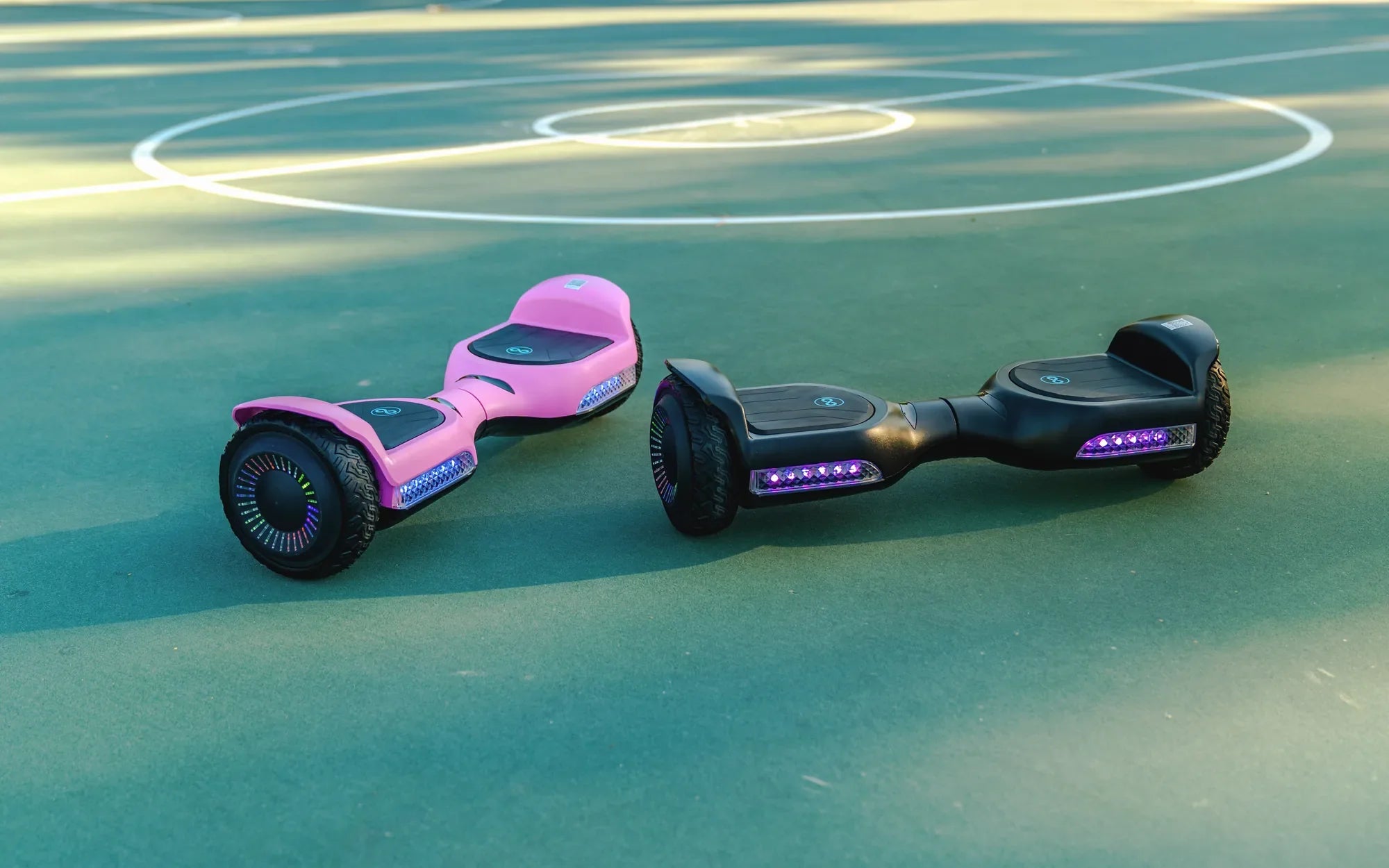
Introduction to the Modern Hoverboard
Forget science fiction. The modern hoverboard, or self-balancing scooter, is a marvel of accessible personal transport powered by real-world physics and sophisticated electronics. It doesn't levitate, but its ability to balance and propel you with a simple lean feels nothing short of magical. This article will dissect that magic, revealing the precise engineering that makes it possible. We will answer the core question: Hoverboard how does it work? By exploring the intricate dance of sensors, processors, and motors, you'll gain a deep appreciation for the technology beneath your feet and the importance of choosing a well-engineered model for safety and performance.
The Core Components: What's Inside Your Hoverboard?
Understanding how a hoverboard works begins with knowing its key parts. Each component plays a critical role in the self-balancing act, transforming your subtle weight shifts into smooth, controlled movement.
The Brain: The Gyroscope and Sensor System
At the heart of the system are micro-electro-mechanical systems (MEMS) gyroscopes and accelerometers. These tiny sensors, often packaged together, are the hoverboard's inner ear and sense of balance. The gyroscope measures angular velocity—how fast the board is tilting—while the accelerometer detects the static angle of tilt relative to gravity. Mounted on the logic board, they provide a constant, real-time data stream, updating hundreds of times per second to create a precise picture of the board's orientation.
The Muscle: Electric Motors and Wheels
Each wheel is driven by its own independent, brushless DC electric motor. These high-torque motors are the physical executors of the logic board's commands. They are capable of spinning forward and backward at variable speeds with rapid response times. The independence of these two motors is what allows for not just forward/backward movement but also precise turning and even spinning in place, a direct result of the differential speed control between the left and right wheels.
The Power Source: The Battery Pack
All this electronic activity demands a robust and stable power source. Modern hoverboards use lithium-ion battery packs, typically with a voltage of 36V or 42V. The quality of this battery is paramount. A high-quality, UL-certified battery pack, like those used in Gyroor hoverboards, provides consistent voltage and includes a Battery Management System (BMS) to prevent overcharging, over-discharging, and short circuits. This stability is non-negotiable for the sensitive sensor and motor systems that rely on clean, uninterrupted power.
The Conductor: The Main Logic Board (Motherboard)
This is the central processing unit. It receives the constant flow of data from the gyroscopes, accelerometers, and pressure-sensitive footpads. Using complex algorithms, it calculates the exact motor output required to counteract a tilt (to balance) or to initiate movement in response to a lean. It acts as the ultimate decision-maker, orchestrating the entire operation.
The Science of Self-Balancing: A Step-by-Step Process
The true genius of a hoverboard lies in its real-time feedback loop. This process, happening in milliseconds, is the definitive answer to Hoverboard how does it work. Let's break it down into a clear sequence.
Step 1: Sensing Your Lean (The Input)
When you step onto a powered-on hoverboard and stand upright, the sensors establish a "zero point" or balance point. To move forward, you subtly shift your weight forward, pressing down with your toes. This action tilts the entire platform forward. The gyroscope and accelerometer instantly detect this change in angular position and acceleration. Simultaneously, pressure sensors in the footpads register the increased force at the front.
Step 2: Processing the Command (The Calculation)
The sensor data is sent to the main logic board. The board's microprocessor runs a control algorithm, often based on a Proportional-Integral-Derivative (PID) controller. This algorithm calculates two key things: the degree of imbalance (how far you're leaning) and the rate of change. It then determines the exact corrective action needed: how fast and in which direction each motor must spin to both prevent a fall and initiate movement in your desired direction.
Step 3: Executing the Move (The Output)
The logic board sends pulse-width modulation (PWM) signals to the motor controllers. To counteract a forward lean and go forward, both motors are commanded to spin forward. The speed is proportional to the degree of lean—lean more, go faster. To stop, you straighten up. The sensors detect the board returning to level, and the logic board gradually reduces motor speed to zero, maintaining balance.
Step 4: Mastering Turning and Rotation
Turning is a masterpiece of differential control. To turn right, you apply more pressure with your left foot (or push your right heel). The sensors detect this asymmetrical pressure, and the logic board commands the left wheel to spin faster than the right wheel (or the right wheel to slow down/reverse slightly). This speed difference causes the board to pivot. A sharp turn or spin is achieved by having one wheel move forward while the other moves backward.
Hoverboard vs. Segway: A Key Technology Comparison
While both are self-balancing personal transporters, a hoverboard and a Segway (or similar kick scooter with self-balancing) differ significantly in form and control mechanics, stemming from their core design philosophies.
| Feature | Two-Wheel Hoverboard | Segway/Self-Balancing Scooter |
|---|---|---|
| Primary Balance Mechanism | Footpad tilt sensors & gyroscopes | Handlebar lean & gyroscopes |
| Steering Input | Differential foot pressure (left vs. right) | Handlebar tilt or turning column |
| Form Factor | Compact, no handlebars, foot-guided | Larger, features a handlebar or T-bar |
| Learning Curve | Moderate; requires lower-body coordination | Easier for many; uses intuitive handlebar lean |
| Portability | Highly portable, often under 30 lbs | Less portable due to size and handlebar |
| Intended Use Case | Recreation, short commutes, trick-riding | Tourism, security, longer urban commutes |
The Handlebar Factor: Steering Mechanics
The Segway's handlebar is not just for holding on; it's a primary control interface. Leaning the handlebar left or right provides a direct steering input to the logic board, which then adjusts wheel speeds. In contrast, a hoverboard eliminates this intermediary. Steering is accomplished entirely through the rider's feet and lower body, creating a more immersive, board-sport-like feeling. This direct connection is central to understanding how a hoverboard works differently.
The Form Factor: Portability and Intuition
The hoverboard's compact, handlebar-free design makes it exceptionally portable and agile. It's designed for spontaneous use and easy storage. The Segway, with its larger frame and handlebar, offers greater stability at higher speeds and over longer distances but sacrifices the hoverboard's nimbleness and ease of transport. The choice often comes down to priority: ultimate portability and fun versus extended-range commuting with a traditional steering feel.
Safety and Stability: How Quality Engineering Matters
The explanation of Hoverboard how does it work is intrinsically linked to safety. The system's reliability depends entirely on the quality and integration of its components. Cutting corners on any part can lead to system failure, which at best means a dead board, and at worst, a fall or fire hazard.
The Critical Role of UL-Certified Batteries
The battery is the system's lifeblood. A non-certified, poor-quality battery can have unstable cells, inadequate thermal management, and a weak BMS. This can lead to voltage drops during high load (causing the board to shut off mid-ride), failure to charge properly, or in extreme cases, thermal runaway and fire. Gyroor's use of UL 2272 certified battery packs ensures each cell and the entire pack has passed rigorous electrical, mechanical, and environmental stress tests, providing the stable, safe power the sensitive balance system demands.
Importance of Water and Dust Resistance (IP Ratings)
The internal electronics are vulnerable. Riding through a puddle or on a dusty path can expose the logic board and sensors to moisture and debris. An ingress protection rating like IPX5 (a standard for many Gyroor models) means the unit is protected against water jets from any direction. This prevents short circuits and corrosion, ensuring the gyroscopes and pressure sensors continue to deliver accurate data. Without this protection, a small amount of water can disrupt the sensor readings, causing erratic behavior or complete failure.
Frame and Wheel Construction
Safety isn't just electronic. A robust, impact-resistant ABS shell protects the internal components from shocks. Similarly, high-traction, durable rubber tires with good tread patterns are essential for maintaining grip, especially during turns and on slightly wet surfaces. The motor's torque must also be appropriately matched to the wheel size and rider weight to ensure adequate power for starts and inclines without straining the system.
Advanced Features in Modern Hoverboards
Building on the core self-balancing technology, modern hoverboards incorporate features that enhance safety, connectivity, and the riding experience, further demonstrating the sophistication of these devices.
Bluetooth Connectivity and Mobile Apps
Many models, including several from Gyroor, feature Bluetooth modules. Pairing with a smartphone app allows riders to lock/unlock the board, monitor battery life in real-time, adjust riding sensitivity modes (beginner vs. advanced), control LED light patterns, and track riding statistics. This connectivity transforms the hoverboard from a simple transporter into a smart, customizable device.
Built-in Speakers and LED Lighting
While primarily for entertainment, built-in speakers allow for music playback from a connected device. More importantly, comprehensive LED lighting—under-glow, wheel lights, and front/rear lights—serves a critical safety function by increasing rider visibility to others at night, making it a practical feature for evening use.
Rider Weight and Speed Limiters
Advanced logic boards can be programmed with safety limiters. A beginner mode may cap the top speed and reduce motor responsiveness to make learning easier. The board's maximum weight capacity is also a function of motor torque and frame strength. Exceeding it can overstress the motors and battery, leading to premature failure and unsafe operating conditions.
Maintenance and Care for Longevity
Knowing how a hoverboard works informs how to care for it. Proper maintenance ensures the sensitive components continue to function as designed for years.
Battery Care and Charging Best Practices
Always use the manufacturer-provided charger. Avoid draining the battery to 0%; recharge when it drops to 20-30%. Do not leave the board on the charger indefinitely after it's full. For long-term storage, charge the battery to about 50-60%. This care maximizes the lifespan of the UL-certified battery pack, which is typically rated for 500+ charge cycles.
Tire and Hardware Checks
Regularly inspect tire pressure (if using air-filled tires) and tread wear. Check that all external screws are tight and that the footpads and shell show no major cracks. Keep the wheels and footpads clean from mud and debris that could interfere with sensors or motors.
Software and Calibration
If the board begins to feel unbalanced or drifts to one side, it may require a calibration. This process (detailed in the user manual) resets the gyroscope's "zero point" on a perfectly level surface. Keeping the firmware updated via a manufacturer's app, when available, can also improve performance and stability.
Frequently Asked Questions (FAQ)
Can a hoverboard work on carpets or rough terrain?
Performance depends on motor torque and wheel size. Standard hoverboards with 6.5-inch wheels are best for smooth, hard surfaces like pavement and tile. Low-pile carpet is usually manageable. For rougher terrain like grass, gravel, or off-road paths, all-terrain models with 8.5-inch or 10-inch air-filled tires and higher-torque motors are required. These provide the necessary power and suspension to overcome bumps and maintain sensor stability.
How does the hoverboard know when to stop?
When you step off, two things happen. First, the pressure sensors in the footpads detect the absence of weight. Second, without a rider to lean it, the board returns to a level position, which the gyroscope detects. The logic board interprets this combined data as a "rider off" command, cutting power to the motors and entering a balanced standby mode. An automatic shut-off timer usually engages after a period of inactivity to conserve battery.
What happens if a sensor fails while riding?
Quality hoverboards have redundant systems and fail-safes. If a primary gyroscope fails, the logic board may use data from the accelerometer or secondary sensors to maintain basic function while alerting the rider (often via beeping or flashing lights) to stop. In a critical failure, the logic board's primary safety protocol is to cut power to the motors, causing the board to stop abruptly. This is why a robust construction that protects sensors from impact is crucial.
Why is a warranty important for a hoverboard?
Given the complexity of the integrated sensor-motor-battery system, a comprehensive warranty is a sign of manufacturer confidence and protects your investment. Gyroor's 1-year warranty covers defects in materials and workmanship, ensuring that if any component of the delicate balance system fails under normal use, it will be repaired or replaced. This peace of mind is invaluable for a device relying on such precise technology.
How is speed controlled if there's no throttle?
Speed is directly and proportionally controlled by your body's angle. The further you lean forward from the balance point, the faster the logic board commands the motors to spin to "catch" you and prevent a fall. The board's maximum speed is a pre-set limit in the software. To slow down, you simply reduce your forward lean, bringing your body back toward the balance point. The motors slow accordingly.
Conclusion: Engineering in Motion
The modern hoverboard is a testament to applied physics and consumer electronics. The seamless operation that answers Hoverboard how does it work is the result of a meticulously engineered feedback loop: gyroscopes and sensors act as the nervous system, a powerful logic board serves as the brain, and high-torque motors function as the muscles. This understanding underscores that not all hoverboards are created equal. The reliability of this complex dance hinges on the quality of each component—from UL-certified batteries that ensure safe, stable power to IP-rated enclosures that protect delicate circuitry. For a ride that is not only fun but fundamentally safe and dependable, choosing a brand committed to this quality engineering is essential. Experience the confidence that comes with robust design and certified safety by exploring the range of high-performance models. Browse the full Gyroor collection at gyroorboard.com.
Large Hoverboard: The Ultimate Guide to Choosing and Riding the Best Models
Large Hoverboard: The Ultimate Guide to Choosing and Riding the Best Models