


The Thrill of Speed on a Hoverboard Go Kart
Hoverboard go karts, also known as drift karts, transform a self-balancing hoverboard into a thrilling, seated electric vehicle. The central question for any potential rider is: how fast does a hoverboard go kart go? The answer unlocks everything from safety considerations to pure adrenaline. This exploration dives deep into the mechanics of speed, providing a data-driven look at what you can realistically expect from different models and configurations.
You will learn the technical factors dictating top speed, from motor wattage to battery specs. We'll examine real-world speed tiers for kids, teens, and adults. Crucially, we'll balance this performance with essential safety protocols and maintenance tips to ensure your ride is both exhilarating and reliable. Brands committed to certified safety, like Gyroor, engineer this performance within a robust framework, ensuring fun doesn't come at the expense of durability or rider security.
Understanding Hoverboard Go Kart Speed: The Key Factors
Top speed isn't a random number; it's the product of several interacting engineering components. Understanding these factors is crucial for setting realistic expectations and choosing the right kart for your needs. Performance hinges on the synergy between power, energy, and load.
Motor Power and Configuration
The motor is the heart of your kart's acceleration and top speed. Power is measured in watts (W). A single 300W motor provides adequate power for light riders on flat ground. However, dual-motor configurations, such as dual 350W or dual 500W setups, are common and offer superior torque and higher potential speeds.
Dual motors distribute power more efficiently, especially during turns and on slight inclines. For a hoverboard go kart designed for teens and adults, a combined motor power of 700W or more is typically the entry point for zippy, responsive performance. More wattage generally translates to a higher ceiling for both speed and hill-climbing ability.
Battery Voltage and Capacity
Voltage (V) acts like the pressure in a water hose—it determines how much power can be delivered to the motor at once. Common voltages are 36V and 48V. A 48V system can deliver more power than a 36V system, often resulting in a higher top speed and better performance under load.
Capacity, measured in ampere-hours (Ah), relates to range, not directly to top speed. A larger capacity battery allows you to sustain top speed for longer. It's vital that this power source is safe. Brands like Gyroor utilize UL-certified lithium-ion battery packs, tested for 500+ charge cycles, ensuring consistent, reliable power delivery without the safety risks associated with uncertified cells.
Rider Weight and Terrain
Advertised top speeds are usually achieved under ideal conditions: a lightweight rider on smooth, flat pavement. Adding payload directly impacts performance. A kart moving a 120-pound rider will accelerate faster and reach a higher speed than the same kart carrying a 200-pound rider.
Terrain is equally critical. Riding on grass, gravel, or uphill introduces significant resistance. Even a gentle 5-degree incline can reduce your hoverboard go kart's speed by 20-30%. Most consumer models have a recommended weight limit between 220 and 265 pounds; exceeding this will noticeably diminish speed, acceleration, and battery life.
How Fast Do They Really Go? A Real-World Speed Breakdown
Translating specs into real-world experience requires looking at market segments. Performance generally falls into three distinct tiers, each catering to different rider profiles and use cases.
Entry-Level & Kids' Models (Up to 10 mph)
Designed primarily for safety and younger riders (typically ages 6-12), these karts often pair with lower-powered hoverboards (single 300W-400W motors) or have built-in speed limiters. Speeds cap at around 8-10 mph. This range provides a thrilling sense of motion for a child while allowing parents to keep pace easily on foot.
The focus here is on controlled fun, stability, and durability. They are perfect for driveway use, smooth park paths, and supervised play. While not built for commuting, they offer an excellent introduction to electric personal mobility.
Mainstream Adult & Teen Models (10 - 15 mph)
This is the most popular performance bracket, representing the sweet spot for recreational riders and short-distance commuting. Equipped with dual motors (often 350W each) and 36V or 48V systems, these karts reliably achieve speeds of 12-15 mph.
At this speed, the ride feels dynamic and engaging. It's fast enough for a fun trip around the neighborhood or to a local friend's house, yet slow enough to maintain control and react to obstacles. This category includes many of Gyroor's compatible models, which emphasize a balance of IPX5 water-resistant design and reliable power for everyday adventure.
High-Performance Models (15+ mph)
Premium karts, often paired with high-output hoverboards featuring dual 500W+ motors and 48V+ battery systems, can push speeds beyond 15 mph, with some reaching 18-20 mph under optimal conditions. This performance demands respect and experience.
At these velocities, reaction times shorten, and the consequences of a mishap increase significantly. These models are suited for experienced riders on private property or designated areas. They highlight the importance of a sturdy frame, wide wheelbase, and premium braking systems—features engineered into performance-focused designs.
Speed vs. Safety: Navigating the Performance Balance
Speed is thrilling, but safety enables confident enjoyment. A well-designed hoverboard go kart integrates features that manage performance to protect the rider. View these not as limitations, but as the foundation for worry-free fun.
The Role of Speed Modes
Most modern electric vehicles, including quality hoverboards used in karts, feature programmable speed modes. A beginner mode may limit top speed to 6-7 mph, perfect for first-time riders to learn steering and braking. Intermediate and sport modes progressively unlock the full performance.
This system allows skill development in a controlled manner. It's a critical feature for families, ensuring a child's kart can grow with them as their proficiency increases, all while maintaining a safety ceiling set by parents.
Essential Safety Features for Speed
As speed increases, the quality of core components becomes non-negotiable. Reliable braking is paramount; look for responsive electronic brakes or mechanical disc brakes. The frame must be constructed from reinforced steel or aluminum to handle stresses at higher speeds and during drifts.
A wide wheelbase enhances stability, preventing tip-overs during sharp turns. Furthermore, IPX5 water resistance, a standard on Gyroor scooters and hoverboards, means the electronics are protected from water splashes, allowing for confident riding on damp pavement without risk of short-circuiting.
Mandatory Safety Gear
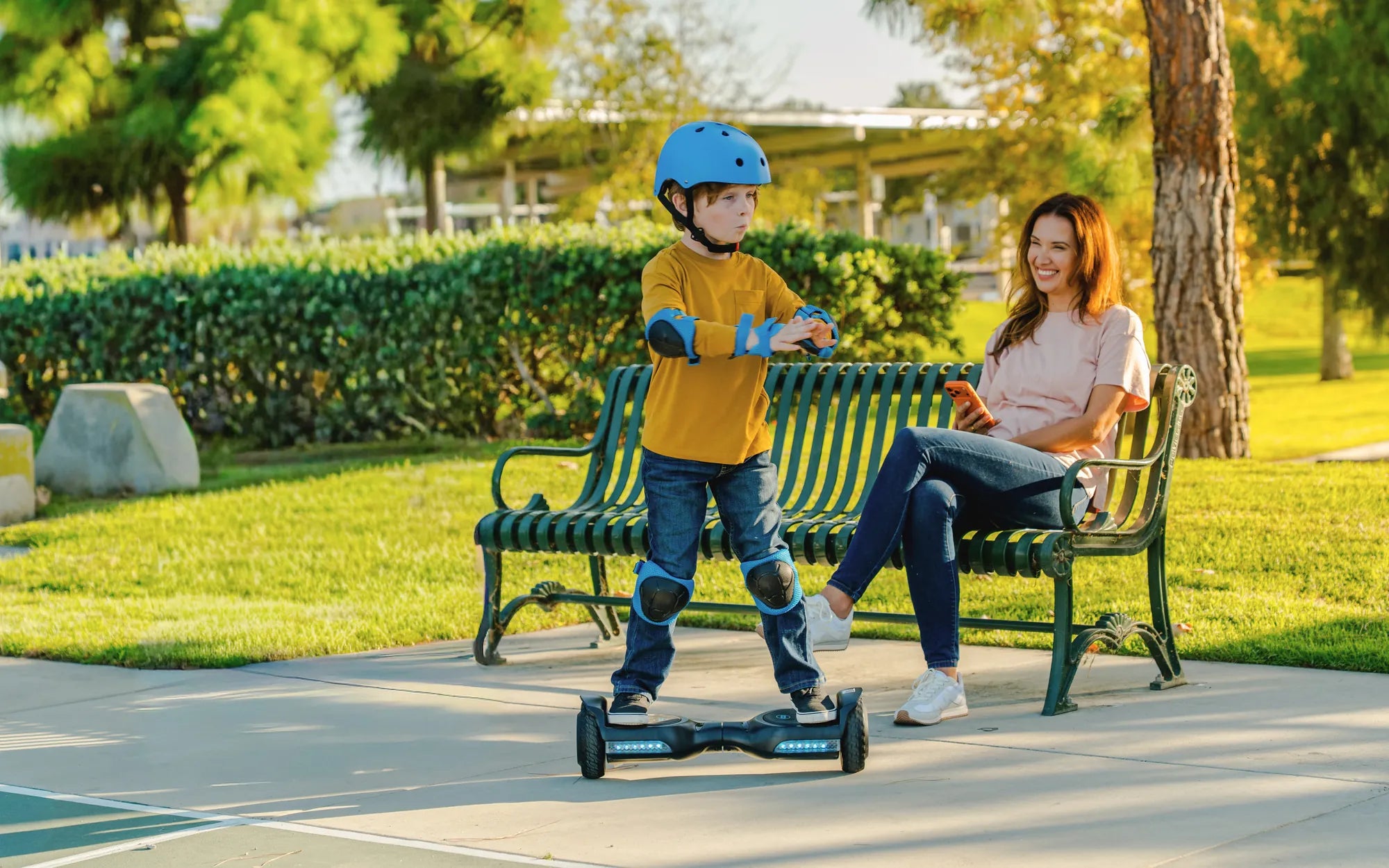
Your safety system is incomplete without personal protective equipment (PPE). A certified helmet is an absolute must, regardless of speed. As you approach and exceed 10 mph, full gear becomes strongly advisable.
- Helmet: DOT, CPSC, or CE certified.
- Knee and Elbow Pads: Protect against abrasions.
- Gloves: Improve grip and protect hands.
- Closed-Toe Shoes: Essential for foot protection.
This gear is your last line of defense and should be considered part of the vehicle's required equipment.
Maximizing Your Hoverboard Go Kart's Performance
To ensure your kart consistently delivers its advertised performance and longevity, proper care and smart riding are essential. These practices help maintain optimal speed and range throughout the product's life.
Proper Maintenance for Consistent Power
Regular checks are simple but impactful. Maintain proper tire pressure (as per the manual); under-inflated tires create drag and sap speed. Periodically check and tighten frame, seat, and steering column bolts to prevent wobble.
Battery care is crucial. Follow the manufacturer's charging guidelines—avoid leaving the battery fully depleted or at 100% charge for extended periods. Using the official, UL-certified charger that comes with your device, like those from Gyroor, ensures correct voltage and prevents battery damage that can reduce power output over time.
Riding Techniques for Efficiency
How you ride directly affects your speed and range. Smooth, gradual acceleration is more efficient than jolting starts. Maintaining a steady cruising speed, rather than constant stop-and-go, maximizes battery range.
Plan your route to favor smooth, flat pavement. Avoid grass, sand, and steep hills when trying to achieve top speed. Reducing wind resistance by sitting upright (not slouching) can also have a minor but positive effect at higher speeds.
Understanding and Respecting Local Regulations
Before taking your kart to public paths or parks, research local laws. Many municipalities have speed limits for electric personal mobility devices on multi-use paths, often around 15 mph.
Riding responsibly—yielding to pedestrians, avoiding crowded sidewalks, and using lights if riding at dusk—ensures you enjoy your hoverboard go kart without conflict. Adhering to regulations helps maintain access for all riders.
Performance Comparison: Hoverboard Go Kart Tiers
The table below summarizes the key differences between the primary performance categories to help guide your choice.
| Feature | Entry-Level (Kids) | Mainstream (Teens/Adults) | High-Performance |
|---|---|---|---|
| Typical Top Speed | 8 - 10 mph | 10 - 15 mph | 15+ mph (up to 20 mph) |
| Motor Configuration | Single 300W-400W | Dual 350W (700W total) | Dual 500W+ (1000W+ total) |
| Battery System | 24V - 36V | 36V - 48V | 48V and above |
| Ideal Rider | Children (6-12) | Teens & Adults for Recreation/Commute | Experienced Enthusiasts |
| Primary Use Case | Supervised Play, Driveways | Neighborhood Riding, Park Paths | Private Property, Designated Areas |
| Safety Focus | Low Speed, Stability | Balanced Performance, Braking | High-Speed Stability, Premium Brakes |
Frequently Asked Questions (FAQ)
Q: Can I make my hoverboard go kart faster?
A: We strongly advise against aftermarket modifications like "speed chips" or firmware hacks. These void the warranty, can overload the motor or battery leading to failure or fire, and compromise critical safety features. The safe way to get more speed is to choose a model with higher power specifications from the start.
Q: How does speed affect the battery range?
A: Speed and range have an inverse relationship. Riding consistently at top speed drains the battery much faster than cruising at a moderate pace (e.g., 10 mph). You might get 10-12 miles of range at a steady 12 mph, but that could drop to 6-8 miles if you constantly push 15+ mph. Aerodynamic drag increases exponentially with speed.
Q: Is a 15 mph hoverboard go kart safe for a 12-year-old?
A: Safety depends more on maturity, experience, environment, and supervision than age alone. A responsible 12-year-old with proper safety gear, initial training in a beginner mode, and supervision in a safe, open area may handle it. However, many parents find the 10-12 mph range more appropriate. Always use the speed limiter function when available.
Q: Why is my new kart not reaching its advertised top speed?
A: Several common factors can cause this: 1) Rider weight is near or at the maximum limit. 2) Battery charge is low (performance drops as charge depletes). 3) Tire pressure is insufficient. 4) Terrain is not perfectly flat, paved surface. 5) There may be a slight speed calibration difference between the hoverboard's display and real-world GPS speed.
Q: What's more important for speed: motor wattage or battery voltage?
A: They work in tandem, but voltage is the enabling factor. A high-wattage motor (e.g., 500W) paired with a low-voltage battery (24V) will be starved for power and cannot perform optimally. For higher speeds, prioritize a combination of higher voltage (48V) and sufficient motor wattage. This ensures the system can deliver the necessary power sustainably.
Choosing the Right Speed for Your Ride
The perfect speed for your hoverboard go kart is a personal equation balancing thrill, control, and intended use. For families, a model with a robust speed limiter provides safe, scalable fun. For teens and adults, the 12-15 mph range offers an ideal mix of excitement and practicality for neighborhood exploration. Enthusiasts seeking peak performance must pair it with heightened safety awareness and appropriate gear.
Ultimately, the best performance is reliable performance. Choosing a kart built with quality components—like UL-certified batteries, water-resistant electronics, and a sturdy frame—ensures the speed you get is consistent and safe. Trusted brands engineer this balance, backing it with warranties and support. For a collection of electric rideables designed with this philosophy of certified performance, explore the engineering and innovation behind every model.
Browse the full Gyroor collection at gyroorboard.com.
Adult Size Electric Scooter Self Balancing Hoverboard for Kids: The Ultimate Guide
Wide Scooter for Kids: The Ultimate Guide to Safety and Fun