


Introduction: Why Security is the Foundation of Modern Hoverboarding
A Security Hoverboard represents a fundamental shift in personal electric transport. It is a device engineered with rider safety as its core principle, integrating advanced hardware protections, intelligent software, and robust construction from the ground up. This is not merely a marketing term but a classification defined by specific, verifiable standards and features designed to prevent the common failures—battery fires, sudden cutouts, loss of control—that plagued early models.
For brands like Gyroor, a leader trusted by over 100,000 riders, security is non-negotiable. It's built into every component, from the UL-certified battery pack to the water-resistant shell. This guide provides a comprehensive roadmap. You will learn to identify the critical features of a secure hoverboard, master proactive safety checks, adopt confident riding techniques, and perform essential maintenance. The goal is to transform you from a passive user into an informed, secure rider.
What Makes a Hoverboard "Secure"? Key Features Decoded
The distinction between a basic hoverboard and a true security hoverboard lies in a suite of integrated technologies. These features work in concert to manage risk, prevent component failure, and protect the rider. Understanding them is the first step in making a smart purchase and ensuring safe operation.
Security begins with the electrical system and enclosure. Premium models utilize high-grade lithium-ion cells arranged in packs with robust physical and electronic safeguards. The motor control system must deliver smooth, predictable power without lag or surges. Every aspect, from the wiring harness to the charging port, is designed to a higher standard of durability and isolation.
UL 2272 Certification: The Non-Negotiable Safety Standard
UL 2272 certification, developed by Underwriters Laboratories, is the single most critical safety benchmark. It is not a simple check but a rigorous series of over 20 tests simulating extreme conditions. These tests evaluate the battery system's resilience to overcharging, short circuits, vibration, impact, and thermal runaway—the chain reaction that leads to fires.
A hoverboard without this certification carries a significantly higher risk. The certification process examines the entire electrical system, ensuring all components work together safely. All Gyroor hoverboards utilize UL 2272 certified battery packs, a foundational commitment that has contributed to their 4.5/5 average customer rating and trust across North America and Europe.
Advanced Battery Management Systems (BMS)
An Advanced Battery Management System (BMS) is the brain of a secure battery pack. A sophisticated BMS actively monitors each individual cell's voltage, temperature, and current in real-time. It performs critical functions like cell balancing, ensuring all cells charge and discharge evenly to prevent stress on any single cell.
More than just monitoring, a high-quality BMS enforces limits. It will cut power to prevent over-discharging (which permanently damages cells) and halt charging when full. It also manages thermal output, reducing power if temperatures rise dangerously. This constant vigilance is what extends battery life to 500+ charge cycles and prevents the catastrophic failures that basic BMS units might miss.
IP Water Resistance Rating: Protection from the Elements
The IP (Ingress Protection) rating quantifies a device's defense against solids and liquids. For hoverboards, the liquid protection rating (the second digit) is paramount. An IPX5 rating, as found on Gyroor models, means the enclosure can withstand water jets from any direction.
This is crucial for real-world riding. It protects the sensitive electronics and battery from puddle splashes, wet pavement, and light rain. Water damage is a leading cause of electrical shorts and motor failure. An IPX5 rating doesn't mean submersible, but it provides a critical margin of safety for everyday conditions, allowing for more confident riding without constant fear of a minor splash causing a major malfunction.
Firmware & Software Safeguards
Beyond hardware, security is enforced through intelligent firmware. These software-based protections create a safe operating envelope for the rider. A speed governor prevents the board from exceeding its designed maximum speed, often accompanied by a tilt-back feature that gently angles the footpads back to discourage leaning further.
Other key software safeguards include low-battery alerts and progressive power reduction. Instead of shutting off abruptly at 0%, a secure board will warn the rider and gradually limit top speed to conserve power for a safe, controlled stop. Auto-shutoff features activate if the board is left idle or falls over, preventing the motors from spinning uncontrollably. These are the digital guardians that work silently to prevent user error from becoming an accident.
The Smart Rider's Pre-Ride Checklist: Proactive Security Measures
Security is a partnership between the device and the rider. A thorough pre-ride routine takes less than two minutes but is the most effective way to catch potential issues before they become hazards. This habit ensures both you and your hoverboard are prepared for a safe journey.
Begin in a clear, flat area. Visually inspect the board's shell for any new cracks, especially near the wheel axles and central hinge. Check that the LED lights are functioning, as they are vital for visibility. Gently rock the board side-to-side and listen for any unusual rattles from loose internal components. A secure hoverboard should feel solid and rattle-free.
Gear Up: Essential Protective Equipment
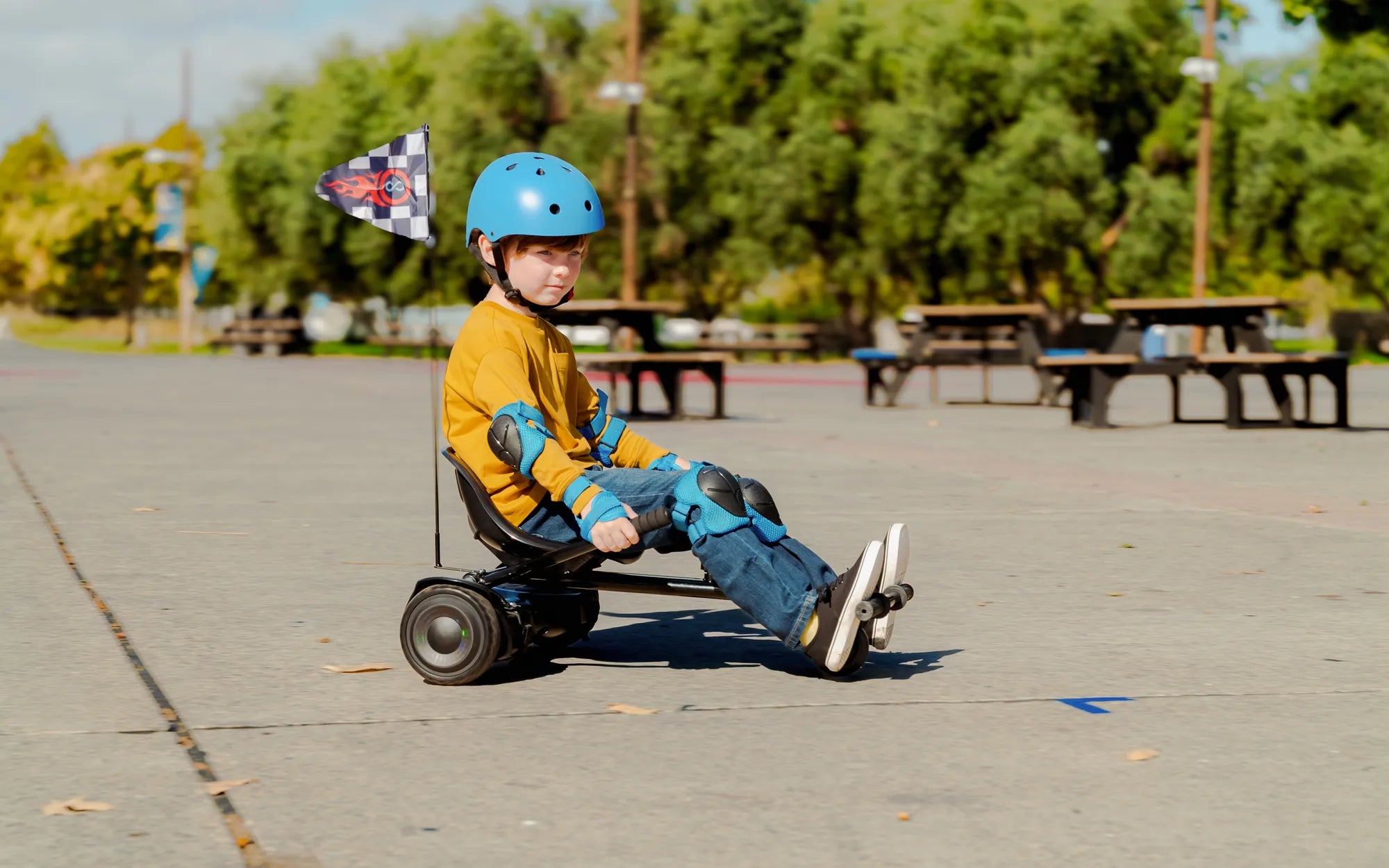
Rider gear is your personal security system. A certified multi-impact helmet is non-negotiable for protecting against head injuries. Wrist guards are equally critical, as falls often involve instinctive bracing with hands. For new riders or high-speed use, knee and elbow pads provide comprehensive joint protection.
For enhanced security, consider your environment. Riding at dusk or dawn requires high-visibility clothing or reflective strips. Some riders add LED armbands or helmet lights. The right gear transforms a potential accident into a minor incident, allowing you to ride with greater confidence and control.
The 60-Second Security Diagnostic
This rapid diagnostic focuses on critical touchpoints. First, check tire pressure and tread; under-inflated tires affect balance and strain the motor. Inspect the tire surface for embedded debris or excessive wear. Second, ensure the battery compartment cover is securely fastened with no gaps.
Third, perform a stationary power test. Turn on the board and, while holding it off the ground, gently tilt it forward and backward. Both wheels should engage smoothly and quietly without stuttering. Finally, plug in the charger briefly to confirm the charging indicator lights up properly. Any failures in this checklist mean the ride should be postponed until the issue is resolved.
Safe Riding Practices: Operating Your Security Hoverboard with Confidence
Operating a security hoverboard safely requires skill and awareness. Mastery comes from understanding the device's dynamics and respecting the riding environment. The most advanced safety features are only effective when paired with prudent rider behavior.
Always start in a beginner mode if available. This limits speed and acceleration, allowing you to build muscle memory for balance and control. Your posture is key: stand upright with knees slightly bent, distributing weight evenly across both feet. Avoid looking down at your feet; instead, look several meters ahead in your intended direction of travel to maintain balance and awareness.
Mastering Control: Starting, Stopping, and Maneuvering
Mounting and dismounting are the most precarious moments. To mount, place one foot firmly on the board, press the power button to activate the gyroscope, then step up smoothly with the second foot. To dismount, come to a complete stop, step backward off the board with one foot, then the other—never jump off forward.
Acceleration and braking should be gradual. Lean forward from your ankles, not your waist, to move forward. To brake, shift your weight slowly backward. For turns, apply gentle pressure with the toes or heel of the foot in the direction you wish to turn. Practice these maneuvers in an empty parking lot until they become instinctive before navigating complex paths.
Navigating Different Terrains Securely
Different surfaces demand different strategies. On smooth, dry pavement, a security hoverboard performs optimally. Maintain a moderate, steady speed. When transitioning to packed dirt or smooth grass, reduce speed significantly and keep your body loose to absorb minor bumps; these surfaces require more power and can reduce range by up to 30%.
Gravel, sand, and wet leaves are high-risk terrains and should be avoided. They offer poor traction and can cause sudden slips. For slight inclines (under 15 degrees), approach with steady momentum. Never attempt steep hills, as they can overwhelm the motor's torque, cause overheating, and lead to a sudden loss of power on the descent.
Rules of the Road & Path: Etiquette and Awareness
Legally, hoverboards often occupy a gray area. Always check local regulations; they may be prohibited on public roads, restricted to bike lanes, or limited to private property. On shared-use paths, you are a guest. Yield to all pedestrians and cyclists. Announce your presence politely with a bell or a verbal "on your left" when passing.
Maintain a safe, controllable speed—typically under 10 mph in shared spaces. Be hyper-aware of your surroundings: watch for car doors opening, pets on leashes, children, and surface hazards like cracks or potholes. Your situational awareness is the final, and most important, layer of your security protocol.
Data-Driven Security: Understanding Performance and Limits
True security involves respecting the engineered limits of your device. Manufacturer specifications for weight, range, and speed are not arbitrary; they are calculated based on the motor's power, battery capacity, and thermal management. Exceeding these limits stresses components, disables safety margins, and invites failure.
For example, consistently riding at the maximum weight limit on hilly terrain will cause the motor and battery to overheat, potentially triggering the BMS to cut power abruptly mid-ride. Understanding the relationship between terrain, rider weight, speed, and range is key to planning safe trips that don't push the board beyond its secure operating window.
Range, Speed, and Weight Limits: Adhering to Specifications
The advertised range is typically a best-case scenario (light rider, flat, smooth terrain at moderate speed). For security planning, assume a 20-25% reduction. If your board has a 12-mile range, plan trips under 9 miles to ensure you have ample reserve power for safe operation and controlled stops.
Weight limits are critical for structural and functional integrity. Exceeding them can damage the frame, overstress the motor axles, and lead to premature battery depletion. Speed limits are set based on wheel size, motor power, and stability algorithms. Using unofficial apps to "unlock" higher speeds disables crucial firmware safeguards, turning a security hoverboard into a significant liability.
Security Feature Comparison: Entry-Level vs. Premium Models
The difference between a generic board and a security-focused model is stark, as this comparison illustrates. The investment in a premium model like those from Gyroor is fundamentally an investment in risk mitigation and long-term reliability.
| Security Feature | Generic/Budget Hoverboard | Gyroor Security Hoverboard |
|---|---|---|
| Certification | Often lacks UL 2272; may have CE/FCC only | UL 2272 Certified Battery & System |
| Battery Management | Basic BMS; minimal cell monitoring | Advanced BMS with cell-balancing & thermal regulation |
| Water Resistance | IPX4 (splash-proof) or unspecified | IPX5 (water jet resistant) |
| Software Safeguards | Basic speed limit; may cut power abruptly | Tilt-back warning, progressive power reduction, auto-shutoff |
| Warranty & Support | 90 days limited, often difficult to claim | 1-Year Comprehensive Warranty, with dedicated support |
| Build Quality | Thin plastic, prone to cracking | Reinforced shell, robust tire construction |
Maintenance for Long-Term Security and Reliability
The security features of your hoverboard degrade without proper care. A consistent maintenance routine preserves the integrity of the battery, motors, and structural components. Think of it as periodic health check-ups for your device, ensuring it remains reliable for the long haul.
Store your hoverboard in a cool, dry place, away from direct sunlight and extreme temperatures. Avoid leaving it in a car trunk in summer. If storing for more than a month, charge the battery to approximately 50-60% first. Periodically check all visible screws and bolts for tightness, especially around the wheel hubs and footpad hinges, using the manufacturer-provided tools.
Battery Care and Charging Best Practices
Battery longevity is synonymous with safety. Always use the official charger provided. After a ride, allow the board to cool for 15-20 minutes before charging. Do not leave the board plugged in indefinitely after reaching 100%; unplug it once fully charged. For daily use, it's fine to keep it between 20% and 80% charge.
Never fully discharge the battery to 0%. Signs of battery wear include a significantly reduced range (over 40% loss), the board struggling to hold a charge, or the battery indicator behaving erratically. A worn-out battery is a security risk and should be replaced only with an official, certified pack from the manufacturer.
Regular Hardware Checks and Cleaning
Every few weeks, perform a deeper inspection. Check tire tread depth and inflate to the PSI rating printed on the tire sidewall. Examine the wheel axles for debris buildup and clean with a soft brush. Inspect the charging port for dust or lint and clean gently with compressed air.
To clean the board, use a slightly damp cloth. Do not spray water directly on it, even with an IPX5 rating. Avoid harsh chemicals. Wipe down the footpad grip tape to maintain traction. Ensuring the wheels spin freely and the body is clean prevents small issues from escalating into mechanical failures that compromise ride security.
FAQ: Your Security Hoverboard Questions Answered
Q: Can I ride my IPX5 hoverboard in the rain?
A: An IPX5 rating provides protection against water jets, meaning light rain and wet pavement are generally safe. However, it is not waterproof. Avoid heavy downpours, deep puddles, and standing water. Always dry the board thoroughly after riding in damp conditions and never charge it while it is wet.
Q: How do I know if my hoverboard's battery needs replacing?
A: Key warning signs include: a dramatic loss of range (less than 60% of original), the board powering off unexpectedly even with charge indicated, the battery taking an unusually long time to charge or not reaching 100%, or visible physical damage like swelling or leakage. If you suspect an issue, stop using it and consult the manufacturer.
Q: Is the 1-year warranty important for security?
A>Absolutely. A comprehensive 1-year warranty, like Gyroor's, is a signal of the manufacturer's confidence in their product's safety and durability. It ensures that if a component fails due to a manufacturing defect—a critical security concern—it will be repaired or replaced. A short or limited warranty often indicates lower overall build quality and higher long-term risk.
Q: What should I do if my hoverboard starts beeping or flashing an error code?
A: First, safely dismount. Consult your user manual for the specific error code meaning. Common beeps indicate issues like a tilted platform (re-mount on level ground), motor obstruction (check for stuck debris), or a battery/gyroscope fault. If the error persists after a power cycle, do not continue riding. This is the board's security system alerting you to a potential problem that needs diagnosis.
Q: Are security hoverboards safe for children?
A>Security hoverboards with appropriate speed limits, robust construction, and all the features discussed can be safer options. However, they are not toys. They require supervision, proper protective gear, and training in a controlled environment. Always choose a model with a speed limit appropriate for the rider's age and skill, and ensure the rider's weight is well within the specified limit.
Conclusion: Investing in Security for Endless, Worry-Free Riding
The journey to secure hoverboarding is built on four pillars: certified hardware, intelligent software, informed riding, and diligent maintenance. A true Security Hoverboard like those engineered by Gyroor integrates these elements seamlessly, offering not just transportation but peace of mind. This transforms the riding experience from one of latent anxiety to pure enjoyment, where the focus is on the freedom of movement, not on potential device failure.
Choosing a hoverboard with UL 2272 certification, an advanced BMS, IPX5 resistance, and comprehensive software safeguards is an investment in your safety. It is a decision that prioritizes long-term reliability and performance over short-term cost savings. By adopting the proactive checks and riding practices outlined here, you become an active partner in that security system. The result is endless miles of confident, smart, and secure riding. Ready to experience the difference? Browse the full collection of certified, security-focused hoverboards, e-scooters, and e-bikes at gyroorboard.com.
Christmas Gift for Teen Girls: The Ultimate Guide to Finding the Perfect Present
Where Can I Buy a Self Balancing Scooter – Your Ultimate Guide to Finding the Best Deals