



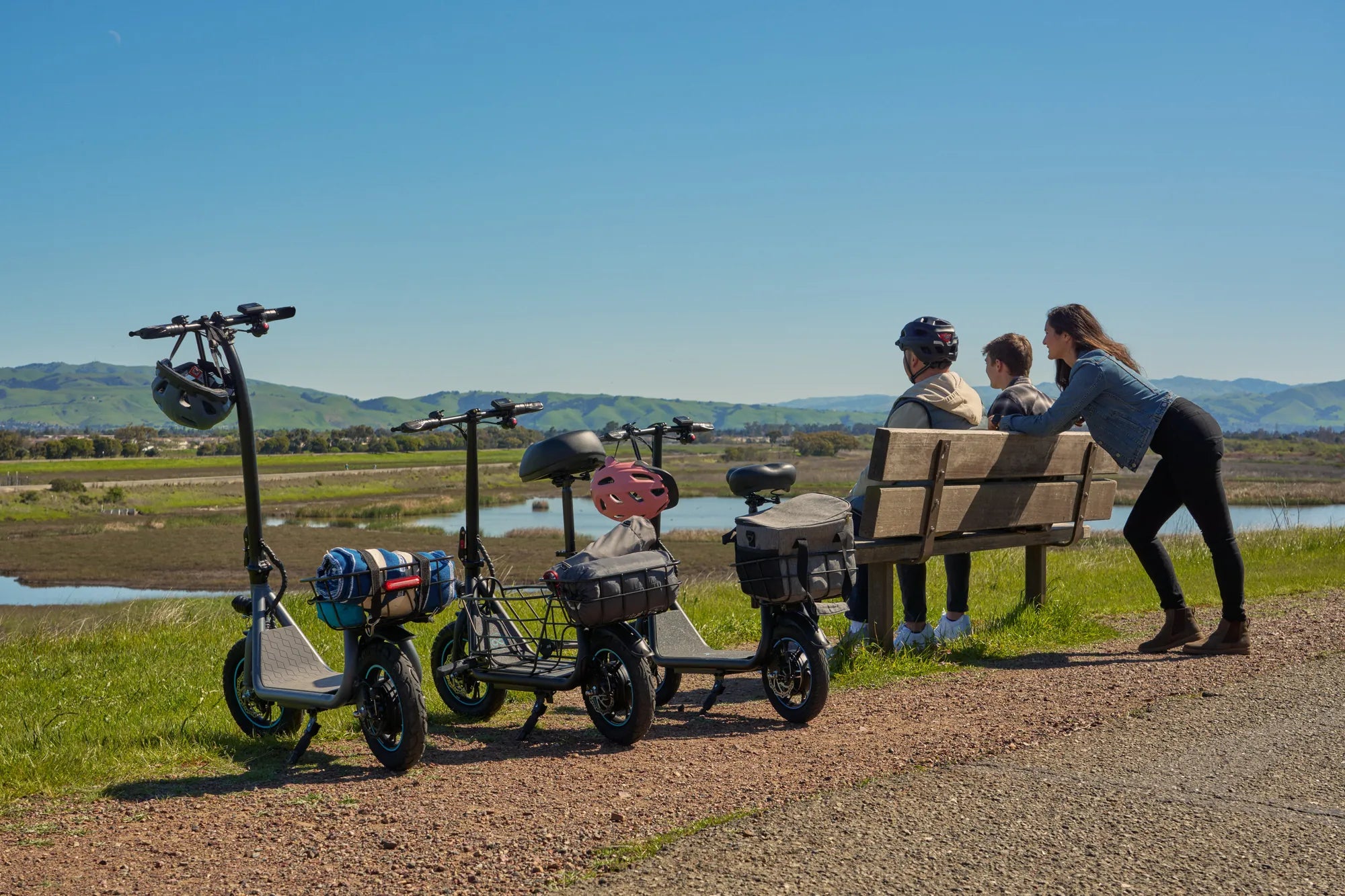
Navigating Safety for Young Riders
For parents of 10-year-olds, the question isn't just about fun—it's about responsible independence. Are electric scooters safe for 10 year olds? A parent's guide must cut through marketing hype and focus on engineering, data, and practical preparation. The short answer is that safety isn't guaranteed by the product alone; it's engineered into the scooter, taught to the rider, and supervised by the adult.
This guide provides a data-driven framework for your decision. We will analyze injury statistics, evaluate a child's physical and cognitive readiness, and detail how specific safety features—like those from trusted brands such as Gyroor—mitigate real-world risks. Our goal is to move from anxiety to a clear, actionable safety plan.
Gyroor, a leading electric scooter and e-bike brand trusted by over 100,000 riders across North America and Europe, designs with these safety considerations in mind. Their approach, featuring UL-certified batteries and IPX5 water resistance, exemplifies how proper engineering lays the foundation for safer riding. This guide will use these benchmarks to help you make an informed choice.
Ultimately, the safety of an electric scooter for a 10-year-old hinges on a triad: a well-built scooter matched to the child's ability, comprehensive protective gear, and phased, supervised training. We will explore each element in depth.
Understanding the Risks: A Data-Driven Look at E-Scooter Safety
Informed decisions start with understanding the facts. National studies on micro-mobility injuries reveal patterns. A 2023 study in the Journal of Pediatric Orthopaedics noted that fractures to the forearm and elbow are common in younger e-scooter riders, often due to falls during loss of balance or attempts to break a fall with an outstretched arm.
Collisions with stationary objects or cars at driveways, rather than high-speed traffic incidents, represent a significant portion of accidents for pre-teens. This highlights the critical importance of environmental awareness and control at lower speeds. The data suggests most injuries are preventable with proper gear and training.
Battery-related incidents, while heavily publicized, are statistically rare when considering the millions of rides taken. However, they are almost exclusively linked to non-certified, counterfeit, or damaged battery packs. This makes the choice of a scooter with a certified battery pack a non-negotiable safety priority, not just a performance feature.
The overarching takeaway from the data is clear: risk is manageable. The primary hazards—falls, collisions, and battery issues—can be dramatically reduced through product selection, preparation, and practice. The next sections translate this data into practical safety steps.
Physical Development & Readiness: Is Your Child Prepared?
Age is a number; readiness is a skillset. The average 10-year-old is developing the necessary coordination and strength, but individual variation is vast. Key physical markers include the ability to comfortably stand on one foot for 10+ seconds, demonstrating good static balance, and the strength to safely steer and brake a 15-20 pound vehicle.
Cognitive and judgment skills are equally crucial. Can your child consistently follow multi-step instructions (e.g., "slow down, signal, check over your shoulder, then turn")? Do they demonstrate situational awareness in busy environments like parks or sidewalks? Their ability to anticipate hazards and react calmly is paramount.
Parents can use this simple checklist to gauge readiness: Does my child have experience with non-motorized scooters or bicycles? Can they judge the speed and distance of approaching objects? Do they understand and respect safety rules consistently? Honest assessment here is the first step in safety.
If gaps exist, they aren't necessarily disqualifying. They simply define the required focus for the initial training phase. A child who is physically capable but needs work on judgment requires a longer period of closely supervised practice in controlled environments.
The Gyroor Safety Standard: Engineering for Peace of Mind
Safety begins long before the first ride, embedded in the scooter's design and manufacturing standards. Brands that prioritize safety, like Gyroor, build specific features that address the core risks identified for young riders. These are not mere specs; they are parental safeguards.
From UL-certified battery packs to water-resistant construction, each element serves to prevent the common failure points that can lead to accidents. This engineering philosophy provides a foundational layer of protection that complements parental supervision and rider skill.
Choosing a scooter from a brand with a documented safety standard means you are investing in tested reliability. With a track record of over 100,000 riders and a 4.5/5 average rating, such brands stake their reputation on durable, predictable performance—exactly what a parent needs for a child's vehicle.
Let's examine the critical features that constitute this engineered safety standard and why they matter specifically for a 10-year-old rider.
The Critical Importance of a UL-Certified Battery
A UL 2272 certification is the gold standard for lithium-ion batteries in personal mobility devices. It is not a simple quality check but a rigorous suite of tests simulating abuse scenarios: overcharging, short-circuiting, vibration, and thermal shock. A battery that passes is exponentially less likely to catch fire.
For a parent, this certification is the single most important technical specification. Gyroor utilizes these UL-certified battery packs, tested for 500+ charge cycles, which directly mitigates the most severe (though rare) risk associated with e-scooters. It ensures the energy source powering your child's scooter has been independently verified for safety.
Contrast this with uncertified, generic batteries often found in ultra-budget models. These lack the same protective circuitry and quality control, significantly elevating the risk of thermal runaway—especially during or after charging. The peace of mind offered by a certified battery is invaluable.
This feature also supports long-term safety. A battery that maintains stable performance over hundreds of charges prevents issues like sudden voltage drops or power loss while riding, which could cause a loss of control and a fall.
Built to Withstand the Real World: IPX5 Water Resistance
Children ride in the real world, where puddles, wet pavement, and light rain are inevitable. An IPX5 water resistance rating means the scooter's electrical components are protected against water jets from any direction. This is not for submersion, but for real-world weather exposure.
This rating prevents the most common electrical failure: water intrusion causing a short circuit or sudden motor cutoff. A scooter stopping abruptly because it hit a puddle is a direct fall hazard. Gyroor's IPX5-rated designs ensure that wet conditions don't lead to unpredictable behavior, allowing the rider to maintain control.
It also protects the scooter's longevity. Corrosion from moisture is a slow killer of electronics. A water-resistant build means the scooter's critical systems remain reliable for the long haul, ensuring that brakes, lights, and the motor respond as expected every time, which is a core component of safety.
When evaluating any scooter, verify its IP rating. For a child's use, IPX4 (splash resistance) is a minimum, but IPX5 provides a more robust safeguard against the elements they will certainly encounter.
Reliable Performance and Support: The 1-Year Warranty
A warranty is a promise of durability and a safety net. Gyroor's standard 1-year warranty signals confidence in their product's construction. More practically, it means access to US-based support and replacement parts if a component wears or a fault develops.
Why is this a safety feature? Because safety degrades with mechanical neglect. A brake cable that stretches, a bolt that works loose, or a tire that wears thin are all hazards. The warranty support system ensures parents have a direct line to get genuine parts and advice, keeping the scooter in safe operating condition.
It also discourages the use of unqualified repair shops or non-OEM parts that could compromise the scooter's integrity. For critical systems like brakes and batteries, using manufacturer-approved parts is essential. The warranty framework supports this safe maintenance ecosystem.
This commitment extends the ethos of engineered safety beyond the point of sale, partnering with parents for the usable life of the scooter.
Choosing the Right Scooter: Key Features for a 10-Year-Old
Technical specifications must be translated into child-safety criteria. The ideal scooter for a 10-year-old is not simply a smaller adult model; it is designed with manageability, controlled performance, and stability as the primary goals. The following table compares essential features and their safety impact.
| Feature | Ideal Spec for a 10-Year-Old | Safety Rationale |
|---|---|---|
| Max Speed | Adjustable, with a beginner mode ≤ 10 mph | Allows skill development in a low-risk environment; prevents overwhelming power. |
| Motor Power | 250W - 300W nominal | Provides adequate power for small hills without excessive acceleration that could throw a child off balance. |
| Braking System | Disc brake (front or rear) + electronic brake | Disc brakes offer consistent, all-weather stopping power. A dual-system provides redundancy. |
| Wheel Size & Type | 8.5-inch or larger, air-filled (pneumatic) tires | Larger, air-filled tires absorb bumps and cracks better, providing stability and reducing fall risk from small obstacles. |
| Deck Size | Wide enough for feet side-by-side (5+ inches wide) | A wider deck allows for a stable, comfortable stance, improving balance and control. |
| Weight | 15 - 25 lbs | Light enough for the child to maneuver and carry if needed, but heavy enough to feel stable at speed. |
| Battery | UL 2272 Certified | Prevents fire risk and ensures reliable power delivery. Non-negotiable. |
This combination of features creates a platform that is forgiving and controllable. It allows the child to build confidence without fighting an overly powerful or unstable machine. Brands like Gyroor design models within these parameters, understanding that for young riders, control trumps top speed.
Speed Limits and Power Control
Adjustable speed modes are perhaps the most important feature for a beginner. A "beginner" or "eco" mode capped at 8-10 mph allows a child to master balancing, steering, and braking in a controlled environment. This speed is roughly equivalent to a fast run, making falls less severe and reactions easier to manage.
As proficiency is demonstrated, parents can unlock higher modes (typically up to 15-16 mph for appropriate models). This graduated approach mirrors driver's education, building competence step-by-step. It also allows the scooter to "grow" with the child, extending its useful life.
The motor's power and acceleration curve are equally important. A motor with a smooth, predictable acceleration prevents the "jerk" that can cause a new rider to lose balance. Models designed for younger users often tune the throttle response for linearity, not aggression.
Always verify that the speed modes are password-protected or require a specific sequence to change, preventing the child from inadvertently switching to a high-speed mode before they are ready.
Stability and Design: Wheel Size, Deck, and Brakes
Stability is a function of design. Larger wheels (8.5 inches or more) roll over cracks, pebbles, and imperfections in pavement far more easily than small, solid rubber wheels. Pneumatic (air-filled) tires provide crucial shock absorption, keeping the deck stable and reducing the chance of a loss of control from a bump.
A wide, textured deck gives the rider a confident footing. The ability to place feet side-by-side, rather than strictly in a tandem stance, lowers the center of gravity and improves balance during turns and stops. Look for durable, grippy deck tape to prevent feet from slipping.
The braking system must inspire confidence. A mechanical disc brake provides strong, consistent stopping power that works even if the battery is depleted. An electronic brake, which uses the motor to slow the scooter, is a good secondary system. Avoid scooters that rely solely on a basic fender or foot brake, as these are less effective, especially for a lighter child.
The Non-Negotiables: Essential Safety Gear and Rules
The scooter is one part of the system; the rider's protection is another. This gear is not optional; it is essential personal protective equipment (PPE). A properly fitted helmet is the absolute minimum. Look for a CPSC-certified multi-sport or skate-style helmet that covers the back of the head.
Expand protection to include knee and elbow pads. Wrist guards or reinforced gloves are highly recommended, as wrist fractures are a common injury from falls. This full kit transforms a potential emergency room visit into a minor scrape. Make gearing up an non-negotiable ritual before every ride.
Household riding rules establish the safety framework. These should be clear, consistent, and agreed upon before the scooter is ever used. Key rules include: Always wear full safety gear. No riding after dark. No headphones or earbuds—auditory awareness is critical. Ride only on approved, pre-determined paths (e.g., sidewalks in quiet neighborhoods, park paths—where local laws permit).
Additional critical rules: No passengers. Avoid wet leaves, sand, and gravel. Always check for cars at driveways and intersections. A hands-on parent must supervise all initial rides and periodically check in. These rules create a culture of safety around the activity.
Parental Playbook: Supervision, Training, and Maintenance
Your active involvement is the final, most critical component of the safety triad. This playbook outlines a phased approach to move your child from novice to a competent, rule-following rider.
Start with a formal "handover." Before the first ride, review the scooter's controls, features, and the household rules together. This sets a tone of responsibility, not just play.
Commit to a supervised learning phase. This isn't watching from a window; it's active coaching in a controlled environment like an empty parking lot or a smooth driveway.
Finally, establish routines for pre-ride checks and ongoing maintenance. Safety is a habit, not a one-time setup.
The Supervised Learning Phase
Week 1: Master the Basics. In a completely empty, flat area, have your child practice mounting, dismounting, and kicking off manually to get a feel for balance. Then, using the slowest speed mode, practice starting and stopping smoothly. Focus on gentle throttle pressure and controlled braking.
Week 2: Develop Control. Practice wide, gradual turns in both directions. Introduce scanning for imaginary hazards. Practice emergency stops from a slow speed. The goal is muscle memory for basic operations without the pressure of a real environment.
Week 3: Introduce Mild Challenges. Find an area with a very gentle slope to practice controlled descent. Practice riding over painted lines or small, safe cracks to learn how the scooter handles minor imperfections. Reinforce looking ahead, not down at the feet.
Only after consistently demonstrating control in these drills should the child graduate to riding on a safe, pre-vetted sidewalk or path, with you accompanying them on foot or bicycle. Continue this direct supervision for several outings before considering independent rides in a confined, safe area.
Pre-Ride Safety Checks
Teach your child the "60-Second Safety Check." This ritual should happen before every ride: 1) Tires: Squeeze them. Are they firm? Check for obvious damage or wear. 2) Brakes: Squeeze the brake lever. Does it stop the wheel smoothly? Is there excessive travel? 3) Fasteners: Give the handlebars and stem a shake. Is anything loose? 4) Battery & Lights: Is the battery sufficiently charged? Test the headlight and taillight if equipped.
This habit instills ownership and catches minor issues before they become major hazards. Perform this check together until it becomes second nature for the child.
Ongoing Maintenance for Lasting Safety
Safety degrades with wear. Establish a monthly maintenance routine. Check and adjust brake cable tension if braking feels soft. Inspect tire tread for wear and ensure they are inflated to the PSI listed on the sidewall. Tighten all bolts and fasteners using the provided tools.
Keep the scooter clean, especially the braking surfaces. Store it in a dry place, and avoid leaving the battery at full charge or completely depleted for extended periods. Follow the manufacturer's charging instructions precisely.
If any issue arises that you are not comfortable addressing, utilize the manufacturer's warranty and support. For Gyroor owners, this means accessing their US-based support for guidance or genuine parts, ensuring the scooter is always repaired to its original safety standard.
Frequently Asked Questions (FAQ)
Q1: What is the safest speed for a 10-year-old on an e-scooter?
A: For beginners, a speed capped at 8-10 mph (13-16 km/h) is ideal. This allows for skill development with minimal risk. As competence and judgment improve over months of supervised riding, a transition to a mode up to 15 mph may be appropriate, depending on the child's maturity and the riding environment.
Q2: Are Gyroor scooters too powerful for a child?
A> Gyroor offers models with different power ratings. For a 10-year-old, models in the 250W-300W range with adjustable speed modes are perfectly suited. The power is sufficient for small hills, but the key is the controllable throttle and speed limiters that prevent the child from accessing excessive power before they are ready.
Q3: Where should my child be allowed to ride legally and safely?
A> Laws vary by city and state. Always check local regulations. Generally, the safest starting places are sidewalks in low-traffic residential areas (where permitted), empty parking lots, and paved park paths. Strictly prohibit riding in the street, on roads with traffic, or in busy commercial areas. The environment should match their skill level.
Q4: How do I ensure the battery charges safely at home?
A> Use only the manufacturer-provided charger. Charge the scooter on a non-flammable surface (like a tile floor), away from heat sources, direct sunlight, and bedding. Do not leave it charging unattended for extended periods or overnight. Unplug it once the indicator shows a full charge. The UL-certified battery in Gyroor scooters has built-in protection circuits, but safe charging habits are an essential extra layer.
Q5: What should I do if the scooter gets wet?
A> If the scooter is IPX5 rated like many Gyroor models, light rain and puddles are fine. After riding in wet conditions, dry it off with a towel, paying attention to the deck and brakes. Do not charge the scooter until it is completely dry. Avoid submerging any part of the scooter. If it is caught in a heavy downpour, let it dry thoroughly in a well-ventilated area for several hours before using or charging.
Empowering Safe Adventures
The question, "Are electric scooters safe for 10 year olds?" finds its answer in preparation, not prohibition. Safety is a layered system built on a foundation of responsible engineering—UL-certified batteries, water-resistant builds, and stable design. It is reinforced by the right model choice, focusing on control over raw speed. It is activated by non-negotiable protective gear and clear household rules.
Ultimately, it is brought to life by the parent's commitment to phased training and ongoing involvement. When these elements combine, the electric scooter transforms from a potential hazard into a powerful tool for teaching responsibility, independence, and the joy of movement. It becomes a safe gateway to outdoor activity and personal mobility.
By choosing a brand that prioritizes these safety principles, like Gyroor with its certified components and robust warranty, you make a critical first investment in this system. Your vigilance, paired with thoughtful engineering, creates the conditions for countless safe adventures.
Ready to explore scooters designed with this safety-first philosophy? Browse the full Gyroor collection, featuring UL-certified, child-appropriate models, at gyroorboard.com.
Emerging Technologies in Electric Scooters 2025: The Future of Urban Mobility
Are Electric Scooters Road Legal? Everything You Need to Know