

Introduction: The Electric Scooter Revolution in India
The Indian electric two-wheeler market is undergoing a seismic shift. This transformation is driven by a powerful convergence of government policy, economic pragmatism, and growing environmental awareness. The search for a detailed Electric Scooters in India 2024 Price List reflects a market moving beyond early adopters to mainstream practicality.
This guide delivers precisely that: a clear breakdown of prices, models, and the critical trends shaping 2024. You will learn how to navigate subsidies, decode battery specifications, and calculate true ownership costs. We cut through the marketing to provide a factual, buyer-centric analysis of the current landscape.
Fuel price volatility and stringent emission norms have made electric mobility a compelling financial proposition. The government's FAME II scheme has been instrumental, but the story is now about technological maturity and consumer choice. This article will serve as your definitive resource for making an informed purchase this year.
Understanding the Electric Scooters in India 2024 Price List requires more than just comparing numbers. It involves analyzing the value proposition behind each price point, from budget commuters to premium performance models. Let's begin by exploring the trends defining this dynamic market.
The 2024 Indian E-Scooter Landscape: Key Trends Shaping the Market
The market has evolved from offering basic alternatives to creating sophisticated mobility solutions. The focus in 2024 is on reliability, technology integration, and building consumer trust for long-term adoption. Price remains a key factor, but it is no longer the sole deciding criterion for informed buyers.
Manufacturers are competing on core engineering, software ecosystems, and after-sales network strength. The narrative has shifted from 'going electric' to 'choosing the right electric scooter.' This reflects a maturing market where consumers are discerning about performance, safety, and total cost of ownership over several years.
The Battery Tech Race: From Lead-Acid to Advanced Lithium-Ion
The shift to lithium-ion (Li-ion) batteries is nearly complete in the new vehicle market. Their higher energy density directly translates to better range and reduced weight. In 2024, the conversation is advancing to specific lithium chemistries, with Lithium Iron Phosphate (LFP) gaining prominence.
LFP batteries offer enhanced thermal stability, longer cycle life, and improved safety—critical factors in India's diverse climate. Battery certification, such as AIS 156, is now a non-negotiable safety benchmark. Furthermore, Ingress Protection (IP) ratings for the battery pack and motor are crucial specifications.
A high IP rating (e.g., IP67) ensures protection against dust and temporary water immersion, a vital feature for monsoon conditions and poor road surfaces. The focus on battery management systems (BMS) that optimize charging, prevent overheating, and prolong cell life is a key differentiator between brands.
Connectivity and Smart Features Become Standard
What was once a premium feature is now an expectation. Bluetooth connectivity and companion smartphone apps are standard across mid and premium segments. These apps provide real-time ride data, battery status, trip history, and location tracking.
Advanced features include geo-fencing, theft alerts with movement detection, and over-the-air (OTA) software updates. OTA updates allow manufacturers to improve performance, add features, and enhance safety remotely, extending the scooter's relevance. The digital dashboard, often a full-color TFT screen, is the control center for navigation, music control, and call management.
Government Policy as a Catalyst: FAME II and State Subsidies
The Faster Adoption and Manufacturing of Electric Vehicles (FAME II) scheme remains the primary demand driver. It provides a direct subsidy on the ex-factory price, significantly reducing the upfront cost for the consumer. The subsidy is contingent on meeting stringent localization and performance criteria.
Several state governments offer additional incentives on top of FAME II, creating substantial regional price variations. It is essential to check your state's EV policy. The industry is closely watching the policy roadmap post-FAME II, which is set to conclude, with expectations of a successor scheme to maintain momentum.
Electric Scooters in India 2024 Price List and Model Breakdown
The following Electric Scooters in India 2024 Price List provides a snapshot of popular models across segments. Prices are approximate ex-showroom (Delhi) post-FAME II subsidy but before state incentives, which can further reduce costs by ₹10,000-₹30,000. Always confirm the final on-road price with your local dealer.
| Model | Approx. Price (₹) Post-FAME II | Claimed Range (IDC) | Key Features |
|---|---|---|---|
| TVS iQube | 1,05,000 - 1,30,000 | 100 km | Digital Cluster, Eco & Power Modes |
| Bajaj Chetak | 1,15,000 - 1,40,000 | 108 km | Retro Design, Metal Body, 3 Driving Modes |
| Ather 450S | 1,10,000 - 1,20,000 | 115 km | 7" Touchscreen, Ather Stack OTA Updates |
| Ola S1 X+ | 85,000 - 95,000 | 95 km | Hypercharger Network, MoveOS 4 |
| Ather 450X | 1,35,000 - 1,45,000 | 146 km | Warpspeed Mode, Google Maps, 7" Dashboard |
| Ola S1 Pro | 1,30,000 - 1,40,000 | 195 km | Hyper Mode, Voice Assist, Music Playback |
Budget Segment (Under ₹80,000 Ex-showroom)
This segment is defined by value-focused models prioritizing essential functionality for daily urban commutes. While features are basic, the focus is on reliable performance and low running costs. These models typically use smaller battery packs, offering a real-world range suitable for intra-city travel of 40-60 km.
Build quality and the availability of service centers are critical considerations here. Brands compete on warranty terms and the density of their service network. This segment is highly sensitive to state subsidies, where additional incentives can make the effective price very attractive for first-time EV buyers.
Mid-Range Segment (₹80,000 - ₹1,20,000 Ex-showroom)
This is the market's sweet spot, offering the best balance of performance, features, and price. Scooters here boast real-world ranges of 70-100 km, making them viable for most urban and some suburban commutes. Advanced features like touchscreen dashboards, app connectivity, and multiple riding modes are standard.
The competition is fiercest in this segment, driving rapid innovation. Buyers can expect better build materials, more powerful motors for quicker acceleration, and comprehensive digital ecosystems. This segment represents the core of the market's growth, appealing to both new and upgrading EV users.
Premium Segment (₹1,20,000+ Ex-showroom)
Premium models are technology flagships, offering the highest performance, longest range (often 120+ km real-world), and most advanced features. They include powerful motors for sporty acceleration, expansive touchscreen interfaces with navigation, and premium build quality with sophisticated design elements.
Ownership in this segment is as much about the experience and brand association as it is about transportation. Features like hill-hold assist, reverse mode, and advanced regenerative braking are common. These models set the trends that eventually trickle down to the mid-range segment.
The Smart Buyer's Guide: How to Choose Your E-Scooter in 2024
Choosing the right scooter requires a structured evaluation of your needs against the product's capabilities. Move beyond marketing claims and focus on verifiable specifications and ownership parameters. This framework will help you prioritize what matters most for your specific situation.
Assess Your Daily Commute: Range is King
Start by calculating your longest daily round-trip distance. Add a 30-40% buffer to account for traffic, weather, battery degradation over time, and occasional detours. The manufacturer's claimed range (usually IDC - Indian Driving Cycle) is an ideal lab test figure.
The real-world range is typically 20-30% lower. Check independent reviews for real-world range tests. Consider your access to charging; if you can charge daily at home or work, a lower-range scooter may suffice. If charging opportunities are limited, prioritize maximum range.
Total Cost of Ownership: Beyond the Sticker Price
The purchase price is just the first component. Calculate the five-year Total Cost of Ownership (TCO) for a clear picture. Factor in the subsidized purchase price, charging electricity costs (far lower than petrol), insurance, annual maintenance, and potential battery replacement after 5-7 years.
Electric scooter maintenance is generally cheaper—no engine oil, spark plugs, or complex transmission. However, service costs can vary by brand. A comprehensive warranty that covers the battery and motor for a long period significantly reduces long-term financial risk and is a key value indicator.
Safety and Reliability: Non-Negotiable Checks
Prioritize models with certified battery packs (AIS 156 Phase 2 is the current standard). Check the IP rating for water and dust resistance—IP67 is excellent for the battery. Evaluate the braking system; combi-braking or disc brakes offer better stopping power.
Research the brand's after-sales service network in your city and its reputation for spare parts availability. Read owner forums for long-term reliability reports. A strong warranty (3-5 years on battery, 3 years on motor) reflects the manufacturer's confidence in its product.
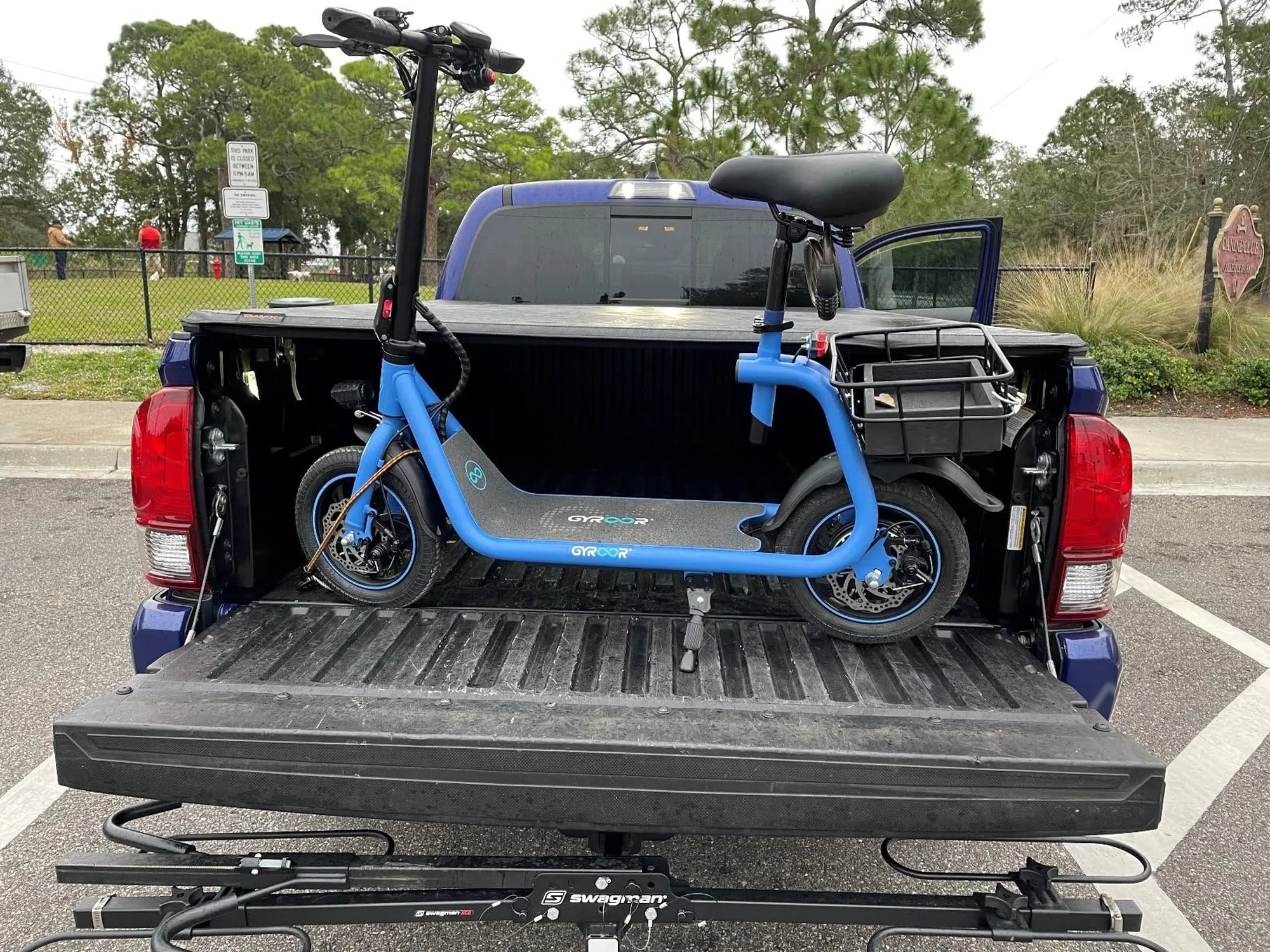
The Gyroor Promise: Engineering for Confidence in Every Ride
While Gyroor is a leading name in personal electric mobility across North America and Europe, its engineering principles align perfectly with the demands of the informed Indian rider. The core tenets of safety, durability, and reliability are universal, especially in challenging urban environments.
Every Gyroor electric scooter and e-bike is powered by a UL-certified lithium-ion battery pack. This global safety standard, involving rigorous testing for over 500 charge cycles, directly addresses the paramount concern for stable and long-lasting battery technology in varied climates. Safety is engineered in from the cell level.
Understanding Indian conditions, features like a robust IPX5 water-resistant rating across all models are not optional extras but essential design criteria. This protection against rain, splashes, and daily dust ensures the scooter's electronics and motor remain protected, enhancing longevity and reducing weather-related anxiety.
With a community of over 100,000 riders worldwide and a 4.5/5 average rating, Gyroor's commitment is backed by a reliable 1-year comprehensive warranty and accessible customer support. This framework of trust provides the peace of mind necessary for long-term ownership, turning a purchase into a confident investment in daily mobility.
Looking Ahead: The Future of Electric Mobility in India
The electric two-wheeler market is poised for its next phase of evolution, moving from vehicle-centric to ecosystem-centric growth. Battery swapping, despite early challenges, is expected to see renewed focus for commercial fleets, potentially reducing upfront cost and addressing range anxiety through rapid exchange.
Increased localization of battery cell manufacturing will be critical for cost reduction and supply chain security. We will also see greater segmentation, with models tailored for specific use cases like hyper-local delivery or rugged semi-urban travel. The integration of vehicles into larger smart city and energy grid systems will begin, with concepts like vehicle-to-grid (V2G) being explored.
Frequently Asked Questions (FAQs)
Q1: What is the real-world range I can expect from an e-scooter?
A: As a rule of thumb, deduct 20-30% from the manufacturer's claimed IDC range. A scooter with a 100 km IDC claim will typically deliver 70-80 km in real-world city conditions, depending on rider weight, traffic, use of modes, and terrain.
Q2: How much can I save on the ex-showroom price with FAME II and state subsidies?
A: FAME II offers a subsidy of ₹10,000-₹22,000 per kWh of battery capacity, capped at 15-20% of the vehicle's cost. State subsidies can add another ₹10,000-₹30,000. For a ₹1.4 lakh scooter, total savings can exceed ₹40,000-₹50,000 in states with strong incentives.
Q3: Is the charging infrastructure reliable in my city? What are my home charging options?
A: Public charging networks are expanding but remain inconsistent. For primary reliance, home charging is essential. Most e-scooters come with a portable charger that plugs into a standard 5A/15A wall socket. A full charge typically takes 4-8 hours. Installing a dedicated home charging point is recommended for safety and convenience.
Q4: How expensive is e-scooter maintenance compared to a petrol scooter?
A: Annual maintenance is significantly cheaper. There are no costs for engine oil, air filters, or fuel injectors. Service primarily involves brake checks, tire care, suspension, and software diagnostics. Annual service costs can be 60-70% lower than a comparable petrol scooter.
Q5: What should I look for in the warranty, especially for the battery?
A: Look for a separate, long-term warranty on the battery pack—ideally 3 to 5 years or a specified number of charge cycles (e.g., 3,000 cycles). Understand the warranty's capacity retention clause (e.g., covers if capacity falls below 70% within the period). Ensure the warranty covers both manufacturing defects and performance degradation.
Final Verdict: Making an Informed Choice in 2024
The Electric Scooters in India 2024 Price List reveals a market rich with choice, catering to every need from frugal commuting to tech-infused riding. The key is to align your primary use case—daily distance, load, and terrain—with a scooter's proven real-world capabilities, not just its brochure specifications.
Prioritize certified safety, a robust service network, and transparent warranty terms over gimmicky features. The most economical model is the one that reliably serves you for years, with a low total cost of ownership. Your decision should balance immediate affordability with long-term dependability.
As the industry matures, the value of engineering-focused brands becomes clear. Whether exploring local options or international standards of safety and durability, the power of informed choice is yours. The electric scooter is no longer just a vehicle; it's a smart, sustainable upgrade to your daily life.
Ready to explore a range of electric scooters built with global safety standards and durable design? Browse the full Gyroor collection at gyroorboard.com to discover models engineered for confidence and performance.
Can You Buy Electric Scooters? The Definitive 2024 Purchasing Guide
Where Are Electric Scooters Illegal? A Complete Guide to Local Laws