


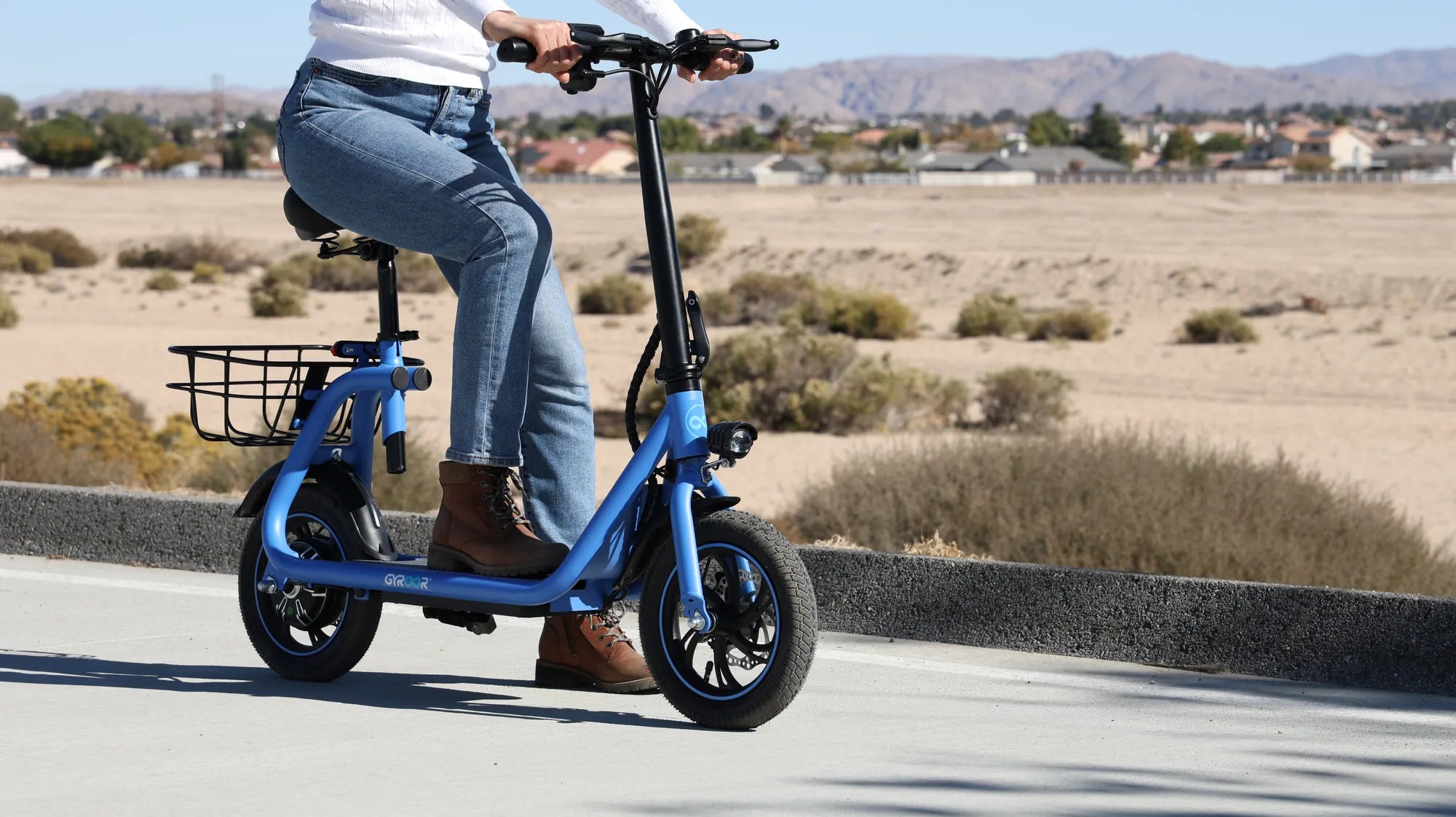
Unlocking Your Scooter's Hidden Speed Potential
Every rider eventually asks the same question: how to make my scooter go faster? The desire for more speed is natural, whether for a quicker commute or enhanced thrill. However, achieving higher velocity requires balancing performance gains with safety, legality, and the long-term health of your vehicle.
This guide provides a complete roadmap, from simple, reversible tweaks to complex modifications. We'll explore the technical limits set by manufacturers and the real-world impact of each change. Understanding these principles is crucial before attempting any adjustment to your ride.
As a leading electric scooter and e-bike brand trusted by over 100,000 riders across North America and Europe, Gyroor designs vehicles with certified safety and reliable performance. Our perspective emphasizes that the best speed upgrade often starts with selecting the right scooter for your needs from the beginning.
Understanding the Limits: Why Your Scooter Has a Top Speed
Factory speed limits aren't arbitrary. They result from careful engineering balancing motor capability, battery discharge rates, thermal management, and legal compliance. The electronic speed controller (ESC) is programmed to enforce this limit, acting as the brain that governs power delivery from the battery to the motor.
Local regulations significantly influence these settings. Many municipalities cap e-scooter speeds at 15-20 mph for use on bike lanes and shared paths. Manufacturers like Gyroor pre-set limits to ensure compliance in key markets, using UL-certified battery packs and robust controllers tested for reliability.
The motor's wattage and the battery's voltage are primary hardware determinants. A 350W motor paired with a 36V battery has different inherent capabilities than a 500W motor with a 48V system. Attempting to push a motor beyond its continuous power rating risks overheating and permanent damage, a critical factor when considering how to make my scooter go faster.
Modifications that alter these factory settings typically void the manufacturer's warranty and may compromise safety certifications. It's essential to know your scooter's baseline specifications and the legal framework in your area before pursuing any performance changes.
Safe & Reversible Tweaks for a Speed Boost
The safest approach to increasing speed involves optimizations that don't alter core electronics or mechanical structures. These methods respect the scooter's design intent while squeezing out marginal gains, often improving efficiency as a welcome side effect.
This tier is recommended for all riders seeking better performance without accepting significant risk. The improvements are subtle but meaningful, typically adding 1-3 mph to your top speed while maintaining full warranty coverage and safety certification integrity.
Optimizing Tire Pressure and Reducing Weight
Tire pressure has a direct, measurable impact on rolling resistance. Under-inflated tires create a larger contact patch with the ground, increasing friction and sapping power that could translate into speed. Consult your scooter's manual for the recommended PSI, usually between 40-50 PSI for pneumatic tires.
Use a quality digital gauge to check pressure weekly. Even a 5 PSI deficit can cause a noticeable drop in top speed and acceleration. Properly inflated tires also improve range and handling, making this the simplest and most effective performance tweak available.
Weight reduction is another key factor. The scooter's motor must overcome the combined mass of the rider, the scooter itself, and any cargo. Minimizing this load directly improves acceleration and can slightly increase top speed. Consider carrying only essential items and, if possible, choosing a lighter riding backpack.
While you can't change your body weight, being mindful of extra gear makes a difference. For example, Gyroor's C7 model weighs approximately 30 lbs; adding a 10 lb backpack increases the total load by over 10%, requiring more power for the same performance.
Ensuring Optimal Battery Health and Charge
A scooter's battery is its heart, and its state of health dictates available power. Lithium-ion batteries, like the UL-certified packs in Gyroor scooters, deliver peak voltage when between 80-100% charge. Voltage directly correlates with motor RPM, meaning a fuller charge can yield higher top speed.
For the fastest ride, start with a battery charged to 100%. Avoid consistently draining the battery to zero, as deep discharges stress cells and reduce long-term capacity. Implement a charging routine that keeps the battery between 20-80% for daily use, with full charges reserved for when you need maximum performance.
Battery age and cycle count also matter. After 300-500 full charge cycles, batteries naturally lose capacity and their ability to deliver peak current. If your scooter feels sluggish and is over two years old with heavy use, the battery may be the limiting factor, not the motor or controller.
Store your scooter in moderate temperatures. Extreme cold temporarily reduces battery output, while extreme heat accelerates permanent degradation. Proper maintenance ensures your battery delivers every watt it was designed to provide.
Advanced Modifications: Understanding the Risks and Rewards
Venturing beyond basic optimizations involves hardware or firmware changes that carry substantial risk. These modifications typically void warranties, may violate local laws, and can compromise the scooter's structural and electrical safety. Proceed with extreme caution and full awareness of the consequences.
This path is for technically adept riders who accept full responsibility for their vehicle's safety and legality. The performance gains can be significant, but so are the potential costs, including premature component failure and safety hazards.
Controller Tuning and "Speed Unlocking"
The electronic speed controller (ESC) governs power flow, current limits, and the software-enforced speed cap. Some manufacturers, though not typically Gyroor, offer official "unlock" codes or modes that raise the limit, often intended for private property use. Using unofficial methods to modify controller firmware is highly risky.
Aftermarket tuning involves connecting the ESC to a computer and altering parameters like current limits, phase timing, and the speed ceiling. This can increase top speed by 20-30%, but at a severe cost. The motor may overheat under sustained load, the battery can be over-discharged, and protective circuits may be disabled.
Overheating is the primary danger. A motor run beyond its continuous rating can demagnetize, melt windings, or damage bearings. Similarly, pushing a battery beyond its safe discharge rate (C-rate) causes voltage sag, excessive heat, and in extreme cases, thermal runaway—a fire risk.
If you pursue tuning, invest in a temperature sensor and monitor motor heat diligently. Understand that any modification to the controller immediately voids the manufacturer's warranty and nullifies safety certifications like UL.
Upgrading Key Components (Motor, Battery)
This is the most invasive and complex method to make your scooter go faster. It involves replacing the motor with a higher-wattage unit or installing a higher-voltage battery pack. These changes usually require a compatible, upgraded controller and potentially modifications to the scooter's frame and wiring harness.
Swapping a 36V battery for a 48V system can increase top speed proportionally, as motor RPM is voltage-dependent. However, the original motor and controller may not be rated for the higher voltage, leading to rapid failure. All components must be matched for voltage, current, and communication protocols.
Motor upgrades present mechanical challenges. A more powerful motor may have different mounting points, axle size, or phase wire connections. It also adds weight and stress to the frame and fork, which were not engineered for the increased torque and forces.
Critical Warning: Using non-UL-certified battery packs, common in the aftermarket, drastically increases fire risk. Gyroor's use of UL-certified batteries involves rigorous testing for short-circuit, overcharge, and thermal stability. Bypassing this safety system for more power is a dangerous gamble.
Data Comparison: Stock Performance vs. Common Mods
The following table provides a realistic, data-driven comparison for a typical commuter scooter, using specifications similar to Gyroor's C7 model as a baseline. These estimates illustrate the trade-offs between speed, range, warranty, and safety for each modification tier.
| Configuration | Est. Top Speed | Est. Range Impact | Warranty Status | Safety Certification |
|---|---|---|---|---|
| Stock (Baseline) | 18 mph | 25 miles | Fully Valid | Maintained (UL/IPX5) |
| Optimized (Tire Pressure/Lightweight) | 19 mph | 25 miles | Valid | Maintained |
| Controller Tune (Unofficial) | 22-24 mph | 20-22 miles | Void | Compromised |
| Motor/Battery Upgrade (48V System) | 28+ mph | Varies Greatly | Void | Compromised |
The table clearly shows diminishing returns. Safe optimizations offer a slight boost with no downside. Advanced mods offer greater speed but at the cost of range, warranty, and most importantly, the engineered safety margins of the vehicle.
Legal and Safety Imperatives You Must Consider
Before asking how to make my scooter go faster, you must understand the legal landscape. Many cities and states classify e-scooters with speed limits. Exceeding the legal limit, often 20 mph, can result in fines, impoundment, or classification as an unregistered motor vehicle requiring license and insurance.
Modifications may also invalidate personal insurance policies if you are involved in an accident. Insurance adjusters can deny claims if the scooter was altered beyond manufacturer specifications, leaving you personally liable for damages and injuries.
Safety is the paramount concern. Scooter frames, brakes, and tires are designed and tested for a specific performance envelope. Exceeding the designed top speed stresses every component. Disc brakes may overheat and fade, tires may exceed their speed rating, and the frame may experience unpredictable vibrations or fatigue.
Lighting and visibility systems are designed for the original speed. Riding significantly faster at night means your headlight may not illuminate far enough to allow safe stopping. Always prioritize a safety margin above your actual riding speed when evaluating modifications.
Frequently Asked Questions (FAQ)
Q1: Will making my scooter faster damage it?
A1: It depends on the method. Safe optimizations like proper tire pressure will not cause damage. Advanced modifications like controller tuning or motor upgrades very likely will cause increased wear, overheating, and premature failure of components not designed for the increased load.
Q2: Does Gyroor offer official speed upgrades or unlock codes?
A2> Gyroor focuses on delivering reliable, safety-certified performance within legal frameworks. We do not provide official speed unlock codes, as our scooters are calibrated to provide optimal balance of speed, range, and longevity while maintaining UL certification and warranty coverage.
Q3: What is the single safest way to get a bit more speed?
A3: The single safest and most effective method is to ensure your tires are inflated to the maximum PSI recommended on the tire sidewall. This minimizes rolling resistance with zero cost or risk, often adding 1-2 mph. Pair this with a full battery charge for the best results.
Q4: How do modifications affect my 1-year warranty?
A4: Any modification that alters the scooter's original electrical or mechanical systems—including controller tuning, motor swaps, or battery replacements—will void the manufacturer's warranty immediately. Only adjustments like tire pressure maintenance preserve your warranty protection.
Q5: If I want more speed, should I just buy a faster scooter?
A5: This is often the wisest and safest path. Purchasing a scooter designed from the ground up for higher performance, like a model with a more powerful motor and higher voltage battery, ensures all components—brakes, frame, tires—are engineered to work safely together under that load, with full warranty and certification intact.
Prioritizing Smart Performance and Long-Term Reliability
The journey to understand how to make my scooter go faster reveals a fundamental truth: sustainable performance is built in, not bolted on. While incremental gains are possible through careful optimization, significant speed increases come with substantial trade-offs in safety, legality, and reliability.
The most satisfying and worry-free riding experience comes from choosing a scooter that meets your speed needs from the start. Brands like Gyroor engineer their vehicles with specific use cases in mind, ensuring that every component from the UL-certified battery to the IPX5 water-resistant frame is matched for harmonious and safe operation.
Investing in a quality scooter designed for higher performance is ultimately cheaper and safer than modifying a budget model. You gain not just speed, but better brakes, a more robust frame, superior ride quality, and the peace of mind that comes with professional engineering and a valid warranty.
Ready to experience thrilling, reliable speed without the risks of modification? Explore scooters engineered for performance from the ground up. Browse the full Gyroor collection at gyroorboard.com to find the perfect ride that matches your need for speed, safety, and enduring quality.
28 Speed Bike: The Complete Guide to Gearing, Performance, and Selection
Best Scooter Reviews: The Ultimate Guide to Choosing Your Perfect Ride