



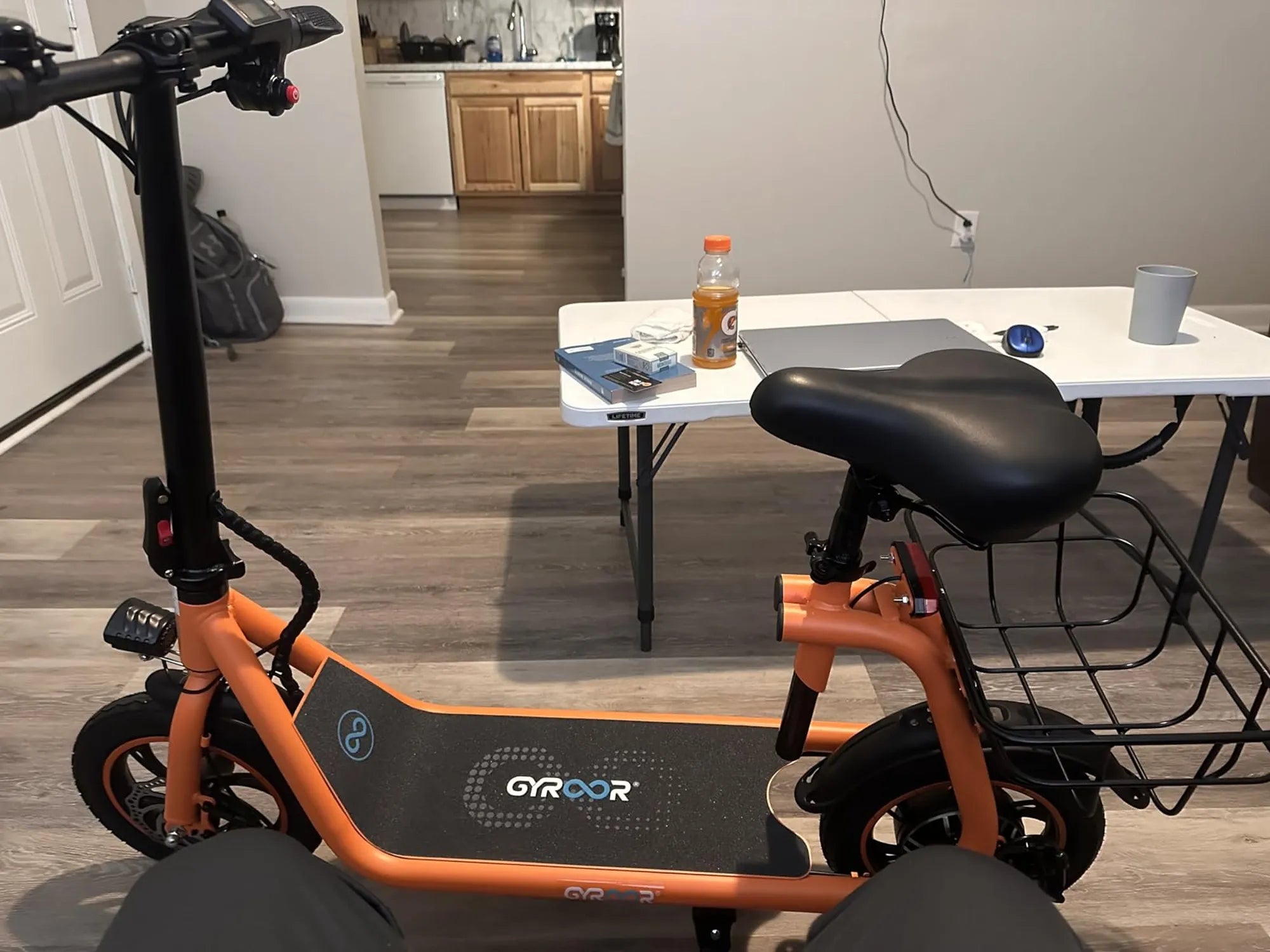
Introduction: Why Sit-Down Electric Scooters Are Redefining Urban Mobility
A sit on electric scooter for adults, often called a seated e-scooter, transforms personal transportation by merging the agility of a scooter with the comfort of a seated ride. This guide provides the ultimate resource on comfort and convenience for adult commuters, recreational riders, and anyone seeking a car alternative. You will learn how to evaluate performance, understand critical safety features, and select a model that fits your lifestyle and daily routes.
These vehicles address a key gap in micro-mobility: sustainable travel without physical strain. Unlike standing models, a seated electric scooter offers a practical solution for longer distances, grocery runs, or for riders who prefer not to stand. Leading brands like Gyroor engineer these scooters with a focus on ergonomic design, certified battery safety, and durable construction trusted by over 100,000 riders.
The evolution from novelty to legitimate transport highlights their growing appeal. Cities are adapting infrastructure, and adults are discovering their utility for the first and last mile of a commute. This shift is driven by models that prioritize rider security and comfort, making the sit on electric scooter for adults a serious contender in urban mobility.
The Unmatched Benefits of Choosing a Seated E-Scooter
Choosing a sit on electric scooter for adults delivers distinct advantages over standing models. The primary benefit is sustained comfort, which directly expands your practical range and frequency of use. A seated position reduces overall fatigue, allowing for enjoyable commutes of 5-10 miles where a standing scooter might become uncomfortable.
Enhanced stability is another significant benefit. The lower center of gravity and seated posture inspire greater confidence, especially at higher speeds or on slightly uneven pavement. This stability is not just a perception; it translates to safer handling and braking, as the rider is more integrated with the vehicle.
Practicality for daily tasks is vastly improved. A seated scooter often includes options for integrated storage or the ability to carry a bag between your feet. This makes trips to the market or transporting a work laptop far more feasible than on a standing scooter, where balance and cargo management can be challenging.
Finally, accessibility broadens the rider base. For adults with minor joint concerns, balance issues, or those who simply prefer not to stand, a seated model opens the door to electric scooter use. It’s a more inclusive design that extends the freedom of micro-mobility to a wider demographic.
Ergonomics and Long-Distance Comfort
The ergonomic design of a quality sit on electric scooter for adults is engineered for anatomical support. A well-padded, contoured seat positions the pelvis correctly, reducing pressure points and promoting better spinal alignment compared to the hunched posture common on standing scooters.
This design directly combats rider fatigue. On a long-distance ride, standing engages core and leg muscles constantly. A seated ride allows those muscles to rest, shifting the work to the scooter’s motor. This means you arrive at your destination feeling fresh, not physically drained.
Suspension systems are critical to this comfort equation. Combined with larger, air-filled tires, a good suspension absorbs vibrations from cracks and bumps. This protects not only your comfort but also reduces stress on the scooter’s frame and components, a feature Gyroor incorporates into its designs for smoother urban travel.
Stability and Safety Perceptions
A seated riding position fundamentally alters the physics of the ride. Your weight is centered and lower, making the scooter less prone to tipping during turns or sudden stops. This is particularly valuable when navigating urban obstacles or when carrying a load.
This stability increases rider confidence, which itself is a safety feature. A confident rider is more likely to maintain a predictable path, use controls smoothly, and focus on the road environment. For new or returning riders, this can shorten the learning curve significantly.
Brands that prioritize safety, like Gyroor, build upon this inherent stability with reliable braking systems and wide decks. The result is a vehicle that feels secure and planted, encouraging regular use for practical transportation rather than just occasional recreation.
Key Features to Evaluate Before You Buy
Selecting the right sit on electric scooter for adults requires careful analysis of specifications that align with your needs. Performance, comfort, and durability are dictated by a set of core components. Ignoring these specs can lead to buyer's remorse when the scooter fails to meet daily demands.
Start by defining your primary use case. Is it a flat, three-mile commute? Weekend rides on park paths? Or tackling moderate hills in your suburb? Your answers will determine the necessary motor power, battery range, and suspension requirements. A mismatch here is the most common error.
Build quality should be non-negotiable. An adult transportation device must support significant weight and withstand daily wear. Look for robust frame materials, reputable brand history, and clear warranty terms. This is an investment, not a disposable toy.
Finally, scrutinize the comfort and convenience features that make the scooter uniquely useful for you. An adjustable seat, adequate storage, and a clear display are not mere accessories; they are integral to a positive ownership experience and daily utility.
Motor Power & Range: Matching Performance to Your Needs
Motor power, measured in watts (W), determines your scooter's ability to accelerate and climb hills. A 350W motor is sufficient for flat urban areas, while 500W or higher is recommended for areas with consistent inclines. Under-powering leads to sluggish performance and battery strain.
Real-world range is a function of battery capacity (Ah), voltage, rider weight, terrain, and speed. Manufacturers often list a maximum range under ideal conditions. A practical rule is to deduct 20-30% for real-world use. For a reliable 15-mile commute, seek a model advertised for 20+ miles.
Consider your typical trip distance. If your longest common trip is 7 miles, a scooter with a 10-15 mile real-world range provides a comfortable buffer. Forgetting to charge occasionally becomes less stressful with this buffer. Gyroor models, for instance, offer clear range specifications based on standardized testing for accurate planning.
Build Quality, Weight Capacity, and Durability
The frame is the scooter's skeleton. Aircraft-grade aluminum alloy is the standard for a strong yet lightweight build. Avoid frames that feel hollow or flex under pressure. The finish should be high-quality to resist scratches and corrosion.
Weight capacity is a direct indicator of structural integrity. Most quality adult sit on electric scooters support 220 to 330 pounds. Exceeding this limit risks frame damage, motor burnout, and unsafe braking performance. Always choose a scooter rated for well above your body weight.
Durability is tested in the details: weld points, folding mechanism solidity, and component integration. A well-built scooter from a brand like Gyroor feels cohesive and rattle-free, even after months of use over imperfect pavement, ensuring longevity and safety.
Comfort & Convenience Specs: Seat, Suspension, and Extras
The seat is your primary interface. Look for ample padding, water-resistant material, and, crucially, adjustability. A seat that adjusts in height and/or fore-aft position allows for a custom fit, improving control and comfort for riders of different sizes.
Suspension type directly impacts ride quality. Spring suspensions are common and effective. Higher-end models may feature hydraulic or dual suspension systems for exceptionally smooth travel over rough surfaces. Pair this with 10-inch pneumatic (air-filled) tires for optimal shock absorption.
Convenience extras elevate the experience. An integrated rear storage basket or a front-mounted bag hook transforms the scooter into a practical errand-runner. A bright headlight, brake light, and audible horn are essential for safety, not just convenience. A digital display showing speed, battery level, and mode is invaluable for trip management.
Gyroor’s Engineering Edge: Safety and Reliability Built-In
Gyroor distinguishes its sit on electric scooters for adults through a foundational commitment to verified safety and dependable performance. In a market with varying standards, Gyroor’s engineering choices provide clear, measurable benchmarks for security and long-term value. This focus addresses the paramount concerns of adult riders investing in daily transport.
The brand’s philosophy centers on risk mitigation. From the battery chemistry to the water-sealing of electronics, each component is selected and tested to prevent common failure points. This results in vehicles that riders can trust for their daily commute, regardless of weather or road conditions.
This engineering edge translates directly to ownership satisfaction. A scooter that starts reliably, charges safely, and withstands the elements requires less maintenance and causes less anxiety. It becomes a true tool for mobility, not a source of constant concern or unexpected repair costs.
The Critical Importance of UL-Certified Batteries
UL certification is the most critical safety feature for any electric scooter. UL 2271 certification specifically tests the battery pack for electrical, mechanical, and environmental safety, rigorously checking for fire and shock risk. For a device stored and charged in your home or office, this is non-negotiable.
Gyroor’s use of UL-certified battery packs provides a verified safeguard. These batteries undergo testing for over 500 charge cycles, ensuring not only safety but also longevity and consistent performance. This certification is your assurance that the most volatile component meets stringent independent safety standards.
Choosing a scooter without this certification poses a tangible risk. It indicates the battery may not have passed crucial stress tests for overheating, short-circuiting, or overcharging. For peace of mind, insist on UL 2271 certification as a baseline requirement.
Weather Resistance and the IPX5 Rating
The IPX5 water-resistance rating defines a scooter's ability to handle wet conditions. An IPX5-rated scooter, like those from Gyroor, is protected against water jets projected from a nozzle from any direction. This means it can safely ride through puddles and in light rain without immediate damage to its electrical systems.
This rating is essential for practical, all-weather usability. Commuters cannot control the weather, and a sudden shower should not strand you or require an expensive repair. The IPX5 rating ensures the scooter's critical controllers, wiring, and connections are sealed against water ingress.
It’s important to note that IPX5 does not mean submersible. Avoid deep puddles and heavy downpours. However, this level of protection is precisely what is needed for the vast majority of real-world urban riding scenarios, providing reliable performance when you need it most.
Warranty and Support: The Value of Peace of Mind
A comprehensive warranty is a brand’s contract of confidence in its product. Gyroor’s standard 1-year warranty on the motor, battery, and frame protects your investment against manufacturing defects. This coverage is a direct reflection of their build quality and reliability testing.
Accessible support is equally important. The ability to reach knowledgeable customer service for troubleshooting or warranty claims without navigating language barriers or overseas time zones is a significant value-add. It transforms a potential headache into a manageable process.
This combination—a strong warranty and responsive support—provides true peace of mind. It means your purchase is protected, and help is available if needed, making the ownership experience straightforward and secure from day one.
Sit-Down Scooter vs. Standing Scooter vs. E-Bike: A Practical Comparison
Understanding where the sit on electric scooter for adults fits within the micro-mobility ecosystem is key to choosing the right vehicle. Each option has distinct strengths tailored to different riders, terrains, and use cases. The following table provides a data-driven comparison to clarify these differences.
| Feature | Sit-Down E-Scooter | Standing E-Scooter | E-Bike |
|---|---|---|---|
| Average Price Point | $$ | $ - $$ | $$$ |
| Typical Range | 15-30 miles | 10-20 miles | 20-50+ miles |
| Top Speed | 15-20 mph | 15-20 mph | 20-28 mph (Class 3) |
| Physical Effort | Very Low | Low (balance required) | Low to Moderate (pedal assist) |
| Portability (Weight/Folding) | Moderate (50-70 lbs), Often folds | High (30-45 lbs), Folds compactly | Low (50-70 lbs), Rarely folds |
| Storage Space | Good (basket options, deck space) | Poor (handlebar bag only) | Excellent (racks, panniers) |
| Ideal Use Case | Leisurely commutes, errands, riders seeking comfort/stability | Last-mile commute, multimodal travel, compact storage | Long commutes, heavy cargo, exercise combined with assist |
The sit-down e-scooter excels in comfort-focused, medium-distance travel. It is the best choice for adults who want a dedicated riding vehicle for trips that are too long to stand comfortably but where an e-bike’s size, cost, or need for pedaling is undesirable. Its inherent stability and cargo options make it uniquely practical.
Standing scooters win on extreme portability and are ideal for combining with public transit. They are less suited for trips over 3-4 miles or for riders who prefer not to stand. E-bikes offer the greatest range, speed, and cargo capacity but come with higher cost, significant weight, and often require more storage space.
Your choice ultimately hinges on your primary need. For a comfortable, stable, and convenient solo ride for daily urban and suburban trips, the sit on electric scooter for adults presents a compelling and often optimal balance of features.
Frequently Asked Questions (FAQs) About Adult Sit-Down E-Scooters
Q1: Do I need a license, registration, or insurance to ride a sit-down electric scooter?
Laws vary significantly by state and country. In most U.S. states, electric scooters with a top speed under 20 mph are treated similarly to bicycles and do not require a license, registration, or insurance for use on bike lanes and roads. However, some cities or states have specific regulations. Always check your local Department of Motor Vehicles (DMV) or city transportation website for the most current rules.
Q2: How long does the battery take to charge fully, and what is the battery lifespan?
Charge times typically range from 4 to 8 hours for a full charge from empty. Most scooters use lithium-ion batteries with a lifespan of 500 to 1000 full charge cycles. With proper care (avoiding full discharges, not leaving it at 100% charge for weeks), the battery should retain good capacity for 2-5 years of regular use. Gyroor’s UL-certified packs are tested for over 500 cycles.
Q3: Are they allowed on bike lanes, paths, and sidewalks?
Bike lanes and multi-use paths are generally the intended and legal riding zones. Riding on sidewalks is often prohibited or discouraged for safety reasons, as scooter speeds can pose a risk to pedestrians. Always yield to pedestrians, obey traffic signals, and ride at a safe, controlled speed, especially in shared spaces.
Q4: Can the seat be removed to use it as a standing scooter?
On many models, yes. Most seated e-scooters feature a seat post that is detachable via a quick-release lever or bolts. This offers flexibility, allowing you to remove the seat for easier storage or if a younger rider prefers to stand. Check the product specifications to confirm this feature.
Q5: What maintenance is required for a sit-down electric scooter?
Regular maintenance is minimal but crucial: check tire pressure monthly (for pneumatic tires), ensure all bolts (especially on the stem and seat) are tight, keep the scooter clean and dry, and store it in a cool, dry place. Periodically check the brakes for wear and ensure the battery contacts are clean. Refer to the user manual for a detailed schedule.
Conclusion: Finding Your Perfect Ride
The journey to selecting your ideal sit on electric scooter for adults culminates in matching engineering excellence with personal need. This guide has outlined the undeniable comfort, enhanced stability, and practical utility that define these vehicles. The choice ultimately rests on prioritizing verified safety features, robust construction, and a design that aligns with your daily life.
Remember, the core value lies in reliable, worry-free performance. Specifications like UL-certified batteries and an IPX5 water-resistant rating are not just checkboxes; they are foundational to a safe and durable product. A strong warranty from a reputable brand like Gyroor protects your investment, ensuring your scooter remains a source of freedom, not frustration.
Assess your most common routes, distance, and cargo needs against the features discussed. Whether your priority is a smooth commute, running local errands, or leisurely exploration, a well-chosen seated e-scooter offers a uniquely convenient and enjoyable form of transportation. It represents a smart investment in personal mobility that prioritizes your comfort and convenience above all.
Ready to experience the ultimate blend of comfort and convenience? Browse the full Gyroor collection of UL-certified, feature-rich sit-down electric scooters for adults at gyroorboard.com and find the model engineered for your journey.
How Heavy Are Electric Scooters: A Complete Weight Guide
Electric Scooters Miami Beach: The Ultimate Guide to Riding in Paradise