



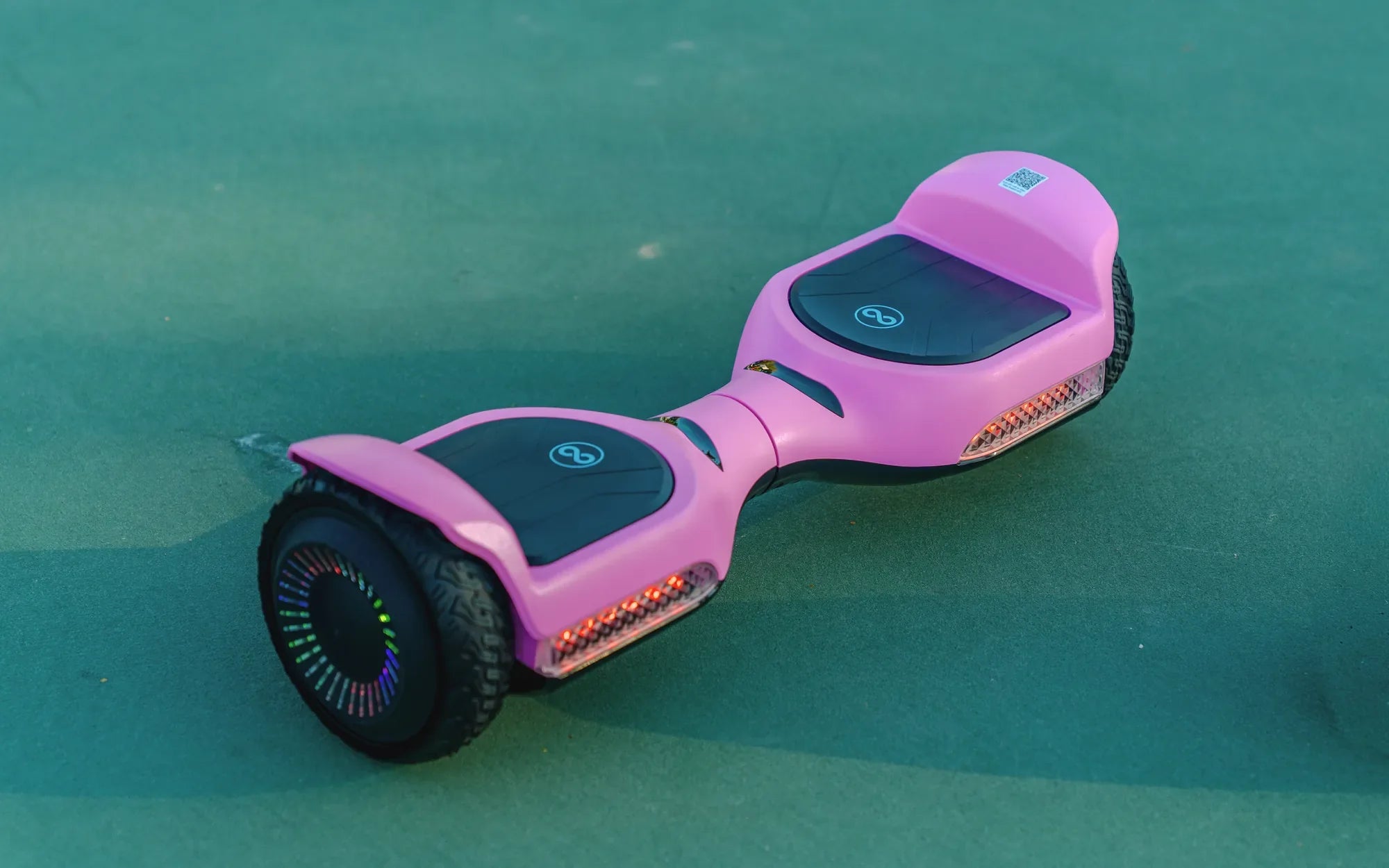
Searching for a cheap hoverboard under $50 reveals hundreds of listings on marketplaces like Amazon, Temu, and Walmart, often with glowing reviews and flashy images. The price tag is undeniably tempting, but it begs a critical question: is this extreme budget option a smart bargain or a dangerous gamble that compromises safety for fleeting savings? This article will dissect exactly what goes into a sub-$50 hoverboard, analyze the documented safety risks, calculate the true hidden costs, and provide a clear framework for identifying a genuinely valuable and safe alternative. As a leading brand trusted by over 100,000 riders, Gyroor's commitment to UL-certified batteries and robust warranties serves as a benchmark for what responsible manufacturing looks like in the personal electric vehicle space.
Decoding the "Cheap" Hoverboard: Anatomy of a $50 Product
To understand the risk of a cheap hoverboard under $50, you must first understand the severe manufacturing compromises required to hit that price point. A functional hoverboard requires a battery pack, two hub motors, a gyroscopic sensor system, a motherboard, a chassis, and tires. At a retail price of $50, the actual cost of materials and assembly for the manufacturer is often below $20.
This razor-thin margin forces the use of the lowest-grade components available. The plastic shell is typically thin, brittle ABS that cracks under minimal stress. The hub motors are often low-torque, generic models that strain with weights over 100 lbs. The internal wiring is frequently thin-gauge and poorly insulated, creating points of potential short-circuiting.
Most critically, the entire system is built around a substandard power and control unit. The motherboard and balance sensors are notoriously unreliable, leading to sudden stops, jerky movements, or complete failure. These foundational flaws mean that even if one component were upgraded, the entire ecosystem remains dangerously weak.
The business model for these products relies on high-volume, low-support sales. Sellers are often anonymous or use constantly changing brand names, making accountability after purchase virtually impossible. When you buy a cheap hoverboard under $50, you are not buying a engineered vehicle; you are purchasing a collection of hazard-prone parts assembled with minimal oversight.
The Battery: The Heart of the Hazard and Fire Risk
The single greatest danger in an ultra-low-cost hoverboard is its battery pack. This is not an area where corners can be safely cut. A quality hoverboard battery uses name-brand, UL-certified lithium-ion cells arranged in a specific configuration with a protective Battery Management System (BMS).
In a cheap hoverboard under $50, the battery is almost certainly comprised of recycled, faulty, or uncertified lithium-ion cells. These cells lack the internal safeguards to prevent overheating, overcharging, and thermal runaway—the chemical chain reaction that leads to fires. The accompanying BMS, if present at all, is rudimentary and fails to properly balance cell voltage during charging.
Data from the U.S. Consumer Product Safety Commission (CPSC) has repeatedly highlighted the fire risk associated with non-compliant hoverboards. In one notable recall, over 500,000 units were removed from the market due to fire hazards. The root cause in almost every case was a faulty, uncertified battery pack.
Charging becomes a high-risk activity. A poor-quality battery paired with a cheap, non-smart charger can lead to overcharging. Without a proper BMS to cut off power, the cells can swell, leak, and ignite. This risk doesn't disappear after use; a damaged battery can fail catastrophically even while sitting idle. In contrast, brands like Gyroor use UL 2272 certified battery packs tested for over 500 charge cycles, with smart BMS protection as a standard, non-negotiable safety feature.
Build Quality and Real-World Performance Shortfalls
On paper, a cheap hoverboard under $50 might advertise a 10-mile range and a 12 mph top speed. In reality, performance is dismal and unpredictable. The weak motors, often rated far below their advertised wattage, struggle with anything beyond a perfectly flat surface. A slight incline or a rider at the upper limit of the weight capacity can cause the board to stutter, stall, or throw the rider.
Range is a major casualty of cost-cutting. The poor-quality battery depletes rapidly and suffers from significant voltage sag. The advertised 10-mile range often translates to 2-3 miles of inconsistent power in real-world conditions. Furthermore, battery life degrades alarmingly fast, sometimes losing over half of its capacity within a dozen charge cycles.
The riding experience is characterized by instability. Low-quality gyroscopes and sensors have slow response times and poor calibration. This can manifest as a delayed reaction to leaning, sudden acceleration, or a tendency to drift to one side. The tires are often made of hard, low-grip plastic instead of rubber, offering poor traction on smooth surfaces and none on slightly wet or uneven terrain.
Durability is virtually non-existent. The thin plastic shell can crack from a minor bump or drop. The footpad sensors, critical for operation, are prone to failure. When a component fails—and it will—there are no replacement parts, no repair guides, and no customer service to contact. The product becomes electronic waste almost immediately.
The True Hidden Costs of a "Budget" Buy
The initial price of a cheap hoverboard under $50 is a classic example of a false economy. The true total cost of ownership quickly escalates when factoring in immediate and probable future expenses. The first hidden cost is the near-certainty of premature product failure, requiring a second purchase. Effectively, you may end up spending $100 or more in rapid succession for a series of defective products.
The second cost is the complete lack of customer support and warranty. Reputable brands offer a safety net; Gyroor, for instance, provides a 1-year warranty on the entire vehicle. A marketplace seller of a $50 board offers no such protection. When the board fails, you bear 100% of the financial loss.
The third, and most severe, category is safety-related costs. These are potential rather than guaranteed, but the risk is significant. A battery fire could lead to property damage, with costs ranging from hundreds to thousands of dollars. A sudden mechanical failure while riding could cause personal injury, resulting in medical bills. These risks pose a tangible financial threat far exceeding any initial savings.
Finally, there is the opportunity cost of time and frustration. Hours spent attempting to troubleshoot a dead board, seeking a refund from an unresponsive seller, or disposing of hazardous waste are all valuable resources wasted on a product designed for immediate obsolescence.
Safety Benchmarks: What a Reliable Hoverboard Must Have
Identifying a safe hoverboard requires looking for specific, non-negotiable certifications and build features. These are the benchmarks that separate legitimate products from hazardous imitations. The cornerstone of safety is electrical system certification.
The Non-Negotiables: UL 2272 Certification and IP Rating
UL 2272 is a comprehensive safety standard set by Underwriters Laboratories specifically for self-balancing scooters (hoverboards). It rigorously tests the entire electrical system—battery, charger, and motor—for fire and electrical shock risk. A hoverboard without this certification has not undergone this critical testing. Any legitimate retailer will prominently display the UL 2272 mark. Additionally, a water-resistance rating (like IPX4 or IPX5) is crucial for durability. It protects the electronics from water splashes, puddles, and dust, preventing shorts and corrosion. Gyroor designs its models with IPX5 water resistance, allowing them to withstand low-pressure water jets from any direction.
Quality Indicators: Warranty, Brand Reputation, and Components
A meaningful warranty is a powerful indicator of quality. A company that offers a 1-year comprehensive warranty, like Gyroor, is demonstrating confidence in its product's durability and is contractually obligated to support you. Research the brand's history, customer service presence, and reviews across multiple platforms. Established brands have a reputation to uphold. Examine the specifications for transparent details: motor wattage (250W per motor is a common entry-level standard), battery capacity in Watt-hours (Wh), and the use of rubber, air-filled, or all-terrain tires for better grip and shock absorption.
Comparison: $50 Generic vs. Value-Tier Certified Hoverboard
The table below contrasts the typical characteristics of a hazardous budget board with those of an entry-level model from a certified brand, illustrating the stark differences in safety, performance, and value.
| Feature | Typical $50 Generic Hoverboard | Certified Value-Tier Hoverboard (e.g., Gyroor Entry Model) |
|---|---|---|
| Battery & Safety | Uncertified, generic cells. No functional BMS. High fire risk. | UL 2272 Certified battery pack. Smart BMS for overcharge/overheat protection. |
| Build Quality | Thin, brittle plastic shell. Poorly soldered connections. | Reinforced ABS shell. Secure internal component layout. |
| Motor & Performance | Weak motors (~150W). Struggles with inclines >5°. | Adequate power (250W+ motors). Handles moderate inclines. |
| Range (Real World) | 2-4 miles, with rapid degradation. | 6-9 miles, consistent performance over battery life. |
| Warranty & Support | None or 30-day return at best. No serviceable parts. | 1-year comprehensive warranty. Accessible customer service. |
| Total Cost of Ownership | High (replacement, safety risks, no support). | Predictable (covered by warranty, durable build). |
Responsible Alternatives: Finding Genuine Value and Safety
Genuine value in a hoverboard is found at the intersection of safety certification, reliable performance, and manufacturer support. While the market for a cheap hoverboard under $50 is fraught with risk, the market for certified, entry-level hoverboards offers viable options. These typically start in the $150 to $300 range, representing the true minimum investment for a product that won't endanger your home or person.
Focus your search on brands that are transparent about their certifications and specifications. Look for the UL 2272 mark on the product page and physical unit. Prioritize models with a clear IP water-resistance rating for added durability. Assess the warranty terms—a 1-year warranty is a strong positive signal.
Consider certified refurbished models from reputable companies. These are often units returned within a trial period, fully inspected, tested, and resold with a warranty at a significant discount. This can be an excellent way to access higher-tier models from brands like Gyroor at a more accessible price point while retaining all safety and support benefits.
Ultimately, reframe the purchase from finding the lowest price to securing the lowest risk. The true value of a hoverboard is not in its initial cost but in its safe, reliable operation over time. Investing in a certified product is an investment in peace of mind, ensuring that the fun of riding is never overshadowed by worry.
FAQ: Navigating the Risks of Ultra-Cheap Hoverboards
Q: Are hoverboards under $50 ever UL 2272 certified?
A> It is extremely unlikely. The cost of sourcing certified cells, undergoing rigorous testing, and implementing a proper BMS makes it financially impossible to sell a compliant hoverboard at that price point. Assume any hoverboard advertised under $50 lacks this critical safety certification.
Q: I already bought one. What should I do?
A> Exercise extreme caution. Charge it only on a non-flammable surface in an open area, away from people, pets, and anything flammable. Never leave it charging unattended or overnight. Monitor it closely for overheating, swelling, or strange smells. Consider discontinuing use and disposing of it properly at a designated electronics recycling facility that handles lithium batteries.
Q: Can't I just replace the dangerous battery with a safe one?
A> This is not recommended and is often impractical. The charger and internal wiring are designed for the low-quality original system. Installing a different battery could introduce compatibility issues. Furthermore, the root safety problems—poor construction, weak motors, and bad electronics—remain. You would be investing more money into a fundamentally flawed product.
Q: What is a realistic price for a safe, basic hoverboard?
A> For a new, UL 2272 certified hoverboard from a reputable brand with a basic feature set, expect to invest between $150 and $250. This price reflects the actual cost of safe batteries, reliable motors, and responsible manufacturing. Certified refurbished models can sometimes be found for slightly less.
Q: How does Gyroor ensure safety compared to these low-cost options?
A> Gyroor's approach is fundamentally different. It starts with UL-certified battery packs and builds the entire vehicle around them, using a robust BMS, quality motors, and water-resistant designs. This is backed by a 1-year warranty and dedicated customer support, creating a full ecosystem of safety and reliability that simply does not exist in the sub-$50 market.
Invest in Safety, Not Just a Price Tag
The evidence is clear: the pursuit of a cheap hoverboard under $50 is a high-stakes gamble where the potential losses—financial, property, and personal—drastically outweigh the minimal upfront savings. These products are engineered to a price point that inherently excludes the safety features and quality controls necessary for a reliable personal transportation device. The certified battery, durable construction, and legitimate warranty that define a responsible product are absent by design. True value is measured in safe miles ridden, not in dollars initially saved. Choosing a hoverboard from a trusted brand with verifiable certifications is not an extravagance; it is a fundamental requirement for responsible ownership. Protect your investment, your home, and yourself by starting your search with safety as the non-negotiable criterion.
Ready to explore hoverboards built with safety and performance as the priority? Browse the full collection of UL-certified, warranty-backed electric scooters and hoverboards at Gyroor. Find the right model for your needs and ride with confidence. Visit gyroorboard.com to discover genuine value on two wheels.
Hoverboard Comparison: Finding the Best Ride for Your Needs
Hoverboard Stickers: The Ultimate Guide to Personalizing Your Ride