


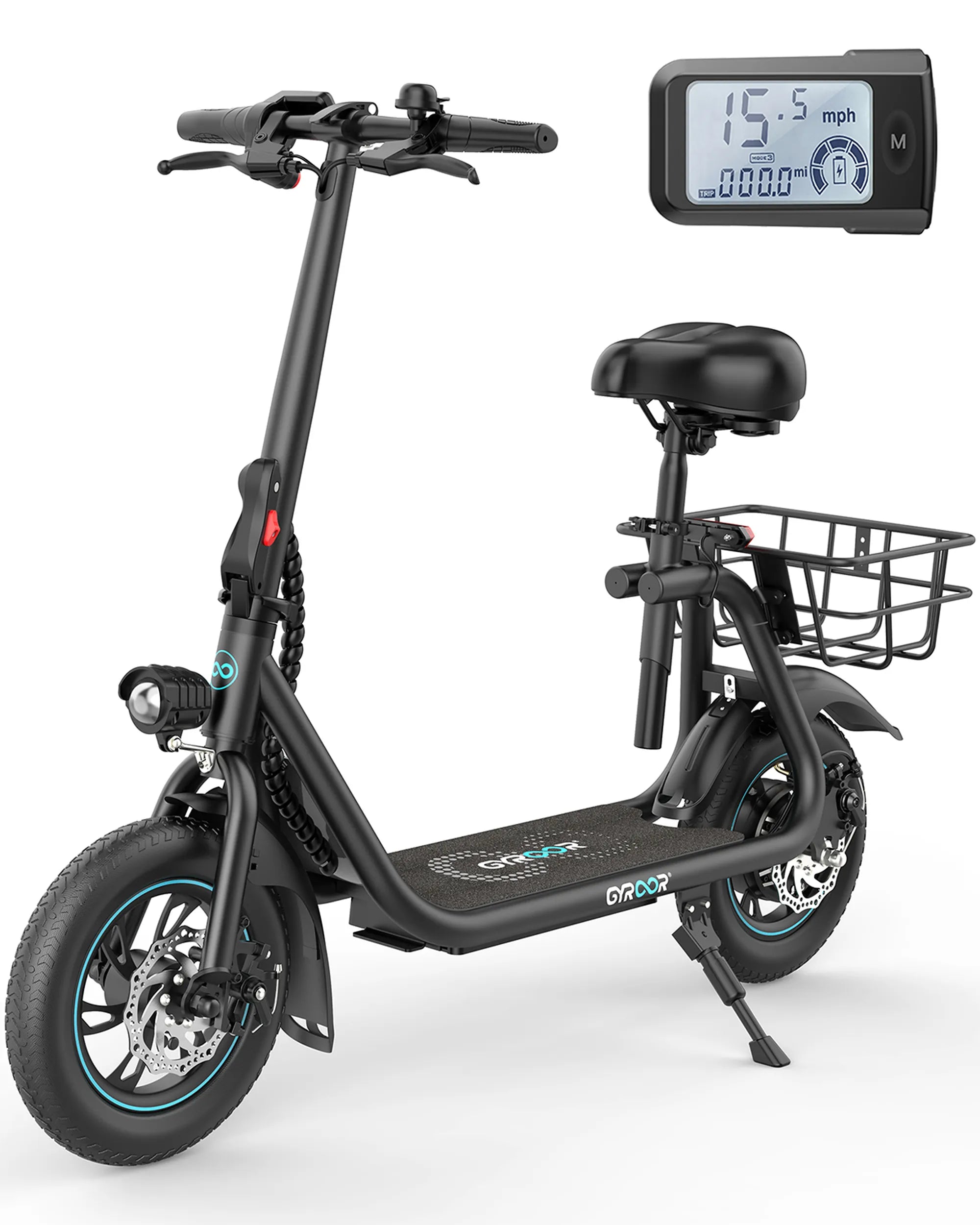
Nineteen miles per hour is more than just a number on a speedometer; it's the critical performance benchmark that defines the modern urban electric scooter. This speed represents the perfect equilibrium between brisk commuting and safe, legal operation. For riders navigating city streets, electric scooters 19 MPH deliver the ideal blend of thrill and practicality. This ultimate guide dissects the engineering, legal landscape, and rider experience behind this pivotal speed tier, providing you with the data needed to make an informed choice. You'll learn why 19 MPH is the industry sweet spot, how leading brands like Gyroor engineer for this specific performance, and what you can expect in terms of range, safety, and real-world utility.
The Legal and Practical Significance of 19 MPH
Electric scooters operating at 19 MPH are strategically positioned within a complex web of municipal regulations. This speed is not arbitrary; it is a direct response to the legal frameworks governing micromobility in major urban centers across North America and Europe. Adhering to these limits is crucial for rider safety and to ensure the long-term integration of e-scooters into city transportation ecosystems.
Operating at 19 MPH allows riders to keep pace with urban bicycle traffic, which typically averages 10-15 MPH, while providing a significant speed advantage over walking. This creates an efficient flow within dedicated bike lanes, reducing conflicts and enhancing safety for all users. The speed is fast enough to make commuting viable over distances of 3-7 miles, yet slow enough to allow for adequate reaction time to obstacles, pedestrians, and vehicles.
From a rider psychology perspective, 19 MPH hits a 'confidence threshold.' It feels sufficiently fast to be exciting and efficient, but remains within a velocity where most adults feel in control. Speeds significantly higher can increase anxiety for new riders and raise the severity of potential accidents. Therefore, 19 MPH serves as a de facto standard that balances utility with widespread rider adoption and regulatory acceptance.
Navigating City Speed Regulations
Understanding local laws is paramount. In the United States, many cities model their regulations on state legislation, often capping e-scooter speeds at 15-20 MPH on roadways and lower on sidewalks. For instance, key markets enforce specific limits that make 19 MPH-capable scooters ideal.
- New York City: The official speed limit for electric scooters is 15 MPH. A scooter capable of 19 MPH allows for a performance buffer on inclines while ensuring easy compliance with the law via selectable speed modes.
- San Francisco: Regulations typically limit scooters to 15 MPH, with strict enforcement in shared mobility programs. A private scooter with a 19 MPH maximum gives riders flexibility while respecting the spirit of the law.
- London, UK: E-scooters in rental trials are limited to 15.5 MPH (25 km/h). Privately owned models are in a legal gray area but are expected to adhere to similar standards for future legalization, making a 19 MPH-capable model a future-proof choice.
These examples illustrate why manufacturers engineer scooters to peak near 20 MPH. It provides headroom for varying conditions while ensuring riders can easily set a lower, compliant cruising speed. A brand like Gyroor designs its scooters with multiple speed modes, allowing riders to select a 15 MPH mode for strict compliance or unlock the full 19 MPH for permitted zones.
Engineering for Efficiency: How Performance is Optimized at 19 MPH
Delivering consistent, efficient power at 19 MPH requires careful engineering synergy between the motor, battery, controller, and firmware. This is not merely about attaching a powerful motor; it's about creating a system where all components work in harmony to achieve optimal performance within a specific power band.
The heart of this system is the motor. A sustained 19 MPH cruise typically requires a continuous power output of 350-500 watts, depending on rider weight and incline. Many premium commuter scooters, including several Gyroor models, utilize brushless DC hub motors rated between 350W and 500W. This provides sufficient torque for acceleration and hill-climbing while operating efficiently at the target speed. Over-motorizing (e.g., using a 1000W motor) can lead to inefficiency at lower speeds and unnecessary weight and cost.
The electronic speed controller (ESC) is the brain. A high-quality ESC manages power delivery from the battery to the motor with precision. It ensures smooth acceleration (preventing jerky starts) and implements regenerative braking where available. The firmware within the ESC is often tuned to prioritize efficiency at common cruising speeds, which is why a well-tuned scooter feels effortless and responsive at 19 MPH.
Physical design plays a crucial role. Aerodynamics, while not a primary concern at this speed, still matter. Clean cable management, a streamlined stem, and a deck design that minimizes air resistance all contribute to requiring less power to maintain speed. Tire choice is also critical; pneumatic (air-filled) tires offer better rolling efficiency and shock absorption than solid tires, directly impacting the energy required to sustain 19 MPH.
The Role of the UL-Certified Battery in Sustained Performance
The battery is the fuel tank, and its quality dictates not just range, but the consistency of performance. A scooter's ability to hold 19 MPH up a slight incline or into a headwind depends on the battery's ability to deliver stable voltage under load. This is where certification and cell quality become non-negotiable.
Gyroor, like other responsible manufacturers, uses UL 2271 certified battery packs. This certification involves rigorous testing for electrical, mechanical, and environmental safety, including overcharge, short circuit, and crush tests. From a performance perspective, a UL-certified pack uses high-quality lithium-ion cells (commonly from brands like LG or Samsung) with low internal resistance.
Low internal resistance is the key to sustained power output. As a battery discharges, its voltage naturally drops. Cells with high internal resistance experience a more significant voltage sag under the load of a motor drawing high current. This sag can cause the scooter's controller to limit power, resulting in a noticeable drop in speed even if the battery is only half-drained. Quality cells minimize this sag, allowing the scooter to maintain near-peak speed for a greater portion of the battery's charge cycle.
Furthermore, a well-designed Battery Management System (BMS) inside the pack protects the cells, balances their charge, and communicates accurately with the scooter's dashboard. This ensures the range estimate is reliable and that the rider isn't unexpectedly left without power. The synergy of quality cells, a robust BMS, and UL certification is what allows a scooter to reliably deliver on its 19 MPH promise trip after trip.
Speed vs. Range: The Data-Driven Trade-off
The relationship between speed and range in electric scooters is not linear; it's exponential due to increasing aerodynamic drag. While riding at 19 MPH is efficient for commuting, understanding its impact on your total range is essential for trip planning. The 'sweet spot' for maximum range is often between 10-15 MPH, but sacrificing some range for the time savings of 19 MPH is a calculation most urban commuters are willing to make.
Aerodynamic drag force increases with the square of velocity. This means going from 15 MPH to 19 MPH increases the drag force by approximately (19/15)^2 = 1.6, or 60%. This requires significantly more power from the motor. Rolling resistance and minor drivetrain losses also increase, compounding the effect. Therefore, a scooter rated for 25 miles at 15 MPH might only achieve 16-18 miles at a consistent 19 MPH, depending on conditions.
The following table illustrates a realistic comparison for a typical 500W scooter with a 10Ah (360Wh) battery and a 165 lb rider on flat terrain:
| Speed (MPH) | Estimated Range (Miles) | Power Draw (Approx. Watts) | Commute Time for 5 Miles |
|---|---|---|---|
| 10 | 28 | ~130 | 30 minutes |
| 15 | 22 | ~250 | 20 minutes |
| 19 | 17 | ~400 | ~16 minutes |
| 24 (if capable) | 12 | ~650 | 12.5 minutes |
This data shows the clear trade-off. The 4 MPH increase from 15 to 19 MPH saves about 4 minutes on a 5-mile commute but reduces range by roughly 23%. For most commuters with a 5-7 mile one-way trip, a 17-mile range is still sufficient with a margin for error, making 19 MPH the optimal balance.
Real-World Range Expectations from Commuter Models
Manufacturer range claims are often based on ideal conditions: a lightweight rider on perfectly flat ground at a constant low speed. Real-world range is affected by rider weight, hills, wind, temperature, and riding style (frequent acceleration/braking).
For a reliable commuter scooter engineered for 19 MPH performance, such as the Gyroor S1 or similar models in its class, riders can use a practical formula. Take the battery's watt-hour (Wh) rating and divide it by 20-25 for a realistic 19 MPH range estimate. For example:
- A scooter with a 360Wh battery: 360 / 22 = ~16.5 miles of real-world range at 19 MPH.
- A scooter with a larger 504Wh battery: 504 / 22 = ~23 miles of real-world range at 19 MPH.
Rider weight adds a significant variable. Every additional 50 lbs of rider and cargo weight can reduce range by 10-15%. Hills are the largest drain; climbing a moderate hill can temporarily double or triple the power draw. Therefore, for reliable daily commuting, it is advisable to choose a scooter whose rated range is at least double your one-way commute distance if you plan to ride at top speed.
Essential Safety and Control Features for 19 MPH Riding
When traveling at 19 MPH—a speed comparable to a brisk bicycle pace—effective safety systems transition from nice-to-have to essential. The kinetic energy in a collision increases with the square of speed, making reliable braking and visibility paramount. A scooter designed for this performance tier must integrate safety into its core design philosophy.
The braking system is the most critical component. A dual-brake system, combining electronic (regenerative) braking and a mechanical disc or drum brake, is the industry standard for reliable stopping power. Regenerative braking helps slow the scooter while recapturing some energy, but a mechanical brake provides fail-safe, consistent stopping power in all conditions, especially wet weather. The brake levers should offer adjustable reach and provide progressive feedback to the rider.
Lighting and visibility are non-negotiable. At 19 MPH, you are a fast-moving vehicle in traffic. A bright, focused headlight (ideally 200+ lumens) is required to see the road ahead, not just to be seen. A rear brake light that illuminates upon braking is crucial. Additionally, side reflectors or integrated deck lighting significantly improve visibility from perpendicular angles, a common blind spot in urban intersections.
Deck design and tires contribute directly to control. A wide, textured deck provides a stable platform for the rider's feet, allowing for secure weight shifting during turns. Pneumatic (air-filled) tires, as mentioned, offer superior traction and shock absorption compared to solid tires. They better grip wet pavement and absorb bumps, maintaining contact with the road and preventing loss of control. The IPX5 water-resistance rating found on models like those from Gyroor ensures the electrical components are protected from water spray from all angles, adding reliability in damp conditions.
Maximizing Your Investment: Maintenance for Peak 19 MPH Performance
To consistently enjoy the performance and safety a 19 MPH scooter offers, a simple, regular maintenance routine is essential. Proper care not only extends the lifespan of the scooter but also ensures it operates safely and efficiently. This maintenance aligns perfectly with preserving the validity of a comprehensive warranty, such as the reliable 1-year warranty offered by Gyroor.
Tire maintenance is the single most impactful routine task. For pneumatic tires, check pressure weekly with a bicycle pump. Under-inflated tires dramatically increase rolling resistance, draining the battery faster and making it harder for the motor to maintain speed. They also increase the risk of pinch flats. Maintain the pressure at the PSI rating printed on the tire sidewall (usually 40-50 PSI).
Brake inspection should be performed monthly. For disc brakes, check pad wear and ensure the rotor is clean and not bent. Adjust cable tension on drum or mechanical disc brakes if the lever feels loose. Test braking power at low speed regularly. Keep the braking surfaces free of oil and debris. Lubricate the moving parts of the brake levers and folding mechanisms with a light silicone spray every few months to prevent corrosion and ensure smooth operation.
Battery care is crucial for long-term health. Avoid completely draining the battery to 0%. Try to recharge when it drops to 20-30%. Store the scooter in a cool, dry place, and avoid leaving it at full charge for weeks on end if not in use. Periodically check all bolts and nuts, especially on the stem, handlebars, and folding mechanisms, for tightness, as vibrations can loosen them over time. A quick wipe-down after riding in wet or dirty conditions prevents grime from building up and damaging components.
Comparing 19 MPH Scooters: Key Features to Evaluate
When shopping for an electric scooter in this performance category, looking beyond the top speed is vital. The following comparison table highlights the key specifications and features that differentiate quality 19 MPH commuter scooters. This data-driven approach helps identify the best value and performance for your needs.
| Feature Category | Budget Tier | Premium Commuter Tier (e.g., Gyroor S1) | Performance-Enhanced Tier |
|---|---|---|---|
| Top Speed | 15-18 MPH | 19-20 MPH | 22-25 MPH |
| Motor Power (Nominal) | 250W - 350W | 350W - 500W | 500W - 800W |
| Real-World Range @ 19 MPH | 8-12 Miles | 15-22 Miles | 18-28 Miles |
| Battery Certification | May be uncertified | UL 2271 Certified | UL 2271 Certified |
| Braking System | Single mechanical (drum/foot) | Dual Braking (E-ABS + Disc/Drum) | Dual Hydraulic or Dual Disc |
| Tire Type | Solid or Basic Pneumatic | Pneumatic (Air-Filled) | Large Pneumatic, Often Tubeless |
| Water Resistance | IPX4 or unspecified | IPX5 | IPX5 or IPX6 |
| Warranty | 90 Days - 6 Months | 1 Year Comprehensive | 1-2 Years |
| Primary Use Case | Short, infrequent trips | Daily Urban Commuting | Longer commutes, varied terrain |
As the table demonstrates, the premium commuter tier offers the optimal balance for the 19 MPH rider. It provides the necessary power and range, prioritizes safety with certified batteries and dual brakes, and includes practical durability features like IPX5 water resistance—all backed by a substantial warranty. This tier is engineered for dependable daily use, not just occasional recreation.
Frequently Asked Questions (FAQ)
Q1: Is 19 MPH fast enough for a daily commute?
Absolutely. For urban commutes under 7 miles, 19 MPH is highly efficient. It significantly outpaces walking and public transport for door-to-door times in congested cities, while remaining manageable and safe in bike lanes. It turns a 30-minute walk into a 10-minute ride.
Q2: Can an electric scooter maintain 19 MPH up a hill?
This depends on the motor power, rider weight, and hill gradient. A 350W-500W scooter can typically maintain 10-15 MPH on moderate hills (5-10% grade). Steeper hills will cause speed to drop. If hills are a major part of your route, consider a model with higher torque or a more powerful motor.
Q3: Do I need a license or insurance to ride a 19 MPH electric scoter?
In most U.S. states and European countries, a driver's license is not required for e-scooters with a top speed under 20 MPH. Insurance is typically not mandatory but is recommended. Always check your local and state laws, as they vary widely and change frequently.
Q4: How does cold weather affect my scooter's performance at 19 MPH?
Cold temperatures (below 50°F/10°C) reduce lithium-ion battery efficiency. You can expect a 20-30% reduction in range. The scooter may also feel slightly less peppy. Store the scooter indoors when not in use and allow the battery to warm up before riding for best results.
Q5: What is the most important safety gear for riding at 19 MPH?
A certified bicycle helmet is the absolute minimum. For enhanced safety, consider gloves to protect your hands in a fall, and reflective clothing or a vest for visibility. Elbow and knee pads are recommended for new riders or those in high-traffic areas.
Smart Speed for Smarter Commuting
The pursuit of the perfect urban electric scooter leads inevitably to the 19 MPH benchmark. It is a speed born from regulatory reality, engineering efficiency, and practical human factors. It represents the convergence of legality, safety, and genuine utility, allowing riders to reclaim time from their commute without introducing excessive risk or complexity. Choosing a scooter designed for this performance tier means selecting a vehicle built for the real world of potholes, rain, regulations, and daily use.
This choice hinges on trusting the engineering behind the product. It means prioritizing certified battery safety for peace of mind, dual braking systems for control, and a robust warranty for long-term value. Brands that engineer to this standard, like Gyroor with its UL-certified batteries, IPX5 water-resistance, and commitment to reliability for over 100,000 riders, understand that 19 MPH isn't just about going fast—it's about going fast well. It's about a consistent, safe, and efficient experience that integrates seamlessly into city life.
Ready to experience the optimal balance of speed and efficiency? Explore a range of models engineered for reliable 19 MPH performance, backed by safety certifications and comprehensive support. Browse the full Gyroor collection at gyroorboard.com to find the perfect electric scooter for your urban journey.
Trails for Electric Scooters: The Ultimate Guide to Safe and Scenic Rides
Trails for Electric Scooters: The Ultimate Guide to Safe and Scenic Rides