



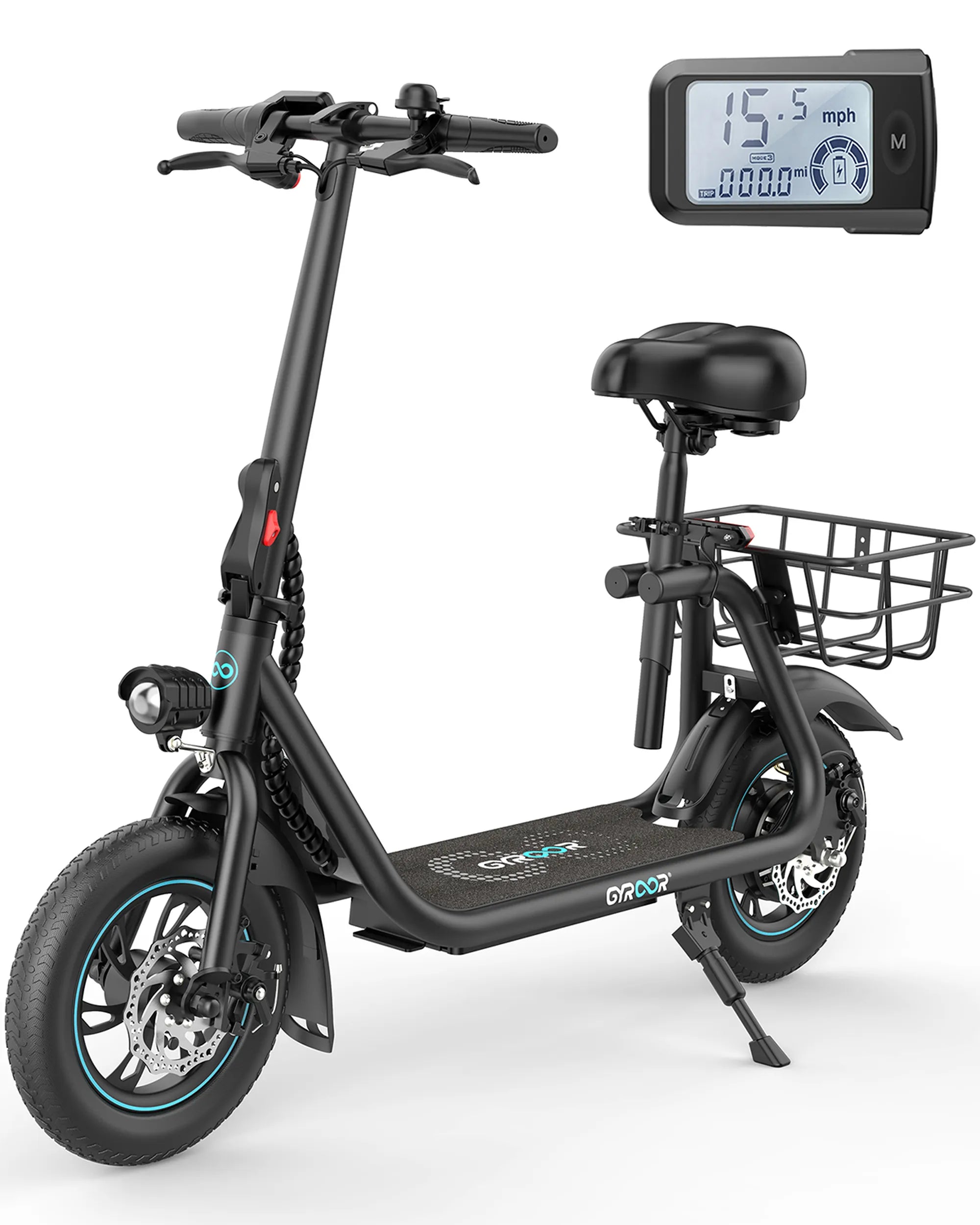
Introduction to the Fat Tire E-Bike Revolution
The fat tire e-bike news cycle is no longer dominated by niche off-road adventures. It's a mainstream story of technological evolution and shifting urban mobility. Sales data and market reports consistently highlight this category as one of the fastest-growing in personal electric transport, driven by a demand for versatility, comfort, and all-weather capability.
This surge represents a fundamental shift in how riders view electric bicycles. They are transitioning from seasonal recreational toys to essential daily tools for commuting, errands, and exploration. The latest fat tire e-bike news reflects this, with innovations focused on reliability, integration, and safety becoming paramount.
As a leading brand trusted by over 100,000 riders across North America and Europe, Gyroor has witnessed this evolution firsthand. The brand's philosophy, centered on UL-certified battery safety, IPX5 water-resistant durability, and a reliable 1-year warranty, aligns directly with the market's mature demands. This article will dissect the key headlines shaping the future of fat tire e-biking.
You will learn about the latest motor and battery advancements, analyze 2024 consumer trends, understand new regulatory landscapes, and discover how forward-thinking engineering is meeting these modern challenges. This is your definitive update on the state of the fat tire e-bike.
Latest Technological Advancements & Innovations
The most exciting fat tire e-bike news often originates on the engineering bench. Recent advancements are making these bikes more powerful, smarter, and significantly more capable than models from just a few years ago. The focus has moved beyond raw power to intelligent power delivery and seamless user experience.
Innovations in frame materials, like advanced aluminum alloys and integrated battery designs, are creating sleeker profiles without sacrificing the rugged aesthetic. Furthermore, component-level news shows a trickle-down of high-end features, such as hydraulic disc brakes and advanced suspension forks, into mid-range models.
This technological push is directly responding to rider feedback. Demands for longer ranges, easier maintenance, and more intuitive controls are driving R&D departments. The result is a new generation of fat tire e-bikes that are not just fun, but profoundly practical and reliable for daily use.
The next wave of fat tire e-bike news will likely involve greater modularity and customization. We are seeing early signs of user-swappable battery packs, configurable motor tuning via apps, and accessory ecosystems that transform a single bike for multiple roles.
The Next Generation of Motor & Battery Systems
Headlines in fat tire e-bike news are dominated by breakthroughs in drive systems. Mid-drive motors, which offer superior torque and balance by leveraging the bike's gears, are becoming more common even in value-oriented models. Their efficiency on hills and varied terrain is a game-changer for utility.
Simultaneously, hub motors are not standing still. New designs feature higher torque ratings and improved heat dissipation, allowing for sustained power output on long climbs or under heavy cargo loads. This addresses a key concern for riders using their bikes for practical hauling tasks.
The most critical fat tire e-bike news, however, revolves around battery technology and safety. The industry is moving decisively towards UL 2849 certification as a baseline standard. Brands like Gyroor lead with UL-certified battery packs tested for 500+ charge cycles, ensuring long-term reliability and mitigating fire risk.
Beyond safety, energy density is improving. News from battery suppliers indicates the arrival of cells that offer longer ranges (often 50+ miles per charge) without increasing the physical size or weight of the pack. Coupled with faster-charging technology, range anxiety is becoming a thing of the past for well-equipped riders.
Smart Integration and Connectivity Features
Connectivity is the new frontier in fat tire e-bike news. The standalone LCD display is evolving into a smart cockpit. Integrated Bluetooth and 4G connectivity are now featured in premium models, enabling a suite of features that enhance security, navigation, and ride tracking.
Anti-theft systems have become a major selling point. New models offer GPS tracking, movement alarms, and remote locking via smartphone apps. If a bike is moved without authorization, the owner receives an instant alert and can track its location in real-time, a powerful deterrent.
Ride analytics are also getting sophisticated. Companion apps now log routes, elevation, calorie expenditure, and motor assist levels. More importantly, they enable over-the-air (OTA) firmware updates. This means a bike's performance, efficiency, and feature set can improve over time without a physical service visit.
This trend towards smart integration signifies the fat tire e-bike's maturation into a connected device. It's no longer just a bicycle with a motor; it's a data-rich platform for urban mobility, offering insights and security that appeal to the tech-savvy commuter.
Market Trends & Consumer Shifts in 2024
Analyzing current fat tire e-bike news reveals clear demographic and behavioral shifts. The typical buyer is no longer solely an adventure seeker. Data shows a rapid increase in purchases by urban professionals, parents, and small business owners who value the bike's practical attributes.
The market is segmenting into distinct categories: rugged off-road machines, sleek urban commuters, and heavy-duty utility/cargo bikes. This specialization allows brands to tailor features more precisely, from gearing and suspension to accessory mounts and integrated lighting.
Another significant trend is the rise of direct-to-consumer (DTC) sales models, which have increased accessibility and lowered prices for premium specs. However, this has also elevated the importance of strong warranty support and accessible service networks, areas where established brands with infrastructure excel.
Consumer expectations are higher than ever. Riders now demand professional-grade assembly services, robust after-sales support, and transparent information on component sourcing and battery safety standards. Trust, built on certifications and proven reliability, is a key market differentiator.
From Seasonal Toy to Year-Round Commuter Solution
Perhaps the most impactful piece of fat tire e-bike news is its redefinition as a year-round vehicle. The wide, high-volume tires provide exceptional stability on wet roads, light snow, and uneven urban terrain like cobblestones or tram tracks, reducing seasonal downtime.
This shift is supported by engineering focused on all-weather durability. Features like IPX5 water resistance—a standard in Gyroor's design philosophy—ensure critical electrical components can withstand rain and road spray. This reliability is essential for someone relying on the bike for daily transportation.
Cities are taking note. As commuter adoption grows, infrastructure news increasingly includes covered bike parking, secure lockers, and even public charging stations tailored for e-bikes. The fat tire e-bike is catalyzing a broader rethink of urban transport micro-infrastructure.
The economic argument is compelling. Compared to the costs of car ownership, insurance, fuel, and parking, a durable fat tire e-bike used year-round offers staggering savings. This practical calculus is driving adoption as much as the fun factor.
The Rise of the "Utility" Fat Tire E-Bike
A dominant thread in recent fat tire e-bike news is the explosion of utility-focused models. These are bikes designed explicitly for work, whether that's delivering groceries, transporting children, or carrying tools to a job site. They represent the functional apex of the category.
Key innovations here include massively reinforced rear racks rated for 100+ lbs, integrated wheel skirts to protect cargo from spray, and extended wheelbases for stability under load. Some models feature dual battery systems to ensure ample range even when fully laden.
The family market is also expanding. News highlights models with long rear decks and integrated footrests for child passengers, or those compatible with heavy-duty child trailers. The stability of the fat tire platform makes it a naturally secure choice for carrying precious cargo.
This trend underscores the fat tire e-bike's transformation into a legitimate car replacement for many local trips. It's not just about recreation; it's about redefining errands, school runs, and small-scale logistics with a zero-emission, agile, and cost-effective vehicle.
Regulatory & Infrastructure Updates Impacting Riders
The regulatory landscape for fat tire e-bikes is dynamic and varies significantly by region. Staying informed on this aspect of the news is crucial for legal and safe riding. In the United States, the three-class system (Class 1, 2, 3) remains the federal framework, but local interpretations differ.
Recent news includes cities and states clarifying where each class of e-bike is permitted. Some trails explicitly allow Class 1 (pedal-assist only) bikes but prohibit Class 2 (throttle-assisted) models. Understanding your bike's classification and local trail designations is essential to avoid fines.
Infrastructure development is positive fat tire e-bike news. Municipalities are accelerating the construction of protected bike lanes, which are ideal for the stable, confident ride of a fat tire bike. Some cities are piloting e-bike purchase incentive programs or subsidies to encourage adoption.
However, challenges remain. Discussions around mandatory insurance, licensing, or helmet laws for higher-speed Class 3 e-bikes are ongoing in several jurisdictions. Riders should proactively check their local department of transportation or parks website for the most current rules.
Gyroor's Forward-Looking Approach in the Fat Tire Segment
In a market flooded with new entrants, Gyroor's strategy, evident in recent product news, is defined by a commitment to foundational quality rather than chasing fleeting specs. With a community of over 100,000 riders, the brand's focus is on building trust through safety, durability, and support.
This approach directly addresses the concerns highlighted in broader fat tire e-bike news: battery safety incidents, waterproofing failures, and inadequate post-purchase service. Gyroor's core USPs are engineered responses to these very real market pain points.
Looking ahead, Gyroor's development pipeline is influenced by the trends of utility and year-round commuting. Future models are expected to further integrate the rugged, dependable DNA of their current lineup with the connectivity and versatility demanded by the modern, multi-use rider.
The goal is not to create the most powerful or the cheapest bike, but the most reliably capable one. This philosophy ensures that a Gyroor fat tire e-bike is a long-term investment, not a disposable gadget, perfectly aligned with the market's maturation.
Engineering for Safety and Durability as Standard
For Gyroor, safety is not a headline; it's the first line in the specification sheet. Every model utilizes UL-certified battery packs. This certification involves rigorous testing for electrical, mechanical, and environmental safety, providing peace of mind that is now a non-negotiable for informed buyers.
Durability is engineered into the frame and components. The IPX5 water-resistant rating across critical electrical systems is a testament to this. It means the bike can handle heavy rain and daily wash-downs, a necessity for a true all-weather commuter or trail explorer.
This commitment is backed by a clear and reliable 1-year comprehensive warranty. It's a promise of support that allows riders to invest with confidence, knowing the brand stands behind the product's construction and performance in real-world conditions.
In an era of fat tire e-bike news occasionally marred by safety recalls, Gyroor's preemptive, standards-based approach offers a model of responsible manufacturing. It sets a benchmark that the entire industry should aspire to meet.
Anticipating the Needs of the Modern Rider
Gyroor's design process is deeply informed by rider feedback and market analysis. Understanding that the modern rider uses one bike for multiple purposes—city streets, park paths, light trails—guides the creation of versatile platforms.
This means prioritizing a balanced geometry that is stable at speed yet maneuverable in traffic. It involves selecting tire compounds that offer a smooth roll on pavement but enough grip for gravel or hard-packed dirt. It's about creating a genuine do-it-all machine.
Furthermore, anticipating needs means building a support ecosystem. Gyroor's US-based service network and readily available replacement parts ensure that maintenance and repairs are straightforward, maximizing uptime for the rider.
By focusing on the holistic experience—from unboxing and assembly to daily riding and long-term ownership—Gyroor ensures its fat tire e-bikes seamlessly integrate into the rider's life, fulfilling the promise of freedom and utility that drives the entire category.
Fat Tire E-Bike Comparison: Key Models & Specs for 2024
When evaluating the latest fat tire e-bike news and models, comparing key specifications is essential. The table below highlights critical differentiators to consider, focusing on the aspects that impact real-world performance, safety, and ownership experience.
| Feature / Consideration | Entry-Level / Budget Models | Mid-Range / Versatile Models (e.g., Gyroor Focus) | High-End / Performance Models |
|---|---|---|---|
| Motor Type & Power | Rear hub, 500W-750W, basic torque | High-torque hub or entry mid-drive, 750W-1000W, better hill performance | Advanced mid-drive, 250W-750W (EU) / 1000W+ (US), optimized power delivery |
| Battery & Safety | Generic pack, often lacking UL certification, ~10Ah capacity | UL-certified battery (Gyroor standard), 15Ah+ capacity, 500+ cycle life | Premium UL-certified pack, high energy density, 20Ah+ capacity, smart BMS |
| Water & Dust Resistance | Basic sealing, not rated for heavy rain | IPX5-rated critical components, built for all-weather use | Full IP rating (e.g., IP65), submersible connectors, professional-grade |
| Frame & Build Quality | Heavier, less refined welding, standard aluminum | Robust 6061 aluminum, reinforced stress points, integrated design | Lightweight alloy or carbon, hydroformed tubes, custom geometry |
| Warranty & Support | 90 days to 1 year, limited parts coverage, offshore support | Comprehensive 1-year warranty, US-based service network, part availability | 2+ year warranty, concierge service, extensive dealer network |
| Primary Use Case | Occasional recreation, flat terrain | Daily commuting, light trail, all-season utility, cargo capable | Serious trail riding, long-distance touring, performance commuting |
Frequently Asked Questions (FAQ)
Q1: With new models constantly launching, what are the key specs I should prioritize in a 2024 fat tire e-bike?
Prioritize safety and durability specs first: a UL-certified battery is non-negotiable for fire safety. Next, look for a clear water resistance rating (IPX5 or higher) for all-weather reliability. Then, consider motor torque (Nm) for hill climbing, battery capacity (Ah) for range, and the quality of brakes (hydraulic disc preferred). Finally, assess the warranty terms and the brand's reputation for customer support.
Q2: I've seen news reports about e-bike battery fires. How can I ensure I'm buying a safe bike?
Always verify that the battery pack is certified to a recognized safety standard, most commonly UL 2849 (system standard) or UL 2271 (battery cell standard). Reputable brands like Gyroor prominently advertise this certification. Avoid no-name batteries or incredibly cheap bikes, as they often cut corners on battery management systems (BMS) and cell quality. Use only the manufacturer-provided charger.
Q3: Are there any new laws I should be aware of before riding my fat tire e-bike on city streets or public trails?
Laws are localized. First, know your e-bike's class (1, 2, or 3). Most cities allow all classes on streets, but many natural surface trails restrict use to Class 1 (pedal-assist only, no throttle) bikes. Some jurisdictions require helmets for all riders, others only for Class 3 or minors. Always check your specific city and county ordinances, as well as trailhead signage, for the most current rules.
Q4: How does the fat tire design specifically benefit riding in urban environments compared to standard e-bike tires?
Fat tires (typically 3.8" to 4.8" wide) provide a larger contact patch, offering superior stability and traction on imperfect surfaces like potholes, cracked pavement, wet metal grates, and streetcar tracks. They absorb vibrations better, leading to a more comfortable ride over long distances. The lower tire pressure also provides a degree of natural suspension, reducing fatigue on your body from constant urban impacts.
Q5: Can a fat tire e-bike truly replace a car for daily needs?
For many urban and suburban residents, yes, for a significant portion of trips. With cargo racks (often rated for 100+ lbs), panniers, or a trailer, a fat tire e-bike can handle grocery runs, school drop-offs, and commutes under 15-20 miles. The stability and all-weather capability make it a practical choice. The key is investing in a reliable, well-built model with good range, waterproofing, and storage solutions to match your specific needs.
Conclusion: The Evolving Landscape of Fat Tire E-Biking
The fat tire e-bike news landscape tells a story of rapid maturation. The category has evolved from a novel off-roader to a sophisticated, multi-faceted solution for modern transportation challenges. Technological innovation in motors, batteries, and connectivity is delivering smarter, safer, and more capable machines.
Market trends clearly show riders embracing these bikes for practical, daily utility—as commuters, cargo haulers, and family vehicles. This shift is supported by, and in turn drives, improvements in urban infrastructure and a clarifying regulatory framework. The fat tire e-bike is now a permanent and growing part of the mobility ecosystem.
Navigating this exciting market requires an informed approach. The most compelling news is not always about the highest wattage or the lowest price. The real story is in the foundational elements: verified battery safety, proven weather-resistant durability, and dependable warranty support. These are the factors that ensure long-term satisfaction and value.
As you explore the possibilities, prioritize brands that engineer these principles into their core. Discover a range of e-bikes built with the safety standards and rugged reliability that today's news proves riders demand. Browse the full Gyroor collection at gyroorboard.com to find a fat tire e-bike designed not just for the headlines, but for the miles ahead.
How Much Is an Adult Tricycle? A 2024 Price & Value Guide
e bike 600 dollars: A Realistic Guide to Value, Safety, and Smart Buying