

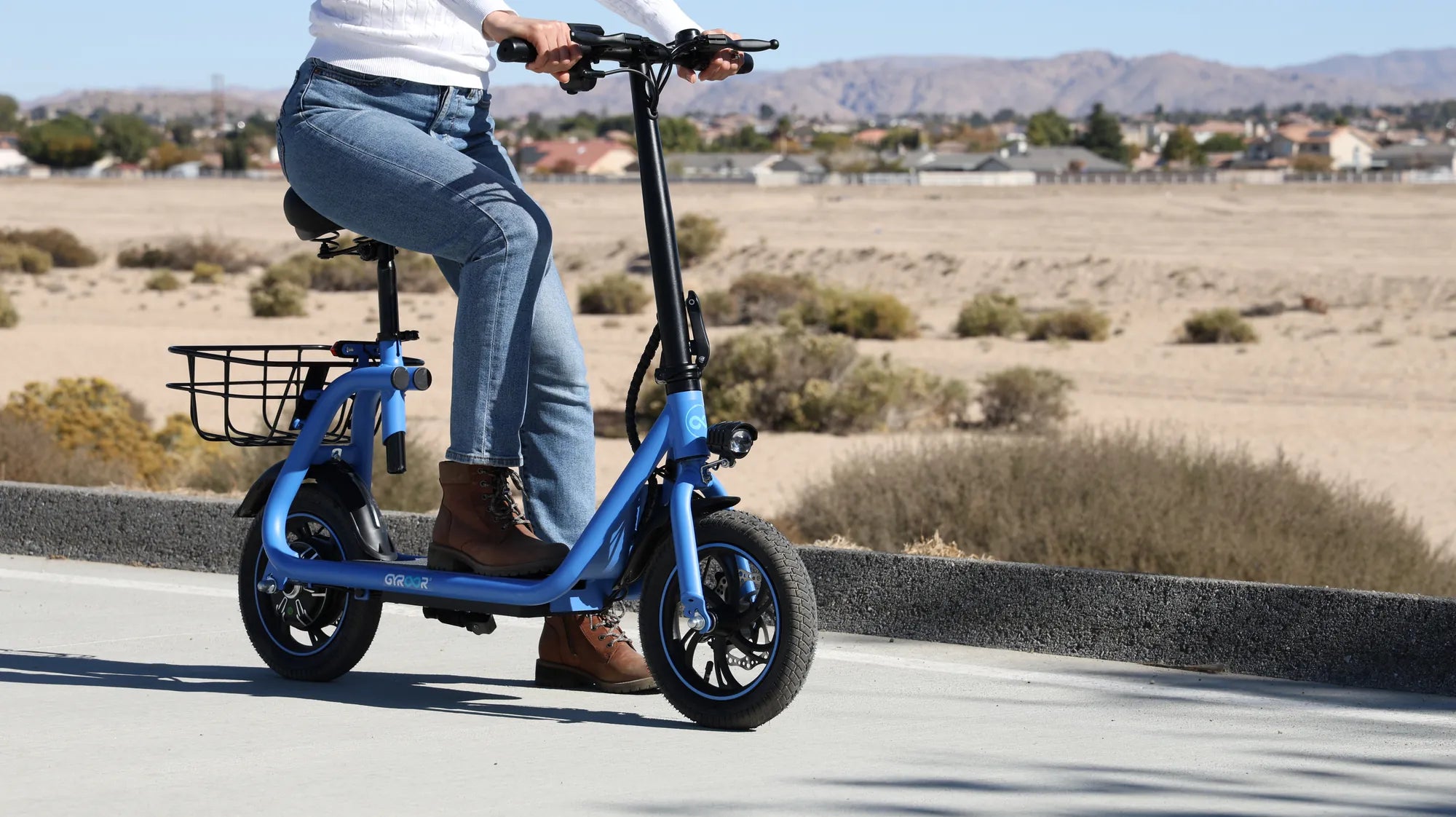
Introduction to Lite Mobility Scooters
A lite mobility scooter represents the pinnacle of efficient urban personal transport. This category is defined by lightweight, often foldable electric scooters engineered for portability, convenience, and navigating dense cityscapes. Unlike bulkier models, a true lite mobility scooter prioritizes a balance of adequate performance with minimal footprint, making it ideal for the 'last mile' of a commute or quick urban errands.
The core appeal lies in transforming short trips. For many, the choice between a 25-minute walk, a costly rideshare, or waiting for a bus is replaced by a swift, 8-minute glide on a lite mobility scooter. This guide will dissect every aspect of these vehicles, from their tangible benefits to the critical technical specifications that separate a quality investment from a subpar product.
Brands that excel in this space, like Gyroor, understand that 'lite' must not mean 'compromised.' With over 100,000 riders trusting their products across North America and Europe, Gyroor builds lite mobility scooters that combine portability with robust, UL-certified safety features and durable construction. We will explore what makes a superior model and how to select the perfect scooter for your needs.
Why Choose a Lite Mobility Scooter? Key Benefits
Adopting a lite mobility scooter is a strategic decision for modern urban living. The benefits extend far beyond simple novelty, offering practical solutions to common daily challenges. These scooters provide a unique blend of independence, efficiency, and environmental consciousness that is hard to match with other modes of transport for short-distance travel.
The primary advantage is time reclamation. City dwellers often lose hours each week to traffic congestion or waiting for transit. A lite mobility scooter operates on your schedule, taking direct routes often inaccessible to cars. This autonomy can shave significant time off daily commutes, especially for distances between one and five miles.
From a financial perspective, the economics are compelling. After the initial purchase, the operating cost is remarkably low—often just pennies per charge. This presents substantial savings compared to daily rideshare fees, parking costs, or even monthly public transit passes. The scooter becomes a one-time investment that pays for itself over time.
Furthermore, the environmental impact is minimal. Electric scooters produce zero direct emissions, contributing to cleaner air and reduced urban noise pollution. For the eco-conscious commuter, choosing a scooter over a car for short trips is a tangible way to reduce one's carbon footprint. The collective effect of many riders making this switch can be significant for city sustainability goals.
Enhanced Portability and Storage
The defining characteristic of a lite mobility scooter is its portability. A quality model typically weighs between 25 and 35 pounds and features a one-step folding mechanism. This transforms it from a rideable vehicle into a compact package in seconds, solving the critical 'last-foot' problem of personal mobility.
This portability unlocks true multi-modal commuting. You can ride to the bus or train station, fold your scooter, carry it aboard effortlessly, and then unfold it to complete your journey from the transit stop to your final destination. This seamless integration makes a lite mobility scooter the ultimate connector in a fragmented urban transport network.
For storage, the advantages are equally clear. Apartment dwellers and office workers can tuck a folded scooter under a desk, in a closet, or beside a couch without it dominating the space. This eliminates the security and logistical headaches associated with locking a bike or scooter outside, providing peace of mind that your vehicle is safe.
Gyroor's designs emphasize this practicality. Their lite models feature reinforced but lightweight aluminum frames and intuitive folding latches, ensuring the scooter is not only easy to carry but also robust when unfolded for riding. This balance is essential for daily reliability.
Perfect for Urban Navigation
Urban environments demand agility, and lite mobility scooters deliver. Their narrow profile and tight turning radius allow riders to navigate crowded bike lanes, weave through stalled traffic safely, and traverse pedestrian zones where appropriate and legal. This agility makes them faster than cars for many inner-city trips.
Parking becomes a non-issue. Rather than circling blocks searching for a metered spot or expensive garage, a scooter rider can simply fold their vehicle and walk inside. This convenience is transformative for running errands, meeting friends, or commuting to work where parking is limited or costly.
The ability to use a mix of infrastructure—from dedicated bike paths to quiet residential streets—gives the rider route flexibility. If one path is blocked or congested, alternatives are readily available. This adaptability makes for a more predictable and less stressful commute compared to being locked into a single traffic-choked road.
However, responsible navigation is key. Riders must be aware of and adhere to local laws, which often designate scooters for bike lanes or streets, not sidewalks. Understanding and respecting these rules ensures safety for both the rider and pedestrians, fostering positive integration into the urban fabric.
Eco-Conscious and Cost-Effective Commuting
The financial and environmental calculus for a lite mobility scooter is overwhelmingly positive. On the cost front, the energy required to charge a scooter's battery is minuscule. Assuming an average electricity cost, a full charge for a 20-mile range scooter typically costs less than 10 cents. This results in a cost per mile that is a fraction of any motorized alternative.
When compared to the recurring costs of car ownership (fuel, insurance, maintenance, parking) or even consistent use of ride-sharing apps, the scooter's payback period can be surprisingly short. For many, the savings on a few months of parking or ride-shares alone can justify the investment in a quality scooter.
Environmentally, the benefits are direct. Electric scooters use energy from the grid, which is increasingly powered by renewable sources. Even on a fossil-fuel-heavy grid, the small amount of electricity used and the lack of tailpipe emissions make scooters a cleaner option per passenger mile than single-occupancy vehicles. They also reduce traffic congestion, which lowers emissions from idling cars.
Choosing a scooter from a brand committed to durability, like Gyroor, amplifies these benefits. A longer-lasting product means less electronic waste and a lower overall environmental footprint over the product's lifecycle, aligning personal convenience with broader ecological responsibility.
What to Look for in a Quality Lite Scooter: A Buyer's Guide
Selecting the right lite mobility scooter requires moving beyond marketing claims to evaluate hard specifications and build quality. A discerning buyer should treat this purchase as an investment in a daily-use vehicle, where safety, reliability, and performance are paramount. This guide outlines the critical factors that separate a dependable scooter from a disappointing one.
First, establish your primary use case. Is it for a two-mile daily commute, weekend leisure rides, or multi-modal travel? Your answer will determine the necessary range, weight tolerance, and desired features. A commuter who must carry the scooter up stairs will prioritize weight over a rider who only needs to roll it into an elevator.
Second, set a realistic budget. While tempting, extremely low-priced scooters often cut corners on safety-critical components like the battery and brakes. Investing in a model from a reputable brand with proven safety certifications is non-negotiable for peace of mind and long-term value.
Finally, research the brand's support ecosystem. A comprehensive warranty and accessible customer service are indicators of a company that stands behind its products. This support is invaluable if you encounter any issues, ensuring your scooter remains a reliable asset rather than a source of frustration.
Safety and Certification: Non-Negotiables
Safety is the most critical factor in choosing a lite mobility scooter. The components demanding the most scrutiny are the battery, braking system, and lighting. Compromising on any of these can have serious consequences, making certification and quality design essential.
The lithium-ion battery pack is the heart of the scooter and its greatest potential hazard if poorly made. A UL-certified battery, like those used in all Gyroor scooters, has undergone rigorous independent testing for electrical, mechanical, and fire safety. This certification is your assurance that the battery is designed to prevent overheating, short-circuiting, and other failure modes. Never purchase a scooter with an uncertified battery.
Braking performance is equally vital for urban riding where sudden stops may be necessary. Look for a dual-braking system, such as a combination of an electronic (regenerative) brake and a mechanical disc or drum brake. This provides redundancy; if one system fails, the other can still bring you to a safe stop. Test the braking feel and stopping distance in a safe area when you first ride.
Visibility is a key component of safety. Your scooter must have a bright front headlight (preferably with multiple modes, including a steady beam) and a solid rear brake light. Reflective stickers or side lighting further enhance visibility to drivers at night. These features are not optional for any rider who plans to commute during dawn, dusk, or after dark.
Performance Specs: Balancing Power with Portability
Understanding performance specifications allows you to match a scooter's capabilities to your needs. The key metrics are motor power, speed, range, and weight. For a lite mobility scooter, the art is finding the optimal balance where performance meets portability without excess bulk.
Motor wattage, typically between 250W and 350W for lite models, determines acceleration and hill-climbing ability. A 250W motor is sufficient for flat to moderately sloped terrain, while a 350W motor provides more confident acceleration and better performance on hills. Consider your local topography when evaluating this spec.
Top speed is usually governed between 15 and 20 mph for safety and legal compliance. This range is ideal for urban environments, matching the pace of bicycle traffic. Real-world range is perhaps the most variable spec. A manufacturer's claimed range is often based on ideal conditions (light rider, flat ground, slow speed). For accurate planning, assume a real-world range of 60-70% of the claimed maximum, especially if your route includes hills or you ride at top speed.
Weight is the counterbalance to performance. More powerful motors and larger batteries for longer range add weight. A sweet spot for a portable yet capable commuter lite mobility scooter is between 28 and 33 pounds. This weight is manageable for most adults to carry up a flight of stairs or through a train station for short distances.
Build Quality and Durability for Daily Use
A lite mobility scooter must withstand the rigors of daily commuting, which means build quality cannot be an afterthought. The frame, water resistance, and tires are the primary elements that determine long-term durability and reliability, ensuring your scooter remains a dependable tool for years.
The frame material is foundational. Aerospace-grade aluminum alloy is the industry standard for high-quality lite scooters. It provides an excellent strength-to-weight ratio, resisting flex and fatigue while keeping the overall weight down. The welding and finishing on the frame should be smooth and consistent, with no sharp edges or visible defects.
Water resistance is crucial for all-weather readiness. An IP rating indicates protection against solids and liquids. For urban commuting, an IPX4 rating (protection against splashing water) is a minimum, but an IPX5 rating (protection against water jets from any direction) is far superior. Gyroor's IPX5-rated scooters, for example, can confidently handle wet roads and light rain, preventing water damage to electrical components and extending the scooter's lifespan.
Tire choice involves a trade-off. Air-filled (pneumatic) tires provide a smoother ride by absorbing road vibrations and offering better traction, especially on wet surfaces. However, they are susceptible to punctures. Solid (airless) tires eliminate flat tires but can result in a harsher ride. Many riders prefer pneumatic tires for comfort, carrying a small repair kit for emergencies.
Gyroor's Approach to Lite Mobility: Engineering Trust
In a market flooded with options, Gyroor has distinguished itself by engineering lite mobility scooters that prioritize verified safety, real-world durability, and rider confidence. Their approach is built on a foundation of third-party certifications, robust design principles, and comprehensive support, directly addressing the core concerns of informed buyers. This philosophy transforms a scooter from a simple gadget into a reliable transportation solution.
Trust is earned through transparency and adherence to the highest safety standards. Gyroor builds this trust by subjecting its most critical components to independent verification, ensuring that every scooter leaving their facility meets rigorous benchmarks for performance and safety. This commitment provides riders with peace of mind, knowing their vehicle is designed for dependable daily use.
The brand's focus extends beyond the point of sale. By offering a substantial warranty and maintaining accessible customer support, Gyroor demonstrates a long-term commitment to the rider experience. This holistic approach to product lifecycle management is a key differentiator, ensuring that customers are supported throughout their ownership journey.
For over 100,000 riders, this engineered trust has translated into a 4.5/5 average rating. The consistency of positive feedback highlights how Gyroor's core principles—certified safety, water-resistant durability, and reliable support—resonate with users who depend on their scooters for daily mobility. This track record establishes Gyroor as a leader in the responsible lite mobility scooter segment.
UL-Certified Battery Packs: Safety Built-In
The UL certification mark on a Gyroor battery pack is not just a sticker; it is the result of exhaustive testing by Underwriters Laboratories, a global safety science leader. This certification process evaluates the battery's design for electrical, mechanical, and environmental safety, testing for risks like overcharging, short-circuiting, and thermal runaway. For the rider, this means a fundamentally safer energy source powering their scooter.
This certification directly addresses the foremost concern with electric scooters: battery fire risk. Uncertified batteries from unknown manufacturers can use lower-quality cells and lack proper battery management systems (BMS), making them prone to failure. Gyroor's UL-certified packs incorporate high-grade lithium-ion cells and sophisticated BMS that monitor temperature, voltage, and current, providing multiple layers of protection.
The benefits extend to longevity as well. These certified packs are engineered for performance, tested to withstand over 500 charge cycles with minimal capacity degradation. This translates to years of reliable range, protecting your investment and ensuring the scooter remains useful long after purchase. The initial cost increment for this certified safety and longevity offers exceptional long-term value.
When evaluating any lite mobility scooter, the presence of a UL, ETL, or equivalent certification for the battery should be the first checkpoint. It is a clear, objective indicator that the manufacturer has prioritized rider safety over cutting corners. Gyroor's commitment to making this certification standard across its lineup sets a benchmark for the industry.
Built for the Real World: IPX5 Water Resistance
Urban commuting is an all-weather activity. A sudden drizzle or a wet road from morning sprinklers shouldn't strand your scooter or cause expensive damage. This is where an official Ingress Protection (IP) rating becomes a critical feature, and Gyroor's IPX5 rating represents a significant engineering achievement for a lite mobility scooter.
The 'IPX5' designation has a specific meaning: The 'X' indicates the scooter is not rated for dust ingress (though it still has basic protection), and the '5' signifies protection against water jets. In practical terms, an IPX5-rated scooter can withstand water projected by a nozzle (6.3mm) from any direction without harmful effects. This equates to heavy rain, riding through puddles, or even an accidental spray from a hose during cleaning.
This level of protection safeguards the scooter's electrical components—the motor controller, wiring, and display—from moisture-induced corrosion and short circuits. It allows riders to commute with confidence, knowing their vehicle is prepared for real-world conditions. Without a good IP rating, even a light rain can lead to malfunctions, reduced performance, or complete failure.
Gyroor integrates this protection through sealed connectors, gaskets, and careful design of the deck and stem compartments. This attention to detail ensures the lite mobility scooter is not just a fair-weather toy but a legitimate four-season transport tool for many climates, greatly enhancing its utility and reliability as a daily companion.
Peace of Mind: The 1-Year Comprehensive Warranty
A warranty is a manufacturer's promise, and its scope reveals their confidence in their product. Gyroor's standard 1-year comprehensive warranty on all electric scooters provides extensive coverage for the frame, motor, battery, and electronic components. This warranty acts as a safety net, protecting your investment from manufacturing defects and component failures under normal use.
The value of this warranty is twofold. First, it mitigates financial risk. Should a covered issue arise, repair or replacement costs are handled by Gyroor, not the rider. Second, it signals quality. A company would not offer a substantial warranty on a poorly made product, as the repair costs would be unsustainable. This warranty is therefore a strong indicator of the scooter's built-to-last design.
Backing this warranty is accessible, US-based customer support. Having knowledgeable support staff available to troubleshoot issues, process warranty claims, and provide advice is an invaluable resource. It transforms the ownership experience from a solitary endeavor into a supported partnership, ensuring any hurdles are quickly resolved.
For the rider considering a lite mobility scooter, the presence of a robust warranty from a reputable brand is a decisive factor. It transforms the scooter from a disposable commodity into a durable good, ensuring that the benefits of efficient, eco-friendly mobility can be enjoyed reliably for the long term.
Lite Mobility Scooter Comparison Table
The following table compares key specifications for different types of lite mobility scooters, illustrating how features align with specific user needs and priorities. This data-driven overview helps clarify the trade-offs between ultra-portable, balanced, and extended-range models.
| Feature / Scooter Type | Ultra-Portable (Sub-30 lbs) | Balanced Commuter (30-35 lbs) | Extended-Range Lite (35-40 lbs) |
|---|---|---|---|
| Ideal Use Case | Multi-modal transit, last-mile, carrying upstairs frequently | Daily urban commute (3-7 miles), mixed terrain | Longer commutes (8-15 miles), fewer carries |
| Typical Motor Power | 250W - 300W | 300W - 350W | 350W |
| Real-World Range | 8 - 12 miles | 12 - 18 miles | 18 - 25 miles |
| Max Speed | 15 - 18 mph | 18 - 20 mph | 19 - 20 mph |
| Key Trade-off | Sacrifices some range/power for minimal weight | Optimal balance of performance and portability | Added weight for significantly longer range |
| Critical Feature | One-step folding, sub-30 lb weight | UL battery, IPX5 rating, dual brakes | Larger capacity UL battery, robust suspension |
Lite Mobility Scooter FAQs
How far can a typical lite mobility scooter go on one charge?
Real-world range varies based on rider weight, terrain, speed, and temperature. A balanced commuter lite mobility scooter with a stated 20-mile range will typically achieve 12-16 miles in real-world urban conditions. For accurate planning, assume 60-70% of the manufacturer's ideal test range. Always check the battery capacity (in Watt-hours) for a more reliable comparison between models.
Are they legal to ride on bike paths and city streets?
Laws vary significantly by city, state, and country. Generally, electric scooters are permitted in bicycle lanes and on streets with speed limits at or below 25-35 mph. They are often prohibited on sidewalks. Most jurisdictions require riders to be a certain age (often 16+), and some have speed limits (e.g., 15 mph on bike paths). It is the rider's responsibility to check and comply with all local regulations before riding.
How heavy are they, and are they easy to carry?
A true lite mobility scooter weighs between 25 and 35 pounds. Models at the lower end (25-28 lbs) are quite easy to carry for short distances, like up a flight of stairs or through a subway station. Those closer to 35 lbs are more manageable to roll or carry for very short stretches. The folding mechanism's design greatly impacts ease of carrying; a compact, balanced fold is key.
Can I ride a lite mobility scooter in the rain?
You can ride in light rain and on wet roads if your scooter has a sufficient water resistance rating. An IPX4 rating offers basic splash protection, but an IPX5 rating (like Gyroor models) is recommended for reliable operation in rain. Avoid deep puddles and heavy downpours, and always dry your scooter after a wet ride. Never ride through flooded areas.
What maintenance is required for a lite mobility scooter?
Regular maintenance is minimal but crucial. Key tasks include: checking tire pressure monthly (for pneumatic tires), ensuring all bolts (especially on the stem and folding mechanism) are tight, cleaning the scooter with a damp cloth (avoiding direct water jets on non-IPX5 models), and storing the battery between 20-80% charge if not using the scooter for extended periods. Periodically inspect the brakes for wear.
The Smarter Way to Commute
The lite mobility scooter has evolved from a niche gadget into a legitimate, efficient tool for modern urban living. It solves tangible problems: traffic congestion, high transportation costs, and the environmental impact of short car trips. By choosing a scooter, you reclaim time, save money, and contribute to a cleaner urban environment, all while enjoying the freedom of personal, on-demand mobility.
However, not all scooters are created equal. The joy and utility of this form of transport are directly tied to the safety, durability, and reliability of the vehicle itself. Investing in a model from a reputable brand that prioritizes certified safety components, weather-resistant construction, and strong customer support is not an extra cost—it is the foundation of a positive, long-term ownership experience.
Brands like Gyroor have set a standard in the lite mobility scooter category by engineering trust into every product. From the UL-certified battery that ensures safe operation to the IPX5 rating that prepares you for real-world weather, these features transform a simple scooter into a dependable daily companion. The comprehensive warranty further secures your investment, allowing you to ride with confidence.
Ready to transform your daily commute and experience the freedom of efficient urban travel? Explore a range of high-performance, safety-focused models engineered for the real world. Browse the full Gyroor collection at gyroorboard.com to find the perfect lite mobility scooter for your journey.
What's a Class 1 E-Bike? The Complete Legal & Technical Guide
How Tall is a 250cc Dirt Bike in Feet? The Complete 2024 Guide