



Introduction: Why Seated Electric Scooters Are Redefining Urban Commutes
The search for efficient, comfortable, and sustainable personal transportation has led to a significant evolution in electric scooters. For commuters, delivery riders, or anyone covering distances beyond a quick errand, standing for the entire journey can lead to fatigue and discomfort. This is where the category of the best electric scooters with seats emerges as a game-changer, seamlessly blending the agility of a traditional scooter with the ergonomic benefits of a seated position.
These models represent a deliberate shift towards vehicles designed for serious, practical use rather than last-mile novelty. By integrating a seat, manufacturers acknowledge that riders demand comfort for longer trips, enhanced stability in varied traffic conditions, and a more car-like riding posture that reduces strain on the legs and back. The result is a vehicle that competes directly with bicycles and public transit for daily commutes.
Our focus is to identify what truly makes for the best electric scooters with seats, examining the engineering and features that deliver on the promise of comfort and convenience combined. This involves scrutinizing motor performance, real-world battery range, build quality, and, crucially, the safety standards that protect your investment. Brands like Gyroor have pioneered this space by engineering scooters with a rider-first philosophy, incorporating UL-certified batteries, robust IPX5 water-resistant designs, and comprehensive warranties trusted by over 100,000 riders.
This guide will equip you with the knowledge to navigate the market, understand key specifications, and choose a scooter that transforms your daily travel from a chore into a genuinely enjoyable experience.
The Unbeatable Advantages of Choosing a Scooter with a Seat
The primary advantage of a seated electric scooter is the dramatic reduction in rider fatigue. Standing for a 20-minute commute requires constant micro-adjustments for balance and engages core and leg muscles continuously. A proper seat allows you to relax your lower body, distributing your weight and making journeys of 30 minutes or more not just possible but pleasant. This transforms the scooter from a short-range gadget into a legitimate primary vehicle for urban travel.
Enhanced stability and safety are equally critical benefits. A seated position naturally lowers the rider's center of gravity, which improves handling, especially during turns and when navigating uneven surfaces. This configuration provides a more planted, confident feel compared to standing scooters, which can feel twitchy at higher speeds. For new riders or those in busy urban environments, this added stability is a significant confidence booster.
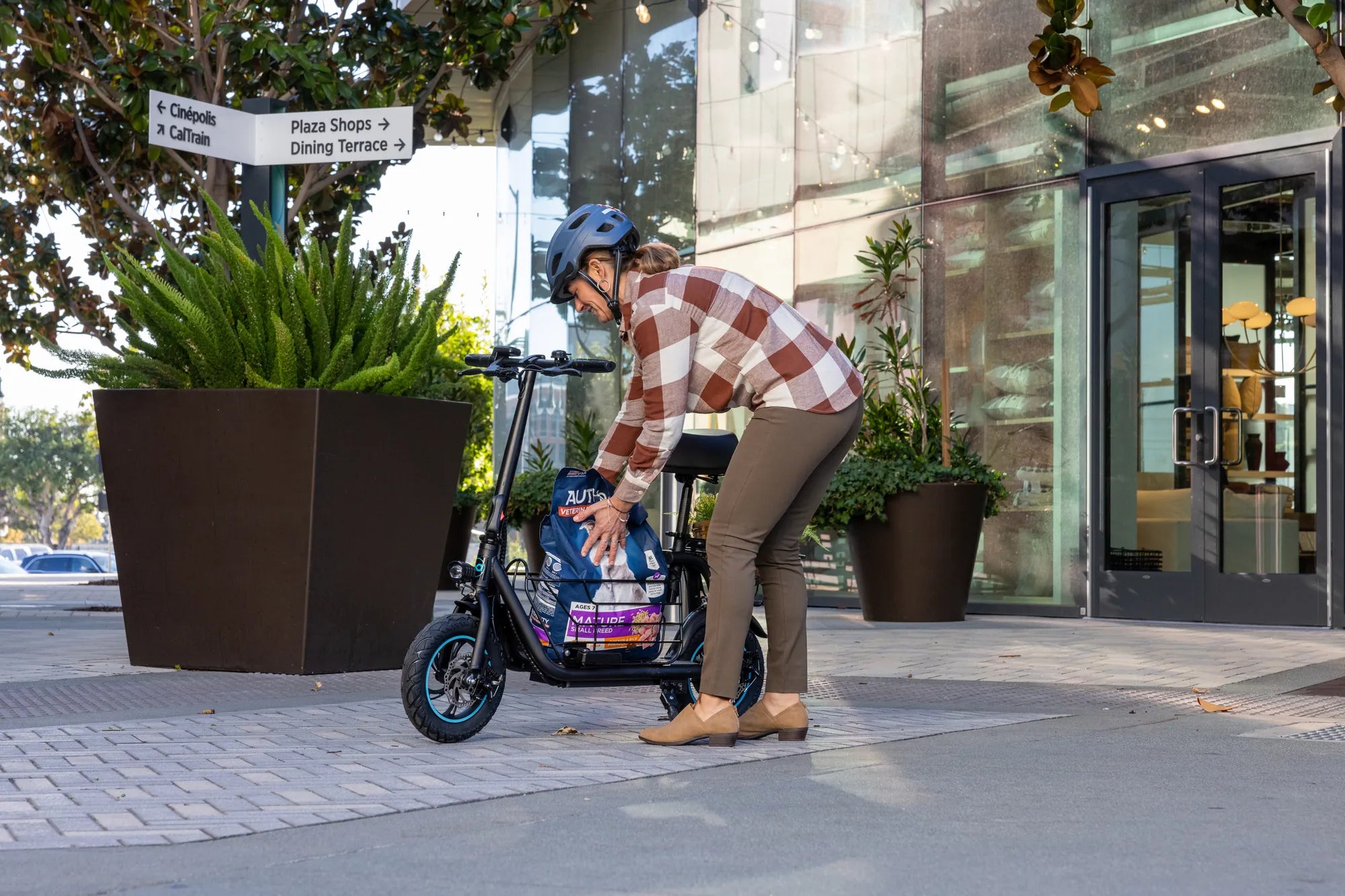
Practicality for cargo and daily use is another major plus. With both feet on a deck and your body supported by a seat, you have a more secure base for carrying a backpack, briefcase, or even grocery bags. Some models come with integrated cargo racks or baskets, further enhancing their utility. This makes seated scooters ideal for commuting to work, running errands, or even for commercial use in delivery services.
Finally, the comfort and convenience combined in these models broaden their user demographic. They are accessible to individuals who may have balance issues, prefer not to stand, or simply want a more leisurely and enjoyable ride. The seated design acknowledges that personal electric vehicles are maturing into legitimate transportation tools, prioritizing user ergonomics for sustained, real-world use.
Key Features to Evaluate in a Seated Electric Scooter
Selecting the right model requires moving beyond marketing claims to understand the specifications that impact daily performance. A great seated scooter is more than just a standing model with a bolt-on seat; it's an integrated system where power, range, construction, and ergonomics are designed to work in harmony from the ground up.
Motor Power & Hill Climbing Ability
Motor wattage is the engine of your scooter, and its importance is magnified when carrying a seated rider. A 350W motor may suffice for flat terrain and lighter riders, but for consistent performance, especially starting from a stop while seated or tackling moderate hills, a 500W or higher motor is recommended. Torque is key here—it determines how quickly the scooter can accelerate and maintain speed on an incline.
Underpowered scooters will struggle on hills, forcing you to dismount or dangerously crawl up. For a true commuter scooter that handles varied urban topography, look for motors in the 500W to 800W range. This ensures you have the power to merge safely with traffic from a stoplight and navigate bridges or overpasses without a significant drop in speed.
Battery Range & Real-World Expectations
Advertised range figures are almost always achieved under ideal laboratory conditions: a light rider, warm weather, flat ground, and slow, constant speed. Real-world range can be 60-70% of the advertised number. Factors that drain battery faster include rider weight, frequent stops and starts, hills, cold temperatures, and use of the throttle at maximum speed.
For a seated commuter scooter, a battery offering a real-world range of 15-25 miles is a practical minimum for most users. This accounts for a round-trip commute with a buffer. Crucially, prioritize scooters with UL-certified battery packs, like those used by Gyroor. This certification is your assurance that the battery has passed rigorous safety tests for electrical, mechanical, and environmental hazards, reducing fire risk and ensuring longevity over 500+ charge cycles.
Build Quality, Weight Capacity, and Portability
The frame must be robust enough to handle the dynamic stresses of seated riding. Look for frames constructed from aerospace-grade aluminum alloy, which offers an excellent strength-to-weight ratio. The scooter's own weight and its maximum load capacity are directly linked. A sturdy commuter scooter might weigh 45-65 lbs and support a rider weight of 220-330 lbs.
Portability involves a trade-off. Heavier, more solidly built scooters are less convenient to carry up stairs but offer a more stable, durable ride. Foldability is a key feature for multi-modal commuters who need to store the scooter under a desk or on public transit. Check the folding mechanism's ease of use and security when locked in the riding position.
Comfort & Ergonomics: Beyond Just a Seat
Comfort is a multi-faceted feature. The seat itself should be well-padded, ideally with memory foam, and offer some degree of height adjustment to fit different leg lengths. A suspension system—whether in the front fork, rear, or both—is arguably as important as the seat. It absorbs vibrations and impacts from cracks and potholes, protecting your spine and making the ride smoother.
Pneumatic (air-filled) tires are superior to solid tires for comfort and traction, as they provide additional cushioning. The deck should be large enough to place your feet comfortably side-by-side. Finally, handlebar height and grip angle should feel natural for a seated riding posture, preventing undue strain on the wrists and shoulders during longer trips.
Safety and Warranty: Your Peace of Mind
Safety features are non-negotiable. Lighting must include a bright front headlight and a rear brake light for visibility. Reflectors on the sides and wheels add another layer of safety. Braking systems are critical; a combination of a front electronic brake and a rear disc brake provides powerful, controlled stopping power.
Weather resistance is vital for a daily driver. An IPX5 rating means the scooter can withstand water jets from any direction, making it safe to ride in rain or through puddles. Finally, a strong warranty reflects the manufacturer's confidence. A comprehensive 1-year warranty on the vehicle, with specific coverage for the battery and motor, is a benchmark for quality, ensuring you have support if any issues arise.
Spotlight on Performance: How Top Models Compare
To understand the market, it's helpful to categorize seated electric scooters by their primary performance profile and intended use case. The following table provides a comparative overview of three distinct segments, highlighting the key specifications and features that define them. This framework allows you to match a scooter's capabilities directly to your commuting needs and budget.
| Category | Urban Commuter Champion | Power & Range Performer | Best Value Proposition |
|---|---|---|---|
| Target Rider | Daily city commuter (5-15 mi round trip) | Long-distance or hilly route commuter | Budget-conscious rider seeking core features |
| Motor Power | 350W - 500W | 500W - 800W+ | 300W - 450W |
| Real-World Range | 15 - 25 miles | 25 - 40+ miles | 12 - 20 miles |
| Key Features | Good suspension, adjustable seat, foldable, IPX5 rating | Dual suspension, dual brakes, premium battery, high load capacity | Removable seat, reliable braking, UL-certified battery |
| Safety/Warranty Benchmark | 1-year warranty, front/rear lights, disc brake | Extended warranty, advanced braking system, superior tires | 1-year warranty, essential lights, proven reliability |
The Urban Commuter Champion
This category represents the sweet spot for most city dwellers. These scooters prioritize a balanced mix of speed (typically capped at 15-20 mph for legality and safety), sufficient range for a typical workday round trip, and essential comfort features. A front or dual suspension system is common to handle urban pavement imperfections.
The seat is often height-adjustable and well-padded, and the scooter almost always features a quick-folding mechanism for easy storage. Build quality is solid, with attention to water resistance (IPX5) for all-weather capability. These models, like several in Gyroor's lineup, are engineered for dependable, daily use without excessive weight or complexity.
The Power & Range Performer
For those with longer commutes, hilly terrain, or a desire for more robust performance, this category delivers. Motors are 500W and above, providing confident acceleration and hill-climbing power. Batteries are larger capacity, enabling extended ranges that can exceed 30 miles in real-world conditions, reducing range anxiety.
Construction is heavier-duty, with stronger frames and higher weight capacities. Dual suspension and hydraulic or dual disc brakes are typical for superior control and comfort at higher speeds. These are premium machines designed for riders who view their scooter as a primary vehicle and are willing to invest in top-tier performance and durability.
The Best Value Proposition
Value-focused models deliver the core experience of a seated electric scooter—comfort and extended range—at a more accessible price. They achieve this by focusing on essential performance: a reliable motor adequate for flat to moderately hilly areas, a battery that provides a usable daily range, and a comfortable, often removable, seat.
They do not typically offer premium features like full suspension or extreme speed, but they should never compromise on fundamental safety. This includes reliable mechanical or disc brakes, proper lighting, and critically, a UL-certified battery pack. These scooters prove that you can find excellent comfort and convenience combined without a premium price tag, provided you verify the build and safety standards.
Maintenance and Safety Tips for Long-Term Reliability
Owning a seated electric scooter is a commitment to proper care. Regular maintenance ensures safety, maximizes performance, and extends the vehicle's lifespan. Start with tire pressure; check pneumatic tires weekly and inflate to the PSI indicated on the sidewall. Proper inflation prevents flats, improves range, and enhances ride comfort.
Brake inspection is crucial. For disc brakes, listen for grinding sounds and check pad wear. For electronic brakes, ensure they engage smoothly and bring the scooter to a controlled stop. Periodically tighten all bolts, especially those on the handlebar, stem, and seat post, as vibrations can loosen them over time. Keep the scooter clean, using a damp cloth to wipe down the frame and deck, avoiding direct high-pressure water sprays on electronic components despite a good IP rating.
Battery care is paramount for longevity. Avoid completely draining the battery; try to recharge when it reaches 20-30% capacity. Use only the manufacturer-provided charger. Store the scooter in a cool, dry place, and avoid leaving it at full charge for extended periods (weeks) if not in use. Adhering to the rated weight capacity is not just a performance tip—it's a safety imperative that protects the frame, motor, and battery from undue stress.
Navigating Legal Regulations and Riding Etiquette
The legality of electric scooters with seats varies significantly by jurisdiction. In many areas, they are classified similarly to standing e-scooters, but local laws may have specific rules regarding maximum speed, motor wattage, helmet requirements, and where they can be ridden (bike lanes vs. roads vs. sidewalks). It is the rider's responsibility to research and comply with local regulations.
Generally, a speed limit of 15-20 mph is common for bike lane use. Always wear a helmet—it's the single most effective safety device. Use hand signals when turning, obey traffic signals, and yield to pedestrians. When riding in bike lanes, maintain a predictable path and be aware of car doors opening. At night, ensure your lights are on and consider adding reflective clothing or accessories. Responsible riding not only keeps you safe but also fosters positive perceptions of this growing mode of transport.
Frequently Asked Questions (FAQs) About Seated E-Scooters
1. Are electric scooters with seats legal?
Legality depends entirely on your local city and state/provincial laws. Many regions treat them under the same rules as standard e-scooters, which often permit them in bike lanes and on roads with speed limits under a certain threshold. Key regulations often focus on maximum speed (e.g., 20 mph), motor power, and whether a helmet is required. Always check your specific local Department of Transportation or city council website for the most current rules.
2. How much weight can a seated scooter hold?
Weight capacities for quality seated scooters typically range from 220 lbs (100 kg) to 330 lbs (150 kg). It is critical to adhere to the manufacturer's stated maximum load. Exceeding this limit stresses the frame, motor, and battery, leading to premature wear, reduced performance, potential failure, and voided warranty. Always factor in your weight plus any cargo you regularly carry.
3. Is it harder to balance on a scooter with a seat?
No, for most adults, it is easier. The seated position lowers your center of gravity significantly, making the scooter feel more stable and planted, especially at cruising speeds and during turns. The seat also provides a fixed reference point, which can increase rider confidence compared to the standing posture, which requires constant active balancing.
4. Can the seat be removed for standing rides?
Many models offer a quick-release or tool-removable seat, providing versatility. This allows you to use the scooter in a traditional standing mode for very short trips or if you need to minimize storage size. Check the product specifications or description for "removable seat" to confirm this feature.
5. How does weather affect a seated electric scooter?
Scooters with a good IP rating (IPX4 or IPX5) are designed to withstand rain and wet roads. However, performance can be affected. Range decreases in cold weather as battery chemistry becomes less efficient. Traction can be reduced on wet leaves or metal surfaces. Avoid deep puddles that could submerge the deck, and always dry the scooter off after a wet ride. Regular maintenance is even more important if you ride frequently in adverse conditions.
6. What is the average lifespan of a seated e-scooter?
With proper care and maintenance, a quality seated electric scooter should provide reliable service for 2-5 years. The battery is often the first component to degrade, typically retaining usable capacity for 2-3 years of daily use (500+ charge cycles). The motor and mechanical parts can last much longer. Build quality, adherence to weight limits, and maintenance habits are the primary factors determining longevity.
Finding Your Perfect Ride
The journey to finding the best electric scooters with seats culminates in aligning engineering with personal need. This is not a purchase of impulse but of investment—in your daily comfort, your time, and your sustainable mobility. The ideal model is the one whose specifications—the motor power for your hills, the real-world range for your commute, the suspension for your city's streets—map directly onto the reality of your life.
Let the benchmarks guide you: UL-certification for battery safety, a meaningful IP rating for weather resistance, a robust warranty for long-term support, and ergonomics designed for seated comfort. These are the pillars of a quality product that will serve you reliably. The market offers clear segments, from the value-conscious commuter to the performance-oriented enthusiast, each delivering on the core promise of comfort and convenience combined.
Your perfect ride is the one that makes your commute something to look forward to, that turns errands into minor adventures, and that redefines what personal urban transport can be. It is a tool for reclaiming time, reducing stress, and moving through your city with a new sense of freedom and practicality.
Ready to explore models that embody these principles? Browse the full Gyroor collection at gyroorboard.com to see how leading engineering, rider-focused design, and unwavering safety standards come together to create exceptional seated electric scooters.
Cheapest Childrens Electric Scooters: Finding Safe, Affordable Fun for Kids
Electric Scooters for 12 Year Olds: A Safe and Fun Way to Ride