



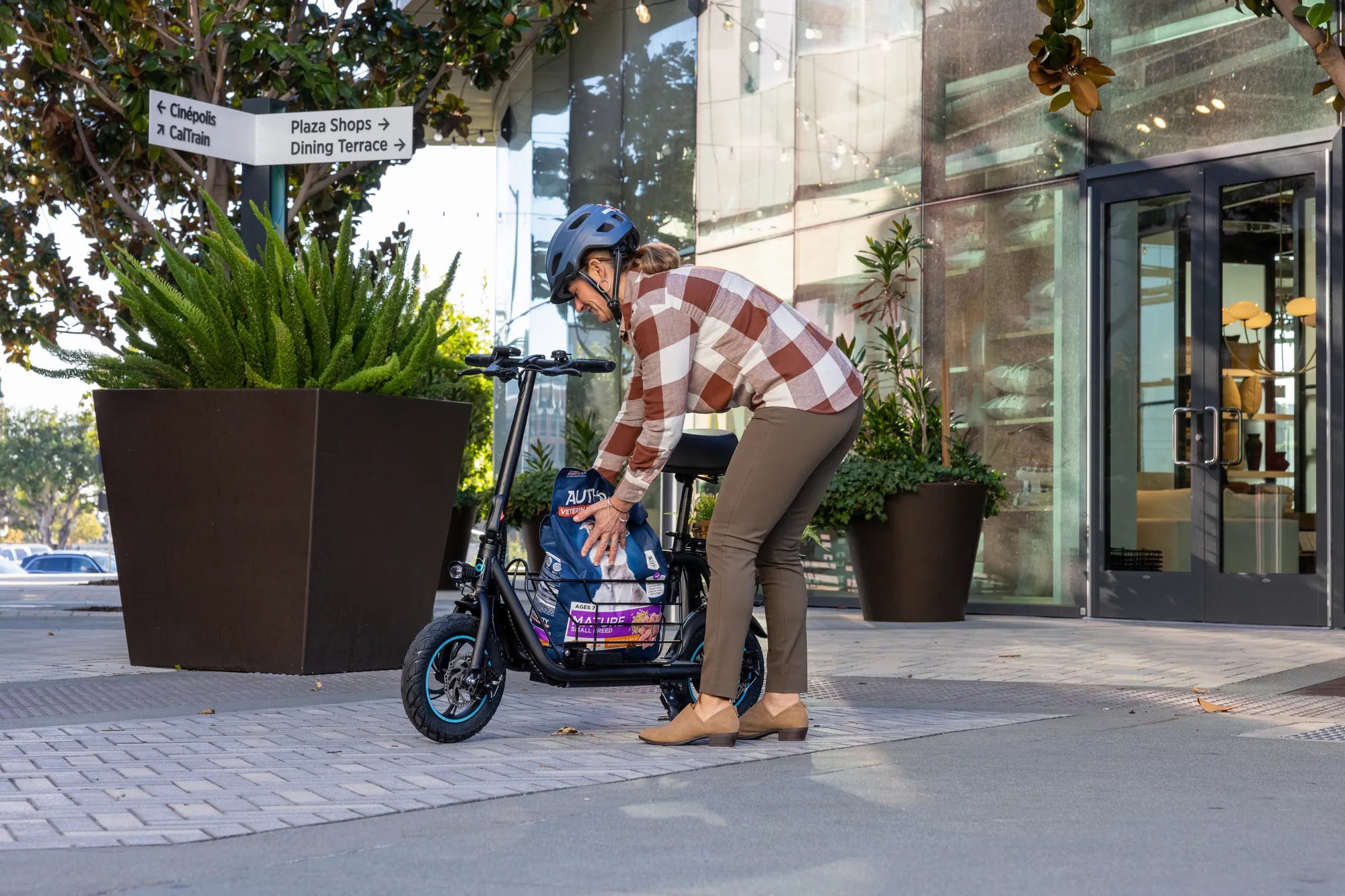
You see the ads everywhere: brand-new electric scooters for an unbelievably low price, promising freedom and fun for less than a tank of gas. The allure is undeniable, but it raises a critical question: Electric Scooters for $50: Are They Worth the Hype? The short, unequivocal answer is no. This article dismantles the marketing fantasy and provides a data-driven analysis of what you're actually buying, the hidden dangers, and why investing in a certified, reliable scooter from an established brand like Gyroor is the only financially and physically safe choice for personal mobility.
Deconstructing the $50 Electric Scooter: Anatomy of a Compromise
To understand the $50 price point, you must examine the severe engineering and material compromises required to hit it. These are not simply "budget" versions of quality scooters; they are fundamentally different and inferior products.
The heart of any e-scooter is its battery. A $50 model typically uses a battery pack with uncertified, low-quality lithium-ion cells of minimal capacity (often 2.5-4.0 Ah). It lacks proper Battery Management Systems (BMS) for cell balancing and thermal protection. The motor is usually a brushed, low-wattage unit (100-150W) with poor torque, struggling on any incline above a gentle slope.
Construction is almost entirely thin, brittle plastic or the lowest-grade aluminum alloy. Folding mechanisms are flimsy or non-existent. Tires are small (6-8 inch) solid rubber, offering a harsh, unstable ride and poor traction. There is no meaningful suspension. The electronic speed controller (ESC) is rudimentary, leading to jerky acceleration and unreliable braking, which is often just a basic friction pad on the rear tire.
The Performance Reality: Specifications Versus Experience
Advertised specs for these scooters are often exaggerated or measured under ideal laboratory conditions. A claimed 10-mile range might translate to 3-4 miles for an average-weight rider, with rapid voltage sag. The advertised 15 mph top speed may only be achievable downhill with a tailwind.
Real-world performance is characterized by sluggish acceleration, an inability to maintain speed on slight inclines, and a dramatic drop in power as the battery depletes. The ride quality is jarring, and the lack of stability at speed poses a significant tipping hazard, especially during turns or over small cracks in the pavement.
The Hidden Costs: The True Price of a "Bargain"
The initial purchase price is merely the entry fee. The long-term and non-monetary costs of a $50 scooter are where the real expense lies, transforming a seeming bargain into a money pit and a safety liability.
First is the extremely short lifespan. These scooters are not built for durability. Components fail within weeks or months of regular use. A broken plastic latch, a seized motor, or a dead battery pack renders the entire unit useless. There is no customer support line, no warranty claim process, and no available replacement parts. Your $50 investment becomes electronic waste.
Safety as a Liability: The Unquantifiable Risk
The most severe hidden cost is risk to personal safety. The uncertified battery is a fire hazard. According to reports from fire safety authorities, faulty lithium-ion batteries from micromobility devices are a leading cause of urban fires. Without a proper BMS, cells can overcharge, overheat, and enter thermal runaway.
Mechanical failure is equally probable. A sheared bolt on the stem can cause a catastrophic collapse at speed. Poor welding on the frame can snap. Inadequate brakes fail to stop the scooter. These are not hypotheticals; they are common failure points in products built without engineering rigor or quality control.
Safety First: Why Certifications Are Non-Negotiable
In the world of electric mobility, certifications are not mere stickers; they are proof of rigorous independent testing. They are the baseline for responsible manufacturing. For a brand like Gyroor, this is foundational.
UL Certification for the battery pack is paramount. Underwriters Laboratories tests for electrical, mechanical, and environmental safety. A UL-certified battery, like those in all Gyroor models, has undergone hundreds of charge-discharge cycle tests, crush tests, short-circuit tests, and exposure to extreme temperatures to ensure it won't fail dangerously. A $50 scooter's battery has passed no such tests.
IP Ratings for water and dust resistance are equally critical for a vehicle used outdoors. An IPX5 rating, standard on Gyroor commuter scooters, means the unit can withstand low-pressure water jets from any direction. This protects against rain, puddles, and street spray. A $50 scooter typically has no sealing (IPX0), meaning a single puddle or light rain can short-circuit the electronics or corrode connections, leading to immediate failure or a shock hazard.
The Gyroor Value Proposition: Reliability as an Investment
Contrast the $50 proposition with a brand engineered for safety and durability. Gyroor, trusted by over 100,000 riders, builds scooters as reliable transportation tools. The higher initial price is an investment in performance, safety, and longevity.
This investment buys tangible benefits: a UL-certified battery with a real-world range of 15-25 miles per charge; a robust motor (350W-500W) that handles hills and maintains speed; a frame constructed from aircraft-grade aluminum with secure folding mechanisms; and often, features like front and rear suspension, pneumatic tires, and dual braking systems for control and comfort.
Most importantly, it buys peace of mind through a comprehensive 1-year warranty and accessible customer support. If an issue arises, it gets resolved. This transforms the scooter from a disposable toy into a dependable asset for daily commuting or recreation.
Cost-Per-Use Analysis: The Math of Long-Term Value
Let's apply a simple cost-per-use analysis to demonstrate true value. Assume a $50 scooter fails completely after 30 days of light use (15 trips). Its cost-per-trip is ~$3.33, and then it's garbage.
Now, consider a Gyroor commuter scooter at $499. Used for just 2 years (104 weeks) at 3 trips per week, that's 624 trips. The cost-per-trip drops to about $0.80. Over 3-4 years, it plummets further. The Gyroor scooter provides continuous value, while the $50 scooter becomes a net loss after a month. The reliable product is, mathematically, the more economical choice.
Comparison Table: $50 Generic vs. Gyroor Entry-Level Commuter
| Feature | Typical $50 "Bargain" Scooter | Gyroor Entry-Level Commuter Model |
|---|---|---|
| Battery | ~2.5Ah, uncertified cells, no BMS | 7.5Ah+, UL-certified, advanced BMS |
| Motor Power | ~150W Brushed, poor torque | 350W Brushless, reliable hill climb |
| Max Range | 3-5 miles (real-world) | 15-20 miles (real-world) |
| Construction | Thin plastic / low-grade alloy | Aircraft-grade aluminum, robust folding |
| Braking | Rear friction pad only | Disc brake + electronic regenerative brake |
| Water Resistance | None (IPX0) | IPX5 (withstands rain/puddles) |
| Warranty & Support | Virtually non-existent | 1-Year Comprehensive Warranty |
| Long-Term Value | Disposable, high cost-per-use | Durable, low cost-per-use over years |
A Practical Guide: Shopping Smart on a Budget
If your budget is constrained, you can still make a safe and smart purchase by shifting your strategy. The goal is to find the intersection of affordability and minimum viable safety standards.
Your Non-Negotiable Checklist: 1) A brand with a verifiable reputation and customer reviews. 2) Battery certification (UL, CE, or equivalent). 3) A minimum IPX4 water resistance rating. 4) A warranty of at least 90 days. 5) Available customer service channels.
Consider looking at previous-generation or refurbished models from reputable brands. These have been professionally inspected, often come with a warranty, and offer proven technology at a reduced price. Set a realistic budget floor; a new, safe, entry-level electric scooter from a trustworthy company typically starts in the $300-$400 range. This investment safeguards your money and your well-being.
FAQ: Electric Scooters on a Tight Budget
Q: Are there any *actually* good electric scooters near $100?
A: No. The component costs for a safe battery, motor, and frame make a reliable new scooter impossible at this price. Products at this level involve the same severe compromises as $50 models, just with slightly better marketing. Your money is at extreme risk.
Q: What is the single biggest risk with a no-name $50 scooter?
A> The lithium-ion battery pack. Without certification or a proper Battery Management System (BMS), it is prone to overheating, fire, and explosion, especially during or after charging. This risk to life and property far outweighs any perceived savings.
Q: Can I upgrade a cheap scooter with a better battery?
A> It is strongly discouraged. The scooter's electronics (charger, controller) are designed for the specific, low-quality battery. Installing a different battery can create incompatible voltages, cause controller failure, and still present a fire risk if not integrated with a proper BMS. You are essentially building a new scooter on a dangerous foundation.
Q: How does Gyroor support its products compared to budget brands?
A> Gyroor provides dedicated customer support via email and phone, a comprehensive 1-year warranty covering major components, and access to replacement parts. Budget brands typically operate as anonymous storefronts on large marketplaces; once the sale is complete, support vanishes, and you are completely on your own.
Q: Is it worth buying a used scooter instead of a new $50 one?
A> Yes, with major caveats. A used scooter from a reputable brand (with a verifiable model name and history) can be a better value. However, you must thoroughly inspect it, test the battery health, and understand it may have limited or no remaining warranty. It still carries less risk than a new, uncertified ultra-budget model.
Beyond the Hype: Choosing Safe, Sustainable Mobility
The hype surrounding Electric Scooters for $50 is a mirage built on ignorance of engineering and safety standards. These products are not "cheap"; they are dangerously deficient. True value in electric mobility is measured in safe miles traveled, years of reliable service, and the peace of mind that comes from certified components and manufacturer support.
When your personal safety and hard-earned money are on the line, the only rational choice is to invest in a scooter built to last and built to protect you. Brands like Gyroor have built their reputation on this exact principle, offering UL-certified batteries, water-resistant designs, and robust warranties. Don't gamble on a gimmick; invest in a tool that delivers.
Ready to experience the difference that certified safety and reliable performance make? Explore the range of durable, high-value electric scooters and e-bikes engineered for real-world use. Browse the full Gyroor collection at gyroorboard.com and find the ride that’s truly worth the investment.
Are Electric Scooters Legal in NJ? What You Need to Know
Best Electric Scooters for Climbing Hills: Power and Performance for Steep Terrains