



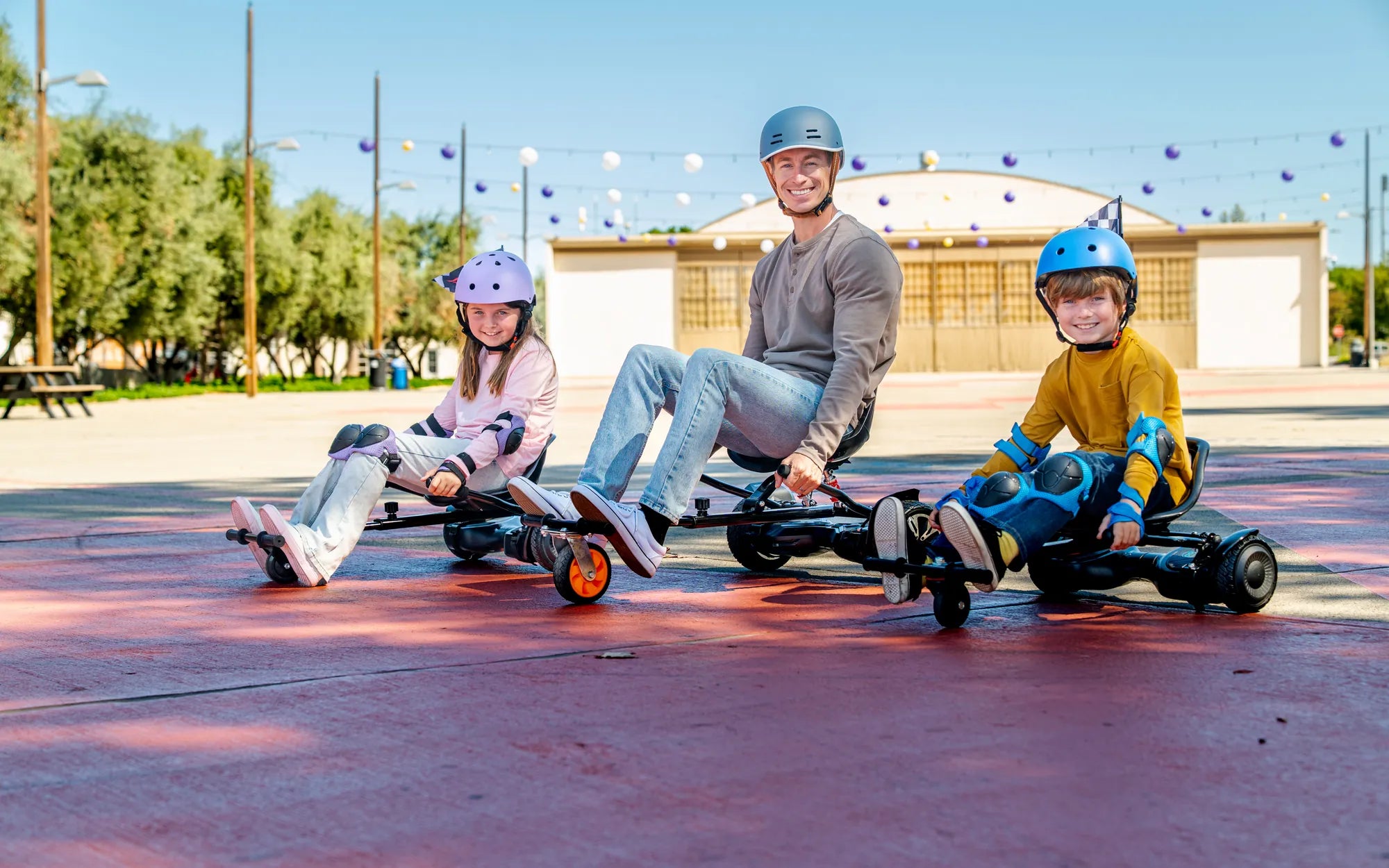
Introduction to Hoverboard Fun: Beyond Basic Riding
A hoverboard is far more than a simple commuting device; it's a versatile platform for creativity, fitness, and pure exhilaration. Mastering fun ways to ride a hoverboard opens up a new dimension of personal expression and skill-based enjoyment. This guide is designed to systematically progress from foundational control to pro-level tricks, ensuring every rider can safely expand their repertoire.
The journey into exciting tricks and tips for beginners and pros begins with the right equipment. A stable, reliable hoverboard from a trusted brand like Gyroor—known for UL-certified batteries, IPX5 water-resistant designs, and robust construction—provides the secure foundation necessary for learning. With over 100,000 riders trusting their technology across North America and Europe, starting with quality gear is the first step toward unlocking lasting fun.
Our exploration will cover everything from mandatory safety protocols to the nuanced body mechanics of advanced spins. We'll break down each trick into learnable components, offer data-driven practice methods, and provide clear comparisons to help you understand your hoverboard's capabilities. The goal is to build not just skill, but also the confidence to explore your own style on two wheels.
Remember, the core of hoverboard fun lies in controlled progression. Rushing into advanced maneuvers without mastering basics is the fastest route to frustration or injury. This guide follows a logical, safety-first curriculum that respects the physics of self-balancing vehicles while encouraging creative exploration. Let's begin by establishing the non-negotiable foundation for all that follows.
Essential Gear and Safety: The Non-Negotiable Foundation
All fun begins with safety. Before attempting any trick, assembling the proper protective equipment is mandatory, not optional. A certified multi-impact helmet is essential, as head injuries are the most serious risk in falls. Wrist guards are equally critical, as instinct leads riders to break falls with their hands, risking fractures or sprains.
Knee and elbow pads complete the core safety ensemble, protecting joints from abrasions and impacts. For those progressing to advanced tricks, consider padded shorts or hip protectors. This gear should be worn every single practice session, regardless of skill level. The statistical reality is that most injuries occur during practice of familiar maneuvers, not when attempting new ones for the first time.
Your practice environment is the second pillar of safety. Seek smooth, flat, open pavement free of cracks, gravel, or debris. Empty parking lots, tennis courts, or smooth bike paths are ideal. The area should be completely away from vehicle traffic and have ample runoff space. Avoid slopes until you have exceptional control, as gravity can quickly amplify speed beyond your braking ability.
The hoverboard itself must be in optimal condition. Check tire pressure (for air-filled models), wheel integrity, and platform grip before each session. Ensure the battery is adequately charged using only the manufacturer's UL-certified charger. Brands like Gyroor build their models with safety as a core feature—their UL-certified battery packs undergo rigorous testing for 500+ charge cycles and are housed in IPX5 water-resistant frames, providing a reliable and secure platform for dynamic riding. Starting with this foundation turns risk management into a routine, freeing you to focus on skill development.
Beginner-Friendly Tricks: Building Confidence and Control
The first fun ways to ride a hoverboard involve mastering the board's basic responsiveness. These foundational tricks build the muscle memory and fine control required for everything that follows. Focus on smooth, deliberate movements rather than speed or flair. Consistency is your benchmark for success at this stage.
Mastering the Basic Spin
The controlled spin is the cornerstone trick. To execute a 180 or 360-degree spin in place, start with your feet parallel near the wheels. Look over your shoulder in your desired spin direction. Apply gentle, sustained pressure with the toes of one foot and the heel of the other to initiate a slow rotation. Keep your arms out for balance and your core engaged.
Practice achieving a full 360-degree rotation without moving from your starting spot. The key is micro-adjustments in foot pressure. This drill dramatically improves your understanding of the board's pivot point and weight transfer mechanics. It's the first step toward making the hoverboard feel like a natural extension of your body, a fundamental skill for all exciting tricks and tips for beginners and pros.
The Smooth "S" Curve (Slaloming)
Slaloming, or weaving in a smooth "S" pattern, is a fundamental agility skill. Set up two markers (like cones or water bottles) about 10 feet apart. Approach at a slow, walking pace. To initiate the first curve, lean your body slightly to one side while applying corresponding foot pressure. As you pass the first marker, transition your lean and pressure to the opposite side to create the "S."
This maneuver teaches you to link turns fluidly and control your momentum. It improves overall board handling and is the prerequisite for navigating obstacle courses. As you improve, reduce the distance between markers to increase the difficulty. This trick is not only a building block but also a genuinely fun way to ride a hoverboard on a path or sidewalk, adding a playful element to any journey.
Controlled Backward Riding
Moving backward confidently unlocks new movement patterns. Start on a flat, open surface. Instead of looking down, turn your head and shoulders to look over your dominant shoulder in the direction you want to travel. Apply gentle, even pressure with your heels to move backward. Start with very short distances—just a few feet.
The instinct is to stiffen up, so consciously relax your knees. Practice alternating between forward and backward movement in a straight line. This drill builds neural pathways for reverse motion and is critical for safety, as it teaches you how to gracefully exit tight spaces. Mastering backward riding is a significant confidence booster and a clear milestone in your progression, demonstrating that you have moved beyond basic transportation.
Intermediate Maneuvers: Adding Style and Fluidity
Intermediate tricks combine foundational skills into more dynamic and stylish movements. Here, the focus shifts from pure control to developing flow and personal expression. These maneuvers are the bridge between basic competence and advanced proficiency, emphasizing the fun in finding fun ways to ride a hoverboard.
The Carving Turn (Surf-Style)
Carving mimics the wide, arcing turns of surfing or snowboarding. On a gentle slope or with slight forward momentum, initiate a turn by leaning your entire body into the direction of the carve. Use your arms for counter-balance—pointing your lead arm where you want to go. Apply sustained, modulated pressure with your toes or heels to hold the turn arc.
The goal is a smooth, continuous curve without skidding or jerking. This maneuver teaches you to use your body English for sharper, more controlled turns and is exceptionally satisfying to execute on a long path. It transforms riding from a simple directional change into a graceful, athletic movement, embodying the exciting tricks and tips for beginners and pros who seek a more immersive experience.
The Pivot Turn (Quick Direction Change)
A pivot turn is a faster, sharper alternative to a basic spin, used for rapid direction changes. While moving slowly forward, sharply press down with the toes of one foot and the heel of the other. This will cause the board to pivot rapidly around its center, allowing you to face a new direction almost instantly. Keep your knees bent to absorb the rotational force.
This trick is highly practical for navigating tight spaces or avoiding obstacles. It relies on a quick, decisive input rather than a sustained pressure. Practice pivoting 90 and 180 degrees. The pivot turn demonstrates advanced control over the board's mechanics and is a key skill for any rider looking to tackle more technical terrain or freestyle routines.
Riding on One Foot
This is a pure balance challenge that significantly improves your overall stability. Begin while stationary on a flat surface. Slightly shift your weight to one foot and slowly lift the other an inch off the pad. Hold for a second, then replace it. Repeat until you can hold for 3-5 seconds comfortably.
Once stable, try gliding forward very slowly on one foot. Use your arms widely for balance. This trick isolates the stabilizing muscles in your standing leg and core, teaching you fine weight distribution. It's a humbling but incredibly effective drill. Success here translates directly to better performance in all other tricks, as it refines your fundamental connection with the board.
Advanced Tricks for Pros: Pushing the Limits
Advanced maneuvers are for riders with excellent control, strong core muscles, and consistent use of full protective gear. These tricks involve higher risk and should first be attempted over soft grass or crash mats. They represent the pinnacle of creative expression in hoverboarding, defining the most exciting tricks and tips for pros.
The 360° Jump Spin
This is a complex trick combining a hop with a mid-air rotation. Start by practicing a small, straight hop on the board to get the feel of the timing. For the full 360°, crouch down, then explode upward while using your shoulders and arms to initiate a strong twisting motion. Tuck your knees up slightly and use your foot pressure to guide the board's spin.
The entire motion must be fluid: crouch, jump, twist, spot your landing, and absorb the impact with bent knees. The board's gyroscopes will re-engage upon landing. This trick stresses the board's frame, so ensuring you have a robust model like those from Gyroor, built to handle dynamic loads, is crucial. Mastery of the 360° jump spin is a major pro milestone.
Riding Backwards in a Circle
This maneuver tests fine motor control and spatial awareness to the extreme. The goal is to maintain a consistent backward circular path. Begin by mastering backward riding in a straight line. Then, on a large open surface, apply slightly more pressure with one heel to initiate a very wide backward circle.
Use your head and shoulders to look and lead in the direction of the circle. The challenge is maintaining a constant radius and speed without wobbling or spinning out. It requires incredibly subtle, continuous adjustments in foot pressure. This trick is less about flash and more about demonstrating supreme, almost subconscious control over the board's movement in its most counter-intuitive direction.
Nose/Tail Manuals (Wheelies)
A manual involves briefly lifting the front (nose manual) or back (tail manual) of the board off the ground. For a nose manual, roll forward at a moderate pace, then quickly and sharply shift your weight backward onto your heels. The front of the board should lift. Immediately counter-balance by leaning forward to prevent flipping over.
The goal is a controlled lift, not a high pop. Start with tiny lifts and focus on the recovery. This trick teaches extreme weight management and is the foundation for more advanced curb tricks. It requires a board with a responsive motor and good center-of-gravity balance. Like all advanced fun ways to ride a hoverboard, it demands respect for the board's physical limits and your own.
Pro Tips for Practice and Progression
Effective practice is strategic, not just repetitive. Adopting a data-driven approach to learning will accelerate your progress and minimize plateaus. These methodologies apply whether you're learning your first spin or perfecting a 360° jump.
Prioritize consistency over duration. Short, focused 15-20 minute daily sessions are far more effective than a single two-hour weekly marathon. This frequency reinforces muscle memory without leading to fatigue-induced mistakes. Use visual markers like chalk, cones, or tape to create precise practice courses. This allows you to measure improvement objectively—e.g., "I can slalom through cones set 6 feet apart now, last week I needed 8 feet."
Analyze failures deliberately. If you bail on a trick, ask why. Was it insufficient speed, late weight transfer, or a lack of commitment? Video recording yourself can provide invaluable feedback. Furthermore, understand your equipment's role. A board's specifications directly impact trick performance. The table below compares key features relevant to trick riding across different vehicle types, highlighting why a well-built hoverboard is uniquely suited for this discipline.
| Feature | Trick-Oriented Hoverboard (e.g., Gyroor Pro Series) | Basic Commuter Hoverboard | Kick Scooter | Electric Skateboard |
|---|---|---|---|---|
| Primary Control Method | Foot Pressure & Lean (Full Body Engagement) | Foot Pressure & Lean | Handlebars & Weight Shift | Hand Remote & Weight Shift |
| Maneuverability for Tricks | Excellent (360° pivot on axis) | Good | Poor (Fixed front wheel) | Good (But speed-dependent) |
| Learning Curve for Tricks | Steep initial, then highly intuitive | Steep initial | Moderate (Balance simpler) | Very Steep (High-speed risk) |
| Typical Weight Limit | 220-265 lbs (Robust frame needed) | 200-220 lbs | 220-250 lbs | 250+ lbs |
| Best for Trick Types | Spins, Carves, Balance Tricks, Low Jumps | Basic Spins, Carving | Jumps, Grinds (with modifications) | High-Speed Carving, Downhill |
Finally, maintain your equipment meticulously. Regularly check for loose screws, clean the footpad sensors with a dry cloth, and ensure tire tread is intact. Gyroor's IPX5 rating allows practice on damp ground, but avoid puddles and heavy rain to protect the electrical systems. This proactive care ensures your board remains a reliable partner in your progression.
FAQ: Hoverboard Tricks and Safety
Q: What is the absolute easiest trick to learn first?
A: The controlled spin or the "S" curve slalom are the best starting points. Both can be practiced at near-zero speed, minimizing risk while building essential control and familiarity with the board's pressure-sensitive steering. Mastering these builds the confidence for forward/backward transitions.
Q: How do I know if my hoverboard is suitable for learning tricks?
A: Look for a robust build quality, good wheel grip (air-filled or high-tread rubber), a responsive motor with adequate torque, and a stated weight limit well above your weight. Models designed for performance, like several in Gyroor's lineup, feature reinforced frames, UL-certified batteries for stable power delivery, and durable shells to withstand the occasional bump or drop during practice.
Q: What should I do the moment I feel I'm about to fall?
A: If a bail is inevitable, try to step or run off the board if at low speed. At higher speeds or during a trick, aim to tuck and roll to disperse the impact energy across your body, rather than bracing stiffly with your arms. This is why wrist guards are non-negotiable—they allow you to slide out without injury.
Q: Can practicing tricks regularly damage my hoverboard?
A: High-impact landings from jumps can stress the frame, axles, and internal components over time. However, normal trick practice—spins, carves, manuals—on appropriate surfaces poses minimal risk to a well-built board. Progressive learning and avoiding abusive impacts are key. Gyroor's 1-year warranty covers manufacturing defects, offering peace of mind for riders pushing their limits within reason.
Q: How long does it typically take to go from beginner to performing advanced tricks?
A: There is no universal timeline, as it depends on prior balance sport experience, practice frequency, and athleticism. With consistent practice (3-4 sessions per week), a dedicated rider can master intermediate tricks within 2-3 months. Advanced tricks like clean 360° jumps or consistent manuals often require 6+ months of dedicated practice. The journey itself—finding new fun ways to ride a hoverboard—is the reward.
Conclusion: Unleash Your Ride with Confidence and Creativity
The path from tentative first steps to flowing, pro-level maneuvers is a journey of incremental mastery and self-discovery. Each trick learned, from a basic spin to a soaring 360, adds a new layer of fun and personal expression to your ride. The exciting tricks and tips for beginners and pros outlined here provide a structured roadmap, but your creativity is the final ingredient.
This progression is only possible on a platform you can trust. A hoverboard built with safety and durability as core principles—featuring UL-certified batteries, water-resistant construction, and a robust warranty—empowers you to practice with confidence. It transforms the board from a fragile gadget into a reliable partner for exploration.
The true essence of hoverboarding lies in that unique feeling of gliding, turning, and spinning under your own control. It's a blend of sport, art, and play. Whether you're carving park paths, mastering a new trick in a parking lot, or simply enjoying the enhanced mobility, these skills deepen your connection to the ride. Start with the fundamentals, gear up, and progress at your own pace. The world of fun ways to ride a hoverboard is waiting for you to explore it.
Ready to begin your trick-riding journey on a board built to perform? Browse the full collection of durable, high-performance hoverboards, e-bikes, and electric scooters designed for adventure at gyroorboard.com.
Where Can You Buy a Hoverboard: The Ultimate Guide to Finding the Best Deals
Best Value Hoverboard: Top Picks for Budget-Conscious Riders