



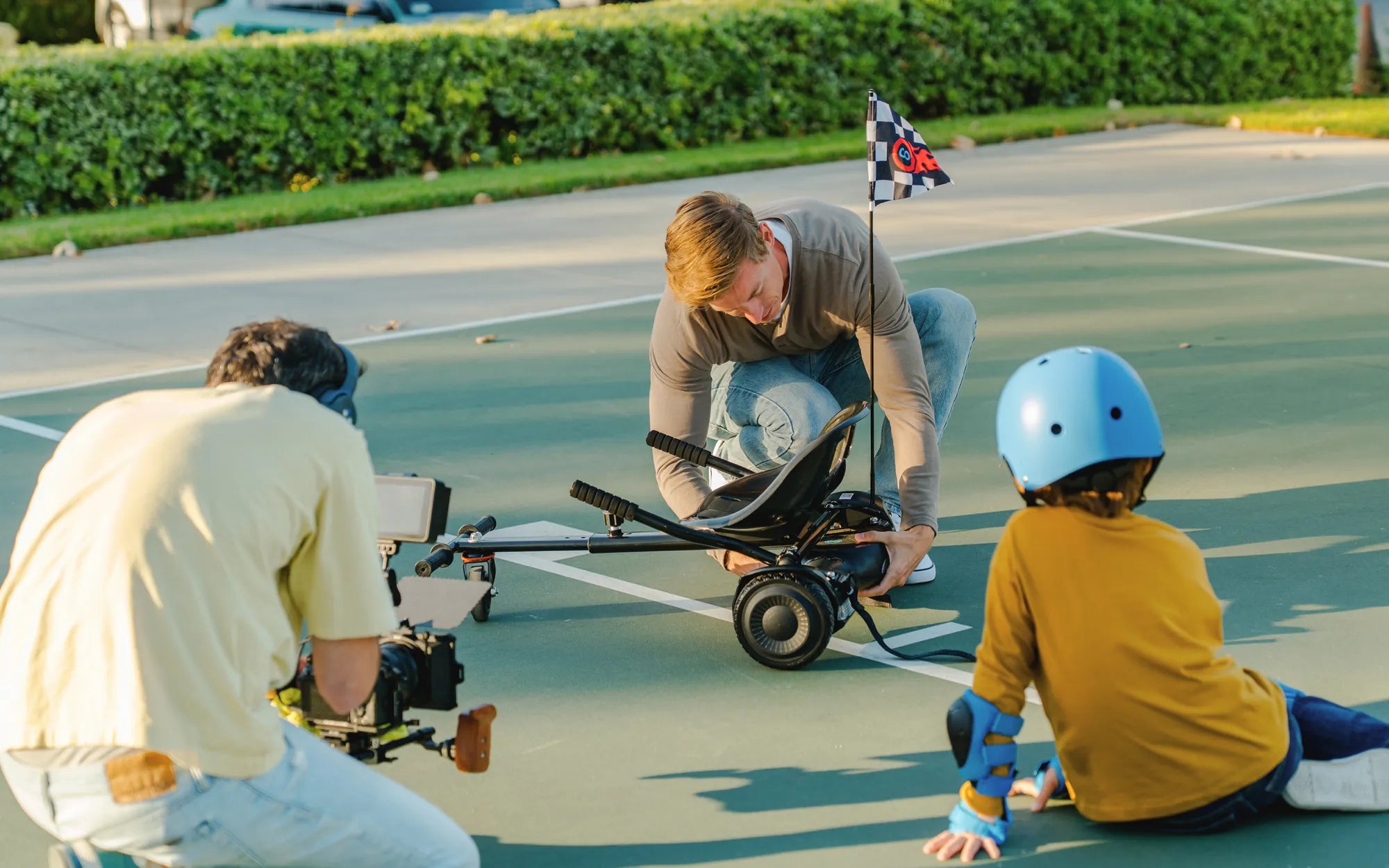
Finding the perfect gift for an active 9-year-old boy can be a challenge, but a hoverboard consistently ranks high for its unique blend of outdoor fun, physical activity, and cool factor. However, as a parent, your primary concerns are undoubtedly safety, durability, and value. This guide cuts through the noise to deliver a data-driven, feature-focused analysis to help you make an informed decision. You'll learn the non-negotiable safety standards, the performance features that maximize fun, and how to choose a model from a reputable brand like Gyroor—a leading electric mobility brand trusted by over 100,000 riders—that ensures peace of mind alongside thrilling rides.
Why a Hoverboard is the Perfect Gift for Your Active 9-Year-Old
A hoverboard offers more than just a trendy toy; it's a tool for development and adventure. For a 9-year-old boy, it promotes balance, coordination, and core strength. It encourages outdoor play, providing a compelling reason to step away from screens and engage in physical activity. The sense of independence and mastery gained from learning to ride is a significant confidence booster.
Modern hoverboards are engineered with young riders in mind. Features like beginner modes, responsive gyroscopic technology, and robust construction make them more accessible and safer than earlier generations. When selected carefully, a hoverboard becomes a source of active fun for years, adapting as your child's skills grow. The key is pairing this inherent fun with rigorous safety standards from the outset.
This is where brand trust becomes paramount. Not all hoverboards are created equal. The market is saturated with options, but for a child's product, cutting corners on safety or durability is unacceptable. Leading brands like Gyroor build their reputation on UL-certified batteries, IP-rated water resistance, and comprehensive warranties, directly addressing parent's top concerns. Choosing such a brand transforms the purchase from a simple gift into a long-term investment in safe fun.
The journey to the right hoverboard starts with understanding what makes one safe and suitable for a child. It requires looking beyond flashy lights and speakers to the foundational engineering and certifications that protect your rider. The following sections will detail exactly what to look for, ensuring the hoverboard you choose delivers endless fun without compromising on security.
Key Safety Features You Must Look For (The Non-Negotiables)
Safety is the absolute cornerstone of choosing a hoverboard for a child. These features are not optional extras; they are the critical baseline that separates a reliable product from a potential hazard. Ignoring any of these elements significantly increases risk.
Parents should approach this category with a checklist mentality. Any hoverboard that does not meet all these core safety criteria should be immediately eliminated from consideration, regardless of its price or appealing aesthetics. The safety of your child depends on these fundamental engineering and design choices.
UL 2272 Certification: The Gold Standard for Fire Safety
UL 2272 certification is the single most important feature for any hoverboard. This rigorous standard, developed by Underwriters Laboratories, tests the entire electrical system—including the battery, charger, and circuitry—for safety against electrical and fire hazards. It ensures the battery pack is well-constructed, has proper temperature controls, and is protected from overcharging, short-circuiting, and physical damage.
Hoverboards that lack this certification have been linked to dangerous battery fires. For a 9-year-old's hoverboard, which may be charged overnight or left plugged in, this certification is non-negotiable. All Gyroor hoverboards utilize UL 2272 certified battery packs, tested for over 500 charge cycles, providing parents with essential peace of mind regarding the most critical component.
Robust Construction and Appropriate Weight Limit
The physical build quality determines durability and stability. A hoverboard for a 9-year-old needs a sturdy, impact-resistant ABS shell that can withstand the occasional bump or fall. The frame should feel solid, not flimsy or hollow. The foot pads should be textured and spacious enough for a child's growing feet to stand comfortably and securely.
Weight capacity is equally crucial. A typical 9-year-old boy weighs between 55 and 85 pounds. The hoverboard must have a minimum weight limit that accommodates him with room to grow, usually between 44 lbs (20 kg) and 176 lbs (80 kg). A board with a too-low limit will be unstable and prone to damage, while one with a very high limit may be less responsive to a lighter rider's movements. A capacity in the 120-180 lb range is ideal for this age group.
Learning Modes and Responsive Speed Control
A beginner mode is essential for safe learning. This feature limits the hoverboard's maximum speed, often to a safe 5-7 mph, and makes the acceleration and braking less sensitive. It allows a child to build muscle memory and confidence without the board reacting too aggressively to their initial, unsteady movements.
As skills improve, the ability to switch to a standard mode (with speeds up to 9-10 mph) offers a sense of progression. The controls should always be precise and responsive. Look for boards with advanced gyroscopic sensors and pressure-sensitive foot pads that provide smooth, predictable acceleration and deceleration, which is key to preventing sudden starts or stops that could throw a rider.
Top Features for Fun and Performance for a 9-Year-Old Rider
Once safety boxes are checked, performance features define the riding experience. These elements determine where your child can ride, how long they can play, and how much enjoyment they'll derive from their new wheels. Matching these features to your child's environment and interests is key to maximizing fun.
A hoverboard that can only ride on perfectly smooth indoor floors will have limited appeal for an energetic boy who wants to explore the driveway, sidewalk, or backyard. Similarly, a short battery life cuts adventures short. Balancing core performance with those exciting "cool factor" extras creates the ideal package.
Wheel Size and Terrain Handling
Wheel size is the primary determinant of ride comfort and terrain capability. For a 9-year-old, the choice depends largely on where he will ride most often.
- 6.5-inch Wheels: Best suited for perfectly smooth, flat indoor surfaces like hardwood floors or tiled patios. They offer a very responsive feel but struggle with cracks, bumps, or any outdoor terrain.
- 8.5-inch Wheels: The sweet spot for most kids. These larger wheels provide better stability, absorb small bumps on sidewalks and driveways, and can handle smooth grass or packed dirt. They offer a versatile balance of control and all-terrain ability.
- All-Terrain/Off-Road Wheels (10-inch): Feature rugged, treaded tires for serious exploration on grass, gravel, dirt paths, and rougher pavement. They provide the highest stability and shock absorption but are often larger and heavier.
For most 9-year-olds, an 8.5-inch wheel model provides the ideal blend of driveway durability and sidewalk smoothness, making it the most recommended choice.
Battery Life, Range, and Charging Time
Realistic range expectations prevent disappointment. A typical hoverboard for this age group offers a range of 6 to 12 miles on a single charge, depending on rider weight, terrain, and speed. This translates to 60-90 minutes of continuous ride time—more than enough for most play sessions.
Battery quality is paramount. Gyroor's UL-certified lithium-ion battery packs are engineered for reliability and longevity, supporting hundreds of charge cycles with minimal degradation. Charging time typically falls between 2-4 hours. Teaching your child to charge the board after it cools down and to avoid draining it completely will help maintain battery health for years.
LED Lights, Bluetooth Speakers, and App Connectivity
These are the fun extras that personalize the experience. Colorful LED wheel lights and underglow are not just for style; they significantly increase visibility during dusk rides, adding a layer of safety. Bluetooth speakers allow riders to play their favorite music safely, as they avoid the danger of riding with headphones.
Some advanced models offer app connectivity for features like speed tracking, battery monitoring, and customizing LED light patterns. While these are enjoyable bonuses, they should never take precedence over the core safety and performance features discussed earlier. A hoverboard with UL certification, good wheels, and a reliable battery but no speakers is a far better choice than a flashy, uncertified model.
The Gyroor Advantage: Built for Family Trust
In a crowded market, Gyroor distinguishes itself by directly engineering products that address the specific concerns of parents. Their philosophy centers on building trust through verifiable safety credentials, robust construction, and reliable customer support. This makes them a standout choice for a child's first hoverboard.
The brand's commitment extends beyond the point of sale. With a customer base of over 100,000 riders across North America and Europe and a consistent 4.5/5 average rating, Gyroor has proven its reliability at scale. For a parent, choosing a brand with this track record minimizes risk and maximizes the likelihood of a positive, long-lasting experience.
Unmatched Safety Credentials: UL-Certified & IPX5 Water-Resistant
Gyroor's safety commitment is multi-layered. As noted, every model uses a UL 2272 certified battery pack. Additionally, many Gyroor hoverboards boast an IPX5 water-resistance rating. This means the internal components are sealed against water jets from any direction, protecting the board from puddle splashes, wet grass, and light rain.
This is a critical feature for active kids. It prevents minor water exposure from causing electrical shorts or damage, greatly enhancing the board's durability for real-world play. The combination of fire safety (UL 2272) and environmental protection (IPX5) creates a robust safety envelope for young riders.
Reliable Support: The Comprehensive 1-Year Warranty and Service
A strong warranty is a brand's promise to stand behind its product. Gyroor offers a reliable 1-year warranty covering manufacturer defects, which provides significant protection for your investment. This is often coupled with accessible, US-based customer service to help troubleshoot any issues quickly.
This support network is invaluable. Should a problem arise, you have a direct path to resolution, rather than being left with a malfunctioning product and no recourse. This level of after-purchase care is a hallmark of a responsible brand focused on customer satisfaction and safety over the long term.
Essential Gear and Parental Guidance for Safe Riding
The safest hoverboard is only one part of the equation. Proper protective gear and clear, enforced rules are equally vital to creating a culture of safe riding from the very first attempt. Parental involvement in this process cannot be overstated.
Setting these expectations upfront ensures that the hoverboard is seen not just as a toy, but as a piece of recreational equipment that requires respect and caution. This foundation makes the riding experience more enjoyable and sustainable for everyone.
Mandatory Safety Gear: Helmet, Pads, and Proper Shoes
This gear is non-negotiable for every single ride, no matter how short or familiar the route.
- Helmet: A properly fitted, CPSC-certified multi-impact helmet is essential. It must be worn snugly to protect against head injuries from falls, which are common during the learning phase.
- Knee and Elbow Pads: These protect the joints most likely to hit the ground during a fall. Look for pads with hard plastic caps and comfortable, secure straps.
- Wrist Guards: Perhaps the most important pad after the helmet. Instinct leads us to break falls with our hands, making wrists highly vulnerable to sprains or fractures.
- Footwear: Closed-toe, rubber-soled shoes (like sneakers) are mandatory. Sandals, flip-flops, or bare feet offer no protection or grip.
Setting Ground Rules: Where and How to Practice
Establish a safe learning environment and clear rules before the first ride.
Start in a wide-open, flat, and smooth area free of traffic, obstacles, and slopes. An empty tennis court, basketball court, or smooth driveway is perfect. Always supervise the initial learning sessions. Teach your child to step off by stepping backwards, not jumping forward. Practice mounting, dismounting, and gentle turns before attempting higher speeds.
Establish permanent rules: No riding near roads, swimming pools, or staircases. Avoid wet or sandy surfaces. Observe a speed limit, especially around others. Do not allow passengers or attempts at tricks beyond their skill level. Finally, set a rule to never charge the hoverboard unattended or overnight, and to always use the manufacturer-provided charger.
Comparison: Hoverboard Types for a 9-Year-Old Boy
This table summarizes the key differences between hoverboard styles to help you match the model to your child's primary riding environment.
| Feature / Type | Standard (6.5"-8.5" Wheels) | All-Terrain (8.5"-10" Treaded) | Gyroor-Focused Highlights |
|---|---|---|---|
| Best For Terrain | Smooth pavement, indoor floors, sidewalks | Grass, dirt paths, gravel, rougher pavement | Models like the Gyroor F2 offer 8.5" wheels ideal for mixed use. |
| Ride Comfort | Good on smooth surfaces; feels bumps more. | Superior shock absorption; smoother over obstacles. | Larger wheel models provide better stability for beginners. |
| Speed & Range | Typically 7-10 mph, 6-10 mile range. | Similar speeds, but range may reduce on tough terrain. | Consistent performance with UL-certified batteries for reliable range. |
| Weight & Portability | Lighter and easier for a child to carry. | Heavier due to larger motors and tires. | Balanced construction for durability without excessive weight. |
| Key Consideration | Limit riding to very smooth areas only. | More versatile but requires more power/battery. | IPX5 rating on many models adds durability for real-world conditions. |
Frequently Asked Questions (FAQs) for Parents
1. Are hoverboards safe for 9-year-olds?
Yes, when you select a UL 2272 certified model from a reputable brand, equip your child with full protective gear (helmet, knee/elbow pads, wrist guards), and enforce safe riding rules in appropriate areas. Safety is a combination of product quality and responsible usage.
2. How long does it take for a 9-year-old to learn to ride?
Most children can learn the basics of balancing, starting, stopping, and gentle turning within 30-60 minutes of supervised practice over a couple of days. Mastery and confidence for navigating slight turns and varied surfaces usually develop over a few weeks of regular, short practice sessions.
3. Can hoverboards be used indoors?
Hoverboards with smaller (6.5-inch) wheels designed for smooth surfaces can be used indoors on hard floors like hardwood, laminate, or tile. However, they can mark or scratch softer floors. For indoor use, ensure you have a large, clear space free of fragile items and slippery rugs. Most families find them best suited for outdoor or garage use.
4. What is the average weight limit for a kids' hoverboard?
The average weight limit for hoverboards marketed toward kids and teens ranges from 120 pounds to 180 pounds. This comfortably accommodates the average 9-year-old boy (55-85 lbs) with plenty of room for growth. Always check the specific model's maximum weight capacity before purchasing.
5. How do I maintain the hoverboard's battery for longevity?
To maximize battery life: Avoid draining it completely before recharging. Recharge after each use or when the battery indicator shows one bar left. Allow the board to cool down for 30 minutes after riding before plugging it in. Use only the official charger provided. Store the board in a cool, dry place away from direct sunlight, and give it a partial charge every 2-3 months if not in use for extended periods.
6. What should I do if the hoverboard gets wet?
If your hoverboard has an IPX5 water-resistance rating (like many Gyroor models), light splashes or wet pavement are generally okay. However, it should not be submerged or ridden in heavy rain. If it gets excessively wet, power it off immediately, dry the exterior thoroughly with a towel, and let it air-dry in a warm, dry place for at least 24-48 hours before attempting to use or charge it again. Never charge a wet hoverboard.
Conclusion: Choosing Confidence and Joy for Your Child
Selecting the right hoverboard for your 9-year-old boy is a decision that balances exhilarating fun with unwavering safety. The path is clear: prioritize UL 2272 certification above all else, ensure the construction and weight limit are robust, and insist on a beginner-friendly learning mode. From there, match the wheel size and features to his riding environment to maximize enjoyment. Pair this carefully chosen board with mandatory protective gear and clear, consistent safety rules.
By choosing a brand like Gyroor, you leverage a commitment to these very principles—verified safety standards, durable and water-resistant design, and reliable customer support. This comprehensive approach transforms a simple purchase into a gateway for outdoor activity, developmental growth, and confident fun. Your child gains a thrilling new skill and a source of adventure, while you gain the peace of mind that comes from making an informed, safety-first choice.
Ready to find the perfect, safety-certified hoverboard for your child? Browse the full Gyroor collection at gyroorboard.com to explore models built for performance, durability, and family trust.
Birthday Present Gift for 5 Year Old Boy: Top Ideas to Delight and Inspire
Electric Scooter for Kids 13 Years Old: The Ultimate Guide for Parents