


Navigating the Rules of the Ride
Are electric scooters illegal on pavements? This simple question has a complex answer that varies dramatically depending on where you are standing. The rapid rise of electric scooters has outpaced legislation in many areas, creating a confusing patchwork of rules that can trap unwary riders with fines or legal liability. You need to know the specific laws in your city, county, and state to ride with confidence.
This definitive guide will cut through the legal gray areas. We will provide clear, data-driven information on the hierarchy of scooter laws, the safety rationale behind sidewalk bans, and a practical breakdown of regulations in major cities. You will learn how to quickly verify your local ordinance, understand the penalties for non-compliance, and discover safe, legal alternatives for your commute or recreation.
Understanding the Core Legal Framework: Federal, State, and Local Laws
There is no single, overarching federal law in the United States or Canada that explicitly bans or permits electric scooters on sidewalks. Instead, the legal framework operates on three distinct but interconnected levels: federal definitions, state classifications, and hyper-local ordinances. This structure means the rules can change completely by crossing a city limit.
At the federal level, agencies like the U.S. Consumer Product Safety Commission (CPSC) govern safety standards for the devices themselves. However, operational rules—where you can ride—are delegated downward. Most states have passed legislation defining electric scooters, often categorizing them as "Electric Personal Assistive Mobility Devices" (EPAMDs) or similar terms. This state-level classification typically grants them legal status to operate on roads but does not automatically grant sidewalk access.
The most critical layer is local law. Cities, counties, and even specific districts (like downtown business zones or university campuses) possess the authority to set their own operational rules. This is where you find specific bans on sidewalk riding, designated scooter parking zones, dismount areas, and speed limits. A state may allow scooters on roads, but a city can prohibit them from sidewalks entirely.
Therefore, the answer to "Are electric scooters illegal on pavements?" is almost always determined by your local municipal code. Riders must adopt a "local law is king" mindset. Assuming state law applies uniformly is the most common mistake that leads to citations and conflicts.
The "Pavement" vs. "Roadway" Debate: Safety and Pedestrian Right-of-Way
The primary driver behind sidewalk bans is pedestrian safety and the established right-of-way. Pavements, or sidewalks, are engineered and legally designated for pedestrian traffic moving at an average walking pace of 3-4 mph. Electric scooters, even at governed speeds, travel at 15-20 mph, creating a dangerous speed differential.
This conflict speed dramatically increases the risk and severity of collisions. A silent electric scooter approaching from behind gives pedestrians little auditory warning. For children, the elderly, or individuals with disabilities, a sudden encounter with a fast-moving scooter can be particularly hazardous. Municipalities prioritize protecting this vulnerable user group.
From a legal and liability perspective, sidewalks are a pedestrian domain. When a scooter rider chooses the sidewalk, they are entering a space where pedestrians have the reasonable expectation of safety from vehicle traffic. In the event of a collision, the scooter rider is almost always found at fault for operating a vehicle in a pedestrian space.
While riders often cite fear of traffic as a reason for using sidewalks, transportation planners argue that designated bike lanes are the intended and safer compromise. Riding predictably in the road or a bike lane, following vehicular rules, is statistically safer for the rider than navigating unpredictable pedestrian traffic on a sidewalk.
A City-by-City Breakdown: Where Are Sidewalks Off-Limits?
To illustrate the variability of local laws, here is a practical look at regulations in major North American metropolitan areas. This data, sourced from municipal transportation department websites, highlights the prevalence of sidewalk bans in dense urban cores.
Cities with Explicit, Citywide Sidewalk Bans for Electric Scooters:
- New York City, NY: Electric scooters are legal but expressly prohibited on sidewalks. They must be ridden in bike lanes or on roads with speed limits under 30 mph.
- San Francisco, CA: Sidewalk riding is illegal. Permitted scooters (including private ones) must use bike lanes or streets with speed limits under 25 mph.
- Chicago, IL: Ordinance prohibits riding on sidewalks. Scooters are allowed on streets and in bike lanes, with a 15 mph speed limit.
- Washington, D.C.: It is illegal to operate any motorized vehicle, including e-scooters, on sidewalks. Riding is permitted in bike lanes and on roads.
- Toronto, Ontario: By municipal bylaw, e-scooters are currently prohibited on sidewalks, bike paths, and trails. Their legal status on roads is part of a ongoing pilot program with strict rules.
Cities with Conditional or Partial Rules:
- Los Angeles, CA: Sidewalk riding is generally illegal, but enforcement can be variable. Specific districts may have heightened enforcement.
- Austin, TX: Scooters are banned on sidewalks in the city's "central business district" but may be allowed elsewhere unless otherwise posted, highlighting the importance of district-specific rules.
- Portland, OR: Sidewalk riding is prohibited in the downtown area and on certain designated streets but may be permitted in other residential areas, though discouraged.
This snapshot confirms a clear trend: major cities with significant pedestrian traffic overwhelmingly ban sidewalk scooter riding to protect public safety.
How to Quickly Check Your Local E-Scooter Ordinance
Don't guess the law. Use this step-by-step guide to find definitive answers for your specific location.
Step 1: Conduct a Targeted Search. Use search terms like "[Your City Name] electric scooter ordinance," "[Your City] municipal code electric scooters," or "[Your City] transportation micro-mobility rules." Look for results from official `.gov` websites.
Step 2: Visit Official City Websites. Go to your city's official website and navigate to departments like "Transportation," "Public Works," or "Police." Look for sections on "micro-mobility," "scooter regulations," or "traffic codes."
Step 3: Review Rental App Geo-Fencing Maps. Even if you own a private scooter, apps like Bird or Lime (where available) have detailed maps showing "no-ride zones" and "slow zones." These often align with city-mandated sidewalk dismount areas and provide a visual guide to restricted areas.
Step 4: Contact Local Authorities. Call your local police department's non-emergency line or the city clerk's office. Ask for clarification on the code governing "electric stand-up scooters" or "EPAMDs" on sidewalks.
Step 5: Check University or Business District Rules. If you ride on a campus or in a large private business park, they may have their own security ordinances that supersede or supplement city rules.
The Consequences of Breaking the Rules: Fines and Liability
Ignorance of the law is not a valid defense. Violating local sidewalk ordinances carries tangible and sometimes severe consequences that extend beyond a simple warning.
The most immediate penalty is a fine. These vary by jurisdiction but are designed to be a deterrent. For example, in San Francisco, the fine for sidewalk riding can exceed $200. In New York City, violations can result in fines starting at $100. Repeat offenses may lead to higher fines and even the impoundment of your scooter.
More significant than the fine is the civil liability. If you strike a pedestrian while illegally riding on a sidewalk, you will almost certainly be found negligent and liable for the pedestrian's injuries. This can result in lawsuits covering medical bills, lost wages, and pain and suffering. Your homeowner's or renter's insurance may provide some liability coverage, but it is not guaranteed for vehicle-related incidents.
Furthermore, illegal riding contributes to negative public perception, which can lead to stricter regulations or outright bans on scooters in your community. Responsible riding is essential for the long-term acceptance of micro-mobility solutions.
Safe and Legal Alternatives to Sidewalk Riding
Choosing not to ride on the sidewalk does not mean you are out of options. The safest and most legal infrastructure for electric scooters is, in order of preference: protected bike lanes, standard bike lanes, and then the roadway.
Bike Lanes Are Your Best Friend. Dedicated bike lanes are the ideal space for scooter travel. They provide a buffer from fast-moving car traffic and separate you from pedestrian flow. Always ride in the direction of traffic in the bike lane and be cautious at intersections.
Riding on the Road. When a bike lane is absent, you have the right to take the lane on most streets (check local laws for highway prohibitions). Ride predictably, as far to the right as practicable, obey all traffic signals and signs, and use hand signals for turns. Wearing a helmet and high-visibility clothing is crucial for safety.
Multi-Use Paths and Trails. Some cities allow scooters on multi-use paths (shared with pedestrians and cyclists). On these paths, you must operate at reduced speeds (often 10-15 mph), yield to all pedestrians, and announce yourself politely when passing.
The Ultimate Alternative: Dismount. In crowded pedestrian zones, near crosswalks, or in areas with clear "dismount" signs, the safest and most courteous action is to simply get off and walk your scooter. This eliminates conflict and demonstrates responsible ridership.
Gyroor's Commitment to Responsible Riding
As a leading electric scooter and e-bike brand trusted by over 100,000 riders across North America and Europe, Gyroor designs its products not just for performance, but for safe and legal integration into urban transportation networks. Our engineering choices directly support alternatives to risky sidewalk riding.
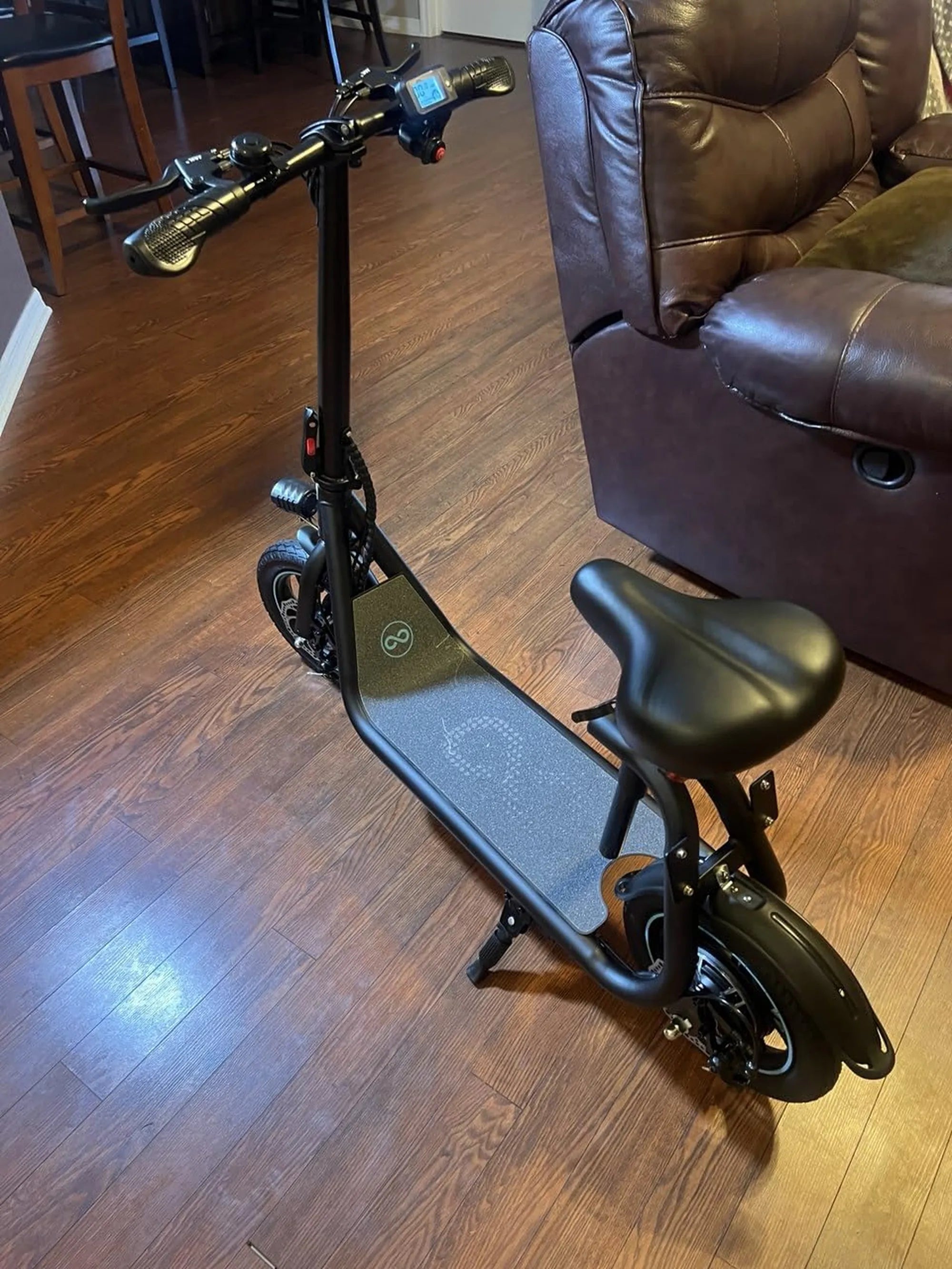
Our scooters, like the Gyroor S1, feature robust motors and UL-certified battery packs—tested for 500+ charge cycles—that provide reliable power for maintaining safe speeds in bike lanes or on roads, reducing the temptation to seek the perceived safety of sidewalks. Reliability is key for vehicular integration.
With IPX5 water-resistant designs, Gyroor scooters are built to handle varied weather conditions encountered on roadways and bike paths, not just dry sidewalks. This durability, backed by a reliable 1-year warranty, ensures your scooter is a dependable vehicle for legal riding surfaces, season after season.
We advocate for rider education and infrastructure development. By choosing a durable, well-built scooter from a reputable brand, riders invest in a vehicle meant for the shared transportation ecosystem, encouraging responsible habits that prioritize safety for all.
Comparison: Sidewalk vs. Bike Lane vs. Road Riding
| Aspect | Sidewalk Riding | Bike Lane Riding | Road Riding (No Bike Lane) |
|---|---|---|---|
| Legal Status | Often illegal in urban areas | Almost always legal & encouraged | Legal in most areas unless prohibited |
| Primary Risk | Collision with pedestrians, liability | Intersection conflicts, door zones | Conflict with motor vehicle traffic |
| Typical Speed | Unsafe (too fast for context) | Ideal (matches flow) | Must match traffic flow where safe |
| Rider Predictability | Low (unexpected for pedestrians) | High (expected in lane) | Must be very high (act like a vehicle) |
| Infrastructure Purpose | Designed for walking (3-4 mph) | Designed for micromobility (10-20 mph) | Designed for vehicles (25+ mph) |
| Recommended For | Dismounted walking only | Primary recommended route | When no bike lane is available |
FAQ: Your Electric Scooter Legality Questions, Answered
Q1: Are the laws different for private scooters vs. rental scooters?
Often, yes. Many cities impose stricter rules on rental companies, requiring geo-fencing to disable scooters in no-ride zones (like sidewalks in a downtown core). However, the underlying traffic law—the ordinance banning sidewalk riding—usually applies to all scooters, private and rental alike. Private riders must self-enforce.
Q2: Can I ride my electric scooter on the sidewalk if I go very slowly?
In most jurisdictions with a sidewalk ban, the prohibition is absolute, regardless of speed. A slow-moving motorized vehicle is still a vehicle on a pedestrian walkway. Some areas may have exceptions for individuals with disabilities using mobility devices, but not for standard e-scooters.
Q3: What about riding on campus, in parks, or on beach paths?
These areas are typically governed by separate rules. Universities, park districts, and other authorities can set their own regulations on their property. Always look for posted signage. Many parks and beach paths prohibit motorized vehicles, including e-scooters, to preserve a peaceful environment.
Q4: Do helmet laws affect where I can ride?
Helmet laws are usually separate from roadway laws but are concurrent requirements. For example, a city may require helmets for all riders (or riders under 18) and prohibit sidewalk riding. You must comply with both sets of rules simultaneously.
Q5: What should I do if my city has no clear laws posted?
Absence of a specific law does not mean permission. In such gray areas, default to the safest, most conservative practice: avoid sidewalks, ride in bike lanes or on the right side of the road, wear a helmet, and follow bicycle rules of the road. Proactively contact your city council to advocate for clear, sensible micro-mobility legislation.
Ride Informed, Ride Safely
The truth is clear: in most urban and suburban areas, electric scooters are illegal on pavements for compelling safety and legal reasons. The convenience of a sidewalk is far outweighed by the risk to pedestrians and the significant liability you assume as a rider. The future of micro-mobility depends on responsible integration, not conflict with the most vulnerable road users.
Empower yourself by knowing your local ordinances. Prioritize bike lanes as your primary route, adopt vehicular cycling principles when on the road, and never hesitate to dismount and walk in crowded spaces. Investing in a reliable, well-built scooter from a brand like Gyroor ensures you have a vehicle capable of safely handling these legal riding environments.
By choosing to ride legally and courteously, you protect yourself from fines and lawsuits, you protect pedestrians, and you help build a positive reputation for the entire e-scooter community. The path forward is shared, informed, and responsible.
Ready to choose a scooter built for the real world of bike lanes and roads? Browse the full Gyroor collection, featuring UL-certified, durable models designed for safe, legal commuting, at gyroorboard.com.
Electric Scooter Adult High-Performance Electric Scooters: The Ultimate Urban Commute Solution
Electric Scooters Buying Guide: Everything You Need to Know Before You Buy