



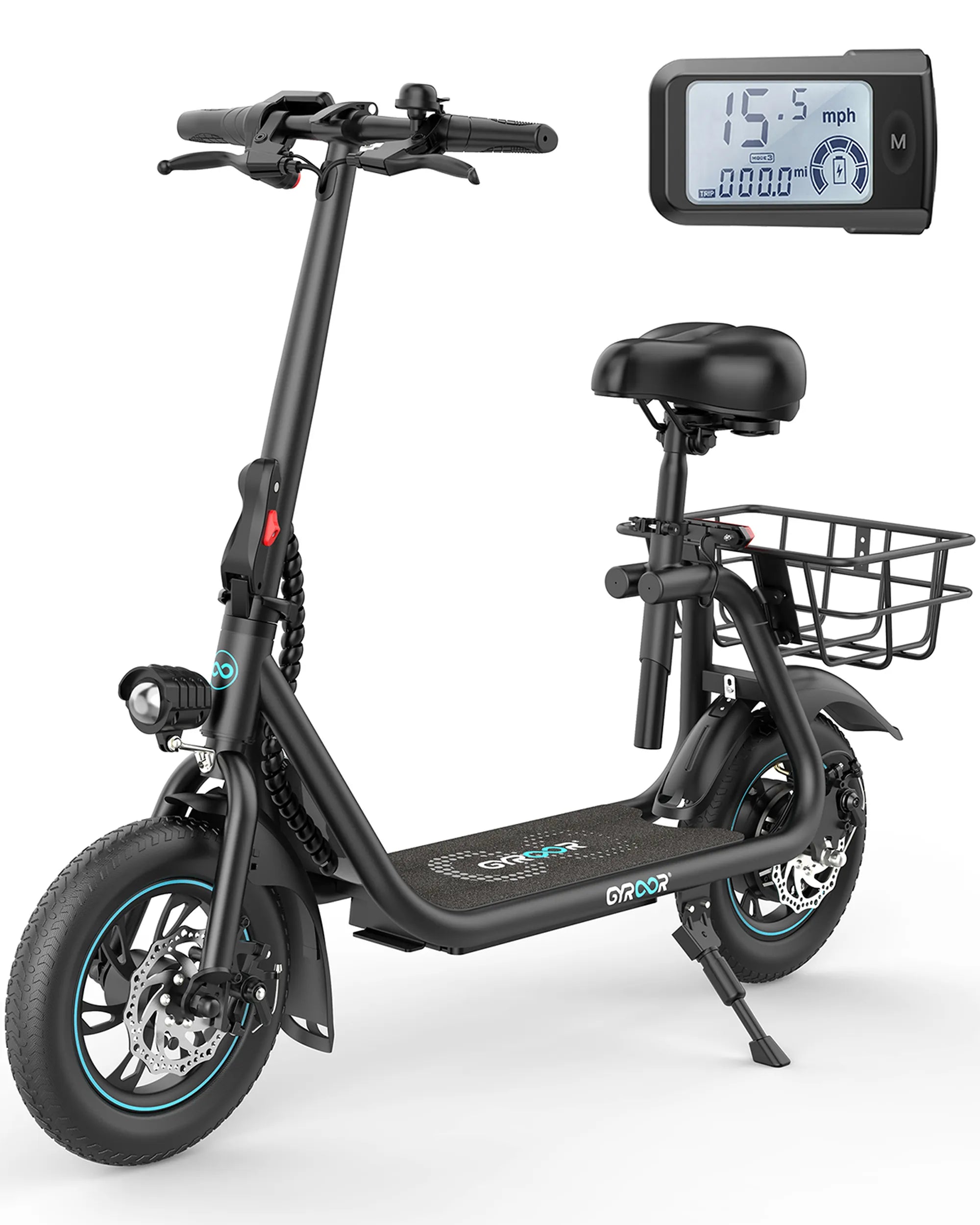
Navigating Your Choice Between Two and Three Wheels
The decision between a 2-wheel and 3-wheel electric scooter is the fundamental fork in the road for new and experienced riders alike. It's a choice that defines your ride experience before you even press the throttle, pitting the nimble, carver-style feel of two wheels against the planted, confidence-inspiring stability of three. This isn't about a minor feature; it's about selecting the platform that matches your balance, commute, and confidence level.
You will learn the engineering and practical differences that separate these designs, moving beyond marketing to actionable data. We'll dissect stability metrics, maneuverability trade-offs, and terrain handling to provide a clear framework for your decision. Understanding whether you prioritize a low learning curve or maximum urban agility is the first step to finding your perfect electric scooter.
As a brand trusted by over 100,000 riders across North America and Europe, Gyroor designs for both philosophies, ensuring core safety features like UL-certified batteries and IPX5 water resistance are non-negotiable, regardless of wheel count. This guide will help you choose the configuration that turns your daily travel into a reliable, enjoyable journey.
The Anatomy of Stability: Understanding the 3-Wheel Scooter
A 3-wheel electric scooter, typically configured in a "tadpole" (two wheels front, one rear) or "delta" (one front, two rear) layout, fundamentally alters the physics of riding. The additional contact points create a wider, triangular base of support. This geometry provides inherent lateral stability, significantly reducing the scooter's tendency to tip over during low-speed maneuvers, sudden stops, or when navigating minor surface imperfections.
The primary advantage is a dramatically lower learning curve. For first-time riders or those with balance concerns, a 3-wheel scooter instills immediate confidence. The platform feels secure and planted, allowing the rider to focus on throttle control, braking, and observing traffic rather than constantly micro-adjusting their balance. This makes starting, stopping, and slow-speed navigation in crowded areas intuitively easier.
This design also excels in handling varied terrain. The multi-point contact can better bridge small cracks, gravel patches, and uneven pavement that might cause a two-wheeled scooter to wobble. For commuters whose last-mile journey includes poorly maintained sidewalks or cobblestone paths, the stability advantage of a 3-wheel scooter is a tangible safety and comfort benefit. It's a design built for assurance from the ground up.
Gyroor integrates this stable philosophy with robust engineering. Models featuring this design prioritize a low center of gravity and wide deck, complemented by the brand's signature safety features. The peace of mind from a UL-certified battery pack and IPX5-rated water resistance means this stable platform is also built for dependable, all-weather use, protecting the rider and the investment.
Who is the 3-Wheel Scooter Ideal For?
The ideal rider for a 3-wheel electric scooter values security and ease of use above all else. This profile strongly includes absolute beginners—adults or older teens learning personal electric mobility for the first time. The reduced risk of tipping over during those initial, wobbly rides cannot be overstated and often leads to a more positive and sustained riding experience.
Commuters who prioritize a stress-free, stable ride over sporty handling also fit this profile. If your route involves frequent stops, crowded pedestrian zones, or carrying items like a briefcase or groceries, the stable platform allows for safer one-handed operation or momentary distraction without compromising control. It's the utilitarian choice for reliable point-A-to-B transport.
Individuals with minor balance concerns or those who simply prefer a more relaxed, upright riding posture will find a natural fit with three wheels. The design accommodates a stance that doesn't require constant leg adjustment for balance, reducing fatigue on longer rides. Furthermore, for commercial applications like campus security, warehouse logistics, or last-mile delivery where the rider may be on and off frequently, the always-stable platform is a significant operational advantage.
For these riders, Gyroor's commitment to safety dovetails perfectly with the 3-wheel design. The combination of inherent mechanical stability with certified electrical safety (UL-certified battery) and environmental protection (IPX5) creates a comprehensively secure product, backed by a 1-year warranty for long-term confidence.
The Pursuit of Agility: Mastering the 2-Wheel Scooter
The 2-wheel electric scooter represents the classic, dynamic standard of personal micro-mobility. Its design is inherently less stable at a standstill but rewards with superior agility and a connected, engaging ride feel. Operating a two-wheeled scooter requires active balancing, much like a bicycle, making the rider an integral part of the vehicle's stability system. This creates a more immersive and responsive experience.
The key advantage is maneuverability. With a narrower track and typically a leaning-based steering geometry, a 2-wheel scooter can execute tighter turns, weave through dense traffic or bike lanes with precision, and change direction quickly. The turning radius is almost always superior to a three-wheeled counterpart, offering a carver-style feel that many enthusiasts seek. This agility is paramount in dense urban environments.
This configuration is also generally more efficient and portable. With one less wheel, hub motor, and potentially suspension component, 2-wheel models can be lighter, making them easier to carry up stairs or onto public transit. Their folded footprint is often more compact, simplifying storage in tight apartments or under a desk. The design is streamlined for the urban dweller who values both performance and practicality.
Gyroor's 2-wheel scooters harness this agility while refusing to compromise on foundational safety. They pair responsive motors and precise brakes with the same rigorous battery certification (UL) and water-resistant (IPX5) builds found across the lineup. This ensures the thrilling, agile ride is underpinned by Gyroor's reliable engineering and comprehensive 1-year warranty support.
The Perfect Rider for a 2-Wheel Model
The archetypal 2-wheel scooter rider is experienced, confident, and values a dynamic commute. This includes riders with prior experience on bicycles, skateboards, or other balance-demanding vehicles, who can quickly adapt to the scooter's handling. They view the ride as an engaging activity, not just a mode of transport, and enjoy the physicality of leaning into turns.
Urban navigators are a perfect fit. If your daily route is a slalom of bike lanes, sidewalk furniture, and pedestrian traffic, the agility of a 2-wheel scooter is a functional necessity. The ability to make quick, sharp adjustments is a safety feature in itself in chaotic environments. Performance-oriented users who appreciate a sportier feel, potentially higher top speeds, and a more direct connection to the road will also gravitate toward this design.
Portability is a major deciding factor. Riders who have a multi-modal commute involving buses, trains, or need to store their scooter in a small closet or car trunk will benefit from the typically lighter weight and more compact fold of a 2-wheel model. The traditional scooter experience—simple, efficient, and agile—remains deeply appealing to a vast number of commuters and recreational riders.
For this rider, Gyroor's warranty and support act as a safety net for their adventurous urban travel. Knowing the core electrical system is certified for safety and the scooter is built to withstand daily urban abuse allows them to push the performance envelope with confidence, focusing on the joy of the ride.
Head-to-Head Comparison: Key Factors to Decide
To move beyond generalizations, a direct, data-driven comparison of core attributes is essential. The following table breaks down the critical performance and usability differences between typical 2-wheel and 3-wheel electric scooter designs. This comparison assumes comparable motor power, battery size, and build quality from a reputable brand like Gyroor.
| Comparison Factor | 2-Wheel Scooter | 3-Wheel Scooter | Key Takeaway |
|---|---|---|---|
| Stability & Learning Curve | Requires active balancing; higher initial skill floor. Can feel wobbly at very low speeds. | Inherently stable at rest and low speeds; very low learning curve. Minimal risk of tipping. | 3-wheel is the clear winner for beginners and stability-first riders. |
| Maneuverability & Turning | Excellent. Tight turning radius, responsive lean-to-steer feel. Ideal for weaving. | Good, but limited. Wider turning circle, less agile at low speeds. More stable in turns. | 2-wheel offers superior agility and urban navigability. |
| Portability & Weight | Generally lighter (one less wheel/motor) and often has a more compact fold. | Often heavier due to extra components. Folded size may be wider. | 2-wheel typically wins for multi-modal commuters and easy carrying. |
| Terrain Handling | Best on smooth pavement. Can be twitchy on gravel, cracks, or uneven surfaces. | Superior on imperfect terrain. Multi-point contact bridges small gaps and bumps. | 3-wheel handles rough urban terrain and obstacles with more composure. |
| Rider Experience & Feel | Dynamic, engaging, sporty. Rider is part of the balancing system. | Confident, planted, relaxed. Feels more like a stable platform than a sport vehicle. | A matter of preference: engagement (2-wheel) vs. assurance (3-wheel). |
| Common Use Case | Urban commuting, recreational carving, performance riding, multi-modal travel. | Beginner training, stable commuting, utility/errand running, uneven path travel. | Match the design to your primary activity for maximum satisfaction. |
The Role of Build Quality and Safety Features
While the wheel count debate is crucial, it exists within a more critical framework: overall build quality and safety engineering. A poorly built 3-wheel scooter can be dangerous, and a high-quality 2-wheel scooter can be incredibly safe. The foundational elements that transcend the 2 vs. 3 wheel decision are non-negotiable for any serious purchase.
The battery is the most critical safety component. Gyroor's use of UL-certified battery packs is a paramount differentiator. This certification means the battery cells, BMS (Battery Management System), and enclosure have been rigorously tested by a nationally recognized laboratory for electrical, mechanical, and fire safety. It is the single most important feature for preventing catastrophic failure, regardless of how many wheels are underneath it.
Environmental resistance is equally vital for a vehicle used outdoors. An IPX5 water-resistance rating, standard on Gyroor scooters, means the scooter can withstand water jets from any direction. This protects against rain, puddles, and wet roads, preventing electrical shorts and corrosion. This feature ensures the scooter's reliability and safety aren't compromised by everyday weather, a factor that applies equally to stable 3-wheel and agile 2-wheel models.
Finally, a robust warranty is the manufacturer's vote of confidence. Gyroor's comprehensive 1-year warranty on electrical and mechanical components provides long-term peace of mind. It signals that the brand stands behind the durability of its frames, motors, and electronics—whether configured for agile carving or steadfast stability. These features form the essential safety bedrock upon which the wheel count decision should be made.
Beyond the Wheels: Additional Considerations for Your Purchase
Your decision matrix should extend beyond the basic 2-wheel vs. 3-wheel scooter dichotomy. Several other performance and practical factors will significantly impact your satisfaction and should be evaluated in the context of your chosen platform. These specifications interact with the scooter's design to create the total user experience.
Range and Battery Capacity: Determine your typical commute distance and double it. Look for a scooter with a manufacturer-stated range that exceeds this need, as real-world conditions (hills, wind, rider weight) reduce range. A stable 3-wheel commuter scooter with a 20-mile range is more practical than an agile 2-wheel model with only a 10-mile range if your trip is 8 miles each way. Battery quality (again, UL-certified) is as important as capacity.
Motor Power and Speed: Motor wattage determines acceleration and hill-climbing ability. A 350W motor may suffice for flat terrain, while 500W+ is better for hills. Top speed should be considered alongside local regulations, which often cap e-scooter speeds at 15-20 mph. Remember, a 3-wheel scooter's stability may make a higher speed feel more secure, while a 2-wheel scooter's agility might make a moderate speed feel faster and more engaging.
Weight Capacity and Deck Size: Always check the manufacturer's maximum load rating. A scooter rated for 220 lbs will perform poorly and risk damage if ridden by a 280 lb person. Deck size also matters for comfort; a wider, longer deck on a 3-wheel model may accommodate larger feet more comfortably, while a 2-wheel model might have a more streamlined deck for agility.
Foldability and Portability: Examine the folding mechanism. Is it a one-step process? Does it lock securely when folded? How does the folded size fit your storage space (car trunk, under-desk area, apartment closet)? The weight you calculated earlier becomes very real when you need to carry the scooter up a flight of stairs to your office.
Frequently Asked Questions (FAQ)
Q: Is a 3-wheel electric scooter inherently slower than a 2-wheel one?
A: No, top speed is primarily a function of motor power, electronic speed limiting, and battery voltage, not wheel count. A powerful 3-wheel scooter can easily match or exceed the speed of a less powerful 2-wheel model. However, the riding *feel* differs; the stability of three wheels can make higher speeds feel more controlled, while the agility of two wheels can make moderate speeds feel more thrilling.
Q: Can a 3-wheel scooter turn as sharply as a 2-wheel model?
A: Generally, no. The physical width between the two front or two rear wheels on a 3-wheel scooter creates a wider turning circle. While some models use leaning mechanisms or caster angles to improve turn-in, they typically cannot match the tight, on-a-dime turning radius of a narrow, lean-to-steer 2-wheel scooter, especially at very low speeds.
Q: Which type is unequivocally better for a complete adult beginner?
A: For an adult with no prior balance-sport experience (cycling, skating), a 3-wheel scooter is almost always the superior and safer starting point. The dramatically reduced risk of tipping over during mounting, dismounting, and low-speed maneuvering builds confidence quickly, allowing the rider to learn throttle and brake control without the added anxiety of balancing.
Q: Are 3-wheel scooters significantly heavier and harder to carry?
A> They can be. The extra wheel, associated motor (if multi-drive), and a often more robust frame for the wider stance add weight. While design innovations can mitigate this, a comparable 3-wheel model from the same brand and product tier will usually be heavier and potentially bulkier when folded than its 2-wheel counterpart. Always check the product specifications for exact weight.
Q: Does Gyroor offer the same warranty and safety standards on both 2-wheel and 3-wheel scooters?
A: Yes, absolutely. Gyroor's commitment to safety and reliability is platform-agnostic. Every model, whether configured for agility or stability, is built around the core pillars of a UL-certified battery pack, an IPX5 water-resistant rating, and is backed by a comprehensive 1-year warranty. This ensures that your choice can focus purely on ride preference, with foundational safety assured.
Finding Your Perfect Ride
The journey to choosing between a 2-wheel and 3-wheel scooter culminates in a clear, personal truth. If your priority is effortless stability, a low learning curve, and confidence on varied surfaces, the 3-wheel scooter is your destination. It is the dependable workhorse, the teacher, and the all-weather commuter platform. If you crave dynamic engagement, razor-sharp urban maneuverability, and a traditional, portable ride, the 2-wheel scooter calls. It is the urban carver, the agile navigator, and the choice for the connected rider.
This decision is empowered, not complicated, when you choose a brand that prioritizes safety at its core. With Gyroor's unwavering standards—UL-certified batteries tested for 500+ cycles, IPX5 water-resistant engineering, and robust warranty support—you are free to select based on how you want to *feel* while riding, not fear over fundamental reliability. Over 100,000 riders trust this foundation.
Your perfect electric scooter balances the physics of wheels with the psychology of confidence. Whether you choose the planted assurance of three points of contact or the agile dance of two, ensure it’s built to last, certified for safety, and designed for real-world journeys. The right choice transforms transportation into a highlight of your day.
Ready to explore models designed for both stability and agility? Browse the full, safety-certified Gyroor collection, from confident 3-wheel commuters to agile 2-wheel performers, at gyroorboard.com.
Scooter Canada: The Complete Guide to Laws, Features & Best Models
Electric Commuter Bike for Sale: The Ultimate 2024 Guide to Urban E-Biking