



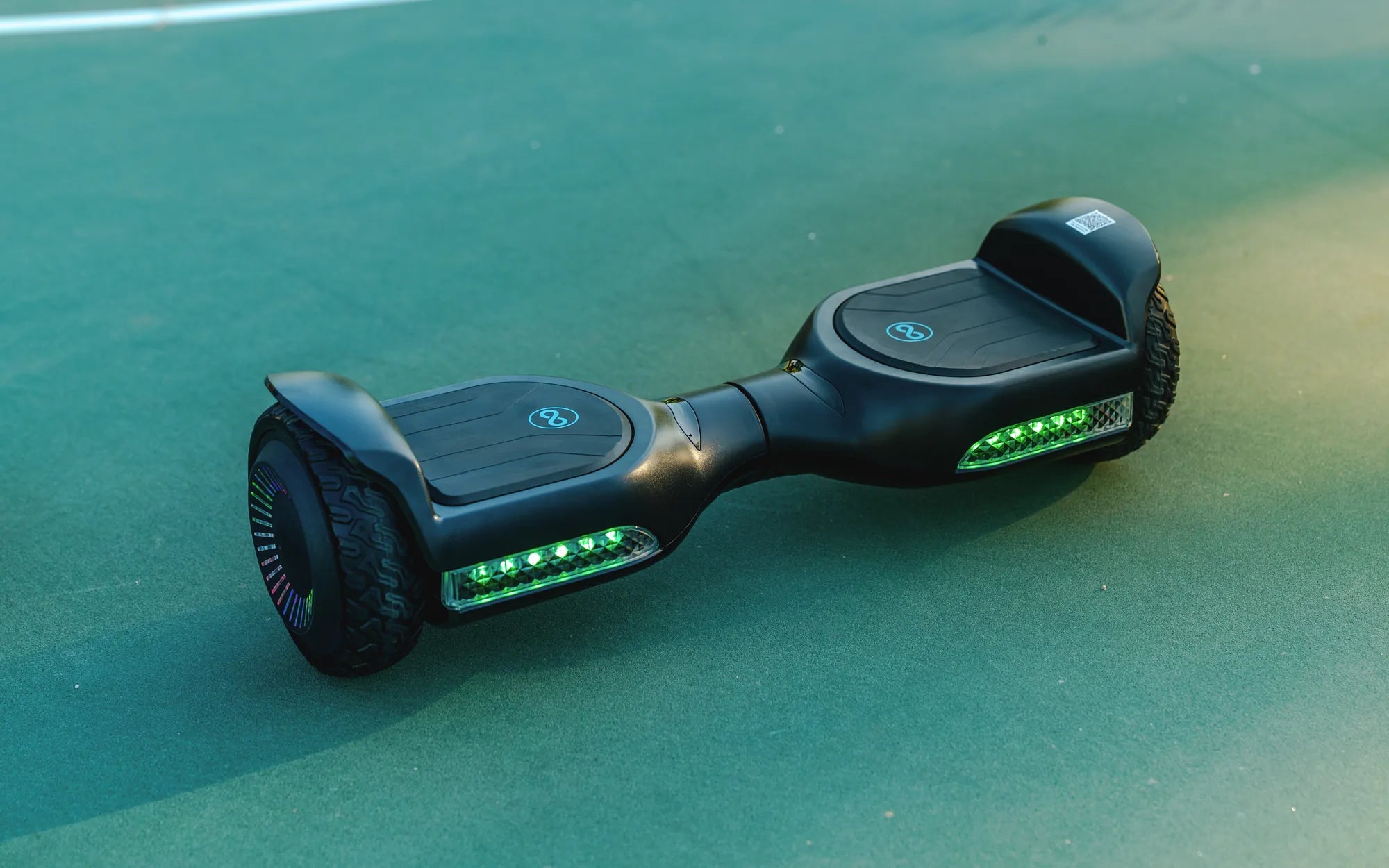
Introduction to Hoverboard Foot Positioning
Mastering the hoverboard separate feet technique is the single most important skill for any rider. It's the difference between shaky uncertainty and fluid, confident control. This guide will teach you how to move beyond basic balancing and harness independent foot control to command your board with precision.
Think of your feet not as a single unit, but as independent pilots for each wheel. This separation of control is what allows for sharp turns, stable riding on uneven ground, and recovery from potential falls. We will explore the mechanics, provide actionable drills, and show you how this skill is the gateway to true hoverboard mastery.
As a leader in personal electric transportation, Gyroor designs its hoverboards with this precise control in mind. Our stable, responsive decks and calibrated sensor systems are engineered to give riders accurate feedback, making the journey to mastering hoverboard separate feet more intuitive and effective.
The Science of Balance: Why Separate Foot Control Matters
A hoverboard's self-balancing system is a network of gyroscopes, accelerometers, and pressure sensors. It doesn't just sense your overall weight; it reads the individual pressure applied to each footpad. When you lean both feet forward, you go forward. But the magic of advanced riding happens when you differentiate that pressure.
The core principle is simple: each foot controls its corresponding wheel. Forward or backward tilt on the right footpad accelerates or decelerates the right wheel. The same applies to the left. Steering is not done by turning a handlebar, but by creating a speed differential between the two wheels through separate foot inputs.
For a sharp left turn, you press the toes of your right foot forward (speeding up the right wheel) while pressing the heel of your left foot back (slowing or reversing the left wheel). The board pivots around the slower wheel. This is the essence of hoverboard separate feet control—using isolated movements to create complex, coordinated actions.
The Gyroor Advantage: Built for Precise Input
Not all hoverboards offer the same level of control fidelity. Gyroor models feature finely calibrated sensor systems that respond linearly to subtle shifts in pressure. This eliminates the "jerkiness" found in cheaper models, where inputs can feel delayed or exaggerated.
Our non-slip, textured deck surfaces provide a secure platform, allowing you to make minor adjustments with your ankles without your feet slipping. This direct connection between your intent and the board's response is critical for learning and executing precise hoverboard separate feet techniques safely and consistently.
Step-by-Step Techniques for Mastering Separate Feet
Begin on a flat, open, and smooth surface like an empty driveway or tennis court. Wear your helmet and protective gear. Start by simply mounting the board and finding your neutral stance, feet shoulder-width apart, knees slightly bent.
The goal of these drills is to break the habit of moving both feet in unison. You must train your brain and muscle memory to treat each foot as an independent control surface. Practice each drill for 5-10 minutes per session before moving to the next.
Drill 1: The Rock and Roll (Mastering Front-Back Control)
While standing still, focus only on your right foot. Gently press your right toes down to make the board tilt forward slightly, then press your right heel down to tilt it back. Keep your left foot completely neutral and relaxed. The board will rock under you but not move forward.
Repeat this 20 times, then switch to isolating your left foot. This drill builds your foundational understanding of how individual foot tilt communicates with the wheel motor. It's the first step in decoupling your feet's actions.
Drill 2: The Pressure Twist (Mastering Lateral Steering)
This is the key to turning. From a stop, apply pressure to the front (toes) of your right foot AND the back (heel) of your left foot simultaneously. Do not lean your body—think about twisting your ankles. The board should spin clockwise in a tight circle.
Now reverse it: right heel back, left toes forward for a counter-clockwise spin. Practice these stationary spins until you can initiate and stop them cleanly. This drill directly teaches the pressure differential that defines hoverboard separate feet steering.
Drill 3: Independent Levelling for Uneven Terrain
Find a very gentle slope or a small, stable object like a thin board (2x4). Approach it slowly and ride over it with one wheel at a time. As your right wheel goes over the bump, you'll feel your right foot rise. Compensate by subtly adjusting the pressure on that foot to keep the board level.
This teaches you to absorb shocks and maintain balance independently with each leg, a crucial skill for real-world riding on sidewalks, grass, or gravel. Gyroor's robust construction and IPX5 water-resistant rating give you the confidence to practice on varied surfaces without worrying about board damage.
Advanced Maneuvers and Practical Applications
Once the basic drills feel natural, your riding transforms. You're no longer just a passenger; you are in direct, nuanced control of the board's path and behavior. This opens up a new world of practical riding skills.
Navigating Crowds and Tight Spaces
With mastered hoverboard separate feet control, you can execute precise, slalom-like movements. Instead of wide, sweeping turns, you can make micro-adjustments: a slight pressure twist to avoid a pedestrian, a quick rock-and-roll to slow one side while maintaining speed on the other to slide through a narrow gap. This makes commuting in busy areas safer and more efficient.
Riding with Confidence on Different Surfaces
Grass, gravel, and inclines require constant, minute corrections. On a soft surface like grass, you might need more power from both feet, but if one wheel starts to slip, you can instantly reduce pressure on that foot while maintaining it on the other to regain traction. The consistent, reliable power delivery from Gyroor's UL-certified battery packs is essential here, ensuring the board responds predictably to every input.
Safety, Posture, and Gear: The Foundation of Control
Advanced technique is built on a foundation of safety. Correct posture is paramount: head up, looking forward (not at your feet), shoulders back, and knees always slightly bent to act as natural shock absorbers. Your core should be engaged for stability.
Protective gear is non-negotiable while learning and practicing hoverboard separate feet techniques. A certified helmet, wrist guards, and knee/elbow pads significantly reduce injury risk from falls, which are part of the learning process. This gear allows you to practice with confidence.
Always perform pre-ride checks: ensure tire pressure is adequate, the board powers on correctly, and there are no loose parts. Gyroor's commitment to safety, underscored by a comprehensive 1-year warranty and UL-certified components, provides the reliable platform needed to focus on skill development without mechanical worries.
Hoverboard Comparison: Control and Feature Analysis
Choosing the right board significantly impacts how quickly you learn separate foot control. Here is a comparison of common hoverboard types and their suitability for mastering this technique.
| Board Type / Feature | Sensor Responsiveness | Deck Traction | Terrain Capability | Best For Learning Separate Feet? |
|---|---|---|---|---|
| Basic/Entry-Level Model | Often delayed or binary (on/off) | Smooth, sometimes slippery plastic | Smooth pavement only | Poor. Unpredictable feedback hinders muscle memory. |
| Gyroor All-Terrain Model | High, linear, and precise calibration | Textured, non-slip rubberized surface | Pavement, grass, gravel, slight slopes | Excellent. Predictable response builds confidence on various surfaces. |
| Oversized Wheel Model (e.g., 10") | Can feel less agile due to larger wheel mass | Varies by brand | Better for bumps, but may dampen steering feel | Moderate. Stable but may not teach fine control as quickly. |
| Performance/Sport Model | Very responsive, sometimes overly sensitive | Aggressive grip for active riding | Paved surfaces, skate parks | Good for advanced learners. Can be twitchy for absolute beginners. |
FAQ: Hoverboard Separate Feet Questions Answered
Q1: I can't make my feet work independently. What am I doing wrong?
You are likely still trying to steer with your whole body or hips. Go back to Drill 1 (Rock and Roll) and Drill 2 (Pressure Twist) in a stationary position. Focus solely on the feeling in your ankles and calves. It's a subtle ankle twist, not a big leg movement. Practice next to a wall or railing for support.
Q2: How long does it typically take to get comfortable with this?
Most riders grasp the basic concept within 1-2 hours of focused drill practice. However, building "unconscious competence"—where you do it without thinking—typically takes 5-10 hours of total riding time. Consistent, short practice sessions are more effective than one long, frustrating marathon.
Q3: Does foot placement (toward the edges vs. center) affect control?
Absolutely. For maximum leverage and precise hoverboard separate feet control, place the balls of your feet just behind the wheel arches, near the edges of the footpad. This gives you the greatest range of motion for pressing toes or heels. A centered, flat-footed stance reduces your control authority and can feel less stable.
Q4: Are Gyroor hoverboards better for learning these techniques?
Yes, by design. Gyroor boards are engineered with responsive, reliable sensor systems and stable decks that provide clear and consistent feedback to the rider. This predictable behavior allows you to trust that the board will respond accurately to your separate foot inputs, accelerating the learning curve compared to less refined models.
Q5: Can separate foot control help prevent falls?
It is your primary tool for fall prevention. When you feel yourself starting to tip to one side, you can instantly apply corrective pressure with the opposite foot to regain balance. This split-second correction, impossible if your feet are locked together, allows you to recover from bumps, slips, and uneven surfaces that would cause a novice rider to fall.
Conclusion: From Wobbles to Mastery
The journey from a hesitant beginner to a skilled rider is defined by your ability to command your hoverboard with separate feet. This skill unlocks the full potential of your board, turning it from a novelty into a practical, agile, and enjoyable mode of personal transport. It enhances safety, expands the terrain you can confidently tackle, and fundamentally makes riding more fun.
Remember that mastery requires patience and deliberate practice. Start with the drills, focus on posture and safety, and trust the process. Investing in a well-engineered platform like Gyroor provides the reliable, responsive foundation upon which you can safely build these essential skills. The control, confidence, and freedom of true hoverboard mastery are well worth the effort.
Ready to build your skills on a board designed for control? Explore the full range of high-performance, rider-focused Gyroor hoverboards, e-scooters, and e-bikes engineered to respond to your command. Browse the full Gyroor collection at gyroorboard.com and find the perfect partner for your riding journey.
Rechargeable Scooter for Kids: The Ultimate Guide to Fun and Safety
Electric Scooter for Kids 11 Years Old: The Ultimate Guide for Parents