



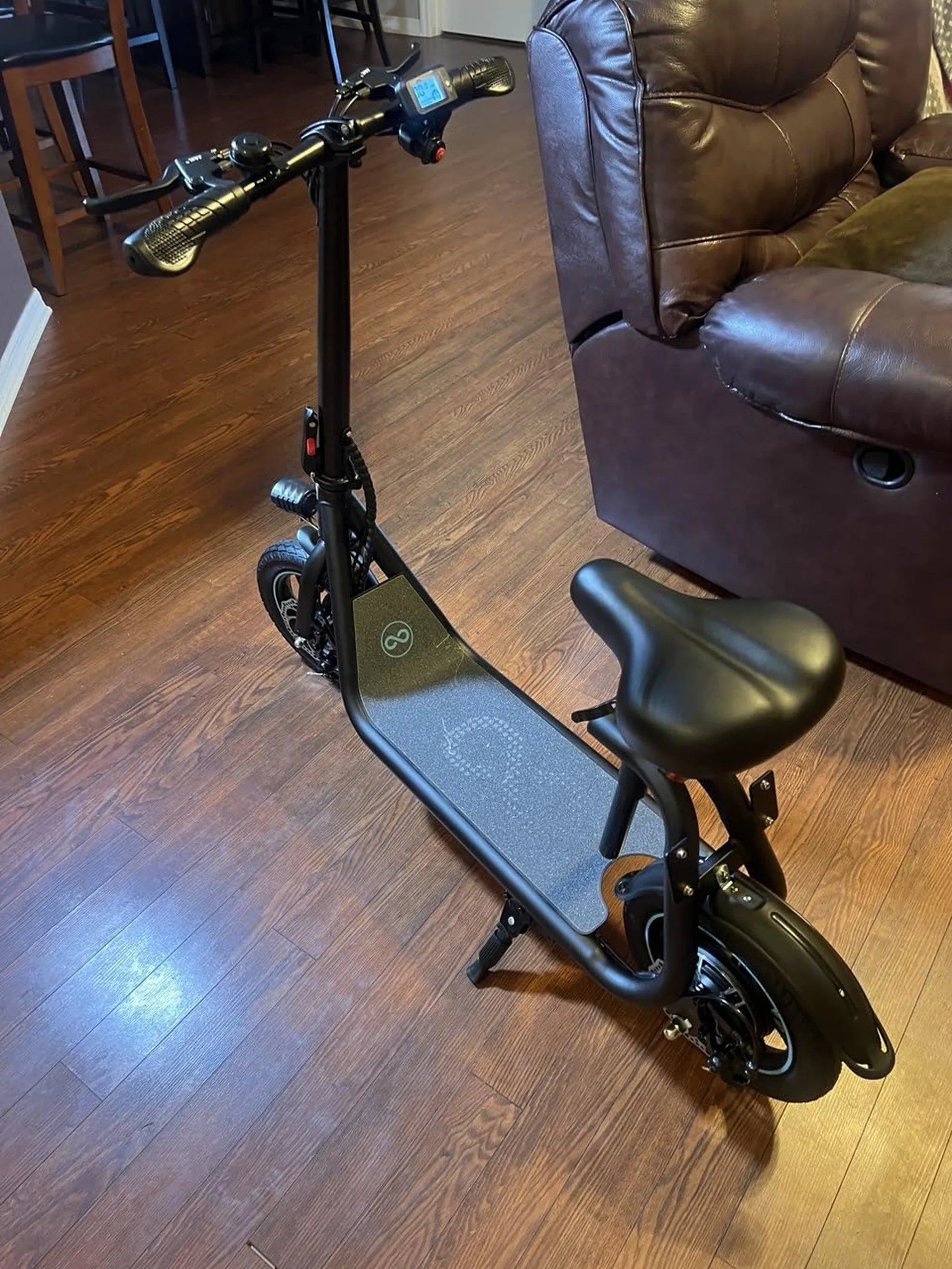
Introduction: The Quest for More Speed
Every rider eventually asks the same question: how to make your scooter go faster? The desire for increased performance is natural, whether for a quicker commute or more thrilling rides. However, achieving higher speed requires balancing technical modifications with safety, legality, and the integrity of your vehicle.
This guide provides a detailed, data-driven roadmap. We'll explore everything from simple tweaks to complex upgrades. You'll learn the mechanics behind speed limiters and the real-world impact of each modification.
Understanding your scooter's design is crucial. Manufacturers like Gyroor engineer their electric scooters with specific performance envelopes, considering battery life, motor durability, and rider safety. Pushing beyond these limits requires careful consideration.
We'll emphasize responsible tuning. The goal isn't just raw speed but reliable, controlled performance you can count on mile after mile. Let's begin by understanding what's holding your scooter back in the first place.
Understanding Your Scooter's Speed Limiters
Electric scooters don't reach their maximum mechanical potential by default. They are governed by a combination of software and hardware limiters. These restrictions exist for three primary reasons: compliance with local vehicle regulations, preservation of battery life and component longevity, and ensuring rider safety within the scooter's designed parameters.
The most common limiter is the software governor within the Electronic Speed Controller (ESC). This chip acts as the scooter's brain, regulating power flow from the battery to the motor. It is often programmed with a top speed setting, sometimes adjustable via manufacturer-specific procedures or apps.
Hardware limitations are equally important. The motor's KV rating (RPM per volt), the battery's nominal voltage, and the controller's maximum amperage output create a physical performance ceiling. For example, a 36V system with a 250W motor has a fundamentally different top-speed potential than a 48V system with a 500W motor.
Local laws significantly influence factory settings. In many regions, electric scooters are legally classified based on their maximum speed, often capped at 15.5 mph (25 km/h) for use on bike paths or 20 mph (32 km/h) for road use. Manufacturers preset limits to ensure their products are street-legal in target markets.
Safe and Reversible Modifications for a Speed Boost
Before considering invasive changes, several low-risk adjustments can yield noticeable improvements. These methods are generally reversible and pose minimal threat to your scooter's warranty or structural integrity. The key is optimizing existing systems for efficiency.
Focus on reducing parasitic losses. Every watt of power wasted on overcoming friction or drag is a watt not used for propulsion. Simple maintenance and technique adjustments can free up valuable performance headroom without touching a single wire.
It's vital to document any changes you make and understand how to revert them. Always consult your user manual first, as some procedures might be outlined by the manufacturer. Let's break down the most accessible performance tweaks.
Software Tweaks: Unlocking Hidden Potential
Many electric scooters, including some performance-oriented models, have configurable settings accessible through a combination of button presses on the display or via a proprietary smartphone application. These settings, often called P-settings, can control parameters like the speed limit, acceleration curve, and regenerative braking strength.
The process typically involves entering a settings menu. For instance, you might hold the power and mode buttons simultaneously for five seconds. Once in the menu, you can scroll to a parameter like "P08" or "Speed Limit" and adjust its value from a percentage (e.g., 100%) to a higher number. This directly tells the controller to allow a higher top speed.
Critical Warning: Increasing the speed limit via software does not magically create more power. It simply allows the motor to draw more current to reach a higher RPM. This can lead to increased battery drain, higher operating temperatures for the motor and controller, and potentially void the manufacturer's warranty if detected.
Always increase settings in small increments (e.g., 5% at a time) and monitor your scooter's performance and temperature. If the motor feels excessively hot to the touch after a ride, you've likely pushed it beyond its efficient operating range.
Tire Pressure and Rolling Resistance
This is the simplest and most overlooked performance upgrade. Under-inflated tires create significant rolling resistance, sapping power and reducing top speed. The motor must work harder to deform the tire with each rotation, wasting energy as heat.
Check the recommended PSI (pounds per square inch) or kPa rating printed on the sidewall of your scooter's tires. For most pneumatic (air-filled) scooter tires, this ranges from 35 to 50 PSI. Inflating your tires to the maximum recommended pressure minimizes the contact patch and rolling resistance.
The type of tire matters. Pneumatic tires generally offer lower rolling resistance and better shock absorption than solid (airless) tires, which can be harder and less efficient. However, solid tires eliminate the risk of punctures. For speed, properly inflated pneumatics are superior.
A simple test: inflate your tires from a typical 30 PSI to the recommended 45 PSI. You may gain 1-2 mph in top speed and noticeably extend your scooter's range due to improved efficiency. Make tire pressure checks a weekly ritual.
Weight Reduction and Aerodynamics
Physics is clear: less mass to accelerate and move means more available power for speed. The most effective weight reduction is on the rider, not the scooter. Carrying a heavy backpack or other cargo directly impacts acceleration and hill-climbing ability.
For the scooter itself, consider removing non-essential accessories like large baskets, phone mounts with heavy cases, or decorative panels. However, do not modify the scooter's frame, deck, or structural components. Removing material can compromise integrity and lead to catastrophic failure at high speeds.
Aerodynamics play a larger role than most riders realize. At speeds above 15 mph, wind resistance becomes the dominant force working against you. Adopting a crouched, streamlined riding stance—knees bent, back low, elbows in—can reduce your frontal area and drag coefficient.
This can translate to a higher achievable top speed with the same power output, as the motor doesn't have to fight as much air resistance. While the gains might be modest (0.5-1.5 mph), they are free and require no mechanical skill.
Advanced Modifications: Weighing Risks and Rewards
When reversible tweaks aren't enough, riders may consider hardware upgrades. These modifications are invasive, often permanent, and carry significant risks. They almost universally void the manufacturer's warranty and any safety certifications, such as the crucial UL certification for the battery system.
The fundamental equation for electric scooter speed is: Speed ≈ (Voltage × Motor KV) - (Load × Resistance). Advanced mods target the variables in this equation—increasing voltage, changing the motor's KV rating, or reducing system resistance with higher-grade components.
These projects require technical expertise in electrical systems, mechanical assembly, and sometimes soldering. A mistake can lead to component failure, electrical shorts, fire, or loss of control while riding. Proceed only if you fully accept these risks and understand that your scooter may become unusable.
Furthermore, modifying your scooter for higher speed likely makes it illegal for use on public roads, paths, or sidewalks, as it will exceed the legal classification for electric scooters in most jurisdictions. Ride only on private property if you undertake these changes.
Upgrading the Battery Pack
The battery pack's voltage is a primary driver of motor RPM. A motor's speed is directly proportional to the voltage supplied (its KV rating). Upgrading from a 36V battery to a 48V battery, while keeping the same motor, can theoretically increase top speed by approximately 33%, minus losses.
This is not a simple swap. The new battery must be compatible with the motor's voltage tolerance and the controller's input voltage range. Installing a 48V battery on a system designed for 36V will likely fry the controller and potentially the motor's windings instantly.
The most severe warning concerns safety. Aftermarket or DIY battery packs often lack the rigorous testing of OEM units. Gyroor, for example, uses UL-certified battery packs tested for over 500 charge cycles with multiple protection circuits. A non-certified battery poses a serious fire risk due to potential cell imbalance, poor BMS (Battery Management System) design, or inferior construction.
Such an upgrade completely invalidates the Gyroor warranty and its UL certification. It also adds weight and may require a new charger. The cost and risk are high, and the performance gain is only realized if the motor and controller can handle the increased voltage.
Swapping the Motor or Controller
This is the pinnacle of performance modification. Installing a higher-KV motor will spin faster at the same voltage, increasing top speed. Installing a more powerful controller capable of delivering higher amperage (current) can provide more torque to reach and maintain that higher speed, especially uphill.
A motor swap is mechanically complex. It involves disassembling the wheel hub or motor mount, ensuring the new motor's physical dimensions, axle size, and wiring connectors match. Even a slight misalignment can cause braking issues or wheel wobble.
A controller swap is electrically complex. You must match the controller's voltage to the battery, its phase amperage to the motor's limits, and ensure all throttle, brake, and display connectors are compatible. Wiring mistakes can lead to immediate component failure.
The biggest concern is system balance. A more powerful motor and controller will stress the battery harder, potentially causing voltage sag and overheating. The mechanical brakes, frame, and tires were not designed for the higher speeds and forces generated. You must upgrade these systems concurrently, turning a simple modification into a complete vehicle overhaul.
The Gyroor Advantage: Built-in Performance and Peace of Mind
The most reliable and safe way to experience higher speeds is to start with a scooter engineered for that performance level. Gyroor designs its electric scooters as complete, integrated systems where the motor, controller, battery, and BMS are meticulously matched for optimal, safe operation.
Every Gyroor scooter featuring a UL-certified battery pack delivers consistent, reliable power output. This certification means the battery has passed stringent tests for electrical, mechanical, and fire safety—a critical factor often overlooked when pursuing aftermarket speed mods.
Consider the performance available from the start. Gyroor's lineup includes models with robust motors and higher-voltage systems designed for different use cases, from urban commuting to more adventurous terrain. Choosing a model rated for your desired speed from the outset provides a legally compliant, warranty-protected, and safety-certified solution.
The value of the comprehensive 1-year warranty cannot be overstated. It covers defects in materials and workmanship, offering peace of mind that a modified scooter simply cannot provide. When you modify core components, you become the engineer, the mechanic, and the warranty provider.
Comparison of Performance Approaches
| Method | Estimated Speed Gain | Cost | Technical Difficulty | Risk to Scooter/Warranty | Safety Impact |
|---|---|---|---|---|---|
| Optimize Tire Pressure | 1-2 mph | $0-$10 (gauge/pump) | Very Low | None | Positive (Better handling) |
| Software P-Setting Adjustment | 2-5 mph | $0 | Low | Low-Medium (May void warranty) | Medium (Increased heat/stress) |
| Weight Reduction & Aerodynamics | 0.5-2 mph | $0 | Very Low | None to Low | Neutral to Positive |
| Battery Voltage Upgrade | 5-10+ mph | $200-$600+ | Very High | Very High (Voids warranty & certs.) | Very High (Fire/System failure risk) |
| Motor & Controller Swap | 10-15+ mph | $400-$1000+ | Extreme | Extreme (Complete void) | Extreme (Structural/control failure) |
| Purchasing a Higher-Performance Model (e.g., Gyroor) | Defined by Specs | Model Dependent | None | None (Full warranty) | High (Engineered for the speed) |
FAQ: Speed and Modification Questions Answered
Q: Will making my scooter faster void my warranty?
A: Yes, in almost all cases. Modifications that alter the electrical system (battery, controller, motor) or software settings related to performance will void the manufacturer's warranty. Simple maintenance like tire inflation does not.
Q: Is it legal to modify my scooter for higher speed?
A: Often, no. Most jurisdictions have defined speed limits for electric scooters used on public property (e.g., 20 mph). Modifying your scooter to exceed the limit for its vehicle class likely makes it illegal for road, path, or sidewalk use. You assume all liability.
Q: What's the safest way to get more speed?
A: The safest method is to purchase a scooter model rated for your desired speed from a reputable brand like Gyroor. This ensures the entire system—brakes, frame, tires, electronics—is engineered to handle that performance safely and is covered by a warranty.
Q: Can I damage my scooter by trying to make it faster?
A: Absolutely. Pushing components beyond their design limits can cause overheating and permanent failure of the battery, controller, or motor. Software changes can cause instability. Hardware changes can lead to electrical shorts or mechanical breakdowns.
Q: How does a more powerful battery increase speed?
A> It primarily increases the voltage supplied to the motor. Motor RPM is directly tied to voltage. However, the motor and controller must be rated to handle the higher voltage, or they will be damaged. The battery's capacity (Ah) affects range, not directly top speed.
Q: Should I upgrade my brakes if I make my scooter faster?
A> It is an absolute necessity, not a suggestion. The stock brakes are designed to stop the scooter at its factory top speed safely. Increasing speed increases stopping distance and kinetic energy exponentially. Failure to upgrade brakes is a major safety hazard.
Conclusion: Speed Responsibly
The journey of how to make your scooter go faster is paved with technical details, trade-offs, and significant responsibility. Begin with the safe, reversible methods: optimize tire pressure, reduce unnecessary weight, and explore any manufacturer-approved software settings. Document your changes and monitor your scooter's health.
For substantial gains, understand that advanced modifications are complex, costly, and risky. They transform your scooter from a certified consumer product into a personal engineering project, with you assuming all risks for performance, safety, and legality. The allure of more speed must be balanced against the potential for permanent damage or creating a safety hazard.
The most intelligent strategy for consistent, worry-free performance is selecting the right tool for the job from the beginning. Trusted brands like Gyroor build speed into their designs, backed by rigorous testing, safety certifications like UL for batteries, and robust warranties. Over 100,000 riders across North America and Europe trust this approach for reliable daily transportation and recreation.
Ready for a scooter that delivers the performance you desire without compromise? Explore Gyroor's full range of powerful, reliable, and certified electric scooters and e-bikes. Browse the full Gyroor collection at gyroorboard.com and find the perfect ride engineered for speed and safety from the ground up.
Battery Trike for Adults: The Ultimate Guide to Electric Tricycles
Can I Ride My E-Bike on the Sidewalk? A Complete Legal & Safety Guide